
Home » Posts tagged 'Tristan Pottas'
Tag Archives: Tristan Pottas
First Development Resources #FDR – Completion of Phase I RC Drilling at Lander West
 First Development Resources plc, the Australia-focused exploration company, is pleased to announce the completion of the first stage of the Phase I reverse circulation (“RC”) drilling programme, announced on 13 July 2026, at the Lander West Prospect within the wholly owned Selta Project in the Northern Territory, Australia.
The work completed to date comprises eight RC drill holes for a total of 1,593 metres drilled, detailed geological mapping and the collection of 243 rock-chip samples from across the southern part of the prospect. All drill and rock-chip samples have now been dispatched to ALS Geochemistry in Adelaide for laboratory analysis.
HIGHLIGHTS
· First stage of Phase I RC drilling programme completed with 1,593 metres drilled across eight holes.
· 243 rock-chip samples collected as part of an extensive geological mapping and reconnaissance programme.
· Drilling, geological mapping and rock-chip sampling have significantly improved the Company’s understanding of the geology at Lander West.
· Multiple pegmatite intervals, quartz veining and alteration were intersected within the southern target area.
· Drilling of the northern magnetic geophysics anomaly intersected mafic rocks and sulphide-bearing intervals, indicating a distinct geological setting.
· Assay results will be integrated with geological and geophysical datasets to refine the geological model and prioritise the next stage of exploration.
Tristan Pottas, Chief Executive Officer of FDR, commented:
“The completion of this maiden Phase I drilling represents an important milestone for First Development Resources, marking the first programme to systematically test our priority exploration targets at depth at Lander West.
Whilst assay results remain outstanding, the programme has significantly improved our understanding of the project’s geology and provided a much stronger framework from which to plan future exploration once assay results are received.”
PROGRAMME SUMMARY
The Phase I RC drilling programme was designed to test priority geophysical and geological targets identified through airborne magnetic geophysical surveys, Gradient Array Induced Polarisation (“GAIP”) geophysics and surface geochemistry.
As announced on 13 July 2026 the total Phase I programme was designed to comprise up to 3,000 metres of RC drilling to be completed in stages, with the results and observations from initial holes to inform subsequent targeting. In the completed first stage of work, a total of 1,593 metres have been drilled across eight RC drill holes (see Table 1 and Figure 1). In parallel, the Company completed detailed geological mapping and collected 243 rock-chip samples targeting pegmatite outcrop, quartz veins and alteration.
The work to date has successfully achieved the primary exploration objectives of the Phase I programme, with all planned priority target areas tested despite the occasional operational challenges extending the drilling time.
Southern Target Area
Six drill holes tested coincident magnetic, chargeability and geochemical anomalies associated with interpreted structural features in the southern part of the prospect.
Drilling intersected multiple pegmatite intervals together with abundant quartz veining, alteration and a range of metasedimentary and mafic lithologies. Geological reconnaissance also identified extensive pegmatite outcrop extending beyond the immediate drill area.
The combination of drilling, geological mapping and systematic rock-chip sampling has materially refined the Company’s understanding of the geological architecture of the southern target area.
Although several lithological and structural features capable of generating the observed geophysical and geochemical responses were encountered, the source of the southern magnetic anomaly has not yet been conclusively identified.
Northern Target Area
Two drill holes tested a separate magnetic anomaly in the northern part of the Lander West Prospect.
Drilling intersected metasedimentary and mafic rocks, including localised sulphide-bearing intervals, indicating that this area represents a distinct geological setting from the southern target area. Whilst these sulphide-bearing lithologies may provide a potential explanation for the northern magnetic anomaly, this interpretation will be evaluated following receipt of assay results and integration with the Company’s geological and geophysical datasets.
NEXT STEPS
Assay results from both the RC drilling and rock-chip sampling will be integrated with the geological observations and geophysical datasets to refine the geological model and determine priorities for the next stage of exploration.
The Company will provide a further update following receipt and interpretation of the assay results.
Figure 1 shows the location of the completed drill holes (Table 1) together with the principal southern and northern exploration targets at Lander West.
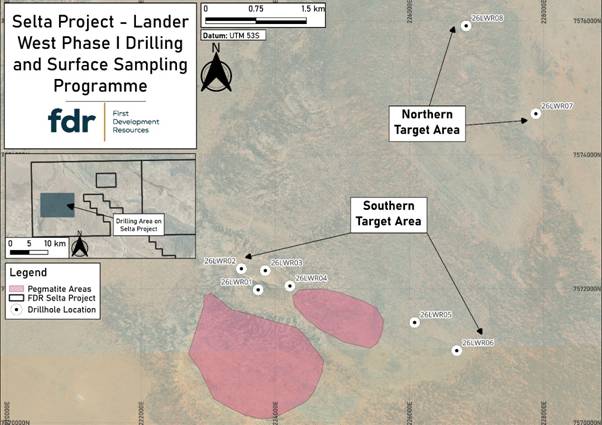
Figure 1: Map of Lander West Target, with Location of Completed Drill Holes, Northern and Southern Targets and Pegmatite Areas.
Table 1: Phase I Reverse Circulation Drill Hole Details
|
Hole ID |
UTM Easting |
UTM Northing |
Azimuth (°T) |
Dip (°) |
Downhole Depth (m) |
|
26LWR01 |
223730 |
7571980 |
025 |
-60 |
312 |
|
26LWR02 |
223481 |
7572295 |
194 |
-56 |
168 |
|
26LWR03 |
223837 |
7572264 |
203 |
-55 |
225 |
|
26LWR04 |
224204 |
7572037 |
203 |
-56 |
216 |
|
26LWR05 |
226062 |
7571492 |
240 |
-57 |
174 |
|
26LWR06 |
226691 |
7571072 |
201 |
-60 |
180 |
|
26LWR07 |
227869 |
7574608 |
324 |
-56 |
150 |
|
26LWR08 |
226830 |
7575921 |
028 |
-60 |
168 |
|
Total |
|
|
|
|
1,593 |
Projection: UTM Zone 53S MGA94 Datum. Azimuth relative to true north (T).
Qualified Person Statement
The technical information contained in this disclosure has been reviewed and approved by Mr Nicholas O’Reilly (MSc, DIC, MIMMM QMR, MAusIMM, FGS), who is a qualified geologist and acts as the Qualified Person under the AIM Rules – Note for Mining and Oil & Gas Companies. Mr O’Reilly is a principal consultant working for Mining Analyst Consulting Ltd which has been retained by First Development Resources plc to provide technical support.
For further information visit www.firstdevelopmentresources.com or contact the following:
|
First Development Resources plc Tristan Pottas (CEO) |
Tel: +44 (0) 20 3778 1397 |
|
Beaumont Cornish Limited Nominated Adviser Roland Cornish / Asia Szusciak |
Tel: +44 (0) 20 7628 3396 |
|
SI Capital Limited Broker Nick Emerson
|
Tel: +44 (0) 1483 413 500 |
Beaumont Cornish Limited (“Beaumont Cornish”) is the Company’s Nominated Adviser and is authorised and regulated by the FCA. Beaumont Cornish’s responsibilities as the Company’s Nominated Adviser, including a responsibility to advise and guide the Company on its responsibilities under the AIM Rules for Companies and AIM Rules for Nominated Advisers, are owed solely to the London Stock Exchange. Beaumont Cornish is not acting for and will not be responsible to any other persons for providing protections afforded to customers of Beaumont Cornish nor for advising them in relation to the proposed arrangements described in this announcement or any matter referred to in it.
First Development Resources #FDR – Selta Project – Gold exploration update
 First Development Resources plc (AIM: FDR), the UK-based, Australia-focused exploration company with mineral interests in Western Australia and the Northern Territory, is pleased to provide an update on its gold (“Au”) focussed exploration at the Selta Project (“Selta” or the “Project”), located in the Aileron Province of Australia’s Northern Territory.
HIGHLIGHTS
· Gradient Array Induced Polarisation (“GAIP”) geophysical survey scheduled to advance the phased gold exploration strategy at the Selta Project.
· Lander West prioritised as a key gold target, interpreted as a continuation of the Stafford Gold Trend adjacent to known gold and antimony mineralisation on neighbouring ground.
· GAIP survey designed to complement the ongoing high-resolution aeromagnetic (“AMAG”) and radiometric geophysical surveys, enhancing understanding of subsurface geology and structural features.
· Integration of geophysical and historical datasets expected to refine and prioritise potential drill targets, informing the next phase of exploration at Selta.
Tristan Pottas, Chief Executive Officer of FDR, commented:
“Today’s announcement represents the next step in the Company’s phased and disciplined approach to advancing its gold exploration strategy at Selta. The gradient array induced polarisation geophysics survey complements the airborne magnetic survey currently underway and, together, these programmes are designed to enhance our understanding of the subsurface geology across the Lander West gold target.
The integration of these datasets is intended to refine and prioritise target areas, increase confidence in their exploration potential and support informed decision-making as we progress our exploration at Selta. This work represents a key step towards the definition of robust drill targets and underpins our objective of systematically advancing Selta through the exploration pipeline.”
SELTA GOLD TARGETS
Following a detailed desktop review, several prospective exploration areas for various metals have been identified at Selta, including two named gold targets of which the Lander West Gold Target is the current priority. The locations of the various targets, together with other exploration areas within the Selta Project, are shown in Figure 1.
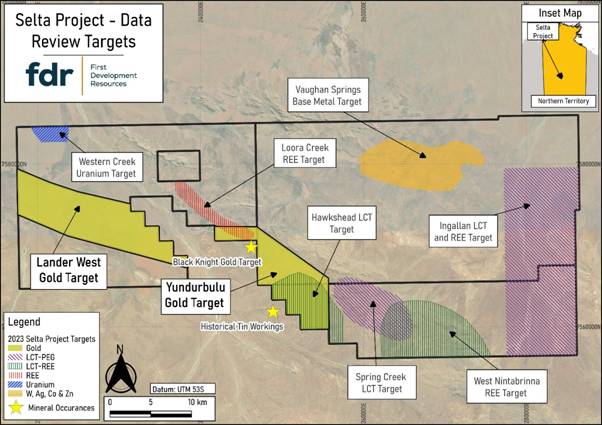
Notes: LCT-PEG = lithium, caesium and tantalum (LCT) pegmatite (PEG)
Figure 1: Selta Project Targets Identified by Data Review
The Company has prioritised the Lander West gold target, which is interpreted as a continuation of the Stafford Gold Trend (Figure 2), where iTech Minerals Pty Ltd (ASX: ITM) has delineated high-grade gold and antimony mineralisation on adjacent ground.1,2 Gold mineralisation within this corridor is interpreted to be shear-hosted, forming along zones of deformation where rocks have been sheared, altered or brecciated.
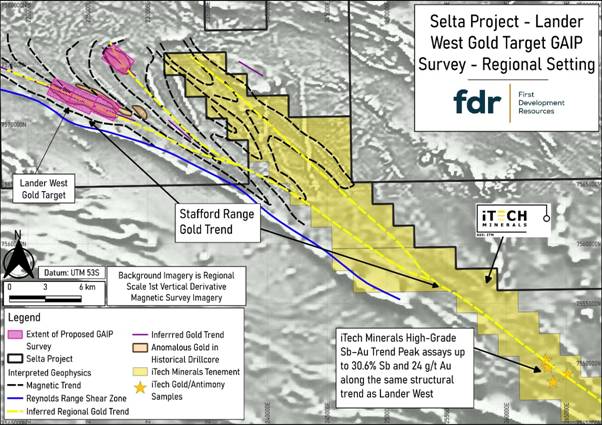
Figure 2: Interpreted extension of Stafford Gold Trend onto the Selta Project
FDR has implemented a staged exploration strategy to progressively refine target areas and define drilling targets. As part of this strategy, the Company is undertaking a Gradient Array Induced Polarisation (“GAIP”) geophysical survey at Selta. GAIP is a proven exploration technique that measures subsurface resistivity and chargeability to assist in the identification of mineralised zones and structural features. The technique provides rapid, high-resolution data over large areas, enabling efficient target prioritisation and focused follow-up exploration, including drilling, on the most prospective areas.
The GAIP survey is planned across four survey blocks (Figure 3), each approximately 2 km × 1.5 km in size, located over anomalous gold and pathfinder element concentrations identified from historical drilling and rock-chip sampling. The survey will collect resistivity data to assist in mapping subsurface geology and structures, and chargeability data to identify anomalies potentially related to disseminated sulphide minerals associated with gold alteration systems. The GAIP results, together with follow-up dipole-dipole IP surveys to assess depth extents, will be integrated with magnetic inversion models and existing drilling data to generate robust targets for drilling.
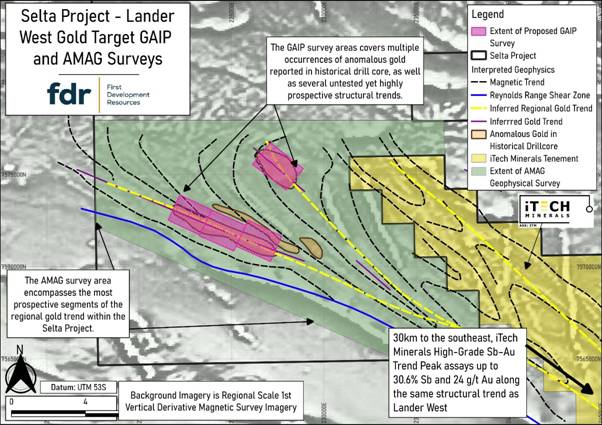
Figure 3: GAIP geophysical survey area in relation to AMAG survey area at the Selta Project
The GAIP survey will follow the Airborne Magnetic (“AMAG”) geophysics survey currently being flown at Selta. The announcement relating to the AMAG survey can be accessed via the following link:
Selta Project -exploration update – 07:00:02 18 Dec 2025 – FDR News article | London Stock Exchange
The integration of GAIP and AMAG data at Lander West is expected to maximise exploration effectiveness, with GAIP providing detailed ground-based information on mineralisation and AMAG mapping broader geological structures and lithological variations. Radiometric data, which is being collected concurrently to the AMAG, will help identify potassic alteration zones in areas with no transported cover, as well as uranium and thorium anomalism potentially related to rare-earth element and lithium-caesium-tantalum pegmatite targets. Together, these datasets will assist the Company in refining exploration models, prioritising drill targets and increasing confidence in the identification of prospective mineralised zones.
SURVEY METHODOLOGY AND PARAMETERS
FDR has appointed Zonge Engineering and Research Organisation (Aust) Pty Ltd (“Zonge”) to conduct the GAIP survey at Selta. Zonge is an established provider of geophysical survey services with over 40 years’ experience operating in Australia and internationally. The company has a proven track record of delivering high-quality geophysical data in a safe, efficient and cost-effective manner, including in technically challenging environments.
GAIP surveys are widely used in mineral exploration to measure subsurface resistivity and chargeability, assisting in the identification of geological features and lithologies associated with mineralisation, particularly disseminated sulphide systems. The method utilises fixed current electrodes and multiple mobile potential electrodes, enabling rapid data acquisition across large areas and supporting the delineation of broad mineralised zones, mapping of structural features and prioritisation of targets for follow-up exploration, including more detailed surveys or drilling.
The GAIP survey involves the injection of an electrical current into the ground via two widely spaced current electrodes, with the resulting voltage gradients measured at multiple locations between these electrodes. From these measurements, key geophysical parameters are derived, including:
· Resistivity, which reflects how strongly rocks resist the flow of electricity, helping map subsurface rock types and alteration zones to identify prospective areas for gold mineralisation. and
· Chargeability (induced polarisation response), which reflects the capacity of subsurface materials to temporarily store electrical charge after the applied current is switched off, helping detect sulphide minerals often associated with gold mineralisation.
These parameters are commonly used to assist in identifying geological features and lithologies associated with mineralisation, particularly disseminated sulphide systems.
Under the gradient array configuration, the current electrodes remain fixed for extended sections of the survey, while multiple pairs of potential electrodes are deployed along survey lines at regular intervals. This configuration enables rapid data collection and high data density across the survey area.
The survey is scheduled to commence in mid-January 2026 and is expected to take approximately four weeks to complete. Following data acquisition, the results will be processed and interpreted, with outcomes used to inform the next phase of exploration at Selta.
REFERENCE
1. iTech Minerals Ltd (ASX: ITM) announcement dated 19 August 2025
( https://announcements.asx.com.au/asxpdf/20250819/pdf/06n0xk4zmh438y.pdf )
2. iTech Minerals Ltd (ASX: ITM) announcement dated 26 November 2025 (https://announcements.asx.com.au/asxpdf/20251126/pdf/06shrvt8qpbc0t.pdf)
GLOSSARY
|
Term |
Definition |
|
Aeromagnetic (AMAG) survey |
An airborne geophysical survey that measures variations in the Earth’s magnetic field to map geology and structures. |
|
Dipole – dipole IP survey |
A geophysical method that measures subsurface electrical chargeability and resistivity using pairs of current and potential electrodes. It is used to map the depth and extent of mineralised zones, supporting target definition for exploration and drilling. |
|
Disseminated sulphides |
Fine-grained sulphide minerals (such as pyrite or arsenopyrite) spread throughout the host rock. Their presence can indicate gold or other metal mineralisation and helps guide exploration and drilling targets. |
|
Gold alteration system |
Zones of rock that have been chemically altered by hydrothermal fluids, often associated with gold mineralisation. Identifying these systems helps geologists locate and prioritise prospective gold targets for exploration. |
|
Gold-mineralised trend |
A corridor where multiple gold occurrences align along a structural or geological control. |
|
Gradient Array Induced Polarisation (GAIP) survey |
A geophysical survey method that maps subsurface geology and mineralisation by measuring electrical properties of the ground. GAIP helps identify and prioritise prospective gold targets for follow-up exploration and drilling. |
|
Pathfinder elements |
Elements such as arsenic, antimony, copper, and bismuth that often occur alongside gold mineralisation. Their presence helps geologists identify areas with potential gold deposits and prioritise targets for exploration and drilling. |
|
Potassic alteration |
Rock altered by hydrothermal fluids to form potassium-rich minerals, often associated with gold or copper mineralisation. |
|
Shear zone |
A zone of intense deformation where rocks have been sheared and fractured, often hosting gold. |
|
Structural feature |
A geological break or deformation in rocks such as faults, shear zones, or folds. |
For further information visit www.firstdevelopmentresources.com or contact the following:
|
First Development Resources plc Tristan Pottas (CEO) |
Tel: +44 (0) 20 3778 1397 |
ABOUT REACH ANNOUNCEMENTS
This is a Reach announcement. Reach is an investor communication service aimed at assisting listed and unlisted (including AIM quoted) companies to distribute media only / non-regulatory news releases into the public domain. Information required to be notified under the AIM Rules for Companies, Market Abuse Regulation or other regulation would be disseminated as an RNS regulatory announcement and not on Reach.
ABOUT FIRST DEVELOPMENT RESOURCES
First Development Resources’ assets comprise eight granted tenements covering a total area of 2,314.4km2. Five of the tenements, comprising three prospective copper-gold projects, are located in Western Australia (WA) while the remaining three tenements, comprising a rare-earth element (REE), uranium, lithium and gold project, are located in the Australian’s Northern Territory. All tenements are wholly owned by FDR. The assets are a mixture of drill ready and earlier stage exploration.
The WA Projects include the Company’s Wallal Project as well as Ripon Hills and Braeside West Projects situated in the Paterson Province, which is widely regarded as one of the most productive regions in Australia for the discovery of world-class gold-copper deposits, and which is home to several world-class mines and more recent discoveries.
The Selta Project in the Northern Territory is located in an area considered highly prospective for uranium and rare-earth element mineralisation along with base and precious metal mineralisation. Numerous companies are actively exploring within the region.
Beyond the existing portfolio, FDR is actively looking to expand its portfolio through the acquisition of early-stage exploration projects in Australia.
First Development Resources #FDR – Selta Project -exploration update
First Development Resources plc (AIM: FDR), the UK-based, Australia-focused exploration company with mineral interests in Western Australia and the Northern Territory, is pleased to provide an update on its gold (“Au”) focussed exploration at the Selta Project (“Selta” or the “Project”), located in the Aileron Province of Australia’s Northern Territory.
HIGHLIGHTS
· High-resolution aeromagnetic (“AMAG”) and radiometric geophysics survey now scheduled for early January 2026, to be flown over the prospective Lander West Gold Target.
· AMAG survey designed to map key structural features and hydrothermal alteration zones within the bedrock to enhance interpretation of potential gold-mineralised trends and controlling structures.
· Results will directly inform and refine drill targeting, supporting efficient prioritisation of high-potential gold targets.
· First-pass rare-earth element (“REE”) sampling programme focused on two priority REE target areas, Ingallan and West Nintabirnna, at the Selta Project was successfully completed earlier this month.
· Samples have now been submitted for laboratory analysis and further updates will be provided once results are received and assessed.
Tristan Pottas, Chief Executive Officer of FDR, commented:
“Our recently completed targeting study has outlined multiple compelling targets along the regionally significant Stafford Gold Trend, an emerging mineralised corridor that hosts gold and high-grade antimony to the south. We believe the same structural controls extend onto the Selta Project, highlighting the potential for meaningful discovery.
The upcoming AMAG geophysics survey represents an efficient, high-impact step forward. The data will enhance our understanding of the regional structures and enable us to refine and prioritise potential drill-ready gold targets.
We are pleased to be working with Thomson Airborne to deliver this important phase of exploration.”
SELTA GOLD TARGETS
Following multiple phases of detailed desktop review, the Company has identified two priority gold target areas at Selta: Lander West and Yundurbulu. The locations of these targets, along with other exploration areas on the Selta Project, are shown in Figure 1.
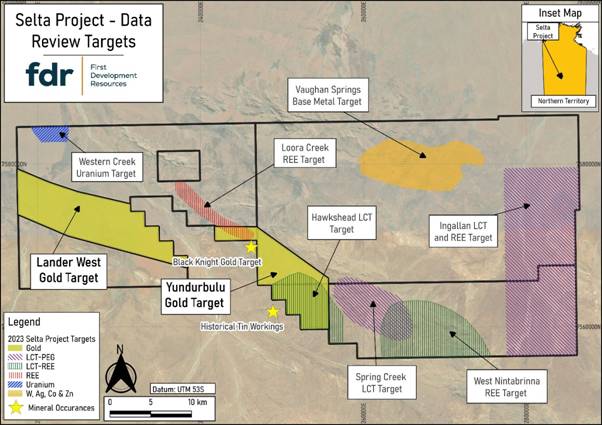
Notes: LCT-PEG = lithium, caesium, and tantalum (LCT) pegmatite (PEG)
Figure 1: Selta Project Targets Identified by Data Review
The potential for gold at both Lander West and Yundurbulu has been further validated by a comprehensive gold targeting study conducted by Perth-based consultants Resource Potentials earlier this year. Commissioned by FDR, the study involved compiling, re-processing, and integrating historical drilling, geological, geophysical, and geochemical datasets to pinpoint gold targets and provide recommendations for future exploration work. The findings were announced on 20 October 2025 and can be accessed via the following link:
While Yundurbulu remains highly prospective and close to known mineralisation, initial exploration will focus on the Lander West gold Target, interpreted as a continuation of the Stafford Gold Trend where iTech Minerals Ltd. (ASX: ITM) has delineated high grade gold and antimony on adjacent ground.1
Gold targets within this corridor are interpreted to be shear-hosted, forming along zones of deformation where rocks have been sheared, altered, or brecciated. These structures often produce subtle, detectable variations in magnetic susceptibility, either from magnetite destruction during alteration or from magnetite enrichment associated with intrusions or shear-related fabrics. Determining these structures is key to identifying areas for further exploration.
A high-resolution magnetic geophysics survey across the Lander West Target will provide critical data to evaluate the structural setting and refine target potential, guiding the planning of follow-up drilling.
SURVEY METHODOLOGY AND PARAMETERS
FDR has appointed Thomson Airborne Pty Ltd (“Thomson”), a leading airborne geophysical consultancy based in New South Wales, Australia, to undertake the AMAG survey. Established in 2007, Thomson has an extensive track record delivering high-resolution magnetic and radiometric datasets for exploration companies and government agencies, including the Australian Federal Government.
The fixed-wing survey will be flown on 30° northeast-oriented lines, with 50-metre line spacing and 500-metre tie lines, using a Geometrics G823-A caesium-vapour magnetometer. The system records 20 readings per second, providing an average sample spacing of 3-4 metres along line.
A radiometric survey will be conducted concurrently as a low-cost add-on, using a Radiation Solutions RS-500w spectrometer, recording potassium, uranium, and thorium at two readings per second. This produces an average sample spacing of 30-40 metres along line and is designed to map potassium concentrations, an element associated with potassic alteration in gold deposits, such as muscovite, sericite, illite, and feldspar.
These high-resolution datasets will allow FDR’s technical team to accurately delineate geological structures and alteration. FDR plans to also utilise the high-resolution magnetics data for three-dimensional inversion modelling which will further facilitate structural interpretation to depth, and help develop well-constrained targets for follow-up exploration. The 30° survey orientation intersects the regional geological fabric at approximately 90° (Figure 2), enhancing magnetic contrast across key fault structures, improving anomaly clarity, and enabling precise mapping of shape, width, and continuity of prospective shear zones.
Identifying these structures will guide targeted exploration in future phases, ensuring a cost-effective and results-driven approach on the Lander West Gold Target.
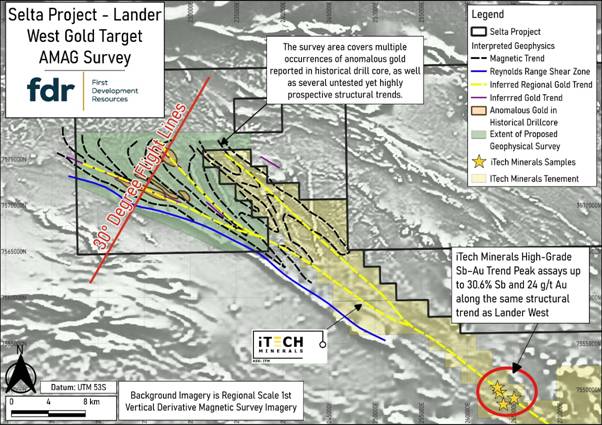
Figure 2: Proposed Survey Area with Interpreted Geology in Relation to High-Grade Au & Sb Rock chip Assays on Neighbouring Ground 1
NEXT STEPS
The AMAG survey represents the first step in a multi-phase exploration strategy, designed to systematically advance high-priority gold targets to a drill-ready stage. This approach will provide FDR’s technical team with critical structural and geophysical data, enabling more precise targeting and increasing the potential for significant gold discoveries, while maintaining a cost-effective exploration programme.
SELTA RARE-EARTH ELEMENT EXPLORATION UPDATE
The Company is pleased to advise that the previously announced first-pass rare-earth element (“REE”) sampling programme at the Selta Project was successfully completed earlier this month. The original announcement dated 19 November 2025 is available via the link below.
The programme focused on two priority REE target areas, Ingallan and West Nintabrinna, which were identified following detailed desktop studies. Field activities were designed to validate historical geochemical anomalies and to generate additional targets for potential follow-up mapping, sampling and investigation of ionic clay-hosted REE potential at Ingallan.
Samples collected from both the Ingallan and West Nintabrinna target areas have now been submitted for laboratory analysis. The Company will provide further updates once results are received and assessed.
REFERENCE
1. iTech Minerals Ltd (ASX: ITM) announcement dated 19 August 2025
( https://announcements.asx.com.au/asxpdf/20250819/pdf/06n0xk4zmh438y.pdf )
QUALIFIED PERSON STATEMENT
The technical information contained in this disclosure has been reviewed and approved by Mr Nicholas O’Reilly (MSc, DIC, MIMMM QMR, MAusIMM, FGS), who is a qualified geologist and acts as the Qualified Person under the AIM Rules – Note for Mining and Oil & Gas Companies. Mr O’Reilly is a principal consultant working for Mining Analyst Consulting Ltd which has been retained by First Development Resources plc to provide technical support.
GLOSSARY
|
Term |
Definition |
|
Aeromagnetic (AMAG) survey |
An airborne geophysical survey that measures variations in the Earth’s magnetic field to map geology and structures. |
|
High-resolution magnetic data |
Detailed magnetic measurements collected at tight line spacing and low flight height to define subtle geological features. |
|
Magnetic anomaly |
A change in the Earth’s magnetic field caused by variations in rock type or alteration. |
|
Hydrothermal alteration |
Chemical and mineralogical changes in rocks caused by hot fluid flow, often associated with mineralisation. |
|
Potassic Alteration |
A type of hydrothermal alteration where rocks are enriched in potassium (K), typically forming muscovite/sericite, biotite, or K-feldspar. It commonly occurs around gold-bearing shear zones and other hydrothermal systems, where hot, potassium-rich fluids replace original minerals. |
|
Structural feature |
A geological break or deformation in rocks such as faults, shear zones, or folds. |
|
Gold-mineralised trend |
A corridor where multiple gold occurrences align along a structural or geological control. |
|
Shear zone |
A zone of intense deformation where rocks have been sheared and fractured, often hosting gold. |
For further information visit www.firstdevelopmentresources.com or contact the following:
|
First Development Resources plc Tristan Pottas (CEO) |
Tel: +44 (0) 20 3778 1397 |
|
Beaumont Cornish Limited Nominated Adviser Roland Cornish / Asia Szusciak |
Tel: +44 (0) 20 7628 3396 |
|
SI Capital Limited Broker Nick Emerson |
Tel: +44 (0) 1483 413 500 |
First Development Resources #FDR – Wallal Phase I Diamond Drilling update
 First Development Resources plc (AIM: FDR) a UK based, Australia focused exploration company with mineral interests in Western Australia and the Northern Territory, provides an update in respect of drilling at the Wallal Project (“Wallal” or the “Project”) in the Paterson Province of Western Australia.
Due to deteriorating downhole conditions at the base of the Canning Basin sedimentary sequence, FDR drillhole (“FDRDW002”) could not be advanced to the planned depth of 1,220 metres and the decision has been made to cease drilling. The drillhole reached a depth of 918.7 metres (916.2 metres total vertical depth) but did not intersect the basement geology interpreted to host the magnetic anomalies identified in the Company’s desktop studies.
With the data obtained from the drilling programme, the Company is working with its consultants to refine the geological interpretation of the Eastern anomaly whilst it assesses potential next steps.
Whilst drilling operations have been underway at Wallal, work to refine the exploration strategy at the Company’s Selta project in the Northern Territory has been developed, initial exploration will focus on Selta’s gold potential. The Company expects to provide a more detailed plan for exploration at Selta later this month.
Tristan Pottas, Chief Executive Officer of FDR, commented:
“The abandonment of FDRDW002 is a bitterly disappointing end to what has been a very challenging maiden drill campaign at our Wallal Project. Exploration drilling is never a straightforward process, particularly in greenfield locations such as Wallal. Throughout the Phase I Diamond Drilling programme the site team, in partnership with our drilling contractor, has overcome multiple downhole challenges which enabled the hole to advance to a considerable depth. Our understanding of the geology specific to Wallal has increased significantly and will now be incorporated back into the geophysical Inversion modelling in order to further inform the exploration strategy for when we return to test what remains to be a highly compelling target.”
Qualified Person Statement
The technical information contained in this disclosure has been reviewed and approved by Mr Nicholas O’Reilly (MSc, DIC, MIMMM QMR, MAusIMM, FGS), who is a qualified geologist and acts as the Qualified Person under the AIM Rules – Note for Mining and Oil & Gas Companies. Mr O’Reilly is a principal consultant working for Mining Analyst Consulting Ltd which has been retained by First Development Resources plc to provide technical support.
For further information visit www.firstdevelopmentresources.com or contact the following:
|
First Development Resources plc Tristan Pottas (CEO) |
Tel: +44 (0) 20 3778 1397 |
|
Beaumont Cornish Limited Nominated Adviser Roland Cornish / Asia Szusciak |
Tel: +44 (0) 20 7628 3396 |
|
SI Capital Limited Broker Nick Emerson |
Tel: +44 (0) 1483 413 500 |
Beaumont Cornish Limited (“Beaumont Cornish”) is the Company’s Nominated Adviser and is authorised and regulated by the FCA. Beaumont Cornish’s responsibilities as the Company’s Nominated Adviser, including a responsibility to advise and guide the Company on its responsibilities under the AIM Rules for Companies and AIM Rules for Nominated Advisers, are owed solely to the London Stock Exchange. Beaumont Cornish is not acting for and will not be responsible to any other persons for providing protections afforded to customers of Beaumont Cornish nor for advising them in relation to the proposed arrangements described in this announcement or any matter referred to in it.
First Development Resources #FDR – Wallal Phase I Diamond Drilling update
First Development Resources plc (AIM: FDR) a UK based, Australia focused exploration company with mineral interests in Western Australia and the Northern Territory, is pleased to provide an update in respect of drilling at the Wallal Project (“Wallal” or the “Project”) in the Paterson Province of Western Australia.
First Development’s drilling partner DDH1 Drilling Pty Ltd (“DDH1 Drilling”) has established an accommodation camp and support infrastructure at Wallal to facilitate the Phase I diamond core drilling programme. The Phase I programme has been designed to test the Eastern magnetic geophysical bullseye anomaly identified within the Wallal project area. The drill rig is now onsite (Figure 1) and is being prepared so that drilling can commence in the coming days. Tristan Pottas, FDR Chief Executive Officer and experienced geologist, will be travelling to Wallal to oversee operational activities and assist with geological logging and core preparation on site.
Tristan Pottas, Chief Executive Officer of FDR, commented:
“When FDR secured Admission to AIM last month, we said we would immediately deploy funds into the ground and today’s announcement demonstrates we are doing just that.
I am grateful for the support we have received from our drilling partner DDH1 Drilling and the assistance from FDR’s operational team in Western Australia for all their efforts in getting us to this point.
I look forward to travelling to site in the coming days and being present for the execution of what we believe will be hugely exciting drilling programme.”
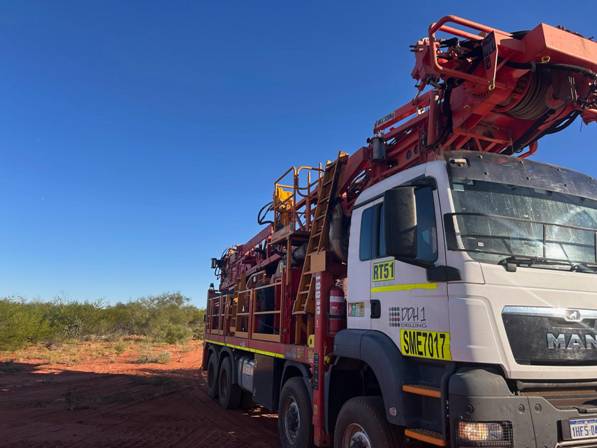
Figure 1: Drilling Rig Arriving at Wallal, Paterson Province, Western Australia, August 2025
WALLAL PHASE I DIAMOND CORE DRILLING PROGRAMME
The Phase I diamond core drilling programme has been designed in conjunction with Perth based consultancy Resource Potentials Pty Ltd (“Resource Potentials”). The programme is targeting the Proterozoic basement rocks which are believed to host the sources of the magnetic geophysical bullseye anomalies, located below approximately 800m of Permian Grant Group cover sequence. The bullseye anomalies were identified as part of an in-depth review of all geological and geophysical data associated with the Wallal project area.
Three magnetic geophysical bullseye anomalies were identified in the review, the Western, Eastern and Border anomalies. The magnetic bullseye anomalies are of particular interest due to their possible geological similarities to the regionally significant Havieron discovery (Greatland Resources LON: GGP, ASX: GGP). The Havieron deposit is coincident with a magnetic bullseye anomaly detected by an airborne magnetic survey and has a similar amplitude to Wallal, approximately 100nanoTesla (“nT”) for the Eastern anomaly and 80nT for Havieron. The Phase I diamond core drilling programme has been designed to initially test the Eastern anomaly. The Eastern anomaly is interpreted to consist of two lobes (Figure 2) which result in a distinct target area of approximately 2.5km x 2.5km (Figure 3). An estimate of depth of the cover sequence has been used to constrain the modelled depth of approximately 800 metres to the top of the Eastern magnetic source body.
To facilitate drilling operations, a Heritage Clearance Survey at Wallal was completed under the supervision of the Yamatji Marlpa Aboriginal Corporation and the Nyangumarta people. The completed survey confirmed exploration activities can proceed.
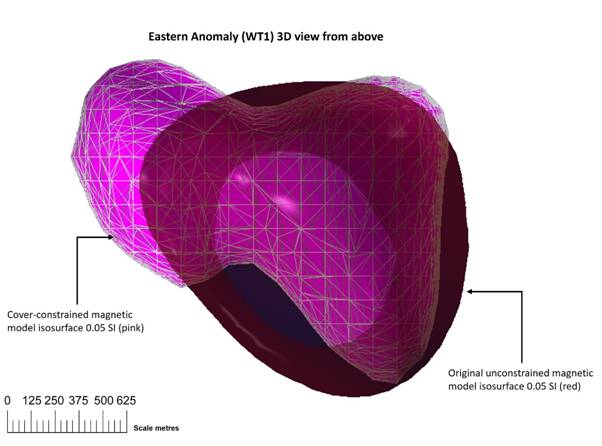
Figure 2: Vertical Plan View of Three-Dimensional Model of the Eastern Magnetic Bullseye Anomaly
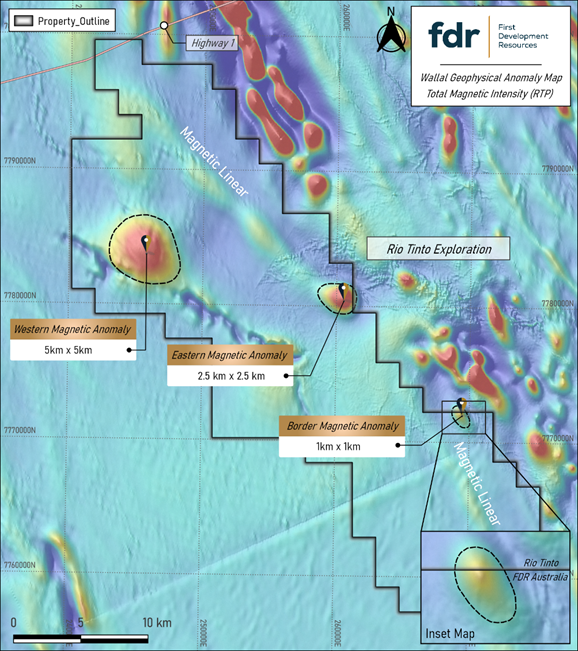
Figure 3 note: UTM Zone 51S, GDA94 datum. Magnetic intensity highs red, lows blue (-50 – +50 nT range)
Figure 3: Wallal Project Geophysical Map of Magnetic Anomalies Identified at Wallal
The Phase I diamond core drilling programme (Figure 4) will consist of a single sub-vertical borehole (DH001) totalling approximately 1,220 metres length, which will be drilled dipping 80° towards 90° (east) using rotary open hole to about 200 metres and then full core drilling techniques there onwards. Depending on ground conditions encountered, it is expected that the hole will be commenced using reverse circulation drilling techniques, followed by 83mm (PQ3) or 61.1mm (HQ3) diameter core with a 50.5mm (NQ2) tail to total depth. The parameters for the planned borehole are set out in Table 1 below.
Table 1: Planned Wallal Phase I Drillhole Parameters
|
Drillhole ID |
UTM Easting |
UTM Northing |
Azimuth (°) |
Dip (°) |
Nominal depth (m) |
|
DH001 |
260325 |
7780690 |
90 |
80 |
1,220 |
Table 1 note: UTM Zone 51S, GDA94 datum
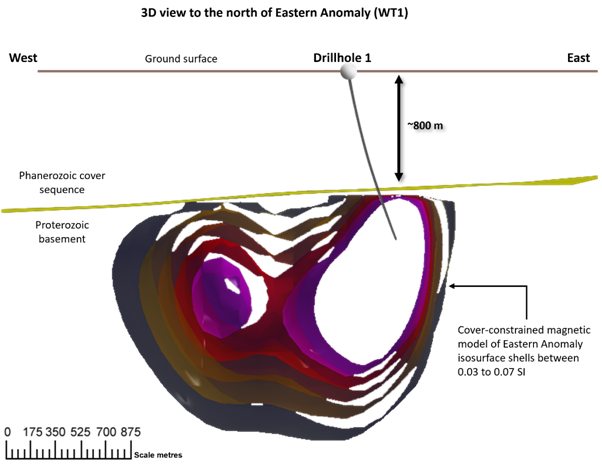
Figure 4: Cross Section View of Eastern Magnetic Bullseye Anomaly showing Planned DH001 Drillhole Designed to test the Eastern Lobe of the Anomaly
Qualified Person Statement
The technical information contained in this disclosure has been reviewed and approved by Mr Nicholas O’Reilly (MSc, DIC, MIMMM QMR, MAusIMM, FGS), who is a qualified geologist and acts as the Qualified Person under the AIM Rules – Note for Mining and Oil & Gas Companies. Mr O’Reilly is a principal consultant working for Mining Analyst Consulting Ltd which has been retained by First Development Resources plc to provide technical support.
For further information visit www.firstdevelopmentresources.com or contact the following:
|
First Development Resources plc Tristan Pottas (CEO) |
Tel: +44 (0) 20 3778 1397 |
|
Beaumont Cornish Limited Nominated Adviser Roland Cornish / Asia Szusciak |
Tel: +44 (0) 20 7628 3396 |
|
SI Capital Limited Broker Nick Emerson |
Tel: +44 (0) 1483 413 500 |
Beaumont Cornish Limited (“Beaumont Cornish”) is the Company’s Nominated Adviser and is authorised and regulated by the FCA. Beaumont Cornish’s responsibilities as the Company’s Nominated Adviser, including a responsibility to advise and guide the Company on its responsibilities under the AIM Rules for Companies and AIM Rules for Nominated Advisers, are owed solely to the London Stock Exchange. Beaumont Cornish is not acting for and will not be responsible to any other persons for providing protections afforded to customers of Beaumont Cornish nor for advising them in relation to the proposed arrangements described in this announcement or any matter referred to in it.
ABOUT FIRST DEVELOPMENT RESOURCES
First Development Resources’ assets comprise eight granted tenements covering a total area of 2,314.4km2. Five of the tenements, comprising three prospective copper-gold projects, are located in Western Australia (WA) while the remaining three tenements, comprising a rare-earth element (REE), uranium, lithium and gold project, are located in the Australian’s Northern Territory. All tenements are wholly owned by FDR. The assets are a mixture of drill ready and earlier stage exploration.
The WA Projects include the Company’s flagship Wallal Project as well as Ripon Hills and Braeside West Projects situated in the Paterson Province, which is widely regarded as one of the most productive regions in Australia for the discovery of world-class gold-copper deposits, and which is home to several world-class mines and more recent discoveries.
The Selta Project in the Northern Territory is located in an area considered highly prospective for uranium and rare-earth element mineralisation along with base and precious metal mineralisation. Numerous companies are actively exploring within the region.
Beyond the existing portfolio, FDR is actively looking to expand its portfolio through the acquisition of early-stage exploration projects in Australia.
First Development Resources #FDR – Drilling Contractor Appointed for Wallal Project
 First Development Resources plc (AIM: FDR) a UK based, Australian focused exploration company with mineral interests in Western Australia and Australia’s Northern Territory, is pleased to announce that it has appointed DDH1 Drilling Pty Ltd (“DDH1 Drilling”) to undertake the Company’s Phase I diamond core drilling programme at its Wallal Project in the Paterson Province of Western Australia.
Established in 2006, DDH1 Drilling is a leading provider of technically innovative drilling services to the Australian mineral exploration and mining industry. DDH1 is part of the Perenti Group (ASX: PRN), an Australian Securities Exchange listed, diversified mining services group with interests in contract mining, drilling services, mining services and technology solutions. DDH1 Drilling is a leading provider of technically innovative drilling services to the Australian mineral exploration and mining industry. Specialising in diamond core drilling, DDH1 delivers high-quality, accurate samples from depths of up to 3,000 metres, supported by an experienced team, best practice safety systems and a modern multipurpose drilling fleet. DDH1 have extensive experience operating in the Paterson region working on notable projects including Greatland Resources’ (LON: GGP) discovery drillholes at Havieron.
With the drilling contract signed the Company will now prepare the infrastructure at Wallal for the mobilisation of the drill rigs to site as soon as practicable for the commencement of drilling.
Tristan Pottas, CEO of FDR, commented:
“We are delighted to have contracted the services of DDH1 to implement the Phase I diamond core drilling programme at our Wallal project in the Paterson. Throughout FDR’s listing process DDH1 has remained committed to partnering with FDR and following the Company’s Admission to AIM earlier this week we are pleased to formalise our relationship as we move towards commencing drilling operations at the earliest convenience. Representatives for the Company will be on site at Wallal next week to assess what level of maintenance to the existing infrastructure may be required to facilitate mobilisation. We look forward to proving further updates in the very near future.”
For further information visit www.firstdevelopmentresources.com or contact the following:
|
First Development Resources plc Tristan Pottas (CEO) |
Tel: +44 (0) 20 3778 1397 |
About Reach announcements
This is a Reach announcement. Reach is an investor communication service aimed at assisting listed and unlisted (including AIM quoted) companies to distribute media only / non-regulatory news releases into the public domain. Information required to be notified under the AIM Rules for Companies, Market Abuse Regulation or other regulation would be disseminated as an RNS regulatory announcement and not on Reach.
ABOUT FIRST DEVELOPMENT RESOURCES
First Development Resources’ assets comprise eight granted tenements covering a total area of 2,314.4km2. Five of the tenements, comprising three prospective copper-gold projects, are located in Western Australia (WA) while the remaining three tenements, comprising a rare-earth element (REE), uranium, lithium and gold project, are located in the Australian’s Northern Territory. All tenements are wholly owned by FDR. The assets are a mixture of drill ready and earlier stage exploration.
The WA Projects include the Company’s flagship Wallal Project as well as Ripon Hills and Braeside West Projects situated in the Paterson Province, which is widely regarded as one of the most productive regions in Australia for the discovery of world-class gold-copper deposits, and which is home to several world-class mines and more recent discoveries.
The Selta Project in the Northern Territory is located in an area considered highly prospective for uranium and rare-earth element mineralisation along with base and precious metal mineralisation. Numerous companies are actively exploring within the region.
Beyond the existing portfolio, FDR is actively looking to expand its portfolio through the acquisition of early-stage exploration projects in Australia.
First Development Resources #FDR – Admission to AIM and First Day of Dealings
First Development Resources plc (AIM: FDR) a UK based, Australian focused exploration company with mineral interests in Western Australia and Australia’s Northern Territory, is pleased to announce the admission of its entire share capital, being 105,859,430 ordinary shares of 1 pence each (“Ordinary Shares”), to trading on the AIM market of the London Stock Exchange (“Admission”).
Admission and dealings in the Ordinary Shares will commence at 8.00 a.m. today under the TIDM and ISIN of FDR and GB00BRY05092 respectively. The Company has raised gross proceeds of £2.3 million (before expenses) through the issue of 34,482,759 new Ordinary Shares at a placing price of 6.67 pence per share.
As from today, the Company’s registered address has been changed to Salisbury House, London Wall, London EC2M 5PS.
The Admission Document as well as information required pursuant to AIM Rule 26 are available at the Company’s website at: www.firstdevelopmentresources.com
Tristan Pottas, CEO of FDR, commented:
“First Development Resources’ admission to AIM comes at a time when the world needs more critical, precious-and base-metals. This presents an exciting opportunity for a company such as ours with ownership of four diverse exploration and development assets located within one of the world’s most attractive mining jurisdictions. We believe FDR represents significant potential and are eager to accelerate both exploration and corporate development activities immediately following our listing.
I would like to extend my sincere thanks to the entire FDR team and our shareholders for their support as we navigated the detailed exploration and corporate steps that have brought us to this point. Their commitment has been instrumental in positioning the Company for future growth and value creation. I would like to take this opportunity to welcome our new investors and we now look forward to advancing and executing our operational work programmes.”
For further information visit www.firstdevelopmentresources.com or contact the following:
|
First Development Resources plc Tristan Pottas (CEO) |
Tel: +44 (0) 20 3778 1397 |
|
Beaumont Cornish Limited Nominated Adviser Roland Cornish / Asia Szusciak |
Tel: +44 (0) 20 7628 3396 |
|
SI Capital Limited Broker Nick Emerson |
Tel: +44 (0) 1483 413 500 |
Beaumont Cornish Limited (“Beaumont Cornish”) is the Company’s Nominated Adviser and is authorised and regulated by the FCA. Beaumont Cornish’s responsibilities as the Company’s Nominated Adviser, including a responsibility to advise and guide the Company on its responsibilities under the AIM Rules for Companies and AIM Rules for Nominated Advisers, are owed solely to the London Stock Exchange. Beaumont Cornish is not acting for and will not be responsible to any other persons for providing protections afforded to customers of Beaumont Cornish nor for advising them in relation to the proposed arrangements described in this announcement or any matter referred to in it.
OVERVIEW OF FIRST DEVELOPMENT RESOURCES
First Development Resources’ assets comprise eight granted tenements covering a total area of 2,314.4km2. Five of the tenements, comprising three prospective copper-gold projects, are located in Western Australia (WA) while the remaining three tenements, comprising a rare-earth element (REE), uranium, lithium and gold project, are located in the Australian’s Northern Territory. All tenements are wholly owned by FDR.
The WA Projects include the Company’s flagship Wallal Project as well as Ripon Hills and Braeside West Projects situated in the Paterson Province, which is widely regarded as one of the most productive regions in Australia for the discovery of world-class gold-copper deposits, and which is home to several world-class mines and more recent discoveries.
The Selta Project in the Northern Territory is located in an area considered highly prospective for uranium and rare-earth element mineralisation along with base and precious metal mineralisation. Numerous companies are actively exploring within the region.
Beyond the existing portfolio, FDR is actively looking to expand its portfolio through the acquisition of early-stage exploration projects in Australia.
Location
Well-endowed with natural resources, Australia is a globally significant producer of more than 20 mineral commodities including bauxite, cobalt, gold, lithium, iron ore, mineral sands, nickel and rare-earth elements (“REEs”). Australia’s resource and energy commodity exports are forecast to be worth AU$387B in FY 24-25. (Office of the Chief Economist, Australian Department of Industry, Innovation and Science, March 2025).
In 2024, Australia had around 350 operating mines producing 26 major and minor mineral commodities. Mining accounts for approximately two-thirds of Australia’s total merchandise exports, with the combined energy and mineral commodity exports forecast to be worth AU$387B in 2024-25.
Projects with Critical and High-Demand Minerals
First Development’s principal focus is to undertake exploration primarily for copper and gold in Western Australia and for REE’s, lithium and uranium in the Northern Territory. The FDR Board believe the Projects give the Company exposure to the traditional precious metals market as well as capitalising on the emerging green metals markets.
FDR’s Wallal Project comprises three granted exploration licences covering a combined area of 572.9 km2 and located approximately 240km east of Port Hedland on the western edge of the Paterson Province, WA. Three copper-gold exploration targets have been defined at the Project using geophysical surveying, and are known as the Eastern, Border and Western anomalies. The primary styles of mineralisation being targeted by FDR are intrusive-related breccia hosted copper gold mineralisation systems. The Company expects to commence its Phase I Diamond Drilling Programme in the coming weeks to test the Eastern anomaly.
FDR’s Selta Project comprises three granted ELs covering approximately 1,575km2, which are considered prospective for lithium, REE, uranium, gold and potentially base metal mineralisation. Based on small field reconnaissance programs in 2022 and 2023, as well as in-depth desktop reviews of publicly available exploration data, FDR has identified nine prospective target areas. FDR proposes to initially explore four target areas considered to have the highest exploration potential. Planned works include soil and rock geochemical sampling, mapping and a geophysical survey (magnetics). Systematic, methodical, first-pass exploration is expected to commence later this year.
Management Team & Strategy
The members of the Company’s Board have deep expertise in mining and mine development, considerable knowledge of the Australia mining sector, as well as expertise in corporate finance, legal and regulatory issues, ecology and the environment.
The Directors believe the establishment of a UK-based, Australian-focused AIM-quoted company creates the opportunity to generate shareholder value through the process of discovering and advancing new mineral deposits with a focus on copper-gold and uranium – rare-earth elements in Australia.
First Development’s mineral assets are currently in the early-stage exploration phase, so whilst this means that they are highly risky, exploration success and progressing one or more of the Projects into the development phase could add significantly to their value.
First Development Resources #FDR – Schedule One re IPO
Power Metal Resources PLC (AIM: POW, OTCQB: POWMF), the London listed exploration company with a global project portfolio is pleased to announce the release today by AIM of a Schedule One announcement in respect of First Development Resources PLC (“First Development”) (“FDR”), a link to which is provided below:
Sean Wade, Chief Executive Officer of Power Metal Resources PLC commented:
“I am very pleased to be able to update shareholders that the First Development Resources IPO is now expected to complete with a listing on AIM in the coming weeks. Market conditions have demonstrably improved of late, which has enabled us to fulfil our commitment to shareholders by bringing this exciting collection of assets to the market.
I am extremely grateful to Tristan Pottas and the FDR board for their unswerving commitment to this project and congratulate them on this achievement.
I look forward eagerly to hearing Tristan update shareholders on FDR’s immediate exploration plans and I am confident that, as we have seen in our successful investment in Guardian Metal, he can add significant value to both POW and FDR shareholders.”
|
ANNOUNCEMENT TO BE MADE BY THE AIM APPLICANT PRIOR TO ADMISSION IN ACCORDANCE WITH RULE 2 OF THE AIM RULES FOR COMPANIES (“AIM RULES”) |
||||||||||||
|
COMPANY NAME: |
||||||||||||
|
First Development Resources Plc (“FDR”, “First Development Resources” or the “Company”)
|
||||||||||||
|
COMPANY REGISTERED OFFICE ADDRESS AND IF DIFFERENT, COMPANY TRADING ADDRESS (INCLUDING POSTCODES): |
||||||||||||
|
201 Temple Chambers 3-7 Temple Avenue London EC4Y 0DT
|
||||||||||||
|
COUNTRY OF INCORPORATION: |
||||||||||||
|
UK
|
||||||||||||
|
COMPANY WEBSITE ADDRESS CONTAINING ALL INFORMATION REQUIRED BY AIM RULE 26: |
||||||||||||
|
https://firstdevelopmentresources.com/
|
||||||||||||
|
COMPANY BUSINESS (INCLUDING MAIN COUNTRY OF OPERATION) OR, IN THE CASE OF AN INVESTING COMPANY, DETAILS OF ITS INVESTING POLICY). IF THE ADMISSION IS SOUGHT AS A RESULT OF A REVERSE TAKE-OVER UNDER RULE 14, THIS SHOULD BE STATED: |
||||||||||||
|
First Development Resources is a UK based, Australian focused exploration company with mineral interest in three prospective copper-gold projects located in Western Australia (WA) and one rare-earth element (REE), uranium, lithium and gold project located in Australia’s Northern Territory.
The WA Projects comprise the Company’s flagship Wallal Project as well as Ripon Hills and Braeside West Projects situated in the Paterson Province, which is widely regarded as one of the most productive regions in Australia for the discovery of world-class gold-copper deposits, and which is home to several world-class mines and more recent discoveries.
The Wallal Project covers an area of 572km2 and is FDR’s primary focus in the region due to several geophysical anomalies which have been identified following the completion of an in-depth desk top study which included the reprocessing of historical seismic data along with the analysis of historic magnetic and gravity geophysical surveys. The three untested magnetic “bullseye” anomalies named the Western, Eastern and Border anomalies are reported in the Competent Person’s Report to have a similar amplitude to the geophysical signature seen at another nearby discovery. At Wallal, FDR’s primary target is the Eastern anomaly where the target is planned to be tested in the Phase I diamond core drilling programme scheduled to commence immediately post Admission.
The other two WA Projects, Ripon Hills and Braeside West, cover a combined area of approximately 175km2. The tenements are located approximately 250km southeast of Port Hedland on the western edge of the Paterson Province in Western Australia in the area which is primarily prospective for manganese, as well as base-metal and gold mineralisation associated with deep seated north to north-westerly trending fault structures. The Directors believe that the fault structures have the potential to be conduits for various styles of hydrothermal mineralisation as recently reported by another exploration company on land adjacent to the Braeside West tenement. An in-depth desktop study has been completed to better understand the prospectivity of the Ripon Hills and Braeside West Projects, and FDR is now planning the next phase of exploration over defined areas targeted for further investigation. The mineral rights for iron and manganese are excluded from both the Ripon Hills and Braeside West tenements.
The Company’s latest addition to its portfolio was the acquisition of the Selta Project located in the Northern Territory in an area considered by the Directors prospective for uranium and rare -earth elements along with lithium and gold. The Northern Territory has a long history of uranium mining and hosts some of Australia’s best known and high-grade uranium and REE deposits. The Selta Project, which covers a total land area of almost 1,600km2, is also considered by SRK to be prospective for base and precious-metal mineralization and Lithium-Tantalum-Caesium (LCT) pegmatites are also known to be present in the region. In addition to the uranium and REE targets identified, reconnaissance work at Selta has also confirmed the presence at surface of pegmatites. Work is currently underway to develop a focused exploration strategy to determine the mineralogy of the pegmatite in an attempt to validate historical commentary which suggest Selta could host LCT style pegmatite.
The Company’s main country of operations is Australia.
|
||||||||||||
|
DETAILS OF SECURITIES TO BE ADMITTED INCLUDING ANY RESTRICTIONS AS TO TRANSFER OF THE SECURITIES (i.e. where known, number and type of shares, nominal value and issue price to which it seeks admission and the number and type to be held as treasury shares): |
||||||||||||
|
Number of ordinary shares of 1 pence each (“Ordinary Shares”) for which Admission is being sought: 105,771,980.
The Ordinary Shares are and will remain freely transferable and have no restrictions as to transfer placed on them.
The issue price: 6.67 pence (the “Issue Price”).
No Shares are or will be held in treasury.
|
||||||||||||
|
CAPITAL TO BE RAISED ON ADMISSION (AND/OR SECONDARY OFFERING) AND ANTICIPATED MARKET CAPITALISATION ON ADMISSION: |
||||||||||||
|
Capital to be raised on Admission: £2.3 million
Anticipated market capitalisation on Admission £7 million (at the Issue Price)
|
||||||||||||
|
PERCENTAGE OF AIM SECURITIES NOT IN PUBLIC HANDS AT ADMISSION: |
||||||||||||
|
58%
|
||||||||||||
|
DETAILS OF ANY OTHER EXCHANGE OR TRADING PLATFORM TO WHICH THE AIM SECURITIES (OR OTHER SECURITIES OF THE COMPANY) ARE OR WILL BE ADMITTED OR TRADED: |
||||||||||||
|
N/A
|
||||||||||||
|
THE COMPANY HAS APPLIED FOR THE VOLUNTARY CARBON MARKET DESIGNATION(Y/N) |
||||||||||||
|
No
|
||||||||||||
|
FULL NAMES AND FUNCTIONS OF DIRECTORS AND PROPOSED DIRECTORS (underlining the first name by which each is known or including any other name by which each is known): |
||||||||||||
|
Michael “Mike” James Moore, Independent Non-executive Chairman
Tristan Lawrence Pottas, Chief Executive Officer
Benjamin “Ben” James Hodges, Finance Director (part-time)
Luke Sebastian Cairns, Independent Non-executive Director
|
||||||||||||
|
FULL NAMES AND HOLDINGS OF SIGNIFICANT SHAREHOLDERS EXPRESSED AS A PERCENTAGE OF THE ISSUED SHARE CAPITAL, BEFORE AND AFTER ADMISSION (underlining the first name by which each is known or including any other name by which each is known): |
||||||||||||
|
|
||||||||||||
|
NAMES OF ALL PERSONS TO BE DISCLOSED IN ACCORDANCE WITH SCHEDULE 2, PARAGRAPH (H) OF THE AIM RULES: |
||||||||||||
|
None
|
||||||||||||
|
(i) ANTICIPATED ACCOUNTING REFERENCE DATE (ii) DATE TO WHICH THE MAIN FINANCIAL INFORMATION IN THE ADMISSION DOCUMENT HAS BEEN PREPARED (this may be represented by unaudited interim financial information) (iii) DATES BY WHICH IT MUST PUBLISH ITS FIRST THREE REPORTS PURSUANT TO AIM RULES 18 AND 19: |
||||||||||||
|
(i) 30 June (ii) 31 December 2024 (iii) – 31 December 2025 (audited accounts for the year ended 30 June 2025) – 31 March 2026 (unaudited interim financial statements for 6 months ended 31 December 2025) – 31 December 2026 (audited accounts for the year ended 30 June 2026)
|
||||||||||||
|
EXPECTED ADMISSION DATE: |
||||||||||||
|
29 July 2025
|
||||||||||||
|
NAME AND ADDRESS OF NOMINATED ADVISER: |
||||||||||||
|
Beaumont Cornish Limited 5-10 Bolton Street London W1J 8BA
|
||||||||||||
|
NAME AND ADDRESS OF BROKER: |
||||||||||||
|
SI Capital Limited 46 Bridge Street Godalming Surrey GU7 1HL
|
||||||||||||
|
OTHER THAN IN THE CASE OF A QUOTED APPLICANT, DETAILS OF WHERE (POSTAL OR INTERNET ADDRESS) THE ADMISSION DOCUMENT WILL BE AVAILABLE FROM, WITH A STATEMENT THAT THIS WILL CONTAIN FULL DETAILS ABOUT THE APPLICANT AND THE ADMISSION OF ITS SECURITIES: |
||||||||||||
|
The AIM Admission Document, which will contain full details of the applicant and admission of its securities, will be available from the Company’s website:https://firstdevelopmentresources.com/
|
||||||||||||
|
THE CORPORATE GOVERNANCE CODE THE APPLICANT HAS DECIDED TO APPLY |
||||||||||||
|
QCA Code
|
||||||||||||
|
DATE OF NOTIFICATION: |
||||||||||||
|
11 July 2025
|
||||||||||||
|
NEW/ UPDATE: |
||||||||||||
|
NEW
|
Power Metal Resources #POW – FDR Selta Lithium Exploration & Company Update
Power Metal Resources PLC (LON:POW), the London listed exploration company seeking large-scale metal discoveries across its global project portfolio provides an update to shareholders in respect of lithium focussed fieldwork at the Selta Project (“Selta” or the “Project”), located in Australia’s Northern Territory. Selta is held through its subsidiary First Development Resources PLC (“First Development Resources” or “FDR”) which is seeking a planned listing in the London capital markets (Power Metal holds 62.12% of FDR and 58.59% after transaction outlined below).
HIGHLIGHTS:
Phase II Lithium Focused Exploration Programme
· Lithium focussed Phase II follow-up fieldwork now underway to further examine the zonation of a prospective pegmatite system present at FDR’s 100% owned Selta Project. Pegmatites are the target lithology which have the potential to host lithium mineralisation.
· Approximately 700 potential outcropping pegmatites have been identified by desktop analysis, within a target area of circa 180km2 (see Fig.1 below). Given the size of the prospective area and the number of targets generated, the planned fieldwork will initially focus on a 30km2 area in the southeast of the Project (see Figure 1).
· The Phase II fieldwork follows on from the successful findings of the Phase I field reconnaissance programme in June 2022, which confirmed the presence of pegmatite geology over a small area within the south of the Project, with lithogeochemical analysis of 17 samples suggesting potential for a zoned pegmatite system originating from the nearby granites 1.
· A desktop analysis of lithium specific publicly available datasets, satellite imagery and purpose commissioned hyperspectral analysis previously outlined the presence of potentially pervasive outcropping pegmatites 2, 3 which are the subject of the current fieldwork campaign.
· Further information in respect of the lithium work programme is provided below.
Company Update
· FDR continues to advance preparations for its planned listing and is very close to completion of all material work streams.
· To further enhance FDR’s position in advance of the planned listing and in light of the positive progress across the exploration programmes at all projects, the net smelter return (“NSR”) royalties retained by the original vendors of FDR’s projects have been purchased by FDR.
· The two NSRs were originally announced on the acquisition of First Development Resources Pty Limited (“FDR Australia”)(RNS: 29.10.2021 4) and URE Metals Pty Ltd (“URE Metals”)(RNS: 19.11.2021 5) and were each a 2% NSR, with a 1% buyout right for A$1,000,000. The NSRs were held by the original shareholders of FDR Australia and URE Metals whose shareholdings were previously acquired, as outlined in the above dated announcements.
· Each NSR has been purchased for £150,000, payable through the issue of 1,875,000 new FDR ordinary shares of 1.0p (“New FDR Shares”) at an issue price of 8p per share, for a total consideration of £300,000 through the issue of 3,750,000 New FDR Shares. The price of 8p per New FDR Share is specific to this NSR purchase transaction only and should not be taken as established pricing in relation to an IPO financing for the planned listing of FDR in the London capital markets.
· As a result, FDR holds a 100% interest in all projects and there are now no NSRs over any of its properties.
· Following the issue of the New FDR Shares, the total FDR issued share capital will amount to 65,894,076 shares of which Power Metal holds 38,605,697 shares representing 58.59% of FDR issued share capital.
Tristan Pottas, Chief Executive Officer of First Development Resources commented:
“Much of the recent focus has been on preparing for FDR’s planned UK listing, however, the team has also remained committed to advancing the project portfolio for the ongoing benefit of FDR shareholders.
Over the past several months the FDR team has worked hard to develop strong relationships with the key stakeholders at Selta to facilitate the efficient deployment of field teams to site to complete value enhancing work.
The technical analysis of the outcropping pegmatites will significantly improve our understanding of the system present at Selta and will help inform future work programmes with the intention of identifying zones within the Project with the potential to host lithium mineralisation.”
Paul Johnson, Chief Executive Officer of Power Metal Resources commented:
“The search for economic deposits of lithium continues to be the focus of many exploration companies globally as they look to capitalise on the strong market conditions which continue to reflect the lack of supply for the ever-growing demand for battery metals including lithium.
Importantly, with our readiness for diamond drilling at Wallal and the ongoing work programme at Selta, we are seeking to ensure FDR is a vibrant exploration business when listed.
The buyout of all project royalties by FDR was an important step, simplifying the structure of the planned listing interests and reflecting the value of FDR’s project portfolio which has been significantly enhanced since their original acquisition.”

Figure 1 : Selta Project showing lithium pegmatite and rare earth element prospective areas of interest and target area for current Phase II pegmatite focussed fieldwork
BACKGROUND – SELTA PROJECT LITHIUM REVIEW
The in-depth review of all publicly available geological, geophysical and geochemical data for the Selta Project identified multiple uranium and rare-earth element (“REE”) targets within the Selta Project area and highlighted the potential for lithium, gold and base-metal mineralisation. The potential for lithium presented an additional opportunity for a mineral discovery within the Selta Project area, an opportunity which had previously been unknown. To gain a better understanding of the potential for lithium-caesium-tantalum (“LCT”) type pegmatites, the Company immediately commenced a lithium review of all publicly available data to help refine target areas for further investigation and deployed a team to Selta to confirm the presence of pegmatite geology.
The announcement in respect of this lithium review and subsequent reconnaissance may be viewed through the following link:
During the reconnaissance the site team was able to confirm the presence of pegmatite geology and collect samples to determine mineralogy.
The results of the sampling and subsequent geochemical testing of pegmatites on the property indicated that the pegmatites analysed on the southwest of the property are part of zoned pegmatite system, most likely originating from the nearby granite. The initial sampling campaign programme covered only a very small portion of the property but provided valuable information for future exploration programmes.
SELTA PEGMATITE SAMPLING PROGRAMME
The mineral deposit model for LCT pegmatites is well defined by the United States Geological Survey and suggests LCT pegmatites tend to show a regional mineralogical and geochemical zoning pattern with respect to the inferred parental granite, with the greatest enrichment in the more distal pegmatites. FDR’s initial analysis of data acquired during the Selta lithium review supports this model.
FDR now plans to expand on this initial interpretation and conduct further exploration over a broader area. Using the data acquired from previous desktop analysis and reconnaissance, a field team led by FDR’s exploration manager will conduct a targeted pegmatite mapping and sampling programme to acquire representative geochemical and geological data in the south of the Selta Project, where previous work has proven the presence of a pegmatite system.
This work aims to constrain the zonation believed to be present in the pegmatite system. The field work will include the systematic mapping of the surface expression of pegmatites along with the collection of representative rock chip samples, which will then be sent for geochemical analysis. This field work will feed into FDR’s technical understanding of pegmatites at Selta, to provide targets and inform future work programmes.
QUALIFIED PERSON STATEMENT
The technical information contained in this disclosure has been read and approved by Mr Nick O’Reilly (MSc, DIC, MIMMM, MAusIMM, FGS), who is a qualified geologist and acts as the Qualified Person under the AIM Rules – Note for Mining and Oil & Gas Companies. Mr O’Reilly is a Principal consultant working for Mining Analyst Consulting Ltd which has been retained by Power Metal Resources PLC to provide technical support.
REFERENCE NOTES
1 Company announcement, First Development Resources – Company Update, 29 July 2022
( https://www.londonstockexchange.com/news-article/POW/first-development-resources-company-update/15562865 )
2 Company announcement, First Development Resources – Selta Lithium Update, 13 June 2022
( https://www.londonstockexchange.com/news-article/POW/first-development-resources-selta-lithium-update/15491241 )
3 Company announcement, Selta Project – Multiple Target Areas Identified, 16 March 2022
( https://www.londonstockexchange.com/news-article/POW/selta-project-multiple-target-areas-identified/15371081 )
4 Company announcement, Power Metal Acquires 100% of FDR Australia, 29 October 2021
( https://polaris.brighterir.com/public/power_metal_resources/news/rns/story/w04g16x )
5 Company announcement, Acquisition of Uranium & Rare-Earth Element Project – Australia, 19 November 2021
( https://polaris.brighterir.com/public/power_metal_resources/news/rns/story/w1ye76w )
This announcement contains inside information for the purposes of Article 7 of the Market Abuse Regulation (EU) 596/2014 as it forms part of UK domestic law by virtue of the European Union (Withdrawal) Act 2018 (“MAR”), and is disclosed in accordance with the Company’s obligations under Article 17 of MAR.
For further information please visit https://www.powermetalresources.com/ or contact:
|
Power Metal Resources plc |
|
|
Paul Johnson (Chief Executive Officer) |
+44 (0) 7766 465 617 |
|
SP Angel Corporate Finance (Nomad and Joint Broker) |
|
|
Ewan Leggat/Charlie Bouverat |
+44 (0) 20 3470 0470 |
|
SI Capital Limited (Joint Broker) |
|
|
Nick Emerson |
+44 (0) 1483 413 500 |
|
First Equity Limited (Joint Broker) |
|
|
David Cockbill/Jason Robertson |
+44 (0) 20 7330 1883 |
NOTES TO EDITORS
Power Metal Resources plc – Background
Power Metal Resources plc (LON:POW) is an AIM listed metals exploration company which finances and manages global resource projects and is seeking large scale metal discoveries.
The Company has a principal focus on opportunities offering district scale potential across a global portfolio including precious, base and strategic metal exploration in North America, Africa and Australia.
Project interests range from early-stage greenfield exploration to later-stage prospects currently subject to drill programmes.
Power Metal will develop projects internally or through strategic joint ventures until a project becomes ready for disposal through outright sale or separate listing on a recognised stock exchange thereby crystallising the value generated from our internal exploration and development work.
Value generated through disposals will be deployed internally to drive the Company’s growth or may be returned to shareholders through share buy backs, dividends or in-specie distributions of assets.
Exploration Work Overview
Power Metal has multiple internal exploration programmes completed or underway, with results awaited. The status for each of the Company’s priority exploration projects is outlined in the table below.
|
Project |
Location |
Current POW % |
Work Completed or Underway |
Results Awaited |
|
Athabasca Uranium |
Canada |
100% |
Preliminary planning for work in Spring/Summer 2023 is ongoing. |
Work programmes for Spring/Summer 2023. |
|
Molopo Farms |
Botswana |
87.71% |
Diamond drill programme underway. MLEM surveys planned over additional AEM targets identified. |
Drill programme updates and findings from further MLEM survey work. |
|
Tati Project |
Botswana |
100% |
RC drilling and sampling of mine dumps complete. |
Mine dumps processing and project commercial and exploration next steps. |
Exploration work programmes may also be underway within Power Metal investee companies and planned IPO vehicles where Power Metal has a material interest, the findings from which will be released on their respective websites, with simultaneous updates through Power Metal regulatory announcements where required. These interests are summarised in the table below:
|
Company |
Status/Operations |
Link |
|
First Class Metals PLC |
Investment – POW 27.91% Exploration in the Schreiber-Hemlo region of Ontario, Canada |
|
|
Kavango Resources PLC |
Investment – POW 9.85% Exploration in Botswana |
|
|
First Development Resources PLC |
Planned IPO – POW 62.12%* (58.59% post NSR buyout) Exploration in Western Australia and the Northern Territory of Australia |
www.firstdevelopmentresources.com
|
|
Golden Metal Resources PLC |
Planned IPO – POW 83.13% Exploration and development in Nevada, USA |
|
|
New Ballarat Gold PLC |
Planned IPO – POW 49.9% Exploration in the Victoria Goldfields of Australia |
A new website is currently in development which will be found atwww.newballaratgoldcorp.com . In the interim further information in respect of NBGC can be found at: https://www.powermetalresources.com/project/victoria-goldfields/ .
|
|
Uranium Energy Exploration PLC |
Planned IPO – POW on listing estimated 50-55% Uranium exploration in the Athabasca region of Canada |