
Home » Posts tagged 'titanium'
Tag Archives: titanium
#SVML Sovereign Metals Ltd – SVM Advances U.S. Strategy as Rio Collab Concludes
HIGHLIGHTS
· Rio Tinto has not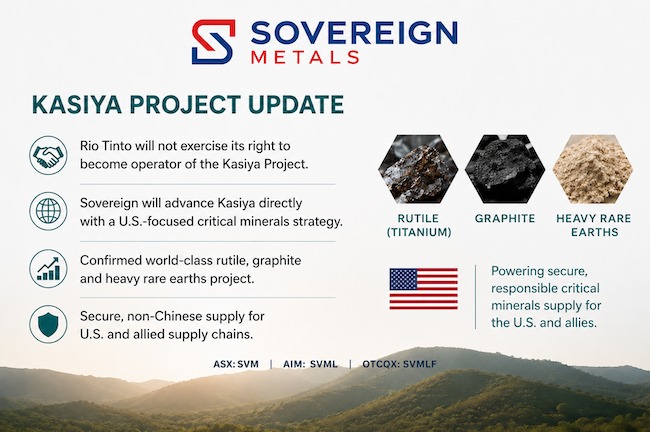 ified Sovereign that it will not exercise its right to elect to become operator of Sovereign’s Kasiya Rutile-Graphite Project under the Investment Agreement
· Rio Tinto has advised the Company, in its formal notice, that its decision reflects its change in corporate strategy regarding its Titanium business
· Accordingly, certain rights that Rio Tinto had in the Investment Agreement have now lapsed, including:
o exclusive marketing rights to market 40% of the annual production of all products
o pre-emptive right over any offer from a third party to acquire an interest in the Project
· Rio’s decision does not reflect any change in the fundamentals, economics or strategic importance of Kasiya as highlighted in the Kasiya DFS, which was completed with technical input from Rio Tinto
· Since the completion of the DFS, Sovereign has had deepening engagement with the U.S. Government, major U.S. companies, and industry stakeholders
· Sovereign can now prioritise a U.S.-focused critical-minerals strategy, positioning Kasiya as a secure, non-Chinese source of titanium feedstock and natural graphite for the U.S. and allied supply chains
· Commercial workstreams will include:
o advancing rutile and graphite offtake discussions toward binding agreements with Mitsui, Traxys and other strategic U.S. and U.S.-allied counterparties
o continued engagement with potential offtake partners and U.S. government stakeholders in relation to the heavy rare earth co-product opportunity
· Kasiya provides exposure to three minerals designated critical by the U.S. – titanium (via natural rutile), graphite and heavy rare earths (via a Heavy Rare Earth Concentrate by-product) – each feeding U.S. and allied supply chains, including Japan, being the dominant supplier of titanium metal to the U.S.
Mr Ben Stoikovich, Chairman, commented:
“As the Sovereign-Rio Tinto collaboration concludes, we would like to acknowledge and thank Rio Tinto for its significant contribution to the advancement of Kasiya.
Since 2023, Rio Tinto has invested over A$60 million in the Project and has provided valuable technical input through its participation on the Sovereign-Rio Tinto Technical Committee. This expertise has contributed to the successful delivery of the unique Pilot Mining and Rehabilitation program, which generated real-world operating and mining data that was incorporated into the tier-1 DFS completed earlier this year.
Sovereign looks forward to Rio Tinto continuing as a supportive shareholder as it builds on this important period of technical and operational progress, with the Company now well positioned to prioritise a U.S.-focused critical minerals strategy, positioning Kasiya as a secure, non-Chinese source of titanium feedstock and natural graphite for the U.S. and allied supply chains.”
Sovereign Metals Limited (ASX:SVM; AIM:SVML; OTCQX: SVMLF) (Sovereign or the Company) confirms that pursuant to the terms of the Investment Agreement between the Company and Rio Tinto Mining and Exploration Limited (Rio Tinto), Rio Tinto has notified Sovereign that it will not exercise its option to elect to become operator of the Kasiya Rutile-Graphite Project (Kasiya or the Project) in Malawi. Accordingly, Sovereign will continue as operator and will advance Kasiya directly.
In its notice to Sovereign, Rio Tinto advised that its decision not to elect operatorship reflects its change in corporate strategy and the strategic review of its Iron and Titanium business. This is consistent with Rio Tinto’s publicly outlined strategy under which it is narrowing its portfolio focus to iron ore, copper, aluminium and lithium. Accordingly, the decision does not reflect any change in the fundamentals, economics or strategic importance of the Project.
As a result of Rio Tinto’s decision not to elect operatorship, certain rights conferred on Rio Tinto under the Investment Agreement, including its operatorship, product marketing rights, consent and pre-emption rights in respect of the Project, cease, and Rio Tinto continues to hold a shareholding of approximately 18.2% in Sovereign. Rio Tinto will continue to hold a right to appoint a nominee director to the board of the Company (for as long as Rio Tinto holds at least a 15% shareholding in the Company) and a right to be notified of future equity issues (for as long as Rio Tinto holds at least a 10% shareholding in the Company).
Sovereign can now advance its commercial workstreams directly.
Sovereign intends to prioritise a US-focused strategy for Kasiya. The Project is positioned to supply natural rutile and natural graphite into supply chains serving the U.S. and allied economies, addressing acute gaps in secure, non-Chinese sources of critical minerals feedstock. Sovereign will deepen its engagement with the U.S. Government and industry stakeholders and focus its offtake and partnership efforts where Kasiya’s strategic value is greatest.
The Company intends to advance its existing rutile and graphite offtake MOUs, including those with its established counterparties, Mitsui & Co., Ltd., and Traxys North America, from non-binding arrangements to binding agreements, subject to negotiation.
Sovereign’s existing Collaboration Agreement with the International Finance Corporation (IFC), a member of the World Bank Group – of which the U.S. Government is the single largest shareholder – positions the Company to advance a development financing strategy for Kasiya alongside a globally recognised development-finance partner. With the Investment Agreement having fallen away, Sovereign is now able to progress its financing workstreams directly and on its own terms. The Company intends to pursue partnerships and financing arrangements for Kasiya, drawing on its engagement with the IFC and with development-finance and export-credit institutions across U.S. and allied economies, consistent with the Project’s role in secure, non-Chinese critical-minerals supply.
Sovereign thanks Rio Tinto for its investment, funding and technical contribution, which have been instrumental in advancing Kasiya to a world-class DFS.
|
Enquiries |
|
|
|
Frank Eagar, Managing Director & CEO South Africa / Malawi +27 21 140 3190
Sapan Ghai, CCO London +44 207 478 3900
|
|
|
|
Nominated Adviser on AIM and Joint Broker |
|
|
|
SP Angel Corporate Finance LLP |
+44 20 3470 0470 |
|
|
Ewan Leggat Charlie Bouverat |
|
|
|
|
|
|
|
Joint Broker |
|
|
|
Stifel |
+44 20 7710 7600 |
|
|
Varun Talwar |
|
|
|
Ashton Clanfield |
|
|
#SVML Sovereign Metals Limited – Japanese Titanium Producer Validates Kasiya Rutile
LEADING JAPANESE TITANIUM PRODUCER VALIDATES KASIYA RUTILE FOR HIGH-SPECIFICATION APPLICATIONS
· Test work by Japan’s Toho Titanium has confirmed that natural rutile from Kasiya is suitable for producing high-performance titanium metal products
· Japan accounts for over 15% of global titanium production capacity and over 60% of non-sanctioned, aerospace-grade titanium, i.e. excluding China and Russia
· Titanium is essential for high-growth industries, including aerospace, defence, and space exploration
o In 2024, global defence spending increased by 7.4% year on year to US$2.46 trillion with titanium critical for advanced fighter aircraft, naval vessels, and precision weapons systems
o Consumption of titanium in the aerospace industry is forecast to grow by a compound annual growth rate (CAGR) of 7% over the next decade, more than doubling to 132kt by 2034
Sovereign Metals Limited (ASX:SVM; AIM:SVML; OTCQX:SVMLF) (Sovereign or the Company), developer of the world’s largest known natural rutile deposit, is pleased to announce that one of Japan’s premier titanium metal (sponge and ingot) producers, Toho Titanium Company Limited (Toho Titanium), has confirmed the suitability of natural rutile from Sovereign’s Kasiya Rutile-Graphite Project (Kasiya or the Project) for manufacturing high-specification titanium products critical to aerospace and industrial applications.
Toho Titanium’s analysis of a sample of rutile from Kasiya concluded that “it is of a quality that can be used without any issues”. Kasiya’s rutile surpassed the requirements for TiO2 grade (>95%), low or no deleterious elements, low radiation value, and suitable particle size distribution and density.
Toho Titanium represents a cornerstone supplier in the global titanium value chain, with combined decades of expertise serving the world’s most demanding aerospace and industrial manufacturers. Toho Titanium, together with Japan’s other major titanium metal producer, Osaka Titanium Technologies Co., Ltd. (Osaka Titanium), account for over 15% of global titanium production capacity and over 60% of non-sanctioned, aerospace-grade titanium metal production (i.e. excluding China, which is not qualified to produce aerospace-grade titanium, and Russia).
Toho Titanium occupies a critical position in titanium supply chains, supporting the aerospace industry across the United States, Europe, and the Indo-Pacific region. Recent geopolitical developments have intensified focus on secure titanium supply chains, creating unprecedented strategic opportunities and strengthening the strategic nature of Kasiya as a future supplier of high-grade titanium feedstock.
Managing Director and CEO Frank Eagar commented: “The validation by Toho Titanium – one of the world’s most respected titanium producers – once again confirms Kasiya’s rutile as a premium and purest form of titanium feedstock for the titanium metals industry. Toho Titanium supplies the most demanding aerospace applications globally, such as Boeing and Airbus commercial aircraft. Confirmation that our rutile meets Toho Titanium’s exacting standards for high-specification titanium production validates our position as a future cornerstone supplier to critical industries. With the world’s largest known rutile deposit, Sovereign is uniquely positioned to capitalise on the intersection of resource security, aerospace supply chain realignment, and national defence priorities. Kasiya’s exceptional scale and quality, combined with Malawi’s stable jurisdiction, offers unparalleled exposure to one of the most strategic and rapidly growing mineral markets of our time.”
Kasiya Rutile Suitable for all Major End-Use Markets
Bulk scale metallurgical test work conducted by Allied Mineral Laboratories in Australia has previously confirmed that a premium-grade rutile product can be produced via a simple, conventional process flow sheet with no requirements for flotation or acid leaching.
World-class specification rutile products were reported ranging from 95.0% to 97.2% TiO2 with low impurities and exceptional metallurgical recoveries of up to 100% (Refer to ASX Announcement: “Outstanding Metallurgical Results at Kasiya” dated 7 December 2021).
The premium chemical parameters and particle sizing (d50 126μm, 8.6% <75μm) of Kasiya’s rutile indicate that the product is suitable for all major end-use markets. Specifically, Kasiya’s rutile product specification makes it a suitable feedstock for superior, high-performance titanium metal products.
Confirmation that Kasiya’s rutile can be used by Toho Titanium establishes Sovereign Metals as a credible future supplier to the global titanium industry’s most discerning customers. This technical endorsement, combined with Kasiya’s unmatched scale and strategic location, positions Sovereign as a potential market leader in the titanium supply chain.
|
Table 1: Kasiya Rutile Specification |
||
|
Constituent |
|
Kasiya (Sovereign Metals) |
|
TiO2 |
% |
95.7 |
|
ZrO2+HfO2 |
% |
0.18 |
|
SiO2 |
% |
0.70 |
|
Fe2O3 |
% |
0.98 |
|
Al2O3 |
% |
0.44 |
|
Cr2O3 |
% |
0.10 |
|
V2O5 |
% |
0.58 |
|
Nb2O5 |
% |
0.37 |
|
P2O5 |
% |
0.018 |
|
MnO |
% |
0.007 |
|
MgO |
% |
0.001 |
|
CaO |
% |
0.011 |
|
S |
% |
0.005 |
|
U+Th |
ppm |
30 |
Selected rutile product specification derived from bulk testwork on samples representing the first three years of mining, which is broadly representative of the overall Kasiya Ore Reserve.

Figure 1: 2024 Global Titanium Sponge Production Capacity by Non-Sanctioned Countries Qualified to Produce Aerospace-Grade Titanium Products
(Source: US Geological Survey; “Other” includes USA and India)

Figure 2: Processed rutile sample from Kasiya
Titanium’s Growing Strategic and Critical Status
According to the International Institute for Strategic Studies, a world-leading authority on global security, political risk and military conflict, global defence spending surged to US$2.46 trillion in 2024, representing a 7.4% real-terms increase as nations respond to escalating security challenges. This increase in defence expenditure is driving unprecedented demand for titanium-intensive military platforms, including advanced fighter aircraft, naval vessels, and precision weapons systems.
Titanium’s unique properties – exceptional strength-to-weight ratio, corrosion resistance, and high-temperature performance – makes it irreplaceable in many conventional and advanced military systems. Consequently, titanium has been officially classified as a critical mineral by the United States, European Union, United Kingdom, Canada, Australia, and Japan, reflecting its strategic importance to national security and economic competitiveness.
The ongoing conflict in Ukraine and rising tensions in the Indo-Pacific have highlighted critical vulnerabilities in titanium supply chains, as titanium production is concentrated in geopolitically sensitive regions. Historical supply dependency on Russia prompted an urgent reassessment of supply security, and in December 2024, NATO designated titanium as a defence-critical, strategic mineral essential for the Allied defence industry.
The recent signing of various critical minerals cooperation agreements, including between the United States and Saudi Arabia, announced during U.S. President Donald Trump’s May 2025 visit, underscores the strategic importance of titanium supply security. Notably, Toho Titanium’s joint venture facility in Saudi Arabia, operating at full capacity with an annual production of 15,000 tonnes, demonstrates the growing importance of secure titanium supply partnerships outside traditional Russian and Chinese-dominated markets.
Aerospace Sector Driving Unprecedented Titanium Demand
The commercial aerospace sector is one of the fastest-growing sources of titanium demand, driven by the ramp-up of commercial aircraft production, next-generation engine programs, and expanding global aviation capacity. Each modern commercial aircraft contains 15-20 tonnes of titanium components, concentrated in critical structural elements, engine components, and landing gear systems. The consumption of titanium in the aerospace industry is forecast to grow at a CAGR of 7% over the next decade, more than doubling to 132kt by 2034 (Source: Project Blue market intelligence).
According to PricewaterhouseCoopers, the aerospace and defence industry saw an 11% increase in revenues in 2023 to US$829 billion, with civil aviation companies leading the way. Boeing Commercial Airplanes’ revenue increased by 30%, with revenues from tier 1 suppliers GE Aerospace, Rolls-Royce, and Safran being higher by more than 20%.
Aircraft manufacturers reported that titanium shortages have impacted production schedules following the disruption of supply from Russia by sanctions and import restrictions. In April 2025, Airbus signed a titanium supply agreement with Saudi Arabia, demonstrating the importance of securing alternative supply chains outside Russian-dominated markets.
According to CAPA – Centre for Aviation, Boeing’s and Airbus’s combined backlogs exceed over 14 years with each aircraft requiring substantial titanium content for structural components and engine systems, while traditional supply sources remain constrained by geopolitical sanctions and trade restrictions.
About Toho Titanium
Toho Titanium, established in 1953, is a leading producer of titanium metals with significant production capacity. Toho Titanium produces 25,000 tonnes of titanium metals per annum, excluding 15,000 tonnes from a joint venture facility in Saudi Arabia. The company operates advanced manufacturing facilities that supply critical materials for aerospace and industrial markets.
|
Enquiries |
|
Frank Eagar, Managing Director & CEO South Africa / Malawi +27 21 140 3190 Sapan Ghai, CCO London +44 207 478 3900 |
|
Nominated Adviser on AIM and Joint Broker |
|
|
SP Angel Corporate Finance LLP |
+44 20 3470 0470 |
|
Ewan Leggat Charlie Bouverat |
|
|
|
|
|
Joint Broker |
|
|
Stifel |
+44 20 7710 7600 |
|
Varun Talwar |
|
|
Ashton Clanfield |
|
|
|
|
|
Buchanan |
+ 44 20 7466 5000 |
Forward Looking Statement
This release may include forward-looking statements, which may be identified by words such as “expects”, “anticipates”, “believes”, “projects”, “plans”, and similar expressions. These forward-looking statements are based on Sovereign’s expectations and beliefs concerning future events. Forward looking statements are necessarily subject to risks, uncertainties and other factors, many of which are outside the control of Sovereign, which could cause actual results to differ materially from such statements. There can be no assurance that forward-looking statements will prove to be correct. Sovereign makes no undertaking to subsequently update or revise the forward-looking statements made in this release, to reflect the circumstances or events after the date of that release.
The information contained within this announcement is deemed by Sovereign to constitute inside information as stipulated under the Regulation 2014/596/EU which is part of domestic law pursuant to the Market Abuse (Amendment) (EU Exit) Regulations (SI 2019/310) (“UK MAR”). By the publication of this announcement via a Regulatory Information Service, this inside information (as defined in UK MAR) is now considered to be in the public domain.
Competent Persons Statement
The information in this presentation that relates to the Exploration Results (metallurgy – rutile) is extracted from announcements dated 7 December 2021, 16 December 2021, 28 September 2023 and 22 January 2025 which are available to view at www.sovereignmetals.com.au. Sovereign confirms that a) it is not aware of any new information or data that materially affects the information included in the original announcement; b) all material assumptions included in the original announcement continue to apply and have not materially changed; and c) the form and context in which the relevant Competent Persons’ findings are presented in this report have not been materially changed from the original announcements.
The information in this announcement that relates to Production Targets, Ore Reserves, Processing, Infrastructure and Capital and Operating Costs is extracted from an announcement dated 22 January 2025, which is available to view at www.sovereignmetals.com.au. Sovereign confirms that: a) it is not aware of any new information or data that materially affects the information included in the original announcement; b) all material assumptions and technical parameters underpinning the Production Target, and related forecast financial information derived from the Production Target included in the original announcement continue to apply and have not materially changed; and c) the form and context in which the relevant Competent Persons’ findings are presented in this presentation have not been materially modified from the original announcement.
In relation to the disclosure of visual information, Sovereign cautions that the images displayed are for general illustrative purposes only, and that the samples displayed and visual methods of mineralisation identification and estimation of mineral abundance should not be considered as a proxy or substitute for laboratory analysis. Laboratory analysis would be required for the grades of mineralisation. Visual information also potentially provides no information regarding impurities or deleterious physical properties relevant to valuations.
|
Enquiries |
|
Frank Eagar, Managing Director & CEO South Africa / Malawi +27 21 140 3190
Sapan Ghai, CCO London +44 207 478 3900 |
|
Nominated Adviser on AIM and Joint Broker |
|
|
SP Angel Corporate Finance LLP |
+44 20 3470 0470 |
|
Ewan Leggat Charlie Bouverat |
|
|
|
|
|
Joint Broker |
|
|
Stifel |
+44 20 7710 7600 |
|
Varun Talwar |
|
|
Ashton Clanfield |
|
|
|
|
|
Buchanan |
+ 44 20 7466 5000 |
#GRX GreenX Metals LTD – Half-year Report
 CORPORATE DIRECTORY
|
DIRECTORS: Mr Dylan Browne Company Secretary PRINCIPAL OFFICES: Tel: +44 207 487 3900
Australia (Registered Office):
SOLICITORS:
AUDITOR: UHY ECA – Poland |
BANKERS: National Australia Bank Ltd
SHARE REGISTRIES:
United Kingdom:
Poland:
STOCK EXCHANGE LISTINGS: Australia:
United Kingdom:
Poland:
|
|
CONTENTS |
|
|
Directors’ Report |
|
|
Directors’ Declaration |
|
|
Consolidated Statement of Profit or Loss and other Comprehensive Income |
|
|
Consolidated Statement of Financial Position |
|
|
Consolidated Statement of Changes in Equity |
|
|
Consolidated Statement of Cash Flows |
|
|
Condensed Notes to the Consolidated Financial Statements |
|
|
Auditor’s Independence Declaration |
|
|
Independent Auditor’s Review Report |
DIRECTORS REPORT
The Directors of GreenX Metals Limited present their report on the Consolidated Entity consisting of GreenX Metals Limited (Company or GreenX) and the entities it controlled during the half-year ended 31 December 2024 (Consolidated Entity or Group).
OPERATING AND FINANCIAL REVIEW
Operations
Highlights during and subsequent to the half year end include:
· German Project – Tannenberg Copper Project
o In January 2025, GreenX was selected as as one of eight exploration companies to participate in BHP’s 2025 Xplor program.
o BHP Xplor will provide GreenX with approximately US$500,000 in non-dilutive funding to support and accelerate its exploration plans at the Tannenberg Copper Project (Tannenberg) during the 6-month period of the program.
o BHP Xplor is expected to accelerate the geological concept build-out and exploration timeframe at Tannenberg.
· Greenland Projects
o The Company notes the recent U.S. strategic interest in Greenland including Greenland Prime Minister publicly stating that he is open to discussions with the U.S.
o Greenland is endowed with an abundance of critical minerals which are essential for batteries, technology and defence.
o The Company is well placed to capitalise on the increased interest in Greenland with two large scale, strategic projects prospective for critical minerals located in Greenland.
· Eleonore North Project
o During the period, GreenX received outstanding antimony results at the Eleonore North project in Greenland (Eleonore North or ELN).
o Antimony price now US$49,000/t from historical prices of ~US$5,000 to 10,000/t.
o Critical mineral crisis escalating – China has now restricted export of critical and strategic antimony, graphite, gallium, germanium, tungsten, titanium and rare earths.
o Antimony has been designated as a “Critical Mineral” by the U.S. and the EU, with NATO designating tungsten as defence-critical for the Allied defence industry.
o Historical results from fieldwork at ELN include grab samples from outcropping mineralised veins with individual specimens grading up to 23% antimony (Sb), and other samples up to 4g/t gold (Au).
o Antimony mineralisation has been identified along a ~4km trend in veins and structures, that broadly aligns with previously identified gold veining at surface within a 15km trend.
o Review and verification of new historical data, including radiometric data, at ELN underway.
· Arctic Rift Copper Project
o The Company is targeting large scale copper in multiple settings across a 5,774 km2 licence at the Arctic Rift Copper Project (ARC).
o Further analysis on remote-sensing options underway which aims to improve understanding of the known copper mineralisation and to plan the next exploration program at the project.
· Arbitration Award
o During the period, GreenX was awarded up to £252 million (A$510 million / PLN 1.3 billion) in compensation (Award) from the successful outcome of the international arbitration claims against the Republic of Poland (Poland) under both the Australia-Poland Bilateral Investment Treaty (BIT) and the Energy Charter Treaty (ECT).
o Interest income of ~£14 million (A$28 million / PLN 70 million) per annum is currently accruing to GreenX. Against this, interest expense of ~£2.7 million (A$5.5 million / PLN 13.5 million) per annum is accruing on the US$11.3 million of litigation funding utilised.
o Upon satisfaction of the Award, it is GreenX’s intention to return the majority of the available cash to shareholders.
o Since the Award was made, Poland has lodged a request to set-aside the award with the courts of England and Wales in relation to the BIT award and the courts of Singapore in relation to the ECT award. Poland is challenging jurisdictional aspects of both awards and alleging procedural unfairness, including in the Tribunal’s decision on damages.
o The Company is strongly defending the set-aside motions
Tannenberg Copper Project (Germany)
Subsequent to the period end, the Company announced that following a rigorous selection process, it has been selected as one of eight exploration companies to participate in BHP’s 2025 Xplor program in relation to Tannenberg.
The Xplor program was established in 2023 to support promising minerals explorers to accelerate the exploration needed to support the energy transition. Over a six-month program period, BHP Xplor targets development of technical, business and operational excellence within participating companies.
As a 2025 BHP Xplor cohort company, GreenX will receive a non-dilutive grant of up to US$500,000 (US$250,000 as first instalment received in January 2025), and in-kind services, mentorship, and networking opportunities with BHP and other industry experts and investors.
It is expected GreenX’s participation in Xplor will expedite the build-out of geological concepts and the exploration timeframe at Tannenberg. GreenX intends to use the grant to conduct geophysics programs over the Tannenberg licence area.

Figure 1: Tannenberg is located in the industrial centre of Europe
GREENLAND PROJETCS
Eleonore North Project
During the period, GreenX announced that high grade antimony mineralisation had been identified at its Eleonore North project in Greenland, based on historical results recently released by the Geological Survey of Denmark and Greenland (GEUS). The historical results indicate the potential for a high-grade antimony-gold mineral system at ELN. Antimony prices have been on a rapid uptrend since China announced antimony export controls from 15 September 2024, with antimony prices in the US having rocketed to over US$49,000/t from US$18,300/t2.

Figure 2: Newly released GEUS assay results show evidence for high-grade antimony and gold mineralisation above the interpreted Noa Pluton.
Previously reported historical data confirmed the presence of gold and high-grade antimony in outcropping veins at ELN including:
· 14m long chip sample grading 7.2% Sb and 0.53g/t Au3
· 40 m chip line with a length weighed average of 0.78g/t Au3
Significantly, GEUS geologist’s identified stibnite (Sb2S3) as the antimony mineral. Stibnite is well-understood and the predominant ore mineral for commercial antimony production.
Antimony is designated a Critical Raw Material by both the EU and the U.S., with China being the world’s major antimony ore producer and major exporter of refined antimony oxides and metallic antimony.
Global strategic interest in antimony has significantly increased in 2024 due to several factors:
· China controls ~50% of global antimony mining, most downstream processing and 32% of global resources according to the Lowy Institute.
· China’s recent export ban on antimony, effective from 15 September 2024, has caused market disruption4.
· Antimony is a crucial material in the defence supply chain, used in various military applications including ammunition, flame retardants, and smart weaponry.
· Antimony is essential in renewable energy technologies including more-energy-efficient solar panel glass and in preventing thermal runaway in batteries.
The antimony market is expected to grow by 65% between 2024 and 20325. However, the supply side, declining antimony grades and depleting resources for existing mines are becoming increasingly relevant.
To aid the Company’s exploration targeting and fieldwork planning for ELN, GreenX’s technical team intend to locate, analyse, and study further historical samples and data within GEUS’s archives.
ANTIMONY RESULTS FROM NEWLY PUBLISHED GEOLOGICAL SURVEY ARCHIVE MATERIAL
GEUS’s archives host an extensive collection of rock samples (with and without assays), maps, as well as government and company reports going back many decades. A sub-set of the archive material is available in digital format. GEUS is continuously digitising and publishing its archive material. The newly released data covers 2008 field work at the Noa Dal valley within the Company’s ELN project. Government geologists collected mineralised samples from outcropping veins and scree near to the interpreted Noa Pluton. Selected highlights are presented in Table 1 below.
|
Table 1: Selected antimony and gold results from 2008 GEUS fieldwork |
|||
|
Sample # |
Sb (%) |
Au (g/t) |
Field description |
|
469506 |
23.40 |
0.00 |
Quartz vein with stibnite. Sample from boulder or scree |
|
496901 |
22.20 |
0.44 |
Massive stibnite from mineralised zone |
|
496918 |
15.10 |
0.54 |
Quartz vein + galena + chalcopyrite |
|
469504 |
6.65 |
0.83 |
Shale with stibnite |
|
496912 |
0.10 |
4.10 |
Clay alteration: hanging wall |
|
496904 |
0.11 |
4.70 |
Clay alteration: footwall |
|
496910 |
0.04 |
2.20 |
Intense clay alteration |
These newly released results conform with previously released historical results from the Noa Dal area (previously reported in ASX announcement dated 10 July 2023).
GEOLOGICAL SIGNIFICANCE OF ANTIMONY
GreenX is targeting Reduced Intrusion-related Gold Systems (RIRGS) at ELN. The hypothesised blind-to-the-surface Noa Pluton forms the basis for the RIRGS exploration model. Antimony-gold veins at surface were considered to be supporting evidence for RIRGS at ELN. With the favourable shift in the antimony market, the outcropping veins have become a potentially viable and attractive target.
The antimony-gold mineralisation at ELN could be analogous to Perpetua Resources’ Stibnite Gold Project in Idaho, USA. There, RIRGS and orogenic gold mineralisation styles overprint each other. Prior to the RIRGS model at ELN, the gold-bearing veins at Noa Dal were thought to be of orogenic origin. It is relatively common in gold deposits which are proximal to intrusions to feature characteristics of RIRGS and orogenic gold mineralisation styles.
The scale and potential of the antimony-gold veins will be evaluated with a follow-up investigation in the next phase of fieldwork.
GEUS is in the process of releasing results from regional mapping and sampling surveys from field seasons in 2022 and 2023 across East Greenland. GreenX plans to use the soon-to-be-released data as part of ongoing evaluation of the antimony and gold potential at ELN and the region.
Given recent developments in the antimony market, GreenX’s exploration strategy at the ELN project in East Greenland will continue with a renewed focus on the known Sb-Au mineral systems at the Noa pluton.
GreenX has been able to access further historical data for ELN with a review currently underway. Following completion of this review further updates will be made.
Arctic Rift Copper Project
ARC in Greenland is an exploration joint venture between GreenX and Greenfields Pty Ltd (Greenfields). GreenX can earn-in up to 80% in ARC with the Company currently owning a 51% interest in the project. The project is targeting large scale copper in multiple settings across a 5,774 km2 Special Exploration Licence in eastern North Greenland. The area has been historically underexplored yet is prospective for copper, forming part of the newly identified Kiffaanngissuseq metallogenic province.
The results of work program announced previously have demonstrated the high-grade nature of the known copper sulphide mineralisation and wider copper mineralization in fault hosted Black Earth zones and adjacent sandstone units. The exact position of a native copper fissure at the Neergaard Dal prospect was also identified.
The Company is in the process of analysing further remote-sensing options for ARC, which would be used to enhance current understanding of the known copper sulphide mineralisation and refine plans for the next exploration program.
Successful Arbitration Outcome in Dispute with Polish Government
In October 2024, GreenX reported a successful outcome of the international arbitration claims (Claim) against Republic of Poland (Poland or Respondent) under both the BIT and the ECT (together the Treaties).
The Company was awarded:
· Up to £252m (A$510m / PLN1.3bn) in compensation by the Tribunal under the BIT (BIT Award) which includes interest compounded at Sterling Over-Night Interbank Average (SONIA) plus one percentage point (+1%) compounded annually from 31 December 2019 to the date of the Award (7 October 2024).
· ~ £183m (A$355m / PLN 941m) in compensation by the Tribunal under the ECT (ECT Award), which includes interest compounded at the SONIA overnight rate +1% compounded annually from 31 December 2019. Interest will continue to accrue at SONIA +1% compounded annually until full and final payment by the Respondent.
· Additional Interest of ~ £6 million (A$12 million / PLN 30 million) has accrued since the Award to the date of this report and will continue to compound annually until full and final payment by the Respondent.
· Interest income of ~£14 million (A$28 million / PLN 70 million) per annum is currently accruing to GreenX. However, interest expense of only ~£2.7 million (A$5.5 million / PLN 13.5 million) per annum is accruing on the US$11.3 million of litigation funding utilised.
· Both Awards are subject to any payments made by the Respondent to the Claimant in the other arbitration such that the Claimant is not entitled to double compensation i.e., any amount paid by Poland in one arbitration (i.e., ECT) is set off against Poland’s liability in the other arbitration (i.e., BIT).
The compensation is denominated in British pound sterling. No hedging is in place for the compensation and accordingly is subject to fluctuations in foreign currency.
During the period, the Polish Prime Minister, Mr Donald Tusk, stated in a press conference that:
“The case is rather hopeless, because a lost arbitration is a lost arbitration. We have two big cases on our shoulders. The PiS government blew this issue.
The Australians, as you know, were promised that their mine would be built there. For years they were misled and later the commitment was withdrawn. It was quite obvious that they would go to arbitration, and it was rather obvious that they would win this arbitration.
Speaking frankly, I would most likely, and I cannot exclude that it will go this way, to find the person directly responsible for Poland now having to pay well over a billion zloty if we do not find a legal solution – which I think has very little probability to set aside the award in this arbitration. So, speaking the truth, I will expect my officers to inform the public in the coming days who made a decision or refrained from making a decision with the consequence of these gigantic losses, that is the compensation that we as the Polish State must pay to the Australians.” 1
Since the Award was made, Poland has lodged a request to set-aside the Award with the courts of England and Wales in relation to the BIT Award and the courts of Singapore in relation to the ECT Award. Poland is challenging jurisdictional aspects of both Awards and alleging procedural unfairness, including in the Tribunal’s decision on damages.
The threshold to succeed on a set-aside motion in either the English or Singapore courts is very high, with the courts rejecting set-aside applications in the vast majority of cases.
It is important to note that a “set-aside” motion is different from a general “appeal” since a set-aside motion can in general only relate to a lack of jurisdiction on the part of the Tribunal or procedural unfairness. Under both set-aside motions, the actual merits of the Claim cannot be revisited by the courts.
The Company is strongly defending the set-aside motions and will update the market, if required, in line with its continuous disclosure requirements.
All of GreenX’s costs associated with the Claim were funded on a limited basis from Litigation Capital Management (LCM). To date, GreenX has drawn down US$11.3 million from LCM. Once the Award compensation is received from Poland, LCM will be entitled to be paid back the US$11.3 million, a multiple of five times of the US$11.3 million and, from 1 January 2025, interest on the US$11.3 million at a rate of 30% per annum, compounding monthly (which equates to interest of approximately US$3.4 million (£2.7 million / A$5.5 million / PLN 13.5 million) per annum).
Further information on the Claim and Award can be found in the Company’s announcements dated 8 October 2024, 17 October 2024, 11 November 2024 and 22 January 2025.
Corporate
At 31 December 2024, GreenX had a cash balance of A$4.8 million allowing further exploration to be conducted at the Company’s projects and to strongly defend the set-aside motions.
Directors
The names and details of the Company’s Directors in office at any time during the half-year and until the date of this report are:
Directors:
Mr Ian Middlemas Chairman
Mr Benjamin Stoikovich Director and CEO
Mr Garry Hemming Non-Executive Director
Mr Mark Pearce Non-Executive Director
Unless otherwise shown, all Directors were in office from the beginning of the half-year until the date of this report.
Results of Operations
The net loss of the Consolidated Entity for the half-year ended 31 December 2024 was $2,092,947 (31 December 2023: $1,997,911 ). Significant items contributing to the current half-year loss and the substantial differences from the previous half-year include to the following:
(i) Arbitration related expenses of $723,787 (31 December 2023: $594,802) relating to the Claim against the Republic of Poland including set-aside defence costs (which are currently unfunded). This has been offset by the arbitration funding income of $251,593 (31 December 2023: $404,858);
(ii) Exploration and evaluation expenses of $338,762 (31 December 2023: $466,094), which is attributable to the Group’s accounting policy of expensing exploration and evaluation expenditure incurred by the Group subsequent to the acquisition of rights to explore and up to the commencement of a bankable feasibility study for each separate area of interest;
(iii) Business development expenses of $314,855 (31 December 2023: $195,882) which includes expenses relating to the Group’s review of new business and project opportunities; including business development costs for the Tannenberg transaction in the period, plus also investor relations activities during the six months to 31 December 2024 including public relations, digital marketing, and business development consultant costs; and
(iv) Interest income of $141,391 (31 December 2023: $252,221) earned on cash and cash equivalents held by the Group.
Financial Position
At 31 December 2024, the Group had cash reserves of $4,831,121 (30 June 2024: $7,170,793) placing it in a good financial position strongly defend the set-aside motions and continue with exploration activities at its projects.
At 31 December 2024, the Company had net assets of $13,724,522 (30 June 2024: $15,149,710) a decrease of approximately 10% compared with 30 June 2024. This is largely attributable to the decrease in cash, which has been offset by the increase in exploration and evaluation assets which amounts to A$10,268,308 (30 June 2024: $9,372,906).
Selected Financial Data (Converted into PLN And EUR)
|
|
Half-Year Ended |
Half-Year Ended |
Half-Year Ended |
Half-Year Ended |
|
|
|
|
|
|
|
Arbitration finance facility income |
657,804 |
1,088,623 |
153,070 |
244,981 |
|
Gas and property lease revenue |
– |
7,193 |
– |
1,619 |
|
Exploration and evaluation expenses |
(885,710) |
(1,253,279) |
(206,103) |
(282,035) |
|
Arbitration related expenses |
(1,892,377) |
(1,599,361) |
(440,352) |
(359,916) |
|
Net loss for the period |
(5,472,116) |
(5,372,179) |
(1,273,350) |
(1,208,943) |
|
Net cash flows from operating activities |
(4,906,747) |
(3,885,394) |
(1,141,790) |
(874,360) |
|
Net cash flows from investing activities |
(505,887) |
(4,737,288) |
(117,719) |
(1,066,068) |
|
Net cash flows from financing activities |
(704,556) |
(429,445) |
(163,949) |
(96,641) |
|
Net increase in cash and cash equivalents |
(6,117,190) |
(9,052,127) |
(1,423,458) |
(2,037,070) |
|
Basic and diluted loss per share (Grosz/EUR cents per share) |
(1.95) |
(1.97) |
(0.45) |
(0.44) |
|
|
31 December 2024 |
30 June 2024 |
31 December 2024 |
30 June 2024 |
|
Cash and cash equivalents |
12,321,290 |
19,203,384 |
2,883,522 |
4,452,442 |
|
Total Assets |
40,663,983 |
46,078,351 |
9,516,495 |
10,683,596 |
|
Total Liabilities |
(5,660,965) |
(5,507,428) |
(1,324,822) |
(1,276,937) |
|
Net Assets |
35,003,018 |
40,570,922 |
8,191,673 |
9,406,659 |
|
Contributed equity |
236,963,294 |
240,800,894 |
55,140,870 |
55,831,415 |
Figures of the consolidated statement of profit or loss and other comprehensive income and consolidated statement of cash flows have been converted into PLN and EUR by applying the arithmetic average for the final day of each month for the reporting period, as published by the National Bank of Poland (NBP). These exchange rates were 2.6146 AUD:PLN and 4.2974 PLN:EUR for the six months ended 31 December 2024, and 2.6889 AUD:PLN and 4.4437 PLN:EUR for the six months ended 31 December 2023.
Assets and liabilities in the consolidated statement of financial position have been converted into PLN and EUR by applying the exchange rate on the final day of each respective reporting period as published by the NBP. These exchange rates were: 2.5504 AUD:PLN and 4.2730 PLN:EUR on 31 December 2024, and 2.6780 AUD:PLN and 4.3130 PLN:EUR on 30 June 2024.
Business Strategies and Prospects for Future Financial Years
GreenX’s strategy is to create long-term shareholder value through the discovery, exploration, development and acquisition of technically and economically viable mineral deposits. This also includes enforcing the Award in relation to the Claim against Poland in the short to medium term.
To date, the Group has not commenced production of any minerals, nor has it identified any ore reserves in accordance with the JORC Code. To achieve its objective, the Group currently has the following business strategies and prospects over the medium to long term:
· Continue to enforce the Award against Poland and defend its rights in relation to the Claim and set-aside motions;
· Use Xplor funding at Tannenberg to accelerate the geological concept build-out and exploration timeframe plus extend the exploration licence prior to its expiry;
· Continue with exploration activities in Greenland; and
· Identify and assess other suitable business opportunities in the resources sector.
All of these activities are inherently risky and the Board is unable to provide certainty of the expected results of these activities, or that any or all of these likely activities will be achieved. Furthermore, GreenX will continue to take all necessary actions to preserve the Company’s rights and protect its investments in Poland, if and as required. The material business risks faced by the Group that could have an effect on the Group’s future prospects, and how the Group manages these risks, include the following:
· Litigation risk – All industries, including the mining industry, are subject to legal and arbitration claims. Specifically, and as noted above, the Company was successful in its Claim against Poland and has been awarded £252m in compensation for breach of Poland’s obligations under the Treaties. Subsequently, in November 2024, Poland lodged a request to set-aside the BIT Award in the courts of England and Wales and in January 2025 Poland lodged it’s request to set-aside the ECT Award in the courts of Singapore. The Company will strongly defend the set-aside motions in the relevant courts. Whilst the Company is extremely confident in the strength of the Award, as reflected in the unanimous Tribunal decision, there is no certainty that the set-aside motions or that a correction of damages filings made by Poland will be rejected. If these motions are not rejected, and the Award is not upheld or the damages amount is lowered compared to original amount awarded, then this may have a material impact on the value of the Company’s securities.
· Earn-in and joint venture contractual risk – The Company’s earn-in right to Tannenberg and ARC are subject to separate earn-in agreements. The Company’s ability to achieve its objectives is dependent on it and other parties complying with their obligations under these agreements. Any failure to comply with these obligations may result in the Company not obtaining further interests in the projects and being unable to achieve its commercial objectives, which may have a material adverse effect on the Company’s operations and the performance and value of the Shares. There is also the risk of disputes arising with the Company’s joint venture partners, the resolution of which could lead to delays in the Company’s proposed development activities or financial loss. The nature of the joint ventures may change in future, including the ownership structure and voting rights, which may have an effect on the ability of the Company to influence decisions on the projects.
· Operations in overseas jurisdictions risk – The Company’s exploration projects are located overseas, in Germany and Greenland, and as such, the operations of the Company will be exposed to related risks and uncertainties associated with overseas country, regional and local jurisdictions. Opposition to the projects, or changes in local community support for the projects, along with any changes in mining or investment policies or in political attitude in Germany or Greenland and, in particular to the mining, processing or use of copper or gold, may adversely affect the operations, delay or impact the approval process or conditions imposed, increase exploration and development costs, or reduce profitability of the Company. Moreover, logistical difficulties may arise due to the assets being located overseas such as the incurring of additional costs with respect to overseeing and managing the projects, including expenses associated with taking advice in relation to the application of local laws as well as the cost of establishing a local presence in Greenland. Fluctuations in the currency of Germany or Greenland may also affect the dealings and operations of the Company.
Failure to comply strictly with applicable laws, regulations and local practices relating to mineral rights applications and tenure, could result in loss, reduction or expropriation of entitlements, or the imposition of additional local or foreign parties as joint venture partners with carried or other interests. Further, the outcomes in courts in Germany or Greenland may be less predictable than in Australia, which could affect the enforceability of contracts entered into by the Company.
The Greenland projects are remotely located in an area that has an arctic climate and that is categorised as an arctic desert, and as such, the operations of the Company will be exposed to related risks and uncertainties of arctic exploration, including adverse weather or ice conditions which may and has prevented access to the projects, which can impact exploration and field activities or generate unexpected costs. It is not possible for the Company to predict or protect the Company against all such risks.
The Company also had previous operations in Poland which may be subject to regulations concerning protection of the environment, including at the Debiensko and Kaczyce projects which have both been relinquished by the Company. As with all exploration projects and mining operations, activities will have an impact on the environment including the possible requirement to make good any disturbed or damaged land.
Existing and possible future environmental protection legislation, regulations and actions could cause additional expense, capital expenditures and restrictions, the extent of which cannot be predicted which could have a material adverse effect on the Company’s business, financial condition and results of operations.
· The Group’s exploration and development activities will require further capital – The exploration and any development of the Company’s exploration properties will require substantial additional financing. Failure to obtain sufficient financing may result in delaying or indefinite postponement of exploration and any development of the Company’s properties or even a loss of property interest. There can be no assurance that additional capital or other types of financing will be available if needed or that, if available, the terms of such financing will be favourable to the Company.
· The Group’s exploration properties may never be brought into production – The exploration for, and development of, mineral deposits involves a high degree of risk. Few properties which are explored are ultimately developed into producing mines. To mitigate this risk, the Company will undertake systematic and staged exploration and testing programs on its mineral properties and, subject to the results of these exploration programs, the Company will then progressively undertake a number of technical and economic studies with respect to its projects prior to making a decision to mine. However, there can be no guarantee that the studies will confirm the technical and economic viability of the Company’s mineral properties or that the properties will be successfully brought into production.
· The Group may be adversely affected by fluctuations in gold and copper prices – The price of gold and copper fluctuates widely and is affected by numerous factors beyond the control of the Group. Future production, if any, from the Group’s mineral properties will be dependent upon gold and copper prices being adequate to make these properties economic. The Group currently does not engage in any hedging or derivative transactions to manage commodity price risk. As the Group’s operations change, this policy will be reviewed periodically going forward.
· The Group may be adversely affected by competition within the gold and copper industry – The Group competes with other domestic and international copper companies, some of whom have larger financial and operating resources. Increased competition could lead to higher supply or lower overall pricing. There can be no assurance that the Company will not be materially impacted by increased competition. In addition, the Group is continuing to secure additional surface and mineral rights, however there can be no guarantee that the Group will secure additional surface and mineral rights, which could impact on the results of the Group’s operations.
· The Company may be adversely affected by fluctuations in foreign exchange – Current and planned activities are predominantly denominated in Sterling, Danish krone and/or Euros and the Company’s ability to fund these activates may be adversely affected if the Australian dollar continues to fall against these currencies. The Company currently does not engage in any hedging or derivative transactions to manage foreign exchange risk. As the Company’s operations change, this policy will be reviewed periodically going forward.
RELATED PARTY DISCLOSURE
Balances and transactions between the Company and its subsidiaries, which are related parties to the Company, have been eliminated on consolidation. There have been no other transactions with related parties during the half-year ended 31 December 2024, other than remuneration for Key Management Personnel and payments of $156,000 (31 December 2023: $170,000) to Apollo Group Pty Ltd, a Company of which Mr Mark Pearce is a Director and beneficial shareholder, for the provision of serviced office facilities and administration services. The amount is based on a monthly retainer due and payable in advance, with no fixed term, and is able to be terminated by either party with one month’s notice. This item has been recognised as an expense in the Statement of Profit or Loss and other Comprehensive Income.
SUBSTANTIAL SHAREHOLDERS (shareholder with voting power of at least 5%)
Substantial Shareholder notices have been received by the following:
|
Substantial Shareholder |
Number of Shares/Votes |
Voting Power |
|
CD Capital Natural Resources Fund III LP |
50,487,925 |
18.04% |
ORDINARY SHARES HELD BY DIRECTORS’
|
|
At the Date of this Report |
31 December 2024 |
30 June 2024 |
|
Mr Ian Middlemas |
11,660,000 |
11,660,000 |
11,660,000 |
|
Mr Benjamin Stoikovich |
819,406 |
819,406 |
819,406 |
|
Mr Garry Hemming |
– |
– |
– |
|
Mr Mark Pearce |
2,850,000 |
2,850,000 |
2,850,000 |
SIGNIFICANT EVENTS AFTER THE REPORTING PERIOD
(i) On 6 January 2025, GreenX was selected as one of eight exploration companies to participate in BHP’s 2025 Xplor program and will receive a one-off, non-dilutive grant of up to US$500,000 (US$250,000 received to date).
(ii) On 22 January 2025, GreenX advised that further to Poland’s set-aside motion in relation to the BIT Award, it had lodged a request to set-aside the ECT Award with the courts of Singapore.
Other than as disclosed above, there were no significant events occurring after balance date requiring disclosure.
AUDITOR’S INDEPENDENCE DECLARATION
Section 307C of the Corporations Act 2001 requires our auditors, UHY Haines Norton, to provide the Directors of GreenX Metals Limited with an Independence Declaration in relation to the review of the half-year financial report. This Independence Declaration is on page 21 and forms part of this Directors’ Report.
Signed in accordance with a resolution of the Directors.
BEN STOIKOVICH
Director
11 March 2025
Competent Persons Statement
The information in this report that relates to exploration results were extracted from the ASX announcement dated 15 July 2024, 2 August 2024 and 27 November 2024 which are available to view at www.greenxmetals.com.
GreenX confirms that (a) it is not aware of any new information or data that materially affects the information included in the original announcement; (b) all material assumptions and technical parameters underpinning the content in the relevant announcement continue to apply and have not materially changed; and (c) the form and context in which the Competent Person’s findings are presented have not been materially modified from the original announcement.
Forward Looking Statements
This release may include forward-looking statements. These forward-looking statements are based on GreenX’s expectations and beliefs concerning future events. Forward looking statements are necessarily subject to risks, uncertainties and other factors, many of which are outside the control of GreenX, which could cause actual results to differ materially from such statements. GreenX makes no undertaking to subsequently update or revise the forward-looking statements made in this release, to reflect the circumstances or events after the date of that release.
Sources:
1 https://www.gov.pl/web/premier/wsparcie-dla-rodzicow-wczesniakow (refer to the video (29:45-32:00)),
2 SP Angel 22/11/24 & asianmetals.com.
3 Previously reported – refer to ASX announcement dated 10 July 2023.
5 https://www.fortunebusinessinsights.com/antimony-market-104295.
DIRECTORS’ DECLARATION
In accordance with a resolution of the Directors of GreenX Metals Limited, I state that:
In the reasonable opinion of the Directors and to the best of their knowledge:
(a) the attached financial statements and notes thereto for the period ended 31 December 2024 are in accordance with the Corporations Act 2001, including:
(i) complying with Accounting Standard AASB 134 Interim Financial Reporting and the Corporations Regulations 2001; and
(ii) giving a true and fair view of the financial position of the Group as at 31 December 2024 and of its performance for the half-year ended on that date; and
(b) The Directors Report, which includes the Operating and Financial Review, includes a fair review of:
(i) important events during the first six months of the current financial year and their impact on the half-year financial statements, and a description of the principal risks and uncertainties for the remaining six months of the year; and
(ii) related party transactions that have taken place in the first six months of the current financial year and that have materially affected the financial position or performance of the Group during that period, and any changes in the related party transactions described in the last annual report that could have such a material effect; and
(c) there are reasonable grounds to believe that the Company will be able to pay its debts as and when they become due and payable.
On behalf of the Board
BEN STOIKOVICH
Director
11 March 2025
CONSOLIDATED STATEMENT OF PROFIT OR LOSS AND OTHER COMPREHENSIVE INCOME
FOR THE HALF-YEAR ENDED 31 DECEMBER 2024
|
|
Note |
Half-Year Ended |
Half-Year Ended |
|
|
|
|
|
|
Interest Income |
|
141,391 |
252,221 |
|
Other income |
4(a) |
260,104 |
404,858 |
|
Exploration and evaluation expenses |
|
(338,762) |
(466,094) |
|
Employment expenses |
|
(524,939) |
(660,233) |
|
Administration and corporate expenses |
|
(300,693) |
(263,358) |
|
Occupancy expenses |
(210,406) |
(432,280) |
|
|
Share-based payment expense |
(81,000) |
(42,341) |
|
|
Business development expenses |
(314,855) |
(195,882) |
|
|
Arbitration related expenses |
(723,787) |
(594,802) |
|
|
Loss before income tax |
|
(2,092,947) |
(1,997,911) |
|
Income tax expense |
|
– |
– |
|
Net loss for the period |
|
(2,092,947) |
(1,997,911) |
|
|
|||
|
Other comprehensive income |
|
|
|
|
Items that may be reclassified subsequently to profit or loss: |
|
|
|
|
Exchange differences on translation of foreign operations |
|
(46,593) |
(7,127) |
|
Total other comprehensive loss for the period |
|
(46,593) |
(7,127) |
|
Total comprehensive loss for the period |
|
(2,139,540) |
(2,005,038) |
|
|
|
|
|
|
Net loss attributable to: |
|
|
|
|
Owners of the parent |
|
(2,087,681) |
(1,997,911) |
|
Non-controlling interests |
|
(5,266) |
– |
|
|
|
(2,092,947) |
(1,997,911) |
|
|
|
|
|
|
Total comprehensive loss for the year, net of tax attributable to: |
|
|
|
|
Owners of the parent |
|
(2,134,274) |
(2,005,038) |
|
Non-controlling interests |
|
(5,266) |
– |
|
|
(2,139,540) |
(2,005,038) |
|
|
|
|
|
|
|
Basic and diluted loss per share (cents per share) |
|
(0.75) |
(0.73) |
The above Consolidated Statement of Profit or Loss and other Comprehensive Income should
be read in conjunction with the accompanying notes.
CONSOLIDATED STATEMENT OF FINANCIAL POSITION
AS AT 31 DECEMBER 2024
|
Note |
31 December 2024 |
30 June 2024 $ |
|
|
ASSETS |
|||
|
Current Assets |
|
||
|
Cash and cash equivalents |
4,831,121 |
7,170,793 |
|
|
Trade and other receivables |
5(a) |
693,193 |
186,563 |
|
Total Current Assets |
5,524,314 |
7,357,356 |
|
|
|
|||
|
Non-Current Assets |
|
||
|
Exploration and evaluation assets |
6 |
10,268,308 |
9,372,906 |
|
Property, plant and equipment |
7 |
151,538 |
282,461 |
|
Other |
5(b) |
– |
193,532 |
|
Total Non-Current Assets |
|
10,419,846 |
9,848,899 |
|
|
|
|
|
|
TOTAL ASSETS |
|
15,944,160 |
17,206,255 |
|
|
|||
|
LIABILITIES |
|
||
|
Current Liabilities |
|
||
|
Trade and other payables |
|
1,012,805 |
719,393 |
|
Other financial liabilities |
8(a) |
162,323 |
299,385 |
|
Provisions |
9(a) |
771,302 |
760,341 |
|
Total Current Liabilities |
1,946,430 |
1,779,119 |
|
|
|
|
|
|
|
Non-Current Liabilities |
|
|
|
|
Other financial liabilities |
8(b) |
3,409 |
3,195 |
|
Provisions |
9(b) |
269,799 |
274,231 |
|
Total Non-Current Liabilities |
|
273,208 |
277,426 |
|
|
|
|
|
|
TOTAL LIABILITIES |
|
2,219,638 |
2,056,545 |
|
|
|||
|
NET ASSETS |
13,724,522 |
15,149,710 |
|
|
|
|||
|
EQUITY |
|
||
|
Contributed equity |
10 |
90,632,535 |
89,918,183 |
|
Reserves |
11 |
10,911,456 |
10,958,049 |
|
Accumulated losses |
(87,816,065) |
(85,728,384) |
|
|
Equity Attributable to Members of GreenX Metals Limited |
|
13,727,926 |
15,147,848 |
|
Non-controlling interests |
|
(3,404) |
1,862 |
|
TOTAL EQUITY |
|
13,724,522 |
15,149,710 |
The above Consolidated Statement of Financial Position should
be read in conjunction with the accompanying notes.
CONSOLIDATED STATEMENT OF CHANGES IN EQUITY
FOR THE HALF-YEAR ENDED 31 DECEMBER 2024
|
|
Equity Attributable to Members of GreenX Metals Limited |
|
|
|||||
|
|
Contributed Equity
|
Share-based Payments Reserve |
Foreign Currency Translation Reserve |
Other Equity |
Accumulated Losses |
Total |
Non-controlling interest |
Total |
|
|
$ |
$ |
$ |
$ |
$ |
$ |
$ |
$ |
|
Balance at 1 July 2024 |
89,918,183 |
4,560,793 |
185,998 |
6,211,258 |
(85,728,384) |
15,147,848 |
1,862 |
15,149,710 |
|
Net loss for the period |
– |
– |
– |
– |
(2,087,681) |
(2,087,681) |
(5,266) |
(2,092,947) |
|
Other comprehensive income for the half-year |
|
|
|
|
|
|
|
|
|
Exchange differences on translation of foreign operations |
– |
– |
(46,593) |
– |
– |
(46,593) |
– |
(46,593) |
|
Total comprehensive loss for the period |
– |
– |
(46,593) |
– |
(2,087,681) |
(2,134,274) |
(5,266) |
(2,139,540) |
|
Issue of shares |
786,000 |
– |
– |
– |
– |
786,000 |
– |
786,000 |
|
Share issue costs |
(71,648) |
– |
– |
– |
– |
(71,648) |
– |
(71,648) |
|
Balance at 31 December 2024 |
90,632,535 |
4,560,793 |
139,405 |
6,211,258 |
(87,816,065) |
13,727,926 |
(3,404) |
13,724,522 |
|
|
||||||||
|
Balance at 1 July 2023 |
85,917,513 |
4,583,192 |
189,517 |
6,207,493 |
(81,176,205) |
15,721,510 |
– |
15,721,510 |
|
Net loss for the period |
– |
– |
– |
– |
(1,997,911) |
(1,997,911) |
– |
(1,997,911) |
|
Other comprehensive income for the half-year |
||||||||
|
Exchange differences on translation of foreign operations |
– |
– |
(7,127) |
– |
– |
(7,127) |
– |
(7,127) |
|
Total comprehensive loss for the period |
– |
– |
(7,127) |
– |
(1,997,911) |
(2,005,038) |
– |
(2,005,038) |
|
Issue of shares |
4,163,600 |
– |
– |
– |
– |
4,163,600 |
– |
4,163,600 |
|
Share issue costs |
(176,509) |
– |
– |
– |
– |
(176,509) |
– |
(176,509) |
|
Transfer from share-based payment reserve |
64,740 |
(64,740) |
– |
– |
– |
– |
– |
– |
|
Recognition of share-based payments |
– |
42,341 |
– |
– |
– |
42,341 |
– |
42,341 |
|
Balance at 31 December 2023 |
89,969,344 |
4,560,793 |
182,390 |
6,207,493 |
(83,174,116) |
17,745,904 |
– |
17,745,904 |
The above Consolidated Statement of Changes in Equity
should be read in conjunction with the accompanying notes.
CONSOLIDATED STATEMENT OF CASH FLOWS
FOR THE HALF-YEAR ENDED 31 DECEMBER 2024
|
|
|
Half-Year Ended |
Half-Year Ended |
|
Cash flows from operating activities |
|||
|
Payments to suppliers and employees |
|
(1,614,265) |
(1,892,029) |
|
Proceeds from property lease and gas sales |
|
– |
2,675 |
|
Interest revenue from third parties |
|
142,387 |
254,435 |
|
Payments for exploration and expenditure |
|
(404,829) |
(247,161) |
|
Net cash outflow from operating activities |
|
(1,876,707) |
(1,882,080) |
|
|
|
||
|
Cash flows from investing activities |
|
|
|
|
Payments for property, plant and equipment |
|
(3,087) |
(2,244) |
|
Payments for exploration and expenditure |
|
(190,403) |
(1,322,446) |
|
Net cash outflow from investing activities |
|
(193,490) |
(1,324,690) |
|
|
|
||
|
Cash flows from financing activities |
|
|
|
|
Proceeds from issue of shares |
|
– |
4,163,600 |
|
Payments for share issue costs |
|
(110,532) |
(153,528) |
|
Payments for lease liabilities |
|
(158,943) |
(159,710) |
|
Net cash (outflow) / inflow from financing activities |
|
(269,475) |
3,850,362 |
|
|
|
||
|
Net (decrease)/increase in cash and cash equivalents |
|
(2,339,672) |
643,592 |
|
Cash and cash equivalents at the beginning of the period |
|
7,170,793 |
8,674,728 |
|
Cash and cash equivalents at the end of the period |
|
4,831,121 |
9,318,320 |
The above Consolidated Statement of Cash Flows
should be read in conjunction with the accompanying notes.
CONDENSED NOTES TO THE CONSOLIDATED FINANCIAL STATEMENTS
FOR THE HALF-YEAR ENDED 31 DECEMBER 2024
1. SUMMARY OF MATERIAL ACCOUNTING POLICIES
(a) Statement of Compliance
The interim consolidated financial statements of the Group for the half-year ended 31 December 2024 were authorised for issue in accordance with the resolution of the Directors.
This general purpose financial report for the interim half-year reporting period ended 31 December 2024 has been prepared in accordance with Accounting Standard AASB 134 Interim Financial Reporting and the Corporations Act 2001.
This interim financial report does not include all the notes of the type normally included in an annual financial report. Accordingly, this report is to be read in conjunction with the annual report of GreenX Metals Limited for the year ended 30 June 2024 and any public announcements made by the Company and its controlled entities during the interim reporting period in accordance with the continuous disclosure requirements of the Corporations Act 2001.
2. BASIS OF PREPARATION AND CHANGES TO THE GROUP’S ACCOUNTING POLICIES
(a) Basis of Preparation of Half-Year Financial Report
The consolidated financial statements have been prepared on the basis of historical cost. Cost is based on the fair values of the consideration given in exchange for assets. All amounts are presented in Australian dollars. The financial statements have been prepared on the going concern basis, which contemplates the continuity of normal business activity and the realisation of assets and the settlement of liabilities in the normal course of business.
(b) New Standards, interpretations and amendments thereof, adopted by the Group
The accounting policies and methods of computation adopted in the preparation of the consolidated half-year financial report are consistent with those adopted and disclosed in the company’s annual financial report for the year ended 30 June 2024 and the comparative interim period, other than as detailed below.
In the current period, the Group has adopted all of the new and revised Standards and Interpretations issued by the Australian Accounting Standards Board (the AASB) that are relevant to its operations and effective for annual reporting periods beginning on or after 1 July 2024.
New and revised Standards and amendments thereof and Interpretations effective for the current half-year that are relevant to the Group include:
AASB 2020-1 Amendments to Australian Accounting Standards – Classification of Liabilities as Current or Non-Current The Group has not early adopted any other standard, interpretation or amendment that has been issued but is not yet effective.
(c) Issued standards and interpretations not early adopted
Australian Accounting Standards and Interpretations that have recently been issued or amended but are not yet effective have not been adopted by the Company for the reporting period ended 31 December 2024. Those which may be relevant to the Company are set out in the table below, but these are not expected to have any significant impact on the Company’s financial statements:
|
Standard/Interpretation |
Application Date of Standard |
Application Date for Company |
|
AASB 2023-5 Amendments to Australian Accounting Standards – Lack of Exchangeability |
1 January 2025 |
1 July 2025 |
|
AASB 2024-2 Amendments to AASs – Classification and Measurement of Financial Instruments |
1 January 2026 |
1 July 2026 |
|
AASB 2024-3 Amendments to AASs – Annual Improvements Volume II. Amendments to AASB 1, AASB 7, AASB 9, AASB 10 and AASB 107 |
1 January 2026 |
1 July 2026 |
|
AASB 18 Presentation and Disclosure in Financial Statements |
1 January 2027 |
1 July 2027 |
3. SEGMENT INFORMATION
AASB 8 requires operating segments to be identified on the basis of internal reports about components of the Consolidated Entity that are regularly reviewed by the chief operating decision maker in order to allocate resources to the segment and to assess its performance.
The Consolidated Entity operates in one segment, being mineral exploration. This is the basis on which internal reports are provided to the Chief Executive Officer for assessing performance and determining the allocation of resources within the Consolidated Entity.
|
|
|
Half-Year ended 31 December 2024 |
Half-Year ended |
4. REVENUE AND OTHER INCOME |
|
||
(a) Other income |
|
|
|
|
Arbitration finance facility income |
|
251,593 |
404,858 |
|
Other |
|
8,511 |
– |
|
|
260,104 |
404,858 |
|
|
|
|
||
|
|
|
31 December 2024 |
30 June 2024 |
5. TRADE AND OTHER RECEIVABLES |
|||
(a) Current |
|||
|
Trade receivables |
|
285,481 |
13,652 |
|
Interest receivable |
|
11,792 |
12,450 |
|
Deposits/prepayments |
|
208,808 |
24,442 |
|
GST and other receivables |
|
187,112 |
136,019 |
|
|
|
693,193 |
186,563 |
|
|
|
|
|
|
(b) Non-Current |
|
|
|
|
Deposits/prepayments |
|
– |
193,532 |
|
|
Arctic Rift Copper Project |
Eleonore North Project |
Tannenberg Project |
Total |
6. EXPLORATION AND EVALUATION ASSETS |
||||
|
Carrying amount at 1 July 2024 |
7,770,000 |
1,602,906 |
– |
9,372,906 |
|
ELN acquisition consideration: Issue of 382,636 Ordinary Shares to GEX (Note 10)2 |
– |
300,000 |
– |
300,000 |
|
Tannenberg Minimum Commitment expenditure3 |
– |
– |
190,402 |
190,402 |
|
Tannenberg acquisition consideration: Issue of 500,000 Ordinary Shares (Note 10) |
– |
– |
405,000 |
405,000 |
|
Carrying amount at 31 December 20241 |
7,770,000 |
1,902,906 |
595,402 |
10,268,308 |
Note:
1 The ultimate recoupment of costs carried forward for exploration and evaluation is dependent on the successful development and commercial exploitation or sale of the respective areas of interest.
2 In July 2024 GreenX entered into a revised agreement with Greenfields to acquire 100% of the Eleonore North project. The transfer of the licence into the Group’s name was completed on 18 October 2024. Other key terms of the transaction are included in the 2024 annual report.
3 In August 2024, GreenX entered into an earn-in agreement (Tannenberg Agreement) through which GreenX can earn a 90% interest in Tannenberg. GreenX will fund a work program up to €500,000 (Minimum Commitment). Once this Minimum Commitment has been discharged, GreenX can elect to acquire 90% of Tannenberg on or before 31 December 2025.
|
|
Plant and |
Right-of-use assets |
Total |
|
$ |
$ |
$ |
|
7. PROPERTY, PLANT AND EQUIPMENT |
|
|
|
|
Carrying amount at 1 July 2024 |
8,349 |
274,112 |
282,461 |
|
Additions |
3,087 |
– |
3,087 |
|
Depreciation and amortisation |
(2,820) |
(131,190) |
(134,010) |
|
Carrying amount at 31 December 2024 |
8,616 |
142,922 |
151,538 |
|
– at cost |
811,533 |
1,487,519 |
2,299,052 |
|
– accumulated depreciation and amortisation |
(802,917) |
(1,344,597) |
(2,147,514) |
|
|
|
31 December 2024 |
30 June 2024 |
8. OTHER FINANCIAL LIABILITIES |
|||
(a) Current: |
|
|
|
|
Lease liability1 |
|
162,323 |
299,385 |
|
|
|
||
(b) Non-Current: |
|
|
|
|
Other |
|
3,409 |
3,195 |
Note:
1 The Company has a lease agreement for the rental of a property. Refer to Note 7 for the carrying amount of the right of use asset relating to the lease. The following are amounts recognised in the Statement of Profit and Loss: (i) amortisation expense of right of use asset $131,190 (31 December 2023: $131,190); (ii) interest expense on lease liabilities of $9,125 (31 December 2023: $18,594); and (iii) rent expense of $32,713 (31 December 2023: $116,504).
|
|
|
31 December 2024 |
30 June 2024 |
9. PROVISIONS |
|||
(a) Current Provisions: |
|
||
|
Provisions for the protection against mining damage at Debiensko1 |
|
736,737 |
724,174 |
|
Provision for closure of gas project2 |
|
28,315 |
26,982 |
|
Annual leave provision |
|
6,250 |
9,185 |
|
|
771,302 |
760,341 |
|
|
|
|
||
(b) Non-Current Provisions: |
|
|
|
|
Provisions for the protection against mining damage at Debiensko1 |
|
269,799 |
274,231 |
|
|
|
269,799 |
274,231 |
Note:
1 As Debiensko was previously an operating mine, the Group has provided for the pay out of mining land damages to surrounding land owners who have made a legitimate legal claim under Polish law.
2 In the prior period, the Company completed the sale of the Kaczyce 1 licence infrastructure to a third party following the expiry of the licence.
|
Note |
31 December 2024 |
30 June 2024 |
|
10. CONTRIBUTED EQUITY |
|||
(a) Issued and Unissued Capital |
|||
|
279,883,668 (30 June 2024: 278,901,032) fully paid ordinary shares |
10(b) |
90,632,535 |
89,918,183 |
|
Total Contributed Equity |
|
90,632,535 |
89,918,183 |
(b) Movements in fully paid ordinary shares during the past six months
|
Date |
Details |
Number of Ordinary Shares |
$ |
|
1 Jul 24 |
Opening balance |
278,901,032 |
89,918,183 |
|
2 Aug 24 |
Issue of Tannenberg consideration (Note 6) |
500,000 |
405,000 |
|
2 Aug 24 |
Issue of shares to a consultant |
100,000 |
81,000 |
|
18 Oct 24 |
Issue of ELN consideration (Note 6) |
382,636 |
300,000 |
|
Jul 24 to Dec 24 |
Share issue costs |
– |
(71,648) |
|
31 Dec 24 |
Closing balance |
279,883,668 |
90,632,535 |
|
Note |
31 December 2024 |
30 June 2024 |
|
11. RESERVES |
|||
|
Share-based payments reserve |
11(a) |
4,560,793 |
4,560,793 |
|
Foreign currency translation reserve |
|
139,405 |
185,998 |
|
Other equity reserve |
|
6,211,258 |
6,211,258 |
|
|
|
10,911,456 |
10,958,049 |
(a) Movements in share-based payments reserve during the past six months
There were no movements in the share-based payments reserve in the past six months.
12. CONTINGENT ASSETS AND LIABILITIES
Arbitration Award
In October 2024, the Tribunal unanimously held that Poland had breached its obligations under the Treaties in relation to the Jan Karski project, entitling GreenX to compensation. The Company has been awarded a total of up to £252m (A$495m / PLN1.3bn) in compensation by the Tribunal, plus interest of approximately six per cent per annum based on today’s rates (SONIA plus one per cent) until full and final satisfaction of the Award by Poland.
All of GreenX’s costs associated with the Claim were funded on a limited basis from LCM. To date, GreenX has drawn down US$11.3 million from LCM. Once the Award compensation is received from Poland, LCM will be entitled to be paid back the US$11.3 million, a multiple of five times of the US$11.3 million and, from 1 January 2025, interest on the US$11.3 million at a rate of 30% per annum, compounding monthly (which equates to interest of approximately US$3.4 million (£2.7 million / A$5.5 million / PLN 13.5 million) per annum). Net of the payments to LCM, GreenX will pay six per cent of the balance of the Award compensation to key management directly involved in the case (as previously approved by shareholders on 20 January 2021) and three per cent to key legal advisers who assisted with the case on a reduced and fixed fee.
In November 2024, Poland lodged a request to set-aside the BIT Award in the courts of England and Wales and in January 2025 Poland has lodged a request to set-aside the ECT award in the courts of Singapore. The Company is currently strongly defending the set-aside motions.
Whilst the Company is extremely confident in the strength of the Award, as reflected in the unanimous Tribunal decision, the Company has not recognised an asset or any corresponding liabilities in relation to the Award at 31 December 2024 while the set-aside motions are ongoing and the outcome is not yet known. Accordingly, the final outcome of Award is not virtually certain which does not meet the recognition requirements for AASB 137, Provisions, Contingent Liabilities and Contingent Assets. The Award has therefore been classified as a contingent asset.
12. CONTINGENT ASSETS AND LIABILITIES (Continued)
Tannenberg
On 2 August 2024, GreenX entered into the Tannenberg Agreement through which GreenX can earn a 90% interest in the project. Under the terms of the Tannenberg Agreement, GreenX will fund the Minimum Commitment which will be sufficient to satisfy requirements for the grant of an extension of the exploration license. Once the Minimum Commitment has been discharged, GreenX can elect to acquire 90% of Tannenberg on or before 31 December 2025 in return for GreenX paying A$3,000,000 to the vendor in GreenX ordinary shares (based on the higher of the 10-day VWAP or A$0.30 per Share). Further, if a scoping study is published by GreenX on the ASX regarding the Tannenberg license area (or area of influence) on or before 1 August 2029, GreenX will issue the vendor 5 million Shares on the completion of the first such scoping study. As there is a possible obligation that will only be confirmed by uncertain future events the deferred share payment has been classified as a contingent liability.
ELN
In July 2024, following renegotiation with GEX, GreenX entered into a revised agreement to acquire 100% of ELN. Under the terms of the revised agreement, if GreenX elects to retain ELN after 31 December 2025 subsequent to having completed further exploration work, the Company will make a deferred payment of A$1,000,000 to GEX in cash or GreenX ordinary shares (with a floor price of A$0.30), at the Company’s election. As there is a possible obligation that will only be confirmed by uncertain future events, the deferred payment has been classified as a contingent liability.
13. FINANCIAL INSTRUMENTS
The Group’s financial assets and liabilities, which comprise of cash and cash equivalents, trade and other receivables, trade and other payables and other financial liabilities, may be impacted by foreign exchange movements. At 31 December 2024 and 30 June 2024, the carrying value of the Group’s financial assets and liabilities approximate their fair value.
14. DIVIDENDS PAID OR PROVIDED FOR
No dividend has been paid or provided for during the half-year (31 December 2023: nil).
15. SIGNIFICANT EVENTS AFTER THE REPORTING PERIOD
(i) On 6 January 2025 GreenX was selected as one of eight exploration companies to participate in BHP’s 2025 Xplor program and will receive a one-off, non-dilutive grant of up to US$500,000 (US$250,000 received to date).
(ii) On 22 January 2025 GreenX advises that further to Poland’s set-aside motion in relation to the BIT Award, it has now lodged a request to set-aside the ECT Award with the courts of Singapore.
Other than as disclosed above, there were no significant events occurring after balance date requiring disclosure.
AUDITOR’S INDEPENDENCE DECLARATION

INDEPENDENT AUDITOR’S REVIEW REPORT

Sovereign Metals #SVML #SVM – Kasiya – Optimised PFS Results
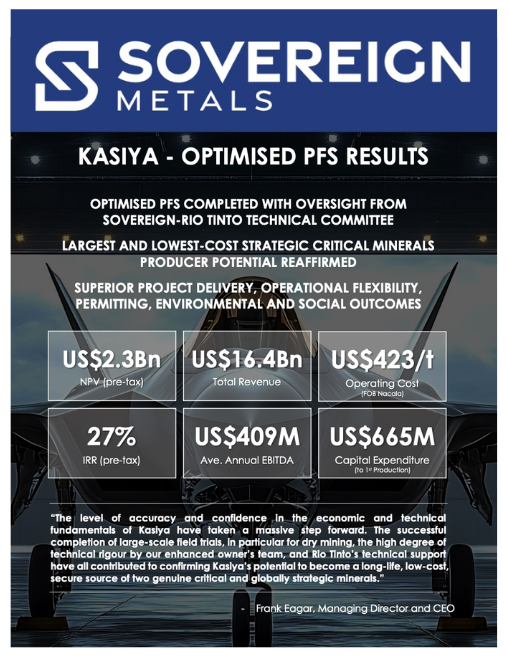
Sovereign Metals Limited (ASX:SVM; AIM:SVML; OTCQX: SVMLF) (Sovereign or the Company) is
pleased to announce the results of an Optimised Pre-feasibility Study (OPFS) for its Kasiya RutileGraphite Project (Kasiya or the Project) undertaken following a strategic investment by Rio Tinto Mining and Exploration Limited (Rio Tinto) in 2023, which established a joint Technical Committee to advance the development of Kasiya.
Following input from various organisations, including world-class consultancies, the Company’s owner’s team, and subject matter experts from Rio Tinto, the OPFS has reconfirmed Kasiya as a leading global future supplier of strategic critical minerals outside of China.
The OPFS proposes a large-scale, long-life operation to deliver substantial volumes of natural rutile and graphite while generating significant returns.
Table 1 summarises the key findings from the OPFS and includes a comparison to the PreFeasibility Study (PFS) results released 16 months ago, in September 2023. It is important to note that the results for the 2023 PFS in Table 1 have not been updated or adjusted for inflation since their release in September 2023.
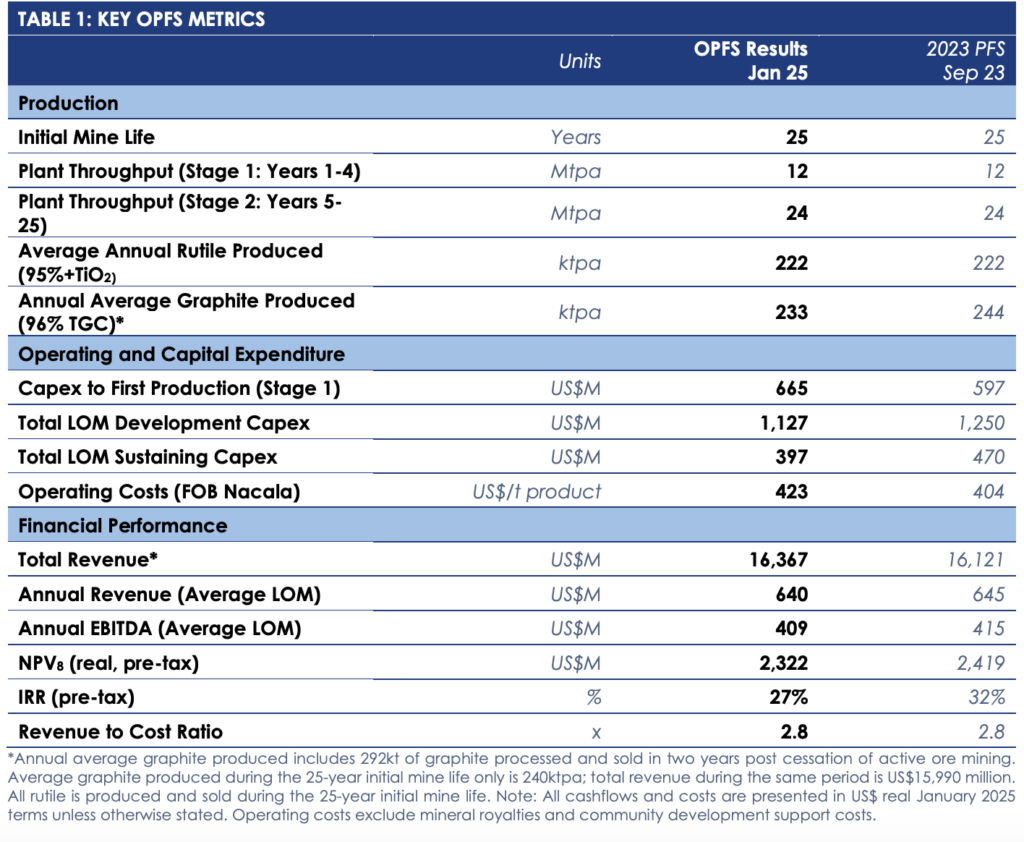
SUMMARY OF OPTIMISATIONS
The OPFS optimises seven key areas compared to the 2023 PFS as summarised below.
Mining Method
The PFS proposed a 25-year initial LOM based on a hydraulic mining process where slurry material would be screened and pumped overland to processing plants.
Based on findings from the mining trials undertaken as part of the Pilot Mining and Land Rehabilitation (Pilot Phase), the OPFS proposes a large-scale open-pit dry mining operation using draglines and trucking of material to the processing plants. The change in mining method has not changed the initial mine life of 25 years.
Operating Model
The 2023 PFS envisaged mining would take place on a contractor basis.
During the OPFS, Sovereign undertook a trade-off analysis between the following operating options:
• Fully owner-operated mine with draglines and trucks purchased by the owner
• Owner-operated mine with draglines and trucks leased by the owner
• Mining contractor operation using excavators and trucks
Due to the preference for draglines and maintaining flexibility, an owner-operated mine with leased equipment is selected as the preferred operating model.
Plant Configuration
Dry mining Kasiya means the material received at the plant is not pre-wet and pre scrubbed. Therefore, the OPFS proposes a process plant front end consisting of two scrubbers and two oversize screens per 12Mt plant. No further changes are proposed to the processing plant flowsheet.
Plant Location
Per the 2023 PFS, mining would commence in the southern area of the Kasiya deposit, ramping up to 12Mt per annum and then scaling up to 24Mt per annum in Year 5 by constructing a second plant module in the same area, reaching nameplate capacity by the end of the year.
In Year 10 of production, another new 12Mt per annum plant module would be built and commissioned in the northern area of Kasiya, supported by the relocation to the north of one of the southern plants to maintain a steady state of 24Mt per annum.
However, the OPFS has determined the most efficient plant locations to be an initial 12Mtpa South Kasiya plant followed by the construction of another 12Mtpa North Kasiya plant in year 5 of production, negating any relocation requirements in later years.
The OPFS maintains the ROM schedule with operations commencing with 12Mt per annum of throughput during the first four years of production (Stage 1) and expanding to 24Mt per annum in year 5, with full capacity reached by end of year 5 (Stage 2).
Tailings Management
Per the PFS, a conventional process would be used to produce rutile and graphite concentrate with tailings in separate sand and fines streams being pumped to a conventional TSF. Mined out pit areas would be backfilled as part of a rehabilitation process.
The OPFS proposes maximising backfilling of pits as undertaken during the Pilot Phase and the introduction of mud farming on the TSF to accelerate dewatering. This approach has reduced tailings volumes in the TSF by 44% from 187 Mm³ to 105 Mm³.
Mud farming is a technique used by Rio Tinto at operations such as its 100%-owned Weipa bauxite operations in Queensland, Australia, which has been in production since 1963 and produced 35.1Mt of bauxite in 2023.
Water Management
The PFS proposed that the primary water supply for the Kasiya mining complex would be created by building a dam and collecting run-off water from the greater catchment area. Following the introduction of dry mining and mud farming, the size of the water dam proposed in the PFS has been significantly reduced, with less process water required and more process water recovered.
The OPFS mining trials and material deposition tests indicated a water demand of 10.2 Mm³ per annum, almost a 40% decrease in water requirement from the PFS (16.7 Mm³). The effect on the raw water dam wall could be a reduction in volume from 0.79 Mm³ to 0.57 Mm³ and a reduction in dam wall height from 20 metres to 17 metres.
Power
The 2023 PFS envisaged a hybrid hydro-generated grid power plus solar power system solution.
The Malawi grid reliability has improved since completion of the PFS and is expected to further improve considerably with the commissioning of the country’s first HV transmission interconnector to Mozambique in Q2 2025.
This will provide the Project with sufficient power and therefore the OPFS proposes to connect the Project’s power system to the hydro-sourced grid network only. This mitigates any risks associated with commissioning a new solar power project and reducing the overall power tariff by eliminating the need for an Independent Power Producer as per the 2023 PFS.

OPTIMISATION MAINTAINS KASIYA’S GLOBAL LEADER POTENTIAL
Kasiya, located in central Malawi, is the world’s largest known natural rutile deposit and second largest flake graphite deposit.
Natural Rutile is the purest, highest-grade form of naturally occurring titanium feedstock.
Natural Graphite is required for various technological and industrial applications.
Both titanium and graphite have been designated “Critical Minerals” by the USA and the EU.
In December 2024, NATO designated both titanium and graphite as defence-critical, strategic minerals essential for the Allied defence industry.
Over the 25-year LOM, Kasiya is set to produce an average of 222kt of natural rutile and 233kt of natural flake graphite per annum. At steady state throughput of 24 million tonnes of ore per annum the Project is anticipated to produce approximately 246kt of natural rutile and 265kt of natural graphite per annum, positioning Sovereign as potentially the world’s largest producer of natural rutile and natural flake graphite.
Further, the depletion of rutile reserves at Lenoil Company Limited’s Area 1 Mine1 in the coming 2-3 years and the recent cessation of mining activities at Energy Fuels Inc.’s Kwale Operations2 in Kenya means that Sovereign could potentially become the world’s only primary natural rutile producer of scale (see Appendix 2).
The incremental cost of producing a tonne of graphite from Kasiya under the OPFS is US$241/t3. Based on public disclosures by listed graphite companies that have undertaken project studies up to a pre-feasibility stage or later, an incremental graphite cost of production of US$241/t would make Sovereign the world’s lowest-cost graphite producer outside of China (see Appendix 3).
The rutile-graphite-rich mineralisation will be extracted from surface and trucked to the process plant front end to scrub and screen ROM before it enters a Wet Concentration Plant (WCP) where a low-energy requirement, chemical-free process using gravity spirals produces a Heavy Mineral Concentrate (HMC). The HMC is transferred to the dry Mineral Separation Plant (MSP) where premium quality rutile (+95% TiO2) is produced via electrostatic and magnetic separation.
The high quality Kasiya rutile product will be amenable for use in high-end titanium products including aerospace and defence applications.
Graphite rich concentrate is collected from the gravity spirals and processed in a separate graphite flotation plant, producing a high purity, high crystallinity and high value coarse-flake graphite product.
1 In 2024, the previous owner of the Area 1 Mine, Sierra Rutile Limited, was acquired by Lenoil Company Limited, a private company based in Sierra Leone. 2 In 2024, the previous owner of the Kwale Operations, Base Resources Limited was acquired by Energy Fuels Inc., a US-based uranium and critical minerals company.
3 Incremental cost of graphite production is calculated with the following costs attributed to rutile production: all mining costs, all G&A, all material handling costs except for graphitic fines reclamation and graphite concentrate transport, and approximately half of total processing costs. Incremental cost of graphite production therefore includes only those costs incurred on top of primary rutile production to produce an incremental tonne from the process plant and transport the graphite to market. Unit cost of rutile production under this scenario would be US$628/t (FOB Nacala)).
Kasiya’s graphite has been confirmed to produce outstanding anode materials suitable for battery production as well as demonstrating suitability for traditional industrial uses such as the production of refractory materials.
The Project has excellent surrounding infrastructure including sealed roads, a high quality rail line connecting to the deep-water port of Nacala on the Indian Ocean and hydro-sourced grid power.
For the duration of the operation, Kasiya’s highly sought-after rutile and graphite products will be railed directly from a purpose-built rail dry port at the mine site eastward via the Nacala Logistics Corridor (NLC) to the port of Nacala. The southern port of Beira, connecting Kasiya via the recently refurbished Sena Rail Line, offers a secondary export route.
Enquiries
Frank Eagar, Managing Director & CEO
South Africa / Malawi
+27 21 065 1890
Sapan Ghai, CCO
London
+44 207 478 3900
Link here to view full OPFS and Appendices
#GRX GreenX Metals Ltd – High Grade Antimony Identified at Eleonore North
 GreenX Metals Limited (GreenX or the Company) is pleased to announce that high grade antimony mineralisation has been identified at the Company’s Eleonore North project (Eleonore North or ELN) in Greenland, based on historical results recently released by the Geological Survey of Denmark and Greenland (GEUS). The historical results indicate the potential for a high-grade antimony-gold mineral system at ELN. Antimony prices have been on a rapid uptrend since China announced antimony export controls from 15 September 2024, with antimony prices in the US having rocketed to US$37,500/t from US$18,300/t1 in the past week.
HIGH GRADE ANTIMONY IDENTIFIED AT ELEONORE NORTH PROJECT
|
· |
GreenX receives outstanding antimony results at Eleonore North project in Greenland. |
|
· |
Antimony price now US$37,500/t from historical prices of ~US$5,000 to 10,000/t. |
|
· |
Critical mineral crisis escalating – China has now restricted export of critical and strategic antimony, graphite, gallium, germanium, tungsten, titanium and rare earths. |
· Historical results from GEUS 2008 fieldwork at ELN have been made available and include grab samples from outcropping mineralised veins with individual specimens grading up to 23% antimony (Sb), and other samples up to 4g/t gold (Au).
· Previously reported historical data confirmed the presence of gold and high-grade antimony in outcropping veins at ELN including:
o 14m long chip sample grading 7.2% Sb and 0.53g/t Au2
o 40 m chip line with a length weighed average of 0.78g/t Au2
· Antimony mineralisation has been identified along a ~4km trend in veins and structures, that broadly aligns with previously identified gold veining at surface within a 15km trend.

Figure 1: Newly released GEUS assay results show evidence for high-grade antimony and gold mineralisation above the interpreted Noa Pluton.
· Significantly, GEUS geologist’s identified stibnite (Sb2S3) as the antimony mineral. Stibnite is well-understood and the predominant ore mineral for commercial antimony production.
· Antimony is designated a Critical Raw Material by both the EU and the US, with China being the world’s major antimony ore producer and major exporter of refined antimony oxides and metallic antimony.
· Global strategic interest in antimony has significantly increased in 2024 due to several factors:
o China controls ~50% of global antimony mining, most downstream processing and 32% of global resources according to the Lowy Institute.
o China’s recent export ban on antimony, effective from 15 September 2024, has caused market disruption3.
o Antimony is a crucial material in the defence supply chain, used in various military applications including ammunition, flame retardants, and smart weaponry.
o Antimony is essential in renewable energy technologies including more-energy-efficient solar panel glass and in preventing thermal runaway in batteries.
· The antimony market is expected to grow by 65% between 2024 and 20324. However, the supply side, declining antimony grades and depleting resources for existing mines are becoming increasingly relevant.
o In terms of new deposits, antimony is harder to find than most metals because stibnite has no geophysical electrical or magnetic response
· To aid the Company’s exploration targeting and fieldwork planning for ELN, GreenX’s technical team intend to locate, analyse, and study further historical samples and data within GEUS’s archives in the coming weeks.
GreenX Metals’ Chief Executive Officer, Mr Ben Stoikovich, commented: “Antimony is of critical importance in multiple defence applications and for the energy transition. Antimony features on both the EU and US critical raw materials lists due to China’s dominance of global antimony supply. Whilst we had previously focussed on the ELN project primarily for gold mineralisation, the newly published historical results with out-cropping vein samples grading up to 23% antimony, indicate the potential for ELN to host viable antimony mineralisation. We plan to now re-focus our exploration program at ELN on both gold and antimony targets.“
The Announcement Contains Inside Information

Figure 2: Noa Pluton prospect area within the Eleonore North Licence.
ANTIMONY RESULTS FROM NEWLY PUBLISHED GEOLOGICAL SURVEY ARCHIVE MATERIAL
GEUS’s archives host an extensive collection of rock samples (with and without assays), maps, as well as government and company reports going back many decades. A sub-set of the archive material is available in digital format. GEUS is continuously digitising and publishing its archive material. The newly released data covers 2008 field work at the Noa Dal valley within the Company’s ELN project. Government geologists collected mineralised samples from outcropping veins and scree near to the interpreted Noa Pluton. Selected highlights are presented in Table 1 below.
|
Table 1: Selected antimony and gold results from 2008 GEUS fieldwork |
|||
|
Sample # |
Sb (%) |
Au (g/t) |
Field description |
|
469506 |
23.40 |
0.00 |
Quartz vein with stibnite. Sample from boulder or scree |
|
496901 |
22.20 |
0.44 |
Massive stibnite from mineralised zone |
|
496918 |
15.10 |
0.54 |
Quartz vein + galena + chalcopyrite |
|
469504 |
6.65 |
0.83 |
Shale with stibnite |
|
496912 |
0.10 |
4.10 |
Clay alteration: hanging wall |
|
496904 |
0.11 |
4.70 |
Clay alteration: footwall |
|
496910 |
0.04 |
2.20 |
Intense clay alteration |
These newly released results conform with previously released historical results from the Noa Dal area (previously reported in ASX announcement dated 10 July 2023).
GEOLOGICAL SIGNIFICANCE OF ANTIMONY
GreenX is targeting Reduced Intrusion-related Gold Systems (RIRGS) at ELN. The hypothesised blind-to-the-surface Noa Pluton forms the basis for the RIRGS exploration model. Antimony-gold veins at surface were considered to be supporting evidence for RIRGS at ELN. With the favourable shift in the antimony market, the outcropping veins have become a potentially viable and attractive target.
The antimony-gold mineralisation at ELN could be analogous to Perpetua Resources’ Stibnite Gold Project in Idaho, USA. There, RIRGS and orogenic gold mineralisation styles overprint each other. Prior to the RIRGS model at ELN, the gold-bearing veins at Noa Dal were thought to be of orogenic origin. It is relatively common in gold deposits which are proximal to intrusions to feature characteristics of RIRGS and orogenic gold mineralisation styles.
The scale and potential of the antimony-gold veins will be evaluated with a follow-up investigation in the next phase of fieldwork.
GEUS is in the process of releasing results from regional mapping and sampling surveys from field seasons in 2022 and 2023 across East Greenland. GreenX plans to use the soon-to-be-released data as part of ongoing evaluation of the antimony and gold potential at ELN and the region.
Given recent developments in the antimony market, GreenX’s exploration strategy at the ELN project in East Greenland will continue with a renewed focus on the known Sb-Au mineral systems at the Noa pluton.
ENQUIRIES
Ben Stoikovich Sapan Ghai
Chief Executive Officer Business Development
+44 207 478 3900 +44 207 478 3900
-ENDS-
COMPETENT PERSONS STATEMENT
Information in this announcement that relates to Exploration Results is based on information compiled by Mr Joel Burkin, a Competent Person who is a member of the Australian Institute of Geoscientists. Mr Burkin is a consultant engaged by GreenX. Mr Burkin has sufficient experience that is relevant to the style of mineralisation and type of deposit under consideration and to the activity being undertaken, to qualify as a Competent Person as defined in the 2012 Edition of the ‘Australasian Code for Reporting of Exploration Results, Mineral Resources and Ore Reserves’. Mr Burkin consents to the inclusion in this announcement of the matters based on his information in the form and context in which it appears.
FORWARD LOOKING STATEMENTS
This release may include forward-looking statements, which may be identified by words such as “expects”, “anticipates”, “believes”, “projects”, “plans”, and similar expressions. These forward-looking statements are based on GreenX’s expectations and beliefs concerning future events. Forward looking statements are necessarily subject to risks, uncertainties and other factors, many of which are outside the control of GreenX, which could cause actual results to differ materially from such statements. There can be no assurance that forward-looking statements will prove to be correct. GreenX makes no undertaking to subsequently update or revise the forward-looking statements made in this release, to reflect the circumstances or events after the date of that release.
The information contained within this announcement is deemed by the Company to constitute inside information as stipulated under the Market Abuse Regulations (EU) No. 596/2014 as it forms part of UK domestic law by virtue of the European Union (Withdrawal) Act 2018 (‘MAR’). Upon the publication of this announcement via Regulatory Information Service (‘RIS’), this inside information is now considered to be in the public domain.
Sources:
1 Source: SP Angel 22/11/24 & Asianmetals.com
2 Previously reported – refer to ASX announcement dated 10 July 2023
3 https://chemical.chemlinked.com/news/chemical-news/china-restricts-export-of-antimony-and-related-products
4 https://www.fortunebusinessinsights.com/antimony-market-104295
Appendix 1: Exploration results and JORC Tables
Table 1: Historical GEUS rock samples from 2008
|
Sample ID |
Easting |
Northing |
Sb (ppm) |
Au (g/t) |
Field Description |
|
469501 |
-25.0093 |
73.29184 |
85,100 |
0 |
Silicified quartzite with stibnite |
|
469502 |
-25.0078 |
73.29173 |
39,600 |
0.55 |
Silicified quartzite with stibnite |
|
469503 |
-25.0054 |
73.29182 |
96,500 |
0 |
Silicified quartzite with stibnite |
|
469504 |
-24.9471 |
73.2908 |
66,500 |
0.83 |
Shale with stibnite |
|
469505 |
-25.0675 |
73.30148 |
129,000 |
0 |
Quartzite with stibnite |
|
469506 |
-25.0675 |
73.30148 |
234,000 |
0 |
Vein quartz with stibnite, Sample from boulder or scree |
|
469507 |
-25.0669 |
73.30519 |
987 |
Vein quartz with galena and chalcopyrite |
|
|
469508 |
-24.925 |
73.29301 |
577 |
Silicified limestone breccia |
|
|
496901 |
-25.0063 |
73.29178 |
222,000 |
0.44 |
Massive stibnite from mineralised zone |
|
496902 |
-25.0063 |
73.29178 |
50,900 |
0 |
Quartzite breccia + stibnite |
|
496903 |
-25.0015 |
73.28947 |
274 |
Footwall quartzite |
|
|
496904 |
-25.0064 |
73.29182 |
1,130 |
4.7 |
Clay alteration: footwall |
|
496905 |
-25.0063 |
73.29178 |
451 |
1.1 |
Clay alteration: footwall |
|
496906 |
-25.0063 |
73.29178 |
184 |
0.07 |
Quartzite breccia |
|
496907 |
-25.0062 |
73.29173 |
62 |
0 |
Quartzite breccia + stibnite |
|
496908 |
-25.0061 |
73.29168 |
78 |
2 |
Stibnite-rich breccia + heavy alteration |
|
496909 |
-25.0062 |
73.29166 |
143 |
2.4 |
Clay alteration: hanging wall |
|
496910 |
-25.0064 |
73.29171 |
383 |
2.2 |
Intense clay alteration: hanging wall |
|
496911 |
-25.0065 |
73.29166 |
58 |
0.18 |
Quartzite hanging wall |
|
496912 |
-25.0075 |
73.29166 |
1,080 |
4.1 |
Clay alteration: hanging wall |
|
496913 |
-24.9465 |
73.29073 |
1,180 |
4 |
Quartzite breccia + alteration |
|
496914 |
-24.9471 |
73.29088 |
267 |
0.28 |
Quartzite breccia + quartz-veining |
|
496915 |
-24.947 |
73.29084 |
65,100 |
0.66 |
Quartzite breccia + stibnite |
|
496916 |
-24.9474 |
73.29085 |
63,700 |
0.65 |
Wall rock quartzite |
|
496917 |
-25.0657 |
73.30175 |
10,000 |
Stibnite-rich breccia in quartzite. Sample from boulder or scree |
|
|
496918 |
-25.0658 |
73.30178 |
151,000 |
0.54 |
Quartz-vein + galena + chalcopyrite |
Note: Coordinates are in WGS 84 decimal degree format.
10,000ppm = 1%
JORC Code, 2012 Edition – Table 1 Report
Section 1 Sampling Techniques and Data
(Criteria in this section apply to all succeeding sections.)
|
Criteria |
JORC Code explanation |
Commentary |
|
Sampling techniques |
Nature and quality of sampling (eg cut channels, random chips, or specific specialised industry standard measurement tools appropriate to the minerals under investigation, such as down hole gamma sondes, or handheld XRF instruments, etc). These examples should not be taken as limiting the broad meaning of sampling. |
GEUS collected grab samples of in situ and loose rocks. |
|
|
Include reference to measures taken to ensure sample representivity and the appropriate calibration of any measurement tools or systems used. |
No QAQC was reported. |
|
|
Aspects of the determination of mineralisation that are Material to the Public Report. In cases where ‘industry standard’ work has been done this would be relatively simple (eg ‘reverse circulation drilling was used to obtain 1 m samples from which 3 kg was pulverised to produce a 30 g charge for fire assay’). In other cases more explanation may be required, such as where there is coarse gold that has inherent sampling problems. Unusual commodities or mineralisation types (eg submarine nodules) may warrant disclosure of detailed information. |
Work was not conducted to modern industry standards. |
|
Drilling techniques |
Drill type (eg core, reverse circulation, open-hole hammer, rotary air blast, auger, Bangka, sonic, etc) and details (eg core diameter, triple or standard tube, depth of diamond tails, face-sampling bit or other type, whether core is oriented and if so, by what method, etc). |
N/A |
|
Drill sample recovery |
Method of recording and assessing core and chip sample recoveries and results assessed.
|
N/A |
|
|
Measures taken to maximise sample recovery and ensure representative nature of the samples. |
N/A |
|
|
Whether a relationship exists between sample recovery and grade and whether sample bias may have occurred due to preferential loss/gain of fine/coarse material. |
N/A |
|
Logging |
Whether core and chip samples have been geologically and geotechnically logged to a level of detail to support appropriate Mineral Resource estimation, mining studies and metallurgical studies. |
Rock grab samples were described in the field and are not used in any estimates or studies. |
|
|
Whether logging is qualitative or quantitative in nature. Core (or costean, channel, etc) photography. |
The logging of rock grab samples was qualitative/descriptive in nature. If photos of the samples exist, they have not been released by GEUS. |
|
|
The total length and percentage of the relevant intersections logged. |
N/A |
|
Sub-sampling techniques and sample preparation |
If core, whether cut or sawn and whether quarter, half or all core taken. |
N/A |
|
If non-core, whether riffled, tube sampled, rotary split, etc and whether sampled wet or dry. |
N/A |
|
|
For all sample types, the nature, quality and appropriateness of the sample preparation technique. |
N/A |
|
|
|
Quality control procedures adopted for all sub-sampling stages to maximise representivity of samples. |
N/A
|
|
|
Measures taken to ensure that the sampling is representative of the in situ material collected, including for instance results for field duplicate/second-half sampling. |
N/A |
|
|
Whether sample sizes are appropriate to the grain size of the material being sampled. |
N/A |
|
Quality of assay data and laboratory tests |
The nature, quality and appropriateness of the assaying and laboratory procedures used and whether the technique is considered partial or total. |
All samples are historical in nature and do not comply with modern QAQC protocols. |
|
|
For geophysical tools, spectrometers, handheld XRF instruments, etc, the parameters used in determining the analysis including instrument make and model, reading times, calibrations factors applied and their derivation, etc. |
N/A |
|
|
Nature of quality control procedures adopted (eg standards, blanks, duplicates, external laboratory checks) and whether acceptable levels of accuracy (ie lack of bias) and precision have been established. |
N/A |
|
Verification of sampling and assaying |
The verification of significant intersections by either independent or alternative company personnel.
|
No verification carried out. |
|
|
The use of twinned holes. |
N/A |
|
|
Documentation of primary data, data entry procedures, data verification, data storage (physical and electronic) protocols. |
N/A |
|
|
Discuss any adjustment to assay data. |
N/A |
|
Location of data points |
Accuracy and quality of surveys used to locate drill holes (collar and down-hole surveys), trenches, mine workings and other locations used in Mineral Resource estimation. |
Location of samples was collected with a handheld GPS unit. No Mineral Resource estimate is given. |
|
|
Specification of the grid system used. |
Location data is provided in the World Geodetic System 1984 (WGS 84) in decimal degrees. |
|
|
Quality and adequacy of topographic control. |
N/A |
|
Data spacing and distribution |
Data spacing for reporting of Exploration Results. |
The samples GEUS collected in 2008 are select rock grab samples. They did not attempt to collect data at regular spacings. |
|
|
Whether the data spacing and distribution is sufficient to establish the degree of geological and grade continuity appropriate for the Mineral Resource and Ore Reserve estimation procedure(s) and classifications applied. |
N/A |
|
|
Whether sample compositing has been applied. |
N/A |
|
Orientation of data in relation to geological structure |
Whether the orientation of sampling achieves unbiased sampling of possible structures and the extent to which this is known, considering the deposit type. |
The grab samples are point data and were likely collected biased to visible mineralisation. They were collected within and adjacent to mineralised veins and fault structures. |
|
|
If the relationship between the drilling orientation and the orientation of key mineralised structures is considered to have introduced a sampling bias, this should be assessed and reported if material. |
No sampling bias. |
|
Sample security |
The measures taken to ensure sample security. |
The practices of GEUS in 2008 are unknown to GreenX, but are not considered material for the present potential of Eleonore North. |
|
Audits or reviews |
The results of any audits or reviews of sampling techniques and data. |
GreenX is unaware if any audits or reviews were performed but has no concerns about their absence. |
Section 2 Reporting of Exploration Results
(Criteria in the preceding section also apply to this section.)
|
Criteria |
JORC Code explanation |
Commentary |
|
|
Mineral tenement and land tenure status |
Type, reference name/number, location and ownership including agreements or material issues with third parties such as joint ventures, partnerships, overriding royalties, native title interests, historical sites, wilderness or national park and environmental settings. |
The Eleonore North Project is a result of a scientific and systematic reduction of Greenfield Exploration’s (GEX) ‘Frontier’ Project. Eleonore North comprises two Exploration Licences (MEL2023-39 and MEL 2018-19). The combined spatial area of licences is 1,220.81 km2. The boundaries of Eleonore North Project are defined by the points:
MEL2023-39 (two polygons: 1,189.77 km2) 73.98333 °N 25.30000 °W 73.98333 °N 25.13333 °W 73.95000 °N 25.13333 °W 73.95000 °N 25.01667 °W 73.91667 °N 25.01667 °W 73.91667 °N 24.86667 °W 73.88333 °N 24.86667 °W 73.88333 °N 24.51667 °W 73.86667 °N 24.51667 °W 73.86667 °N 24.48333 °W 73.85000 °N 24.48333 °W 73.85000 °N 24.43333 °W 73.70000 °N 24.43333 °W 73.70000 °N 24.48333 °W 73.68333 °N 24.48333 °W 73.68333 °N 25.01667 °W 73.70000 °N 25.01667 °W 73.70000 °N 25.05000 °W 73.71667 °N 25.05000 °W 73.71667 °N 25.08333 °W 73.73333 °N 25.08333 °W 73.73333 °N 25.21667 °W 73.75000 °N 25.21667 °W 73.75000 °N 25.26667 °W 73.76667 °N 25.26667 °W 73.76667 °N 25.33333 °W 73.78333 °N 25.33333 °W 73.78333 °N 25.38333 °W 73.80000 °N 25.38333 °W 73.80000 °N 25.48333 °W 73.91667 °N 25.48333 °W 73.91667 °N 25.25000 °W 73.95000 °N 25.25000 °W 73.95000 °N 25.30000 °W
73.41667 °N 25.31667 °W 73.41667 °N 25.03333 °W 73.43333 °N 25.03333 °W 73.43333 °N 24.60000 °W 73.23333 °N 24.60000 °W 73.23333 °N 25.60000 °W 73.26667 °N 25.60000 °W 73.26667 °N 25.53333 °W 73.30000 °N 25.53333 °W 73.30000 °N 25.45000 °W 73.31667 °N 25.45000 °W 73.31667 °N 25.31667 °W
MEL 2018-19 (two polygons: 31.04 km2) 73.16667 °N 25.11667 °W 73.16667 °N 25.01667 °W 73.15000 °N 25.01667 °W 73.15000 °N 25.05000 °W 73.13333 °N 25.05000 °W 73.13333 °N 25.15000 °W 73.15000 °N 25.15000 °W 73.15000 °N 25.11667 °W
73.23333 °N 25.05000 °W 73.23333 °N 24.76667 °W 73.21667 °N 24.76667 °W 73.21667 °N 25.01667 °W 73.20000 °N 25.01667 °W 73.20000 °N 25.05000 °W The licences are currently in credit due to previous expenditure. Expenditure above the minimum regulatory requirement is carried forward for a maximum of three years. Eleonore North is in good standing and GreenX owns 100% of the licences following conclusion of a revised option agreement as announced on 15 July 2024..
GreenX will issue a 1.5% NSR for Eleonore North. |
|
|
|
The security of the tenure held at the time of reporting along with any known impediments to obtaining a licence to operate in the area. |
The licences are in good standing. |
|
|
Exploration done by other parties |
Acknowledgment and appraisal of exploration by other parties. |
1953 – lead, copper and zinc bearing veins were discovered in Noa Valley as part of a regional mapping program by Nordisk Mineselskab A/G (‘Nordisk’).
1974 – 1976: Nordisk mapped the Holmesø copper-antimony prospect in Brogetdal, Strindbergland. Geophysical surveying was performed. The outcropping mineralisation was blasted a 100kg bulk sample was retrieved, of which 35kg was sent for analysis. Finally, an attempt was made to drill the mineralisation, and only the top 1.4m of a targeted 17m mineralised horizon was sampled before the rig broke down. Nordisk concluded that the Holmesø mineralisation is epigenetic.
1981 – 1983: Nordisk discovered the two small, high-grade tungsten and antimony-tungsten deposits on Ymer Island. These are respectively known as South Margeries Dal and North Margeries Dal. These deposits were drilled Historical Estimates were made. Economic studies were performed but concluded that more mineralised material was needed. The drilled mineralisation is open at depth and along strike. The historical work on the tungsten and antimony is not material to the understanding of the project’s gold potential.
1984 – 1986: As part of Nordisk’s search for more tungsten mineralisation, a large gold bearing vein was discovered in the southern cliff face of Noa Valley. The mineralisation in the scree was sampled. Geochemical sampling was also performed which identified a 10 to 15 km long multielement anomaly dominated by arsenic and antimony, which have a positive correlation with gold. Nordisk had a strategic shift towards petroleum exploration after this point in time.
1992: With the demise of Nordisk in 1991, the Greenland state owned enterprise, NunaOil A/S in collaboration with Australia’s Pasminco Ltd did additional sampling of the Noa gold veins. The program was successful in finding additional veins in the valley floor and extending the known mineralisation. However, the corporate mandate was for ‘high grade gold’ which it was unsuccessful in locating. This result is unsurprising given that the veins are above the hornfels and correspondingly yield high-grade antimony and low-gold content. GEX expects the gold content to increase, and antimony to decrease at depth towards the causative pluton.
2008 – 2009: GEUS visited Ymer Island and took various rock grab samples in the Noa Dal area. Assay results from these samples were recently made publicly available on the Greenland Portal.
2009: NunaMinerals A/S, a public-private spinout from NunaOil A/S, conducted a heliborne magnetic survey over Margeries Valley and Noa Valley. The purpose of this survey was to directly detect tungsten, and antimony deposits. Neither of the known deposits were detectable using this method, however a distinct circular magnetic feature was identified in Noa Valley. This magnetic feature was interpreted to be a granitic/intermediate intrusion. During this time, samples from the South Margeries Dal deposit were sent for metallurgical analysis, which determined that the material was potentially suited to direct-shipping-ore, and amendable to basic beneficiation methods.
2011: Avannaa Resources Ltd (‘Avannaa’) conducted a basin-wide helicopter supported reconnaissance program. This included visits to the Holmesø mineralisation. Avannaa concluded that the Holmesø mineralisation was epigenetic and likely related to the mineralisation observed on Ymer Island.
2018-2019: Independence Group Ltd (subsequently rebranded as IGO Ltd (‘IGO’) through a joint-venture agreement with GEX, conducted three field programs that were focussed on the sedimentary-hosted copper deposit model. During this time, IGO managed all geological aspects of the program while GEX managed the logistics in 2018 and 2019. IGO visited Noa Valley in 2018 and 2019 but focussed on the north slope away from Noa Pluton, and on areas typified by magnetic highs rather than the lows which define Noa Pluton’s circular magnetic signature. Despite this, quartzite mineralisation reminiscent of Holmesø was identified but no mineralogy is recorded in the documentation. While in the field with IGO in 2019, GEX alerted IGO to the presence of antimony and gold in the south side of the valley, but no commensurate sampling was performed. During the IGO earn-in period, GEX located the historical drillhole collars at North and South Margeries Dal tungsten/antimony deposits.
The Holmesø prospect was visited by IGO in 2018, 2019 and 2022. IGO’s Holmesø sampling did not replicate Nordisk’s high-grade blast/bulk sample, or the drill results. Regional sampling identified diagenetic copper, as well as remobilised epigentic copper that expresses as course blebs of chalcocite within porous, bed-cutting, vuggy conduits.
2022: IGO conducted a structural and geochemical sampling program in Strindbergland (no activity on Ymer Island). This program correctly concluded that the ‘sediment-hosted copper deposit model’ is not a suitable analogy. IGO returned to GEX the licences that were in good standing, with the indebted licences being relinquished by IGO. The remaining licences became the ‘Eleonore North’ project, which is a subset of the original ‘Frontier’ project area.
2023: In May, GEX installed an array of passive seismic nodes on Ymer Island within the licence area. Passive seismic nodes record ambient noise in the crust and accumulate data over many weeks. In September 2023, GEX collected the nodes from Ymer Island. The nodes were returned to the Institute of Mine Seismology (IMS) for data download and processing. IMS produced a 3D velocity model. |
|
|
Geology |
Deposit type, geological setting and style of mineralisation. |
Eleonore North licences, for the most part, cover Neoproterozoic-aged sediments belonging to the Eleonore Bay Supergroup. These sediments trend from clastics up to carbonates. The lithology of the sediments is not a primary consideration in the targeting of reduced intrusion related gold systems. These sediments are intruded by granites and intermediate intrusives that are somewhat shallowly sourced due the Caledonian Orogenic event. However, geochronology of the South Margeries Dal tungsten indicates that post-orogenic fluid flow occurred. Post-orogenic granitic intrusions are consistent with RIRGS mineralisation, as the decompression allows for the fluidisation of gold in the mantle while providing conduits to surface. Elsewhere, such post-orogenic emplacement is associated with deeply sourced lamprophyres, like those mapped in Noa Valley and Brogetdal. GEX identified for the first time, that ~373 Ma post-orogenic mineralisation event is related to the 385 Ma Kiffaanngissuseq hydrothermal event some 1,000 km to the north. In the north at Kiffaanngissuseq the post-orogenic event was characterised by an east-west fluid flow. In the south in the Frontier region that hosts Elenore North, the post orogenic event was dominated by magmatic intrusions and little hydrothermal activity. Separating the two areas is the poorly understood, high-metamorphic grade Eclogite Province where peak metamorphism is of similar age to the Frontier and Kiffaanngissuseq processes. |
|
|
Drill hole Information |
A summary of all information material to the understanding of the exploration results including a tabulation of the following information for all Material drill holes: easting and northing of the drill hole collar elevation or RL (Reduced Level – elevation above sea level in metres) of the drill hole collar dip and azimuth of the hole down hole length and interception depth hole length. |
No drilling is reported with these results. |
|
|
|
If the exclusion of this information is justified on the basis that the information is not Material and this exclusion does not detract from the understanding of the report, the Competent Person should clearly explain why this is the case. |
No information was excluded from the announcement. |
|
|
Data aggregation methods |
In reporting Exploration Results, weighting averaging techniques, maximum and/or minimum grade truncations (eg cutting of high grades) and cut-off grades are usually Material and should be stated. |
No data aggregation has been undertaken. |
|
|
|
Where aggregate intercepts incorporate short lengths of high grade results and longer lengths of low grade results, the procedure used for such aggregation should be stated and some typical examples of such aggregations should be shown in detail. |
No data aggregation has been undertaken. |
|
|
|
The assumptions used for any reporting of metal equivalent values should be clearly stated. |
No metal equivalent results have been reported. |
|
|
Relationship between mineralisation widths and intercept lengths |
These relationships are particularly important in the reporting of Exploration Results. If the geometry of the mineralisation with respect to the drill hole angle is known, its nature should be reported. |
No drilling is reported with these results. The reported results are grab samples from within or adjacent to mineralised veins and structures. They do not characterise the geometry of the mineralisation. |
|
|
|
If it is not known and only the down hole lengths are reported, there should be a clear statement to this effect (eg ‘down hole length, true width not known’). |
N/A |
|
|
Diagrams |
Appropriate maps and sections (with scales) and tabulations of intercepts should be included for any significant discovery being reported These should include, but not be limited to a plan view of drill hole collar locations and appropriate sectional views. |
Appropriate maps and tables are included in the main body of this announcement. |
|
|
Balanced reporting |
Where comprehensive reporting of all Exploration Results is not practicable, representative reporting of both low and high grades and/or widths should be practiced to avoid misleading reporting of Exploration Results. |
All results are reported in Appendix 1: Table 1. |
|
|
Other substantive exploration data |
Other exploration data, if meaningful and material, should be reported including (but not limited to): geological observations; geophysical survey results; geochemical survey results; bulk samples – size and method of treatment; metallurgical test results; bulk density, groundwater, geotechnical and rock characteristics; potential deleterious or contaminating substances. |
All substantive data are reported. |
|
|
Further work |
The nature and scale of planned further work (eg tests for lateral extensions or depth extensions or large-scale step-out drilling). |
In Noa Valley, the target pluton(s) is constrained by seismic, magnetic and geochemical data. The depth to the pluton is thought to be around 150m below surface based on the seismic results. Field confirmation of potential host structures is warranted ahead of a subsequent drilling program. Future fieldwork will be planned and/or undertaken in conjunction with expert consultant(s).
At the South and North Margeries Dal prospects, a higher resolution digital terrain model should be obtained prior to generating Exploration Targets based on the historical drilling.
Bulk sampling at the prospects will also be considered. |
|
|
|
Diagrams clearly highlighting the areas of possible extensions, including the main geological interpretations and future drilling areas, provided this information is not commercially sensitive. |
These diagrams are included in the main body of this release. |
|
#SVML Sovereign Metals LTD – Trading on OTCQX Market
 · Sovereign upgrades to the OTCQX Market, the top tier of the OTC Markets, providing access to a broader eligible U.S. investor base
· OTCQX quotation follows increased U.S. investor and strategic interest in Sovereign and its Kasiya Rutile-Graphite Project in Malawi
· Kasiya has the potential to be the world’s largest, lowest-cost producer of rutile, which is the purest form of titanium feedstock, and a long-term secure source of graphite supply outside of China
· U.S. Department of Energy has designated both titanium and graphite as critical minerals due to national security concerns. China currently dominates global supply of both minerals
·
Sovereign Metals Limited (ASX: SVM; AIM: SVML; OTCQX: SVMLF) (Sovereign or the Company) is pleased to announce that its shares have commenced trading on the OTCQX® Best Market (OTCQX) under the ticker symbol SVMLF.
The OTCQX is the highest market tier of OTC Markets on which over 12,000 U.S. and global securities trade. Sovereign previously traded on the OTC Pink Market and has been upgraded to the OTCQX as it meets high financial standards, follows best-practice corporate governance and has demonstrated compliance with applicable securities laws. Trading on OTCQX began on 5 July 2024 and will enhance the visibility and accessibility of Sovereign to U.S. investors.
Sovereign is focused on becoming a market leader in supplying two critical minerals to global markets: titanium, in the form of rutile, and graphite. China currently dominates the supply of both critical minerals.
Rutile is the purest, highest-grade natural form of titanium dioxide (TiO2) and is the preferred feedstock in manufacturing titanium pigment and producing titanium metal. Titanium is essential for various industries, including aerospace, defence, pigments, medical and consumer technologies. According to the U.S. Geological Survey, China and Russia control ~70% of the global primary titanium supply chain. Currently, the U.S. relies entirely on foreign sources for titanium sponge, yet based on the U.S. Commerce Department’s Bureau of Industry and Security, titanium supports 15 out of 16 critical infrastructure sectors deemed essential by the federal government.
Graphite is vital for the energy transition as the largest component of lithium-ion batteries used in electric vehicles and other energy storage solutions. Graphite anode material can be up to 50% of the mass of a typical lithium-ion battery. According to S&P Global, in 2023, 77% of the world’s graphite production came from China, with the U.S. importing 42% of its graphite supply from China. In December 2023, China imposed several restrictions on the export of Graphite concentrate. In May 2024, the US government imposed a 25% tariff on all natural graphite imported from China from 2026 onwards.
Sovereign’s 100% owned Tier-One Kasiya Rutile-Graphite Project (Kasiya), located in the southeast African country of Malawi, is both the world’s largest known rutile deposit and second-largest flake graphite deposit. Kasiya can become a long-term secure source of natural graphite supply outside of China.
Through numerous technical studies, Sovereign has already confirmed that the Kasiya project could be the world’s largest and lowest-cost producer of rutile and graphite and is currently undertaking an optimisation study. Sovereign’s strategic investor and one of the world’s largest and most accomplished global mining companies, Rio Tinto continues to provide assistance and advice on technical and marketing aspects of Kasiya. With sustainability a core pillar of Sovereign’s strategy, Kasiya would also have the lowest greenhouse gas emissions of any high-grade titanium feedstock or graphite producer.
NOTICE OF CHANGE OF INTERESTS OF SUBSTANTIAL HOLDER
Sovereign Metals Limited (ASX: SVM, AIM: SVML) (Sovereign or the Company) advises that it was notified today via the filing of a Form 604 with the Australian Securities Exchange (ASX) that Rio Tinto Mining and Exploration Limited (Rio Tinto) provided a notice of change of interests of substantial holder (as defined by the Corporations Act 2001) of the Company as of 4 July 2024, having increased its shareholding in the Company from 83,095,592 ordinary shares, representing 15% of the Company’s issued share capital as at the date of its previous notice, to 118,085,108 ordinary shares, representing 19.76% of the Company’s issued share capital, following the issue of 439,918 shares as approved by Sovereign shareholders on 23 August 2023 and the issue of 34,549,598 shares pursuant to the exercise of options on 4 July 2024.
The Form 604 can be viewed in full via the below link:
https://www.investi.com.au/api/announcements/svm/511e90f4-659.pdf
ENQUIRIES
|
Dylan Browne +61(8) 9322 6322 |
|
Nominated Adviser on AIM and Joint Broker |
|
|
SP Angel Corporate Finance LLP |
+44 20 3470 0470 |
|
Ewan Leggat Charlie Bouverat |
|
|
|
|
|
Joint Brokers |
|
|
Stifel |
+44 20 7710 7600 |
|
Varun Talwar |
|
|
Ashton Clanfield |
|
|
|
|
|
Berenberg |
+44 20 3207 7800 |
|
Matthew Armitt |
|
|
Jennifer Lee |
|
|
|
|
|
Buchanan |
+ 44 20 7466 5000 |
|
Frank Eagar (South Africa/Malawi) +27 21 065 1890 |
Sam Cordin (Perth) +61(8) 9322 6322 |
Sapan Ghai (London) +44 207 478 3900
|
|
Nominated Adviser on AIM and Joint Broker |
|
|
SP Angel Corporate Finance LLP |
+44 20 3470 0470 |
|
Ewan Leggat Charlie Bouverat |
|
|
|
|
|
Joint Brokers |
|
|
Stifel |
+44 20 7710 7600 |
|
Varun Talwar |
|
|
Ashton Clanfield |
|
|
|
|
|
Berenberg |
+44 20 3207 7800 |
|
Matthew Armitt |
|
|
Jennifer Lee |
|
|
|
|
|
Buchanan |
+ 44 20 7466 5000 |
Forward Looking Statement
This release may include forward-looking statements, which may be identified by words such as “expects”, “anticipates”, “believes”, “projects”, “plans”, and similar expressions. These forward-looking statements are based on Sovereign’s expectations and beliefs concerning future events. Forward looking statements are necessarily subject to risks, uncertainties and other factors, many of which are outside the control of Sovereign, which could cause actual results to differ materially from such statements. There can be no assurance that forward-looking statements will prove to be correct. Sovereign makes no undertaking to subsequently update or revise the forward-looking statements made in this release, to reflect the circumstances or events after the date of that release.
#SVML Sovereign Metals – Issue of Equity on Exercise of Unlisted Options

Sovereign Metals Limited (Sovereign or the Company) (ASX:SVM, AIM:SVML) advises that it has issued 150,000 fully paid ordinary shares (Shares) upon the exercise of 150,000 unlisted options exercisable at A$0.18 each on or before 30 June 2022.
An application will be made for the Shares to be admitted to trading on AIM (Admission) and it is expected that Admission will become effective on or around 13 July 2022.
Total Voting Rights
For the purposes of the Financial Conduct Authority’s Disclosure Guidance and Transparency Rules (DTRs), following Admission of the Shares, Sovereign will have 470,875,023 Ordinary Shares in issue with voting rights attached. The figure of 470,875,023 may be used by shareholders in the Company as the denominator for the calculations by which they will determine if they are required to notify their interest in, or a change to their interest in the Company, under the ASX Listing Rules or the DTRs.
Following the issue of Shares, Sovereign has the following securities on issue:
· 470,875,023 ordinary fully paid ordinary shares;
· 11,105,125 unlisted options exercisable at A$0.80 each on or before 13 May 2023;
· 5,120,000 performance rights subject to the “Feasibility Study Milestone” expiring on or before 31 December 2023; and
· 7,320,000 performance rights subject to the “Decision to Mine Milestone” expiring on or before 31 October 2025.
ENQUIRIES
|
Dr Julian Stephens (Perth) +61(8) 9322 6322 |
Sam Cordin (Perth) |
Sapan Ghai (London)
|
|
Nominated Adviser on AIM |
|
|
RFC Ambrian |
|
|
Bhavesh Patel / Andrew Thomson |
+44 20 3440 6800 |
|
|
|
|
Joint Brokers |
|
|
Berenberg |
+44 20 3207 7800 |
|
Matthew Armitt |
|
|
Jennifer Lee |
|
|
|
|
|
Optiva Securities |
+44 20 3137 1902 |
|
Daniel Ingram |
|
|
Mariela Jaho |
|
|
Christian Dennis |
|
#SVML Sovereign Metals – Offtake & Marketing Alliance with Japanese Trader
RUTILE OFFTAKE AND MARKETING ALLIANCE WITH MAJOR JAPANESE TRADING HOUSE
|
· |
MoU signed with global trading and investment firm for rutile offtake, marketing and product development for the Kasiya Rutile Project |
|
· |
MoU covers offtake and marketing rights for 30,000 tonnes per annum of natural rutile from Kasiya |
|
· |
Marketing alliance will focus on Asia, a key and established growth market for high-grade titanium feedstocks |
|
· |
Key Asian customers have confirmed premium chemical parameters of Kasiya’s natural rutile as part of product quality assessments |
|
· |
Asian titanium metal producers have confirmed the suitability of the Kasiya rutile product |
Sovereign Metals Limited (ASX:SVM; AIM:SVML) (the Company or Sovereign) is pleased to announce that it has entered into a non-binding Memorandum of Understanding (MoU) with Mitsui & Co Ltd (Mitsui), one of the largest global trading and investment companies in Japan. The MoU establishes a marketing alliance and offtake for 30,000 tonnes of natural rutile per annum from the Company’s world-class Kasiya Rutile Project (Kasiya) in Malawi.
This MoU creates a marketing alliance between the two parties to jointly market Sovereign’s rutile across Asia and other markets. The alliance will allow Sovereign to leverage off Mitsui’s extensive network and their market-leading understanding of the titanium industry and global logistics.
Mitsui has shared samples of rutile product from Kasiya with Asian end-users that have confirmed its premium chemical specifications should be suitable for use in their titanium sponge and pigment processes, as a precursor for high-grade, high-specification titanium metal and pigment production.
Sovereign’s Managing Director, Dr Julian Stephens commented: “The Asia region is a key natural rutile market with all major end-use sectors well established and further strong growth forecast. We expect expanding technology developments and increasing environmental awareness to drive greater demand for natural rutile. This marketing alliance with a very high-calibre partner in Mitsui will assist Sovereign to penetrate these ever-growing markets.
The MoU is non-exclusive and non-binding with no pricing terms which remains subject to negotiation and execution of a definitive agreement. The MoU will expire on 31 December 2023 but can be extended by agreement by both parties should a definitive agreement not have been reached by that time.
ENQUIRIES
|
Dr Julian Stephens (Perth) +61(8) 9322 6322 |
Sam Cordin (Perth) |
Sapan Ghai (London)
|
|
Nominated Adviser on AIM |
|
|
RFC Ambrian |
|
|
Bhavesh Patel / Andrew Thomson |
+44 20 3440 6800 |
|
|
|
|
Joint Brokers |
|
|
Berenberg |
+44 20 3207 7800 |
|
Matthew Armitt |
|
|
Jennifer Lee |
|
|
|
|
|
Optiva Securities |
+44 20 3137 1902 |
|
Daniel Ingram |
|
|
Mariela Jaho |
|
|
Christian Dennis |
Airbus seeks titanium sources beyond Russia to safeguard production ramp-up – Sovereign Metals #SVML

 Airbus SE is searching for alternative sources of titanium to ensure a lack of access to the lightweight metal doesn’t interfere with the planemaker’s plan to increase production.
The planned ramp-up to a rate of 65 A320-family narrow-bodies per month by mid-2023 is the number one priority for the group, European sales chief Wouter Van Wersch said in an interview. Airbus relies on Russia for about half its supply, creating the potential for disruption if shipments are interrupted.
“We are looking into it very closely to see how we can ensure it doesn’t impact our supply chain and our ramp-up,” Van Wersch said on the sidelines of the Airlines for Europe meeting in Brussels. “For now, there’s no issue.”
Link here to full Mining.com story (Sovereign Metals #SVML)
This Is Money – SMALL CAP SHARE IDEAS: Sovereign Metals owns potentially the largest rutile deposit in the world

In fact, it could have the largest rutile deposit anywhere in the world, if the results of ongoing exploration work go its way.
For anyone not familiar, rutile is a significant source of titanium, a metal widely used in aerospace, clean-tech and medical applications, but which is mainly an essential component in paint pigments.
You can get titanium from ilmenite too, and in some cases rutile and ilmenite are found together.
But the kicker is that it’s much more carbon and energy intensive to extract titanium from ilmenite than it is to extract it from rutile.
In other words, rutile is a big tick in the green energy box..
Link here to read the full This Is Money article