
Home » Posts tagged 'south africa'
Tag Archives: south africa
#URU URU Metals Ltd – Zeb Nickel Project 3D Modelling
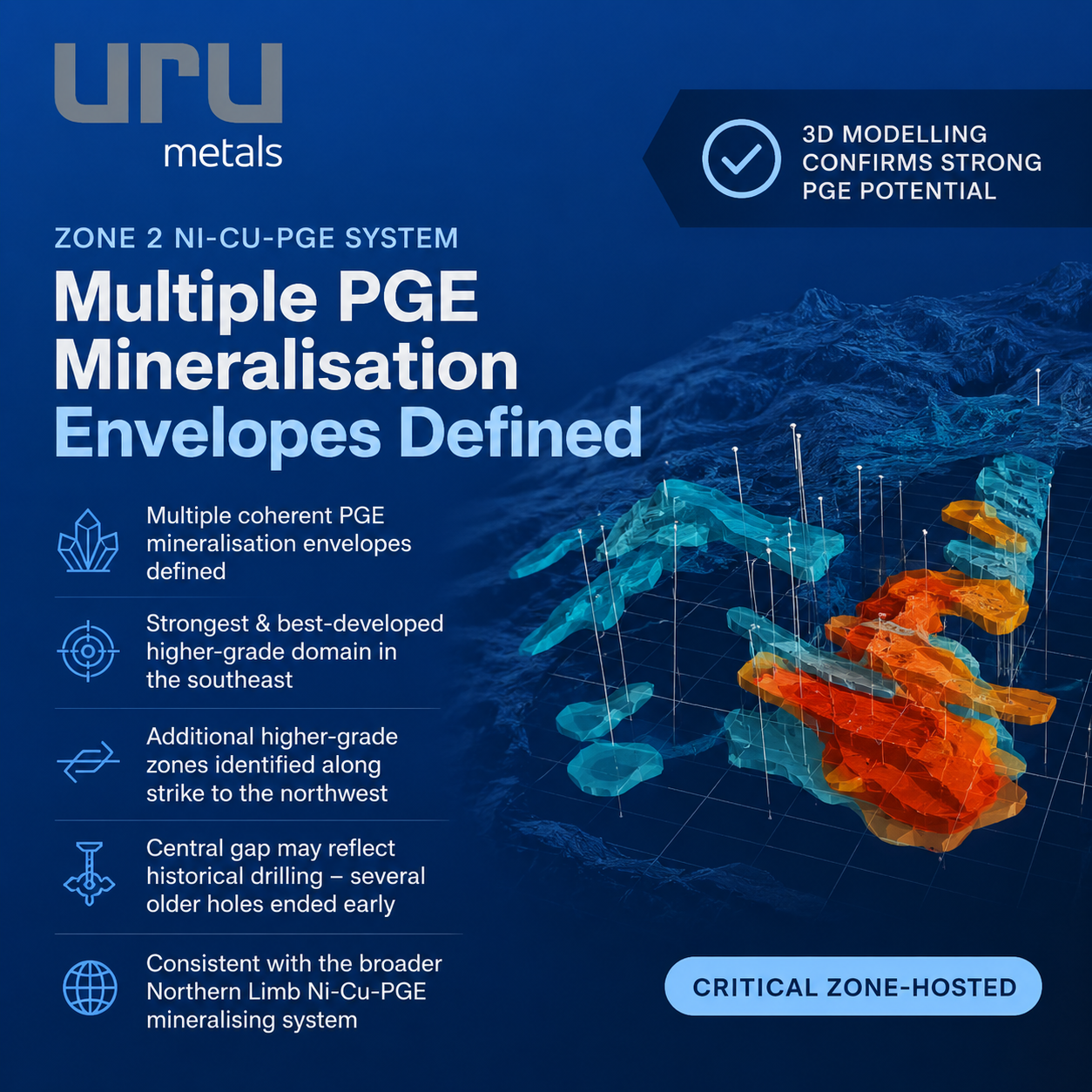 URU Metals Limited (“URU” or the “Company”) is pleased to provide a further update on the ongoing 3D geological modelling programme at the Zeb Nickel Project in Limpopo, South Africa.
Atticus Geoscience has now completed the first stage of 3D mineralisation modelling of the Project’s Zone 2 Ni-Cu-PGE system using historical and recent drill hole data.
The modelling has defined multiple coherent PGE mineralisation envelopes within the Critical Zone rocks and has highlighted a well-developed higher-grade mineralised domain in the southeast of the Project, together with further mineralised zones extending along strike towards the northwest.
Highlights
· 3D modelling has defined multiple coherent PGE mineralisation envelopes within the Critical Zone-hosted Zone 2 Ni-Cu-PGE system.
· The mineralisation is hosted predominantly within the Critical Zone pyroxenitic package.
· The strongest and best-developed higher-grade mineralised domain occurs in the southeast of the Project area, where drilling density is also greatest.
· Additional higher-grade mineralised zones have been identified along strike towards the northwest.
· The apparent break in mineralisation through parts of the central area may reflect the historical drilling pattern, as several older boreholes terminated before reaching the Critical Zone.
· The geological setting and style of Zone 2 mineralisation are consistent with the broader Northern Limb Ni-Cu-PGE mineralising system represented by Ivanhoe Mines’ Platreef Mine and Valterra Platinum’s Mogalakwena Mining Complex.
· The higher-grade mineralisation lies close to the interpreted chonolith and conduit system between the Uitloop I and Uitloop II ultramafic bodies.
· This relationship provides an important exploration vector, as repeated magma flow through the interpreted plumbing system may have created favourable conditions for sulphide saturation and concentration of Ni-Cu-PGE mineralisation.
· Future drilling will initially focus on the better-developed higher-grade areas in the southeast, with the aim of generating sufficient drilling to support a maiden mineral resource for Zone 2.
· Subsequent step-out drilling will test the central area and the possible continuity between the southeastern and northwestern mineralised domains.
· Ground FDEM Target 1 remains a separate high-priority drill target for semi-massive to massive sulphides within the interpreted chonolith system.
Zone 2 Mineralisation Model
Atticus has used the available Pt, Pd and Rh assay data to construct three-dimensional mineralisation envelopes through the Zone 2 Critical Zone.
For modelling purposes, a 3PGE grade of 0.08 g/t Pt+Pd+Rh was used to define the broader mineralised envelope, while 0.5 g/t 3PGE was used to identify the higher-grade mineralised population. These thresholds are modelling parameters and are not mineral resource cut-off grades.
The resulting model shows that Zone 2 mineralisation is concentrated predominantly within the Critical Zone pyroxenitic package and associated Marginal Facies.
The higher-grade mineralisation is best developed in the southeastern part of the Project, where the current drilling density is greatest. Additional higher-grade mineralised areas occur along strike towards the northwest.
Importantly, the apparent reduction in mineralisation through parts of the central area may not represent a genuine geological break. Several historical boreholes in this area terminated before reaching the interpreted Critical Zone, leaving a material portion of the prospective horizon effectively untested.
The southeastern area also contains the highest PGE grades currently represented in the model, with drilling having intersected grades of up to approximately 6 g/t 3PGE+Au.
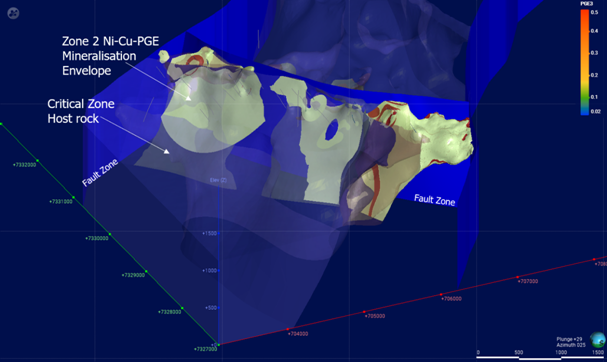
Figure 1: PGE mineralisation envelopes within the Critical Zone rocks.
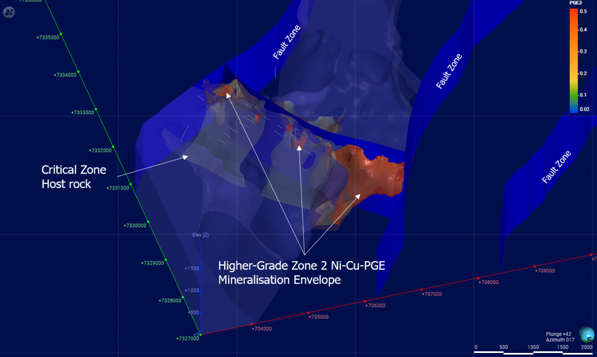
Figure 2: PGE mineralisation envelopes within the Critical Zone rocks, showing a well-developed higher-grade mineralised domain in the southeastern part of the Project area.
Northern Limb Context
The style of Zone 2 mineralisation being modelled at Zeb is consistent with the broader Ni-Cu-PGE mineralising environment of the Northern Limb of the Bushveld Complex.
Approximately the same regional geological package hosts Ivanhoe Mines’ Platreef deposit and Valterra Platinum’s Mogalakwena Mining Complex, both of which contain substantial PGM mineralisation with associated nickel and copper within thick, pyroxenite-rich intrusive sequences.
Ivanhoe describes the Platreef mineralised sequence as comprising norite, pyroxenite and harzburgite, with its principal mineralised units correlated with the Upper Critical Zone of the Bushveld Complex. At Mogalakwena, Valterra describes the Platreef as a thick, heterogeneous mafic package dominated by pyroxenite and norite, with significant nickel and copper associated with the PGM mineralisation.
URU has previously highlighted the similarity between these Northern Limb mineralisation styles and the Critical Zone-hosted Ni-Cu-PGE mineralisation intersected at Zeb. The new 3D modelling strengthens this interpretation by demonstrating coherent mineralised envelopes within the Critical Zone pyroxenitic package rather than isolated mineralised drill intersections.
Relationship to the Chonolith System
A further important outcome of the modelling is the spatial relationship between the higher-grade Zone 2 mineralisation and the interpreted chonolith and conduit system between the Uitloop I and Uitloop II ultramafic bodies.
The higher-grade mineralised envelopes occur relatively close to these interpreted intrusive conduits.
This is consistent with the Company’s broader geological model for Zeb. Repeated or sustained magma flow through a chonolith-style plumbing system may have promoted sulphide saturation and provided favourable conditions for the development and concentration of Ni-Cu-PGE mineralisation.
The relationship between the mineralised envelopes and the interpreted plumbing system gives the Company an additional geological vector for future drilling and will be considered together with the airborne and ground EM responses, gravity and magnetic data and the 3D intrusive model.
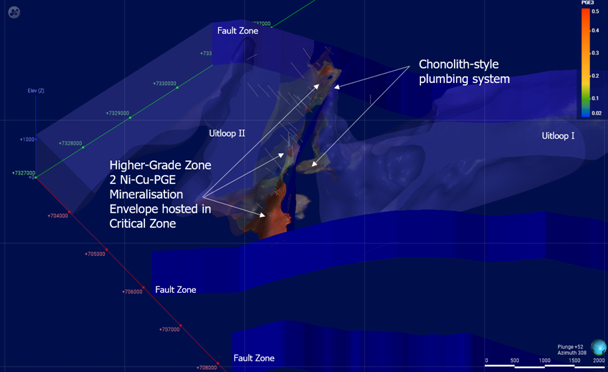
Figure 3: Spatial relationship between the higher-grade Zone 2 mineralisation and the interpreted chonolith and conduit system connecting the Uitloop I and Uitloop II ultramafic bodies.
Building Towards a Maiden Zone 2 Resource
The completed mineralisation model gives the Company a much clearer basis for planning the next phase of drilling.
Initial drilling will focus on the better-developed higher-grade southeastern mineralised domain, where the objective will be to increase drill density and test extensions to the known mineralisation.
The Company intends to use this work to build sufficient geological continuity and drilling density to support a maiden mineral resource estimate for Zone 2.
Further step-out drilling will then test the central area between the southeastern and northwestern mineralised zones. This work will determine whether the currently modelled domains are separate bodies or parts of a more continuous Critical Zone mineralised system that has simply not been adequately tested by the historical drilling.
Ground FDEM Target 1 remains a separate high-priority exploration target. The discrete conductor sits within the interpreted chonolith system at a favourable change in intrusive geometry and will be tested for a possible concentration of semi-massive to massive Ni-Cu-PGE sulphides.
The Company’s geological team will now use the completed mineralisation model, together with the airborne and ground EM, gravity and magnetic datasets, to finalise and rank the proposed drill holes within the available exploration budget.
Richard Montjoie, Exploration Manager of URU Metals, commented:
“Simon’s work has now given us a proper 3D view of where the Zone 2 mineralisation sits and, importantly, where the higher-grade parts of the system are developing.
The southeast is clearly the most advanced area and gives us a sensible place to start building towards a maiden Zone 2 resource. We are also seeing mineralisation continuing along strike to the northwest, while much of the ground in between has simply not been properly tested because a number of the historical holes stopped short.
The Critical Zone setting is also important. This is the same broad geological environment that hosts the Ni-Cu-PGE mineralisation at Ivanhoe’s Platreef and Valterra’s Mogalakwena operations nearby. We have talked about that relationship for some time, but the Leapfrog work is now allowing us to see the geometry of the Zeb mineralisation properly in three dimensions.
The fact that the higher-grade envelopes also sit close to the interpreted chonolith system fits well with our geological model and gives us another vector for drilling. We now have a much clearer strategy: build out the higher-grade Zone 2 mineralisation towards a maiden resource, test whether those mineralised areas connect through the central gap, and drill Target 1 for the more concentrated sulphide target.”
ENDS
For further information, please contact:
URU Metals Limited
John Zorbas
Chief Executive Officer
+1 416 504 3978
SP Angel Corporate Finance LLP
Nominated Adviser and Broker
Ewan Leggat / Caroline Rowe
+44 (0) 203 470 0470
Axis Capital Markets Limited
Joint Broker
Richard Hutchison
+44 (0) 203 026 0320
Market Abuse Regulation (MAR) Disclosure
This announcement contains inside information for the purposes of Article 7 of the Market Abuse Regulation (EU) No. 596/2014 as it forms part of United Kingdom domestic law by virtue of the European Union (Withdrawal) Act 2018 (“UK MAR”). Upon the publication of this announcement via a Regulatory Information Service, this inside information is now considered to be in the public domain.
#URU URU Metals Limited – Zeb Nickel Project Update
 URU Metals Limited (“URU” or the “Company”) is pleased to provide an update on the ongoing 3D geological and geophysical modelling programme at the Zeb Nickel Project in Limpopo, South Africa.
The work is being undertaken by Atticus Geoscience, who have extensive experience in the modelling of magmatic nickel-copper-PGE sulphide systems.
The programme brings together the Project’s drill hole database, geological interpretation, airborne magnetics, gravity and SpectremPlus™ electromagnetic (“EM”) data, together with the recently completed ground frequency-domain electromagnetic (“FDEM”) and gravity surveys, into a single 3D geological model.
Highlights
· Leapfrog modelling has shown a close spatial relationship between the Critical Zone rocks hosting known Ni-Cu-PGE mineralisation, semi-massive sulphide intersections and the strongest airborne and ground EM responses.
· The model brings the geology, drilling, gravity, magnetics and EM datasets together in three dimensions, allowing the Company to assess the mineralised system as a whole rather than as separate datasets.
· The strongest EM responses occur within the same broader geological corridor as known semi-massive sulphide intersections in drill holes Z03, Z017, Z024 and Z031.
· The SpectremPlus™ airborne EM anomaly was subsequently refined by the ground FDEM programme as Target 1, a discrete conductor associated with a coincident gravity anomaly.
· Target 1 is located at the interpreted point where the chonolith extending from the Uitloop II ultramafic body enters a larger intrusive body mapped by the gravity and magnetic datasets.
· This conduit-to-chamber transition is considered a favourable geological setting for changes in magma flow and the potential segregation and accumulation of magmatic sulphides.
· Atticus is now constructing a 3D mineralised envelope from the existing drilling and comparing it directly with the airborne EM responses, ground FDEM data and conductor plate models.
· The work is intended to provide a more efficient path for drilling extensions of the higher-grade Zone 2 Critical Zone mineralisation, with the longer-term objective of supporting a maiden mineral resource for Zone 2.
· In parallel, Ground FDEM Target 1 will be prioritised as a proof-of-concept drill target for semi-massive to massive Ni-Cu-PGE sulphides.
An overview of the Leapfrog model is shown in Figure 1a and 1b below, which illustrates the chonolith system connecting the Uitloop I body to the Uitloop II body, and the location of the Ni-Cu-PGE mineralisation in rocks interpreted to belong to the Critical Zone of the Bushveld Complex.
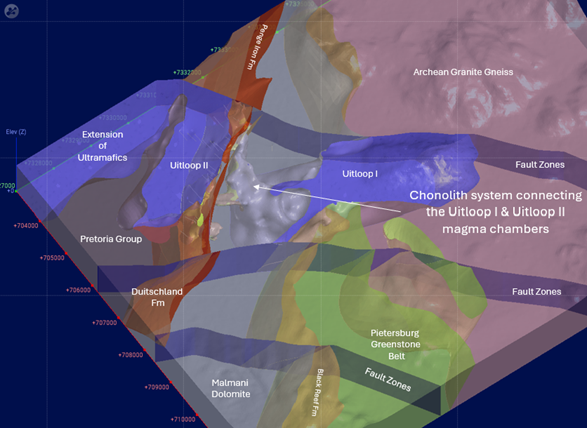
Figure 1a: 3D Overview of the Leapfrog model illustrating the chonolith system connecting the Uitloop I body to the Uitloop II body.
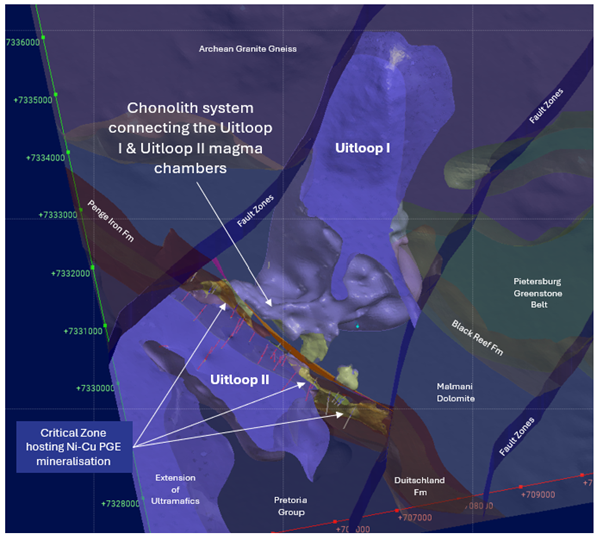
Figure 1b: Overview of the Leapfrog model illustrating the chonolith system connecting the Uitloop I body to the Uitloop II body, as well as the location of the interpreted Critical Zone rocks that host the Ni-Cu-PGE mineralisation
Zone 2 Higher-Grade Ni-Cu-PGE Mineralised Envelope
Atticus is now using the existing drill hole assay data to construct a three-dimensional mineralised envelope through the known Zone 2 Critical Zone mineralisation.
This envelope will be compared directly with the airborne and ground EM responses to determine how closely the geometry of the known mineralisation follows the conductive signature.
If that relationship can be traced beyond the existing drilling, it should allow future drill holes to be positioned more efficiently along the interpreted mineralised corridor.
The Company’s objective is to use this work to target extensions of the higher-grade Zone 2 mineralisation and progressively build sufficient geological and drilling information to support a maiden mineral resource estimate for Zone 2, subject to the results of future drilling and the requirements of applicable mineral resource reporting standards.
Massive Sulphide Target
The model also provides a clearer view of the interpreted chonolith system linking the Uitloop I and Uitloop II ultramafic bodies and the fault architecture controlling the intrusive system, which relates to a second key exploration objective targeting massive sulphides.
A particularly important feature of the geological model is the SpectremPlus™ airborne EM anomaly, which was subsequently refined by the ground-based geophysical programme as Target 1.
Target 1 comprises a discrete EM conductor coincident with a gravity anomaly and is located at the interpreted transition between the chonolith extending from the Uitloop II body and a substantially larger intrusive body interpreted from the magnetic and gravity datasets. The location of this conductor sits in a particularly compelling geological position.
In magmatic sulphide systems, changes in conduit geometry and magma flow can create favourable locations for sulphide segregation and accumulation. The widening of a narrower magma conduit into a larger intrusive body may result in changes in magma velocity and flow dynamics, providing a potential physical mechanism for the concentration of dense sulphide liquid.
The position of Target 1 is therefore considered highly prospective, particularly given its relationship to the broader Critical Zone mineralised corridor and nearby semi-massive sulphide intersections.
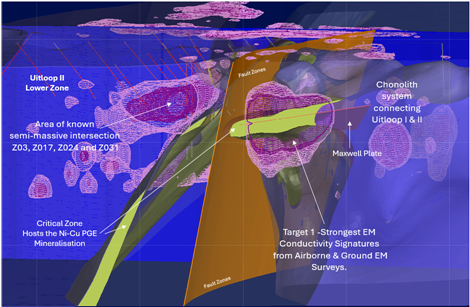
Figure 2: Leapfrog 3D geological and geophysical model showing the interpreted chonolith system between Uitloop I and Uitloop II, Critical Zone Ni-Cu-PGE mineralisation, known semi-massive sulphide intersections, and the coincident airborne and ground EM response at Target 1. The Maxwell plate is shown within the strongest conductivity response adjacent to the interpreted conduit system.
Next steps
Atticus is now using the existing drill hole assay data to construct a 3D mineralised envelope through the known Zone 2 mineralisation.
This work will be compared directly with:
· the modelled Critical Zone geology;
· the SpectremPlus™ airborne EM responses;
· the ground FDEM data and Maxwell plate models;
· gravity and magnetic interpretations; and
· the broader 3D intrusive architecture.
The Company’s geological team will then work with Atticus to finalise and rank proposed drill holes.
The next drill programme is expected to have two clear objectives:
· to target extensions of the higher-grade Zone 2 Critical Zone Ni-Cu-PGE mineralisation, with the aim of building towards a maiden Zone 2 mineral resource; and
· to test Ground FDEM Target 1 for a concentration of semi-massive to massive Ni-Cu-PGE sulphides at the interpreted conduit-to-chamber transition.
The final drill programme will be prioritised within the Company’s available exploration budget.
The Company expects to provide a further update once the integrated mineralised envelope and proposed drill programme have been completed.
Richard Montjoie, Exploration Manager of URU Metals, commented:
“Zeb is really starting to come together properly in 3D. We can now see the strongest EM responses sitting in the same geological corridor as the Critical Zone and the semi-massive sulphides we have already intersected.
What is particularly interesting is Target 1, where a discrete conductor sits at the point where the interpreted chonolith opens into the larger intrusive body. Geologically, that is exactly the sort of position we want to test for sulphide accumulation.
Atticus is now building the mineralised envelope from the drilling and comparing it directly with the airborne and ground EM. That should give us a much better way of targeting the next holes. We have two clear objectives: build the higher-grade Zone 2 mineralisation towards a maiden resource, and drill Target 1 to test whether the conductor represents a concentration of semi-massive to massive sulphides.”
For further information, please contact:
URU Metals Limited
John Zorbas
Chief Executive Officer
+1 416 504 3978
SP Angel Corporate Finance LLP
Nominated Adviser and Broker
Ewan Leggat / Caroline Rowe
+44 (0) 203 470 0470
Axis Capital Markets Limited
Joint Broker
Richard Hutchison
+44 (0) 203 026 0320
Market Abuse Regulation (MAR) Disclosure
This announcement contains inside information for the purposes of Article 7 of the Market Abuse Regulation (EU) No. 596/2014 as it forms part of United Kingdom domestic law by virtue of the European Union (Withdrawal) Act 2018 (“UK MAR”). Upon the publication of this announcement via a Regulatory Information Service, this inside information is now considered to be in the public domain.
#URU URU Metals Ltd – COMMENCEMENT OF GROUND-BASED GEOPHYSICAL PROGRAMME
URU Metals Limited (“URU” or the “Company”) is pleased to announce that line preparation activities commenced on 2 March along the survey lines required for the planned ground-based geophysical programme at the Zeb Nickel Project (“Project”). The line preparation is necessary to provide safe and continuous access for survey crews and equipment, and to ensure accurate data acquisition along the planned gravity and frequency-domain electromagnetic profiles.
The line preparation marks the start of the next phase of exploration, aimed at enhancing the resolution and refining the interpretation of the previously completed airborne geophysical surveys.
Ground-Based Geophysical Programme
The ground-based geophysical survey will be conducted over two priority survey areas (as outlined in the map below) and will include:
· High-resolution gravity surveys
· Frequency-domain electromagnetic surveys
These surveys are being undertaken to improve the resolution and accuracy of the airborne EM, magnetic, and gravity datasets previously completed across the Project.
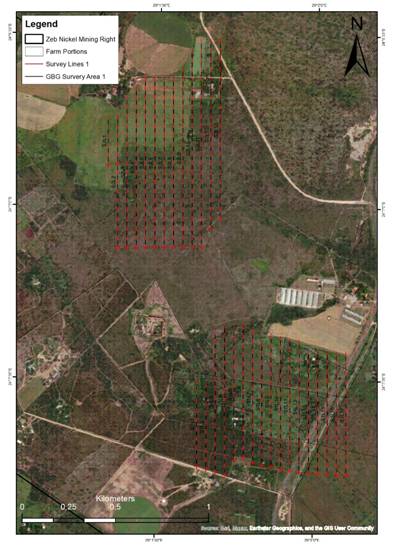
Figure 1: Maps showing the ground-based geophysical survey areas, with the first survey area in the bottom-right of the maps and the second survey area in the top-left. Line preparations along the survey lines commenced in the first survey area on 2 March.
Purpose and Benefits
While the airborne surveys successfully identified several coincident gravity-magnetic-electromagnetic anomalies and confirmed the presence of a magmatic conduit system, ground-based geophysics provides:
· Higher spatial resolution compared to airborne surveys
· Improved anomaly definition and depth constraints
· Enhanced discrimination between lithological contrasts and sulphide conductors
· Greater confidence in prioritising drill targets
In particular, the frequency-domain electromagnetic survey is designed to better delineate conductive bodies that may represent semi-massive to massive nickel sulphide mineralisation associated with the interpreted magmatic conduit system.
The higher-resolution gravity data will further assist in mapping dense ultramafic bodies and identifying potential sulphide accumulations within structural trap-sites.
Together, these surveys are expected to significantly refine drill targeting and reduce exploration risk ahead of the next drilling phase.
CEO John Zorbas commented:
“The commencement of ground-based geophysics represents an important technical step forward for the Zeb Nickel Project. While the airborne programme successfully identified several compelling targets, the higher-resolution ground surveys will allow us to sharpen our focus on the most prospective semi-massive nickel sulphide targets. This work is designed to maximise the effectiveness of our upcoming drilling campaign. We are very excited about the programme now underway and look forward to the coming weeks and months. We will provide shareholders with regular updates as line preparation progresses, the surveys advance, and results are interpreted.”
About the Company
URU Metals is a mineral exploration and development company focused on advancing high-potential critical metals projects in South Africa. The Company is committed to creating sustainable value through responsible mining practices, regulatory compliance, and active stakeholder engagement. For more information, visitwww.urumetals.com
For further information, please contact:
URU Metals Limited
John Zorbas
(Chief Executive Officer)
+1 416 504 3978
SP Angel Corporate Finance LLP
(Nominated Adviser and Broker)
Ewan Leggat / Caroline Rowe + 44 (0) 203 470 0470
#URU URU Metals LTD – Peer publications strengthen model at Zeb Nickel
 URU is pleased to announce that two peer-reviewed publications by Mapiloko et al. (2025), published in Geological Society of America’s journal of Geology (Contribution of the oldest Paleoproterozoic marine sulfate evaporite to Bushveld Complex Lower Zone mineralization) and the South African Journal of Geology (Chromite formation in the Lower Zone and Platreef sequences on Uitloop, northern limb of the Bushveld Complex), provide new independent scientific evidence relevant to the Company’s Zeb Nickel Project in Limpopo, South Africa.
The papers provide additional third-party support for the Company’s exploration model and offer new technical insight into the processes that promote sulphide saturation and nickel sulphide mineralisation in the district. The publications do not constitute, and should not be interpreted as, a change to the Company’s previously reported Mineral Resource Estimates or economic assumptions.
Highlights
· Independent scientific support for the Company’s sulphur-assimilation thesis: the papers present evidence consistent with Palaeoproterozoic sulphate contributing to the formation of immiscible magmatic sulphides in the Uitloop system, a process that can enhance magma “fertility” for Ni-Cu-PGE mineralisation.
· A clearer vector for exploration reinforcing our current exploration model: results reinforce the importance of structural pathways, conduit architecture and the magmatic transport history through (or proximal to) sulphate-bearing stratigraphy, helping to refine targeting beyond the historically drilled footprint.
· Direct integration into the 2026 exploration plan: these insights are being incorporated into ongoing interpretation of recent airborne datasets and current ground programmes, feeding into drill-ready target ranking and programme design.
The publications interpret sulphur isotope systematics and local stratigraphic relationships to support a model in which oxidised, crustal sulphur (sulphate) can be assimilated by mafic-ultramafic magmas, promoting sulphide saturation and allowing Ni-Cu-PGE to partition into sulphide liquids.
For the Company, the practical exploration implication is that the most prospective parts of the system are those that combine:
1. a long-lived magma plumbing system capable of focusing flow and upgrading metal content in sulphides,
2. effective sulphur addition (direct or indirect) from wallrocks during emplacement/transport, and
3. physical traps (embayments, constrictions, contacts, offsets) where sulphides can accumulate.
URU believes these findings are supportive of the Company’s current exploration concept at Zeb Nickel and provide an additional peer-reviewed basis to prioritise feeder-style targets and conductor/density coincidence zones for drilling.
Consistent with URU’s previously disclosed exploration strategy, the Company’s near-term work programme is focused on progressing from interpretation to drill execution:
1. Ground-based geophysics
Ground electromagnetic and gravity surveys are underway to refine airborne interpretations and improve drill vectoring. Results from this phase are being used to enhance and tighten the overall drill target set, including prioritising coincidence conductor and density zones and refining the planned drill collar locations, orientations and target depths.
2. Geological & resource modelling
Update the 3D model integrating geology with new geophysical datasets, and complete target ranking to define the priority drill pattern.
3. Drilling programme design
Finalise drillhole number, position, orientation and depth to test:
o Ni-Cu-PGE resource drilling priorities (Zone 2-style mineralisation); and
o high-grade Ni targets (Zone 3-style feeder/conduit mineralisation), particularly where conductors and density anomalies overlap.
Richard Montjoie, VP Exploration commented: “Peer-reviewed publications that independently support key elements of our geological model are valuable for any exploration company. We view these findings as strengthening the scientific basis for our sulphur-assimilation and conduit-focused targeting approach at Zeb Nickel, i.e. the plumbing system that I have frequently spoken of. Importantly, the work informs where sulphide saturation and accumulation are most likely to have occurred, and we are incorporating this into our ground geophysics, 3D modelling and drill planning as we move toward the next phase of drilling.”
|
URU Metals Limited John Zorbas (Chief Executive Officer)
|
+1 416 504 3978
|
|
SP Angel Corporate Finance LLP (Nominated Adviser and Broker) Ewan Leggat / Jen Clarke |
+ 44 (0) 203 470 0470 |
#URU URU Metals LTD – Zeb Nickel Project to commence SpectremPlus Survey
 Zeb Nickel Project to commission a SpectremPlus™ EM Survey to Build on 2025 High-Resolution Gravity-Magnetic Dataset
URU Metals Limited (“URU” or the “Company”) is pleased to announce that it has engaged Spectrem Air Proprietary Ltd. (“Spectrem”) to conduct an approximately 736 line-kilometre SpectremPlus™ airborne time domain electromagnetic (“AEM”) survey over the Company’s flagship Zeb Nickel Project, located in Limpopo Province, South Africa.
Background
In early 2025 URU completed a re-interpretation of high-resolution fixed-wing gravity and magnetic data. The new inversion models confirmed an ultramafic feeder between the Uitloop I and Uitloop II ultramafic bodies and delineated several NE-SW structural corridors interpreted as magma conduits. Coincident gravity-magnetic highs flanking these structures are considered potential sulphide trap sites. The AEM survey will induce a current in any conductive bodies in the ground and measures their response, thus locating any buried massive nickel sulphide ore bodies.
The SpectremPlus™ system delivers one of the highest transmitter moments in commercial AEM, enabling imaging of conductive bodies to depths of exceeding 700 m, however the depth of investigation is model-dependent and may vary according to local geology, conductivity and noise conditions. By discriminating between highly conductive massive or semi-massive sulphides and resistive host rocks, the survey will complement the existing gravity-magnetic model and sharpen drill-target definition.
A summary of the expected benefit of the SpectremPlus
|
Existing dataset |
New SpectremPlus™ EM |
Integrated benefit |
|
Gravity pinpoints dense ultramafic bodies and feeder conduits |
EM discriminates highly conductive massive‐ to semi-massive sulphides from resistive country rock |
Joint gravity-EM inversions isolate dense and conductive targets characteristic of Ni-Cu-PGE sulphides |
|
Magnetics highlights magnetite-rich critical-zone horizons and fault offsets |
EM traces the sulphide-rich horizons along strike and down-dip |
Structural-lithological framework tied directly to sulphide conductivity, sharpening 3-D drill targeting |
By integrating the EM conductivity voxels with the existing gravity and magnetic models, the technical team expects to generate a prioritised pipeline of drill-ready targets for potential semi-massive to massive nickel-sulphide mineralisation associated with Zones 2 and 3.
Richard Montjoie, VP Exploration, commented: “Previous gravity and magnetic surveys defined the geological architecture and identified dense ultramafic targets across the project area. The SpectremPlus™ system will now allow us to pinpoint which of these targets are conductive, an important indicator of potential sulphide mineralisation. By integrating these datasets, we’re significantly improving our ability to target high-priority drill locations, thereby increasing the likelihood of a semi-massive to massive Ni-Cu-PGE sulphide discovery.”
Survey specifications
The airborne survey will cover approximately 736 line-kilometres, flown using 150 m spaced traverse lines (azimuth 120°) and 1,500 m tie-lines (azimuth 30°). The programme will utilise Spectrem’s converted DC-3 turboprop aircraft, equipped with the proprietary SpectremPlus™ AEM system, which delivers an exceptional RMS dipole moment of 756 kA·m² enabling imaging of conductive bodies at depths exceeding 700 metres. Data acquisition is scheduled for July 2025, with flying expected to be completed within three days, weather permitting. Final processed data and interpretations are expected within 30 days of survey completion.

Figure 1: The specialised Spectrem aircraft that will carry out the SpectremPlus™ airborne electromagnetic (AEM) survey over the Zeb Nickel Project area.
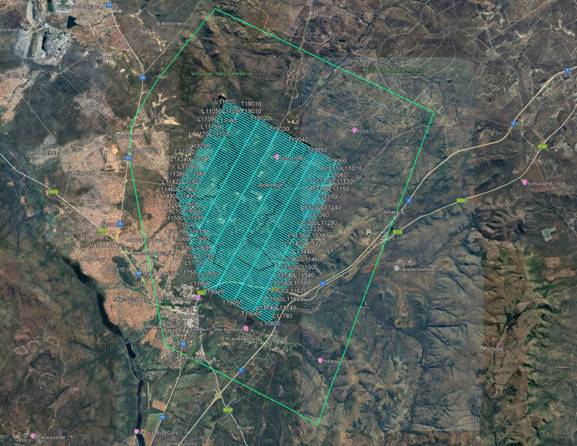
Figure 2: The map shows the Geophysical Airborne Survey Area. The green boundary represents the buffer zone for the survey, the cyan lines indicate the planned survey flight lines, and the black boundary beneath the survey lines outlines the Mining Right area of the Zeb Nickel Project.
Spectrem will provide a comprehensive dataset to support advanced targeting, including:
· Levelled X-, Y-, and Z-component EM data with conductivity depth images (“CDIs”)
· 1D inversion profiles and a 3D conductivity voxel model
· Late-time EM anomaly picks with prioritised target recommendations
· Total Magnetic Intensity (“TMI”) grid and a high-resolution digital elevation model (“DEM”)
These deliverables will be critical in refining drill targeting and de-risking future exploration campaigns.
Next Steps Toward Drilling
Once the EM data has been delivered, Zeb’s technical team will:
• Integrate geological, gravity, magnetic, and EM datasets into a unified 3D geophysical block model.
• Identify and rank high-priority target zones where conductivity, density, and magnetic susceptibility signatures align, which are hallmarks of potential massive sulphide accumulations.
• Design drill programs to optimally test these targets, including modelling drill hole orientation and depth.
Safety & Environmental Assurance
The SpectremPlus™ survey will be flown under the International Airborne Geophysics Safety Association (IAGSA) framework and audited to BARS aviation standards, with a job-specific risk assessment completed before mobilisation. Flights will maintain ~90 m ground clearance within conservative speed and bank-angle limits and are continuously satellite-tracked for real-time oversight. Spectrem’s field protocols minimise disturbance and the non-ionising EM field is proven harmless to wildlife and groundwater.
About the Company
URU Metals is a mineral exploration and development company focused on advancing its high-potential critical metals projects in South Africa. The Company is committed to creating sustainable value through responsible mining practices, regulatory compliance, and engagement with stakeholders. For more information, visit www.urumetals.com.
Market Abuse Regulation (MAR) Disclosure
This announcement contains inside information for the purposes of Article 7 of the Market Abuse Regulation (EU) 596/2014 as it forms part of UK domestic law by virtue of the European Union (Withdrawal) Act 2018 (“MAR”), and is disclosed in accordance with the Company’s obligations under Article 17 of MAR.
For further information, please contact:
URU Metals Limited
John Zorbas
(Chief Executive Officer)
+1 416 504 3978
SP Angel Corporate Finance LLP
(Nominated Adviser and Broker)
Ewan Leggat / Jen Clarke + 44 (0) 203 470 0470
#URU URU Metals Limited – Higher-Grade Nickel Sulphides Confirmed at Zeb
URU Metals Limited (“URU” or the “Company”) is pleased to report assay results and geological interpretations from a two-hole drilling programme at the Zeb Nickel Project in Limpopo, South Africa. Drilled vertically, the holes validate the Zeb geological model, and confirms the presence of thicker, higher-grade nickel-copper-PGE (“Ni-Cu-PGE”) horizons beneath the historic open-pit resource and demonstrates that mineralisation remains open both along strike and at depth.
Key Value Highlights
· Two drillholes plus two deflections completed intersected mineralised material in both Zone 1 and Zone 2.
· Zone 2 Ni-Cu-PGE mineralisation confirmed to be present in a previously untested area beneath Zone 1, confirming the geological model.
· Thicker, higher-grade intervals beneath the historical resource
o Zone 2: up to 2.27 m @ 0.27 % Ni, 0.17 % Cu, 2.27 g/t 3PGE+Au and 4.06 m @ 0.23 % Ni, 0.14 % Cu, 1.36 g/t 3PGE+Au
o Zone 3: up to 0.70 m @ 0.65 % Ni, 0.40 % Cu within a broader 2.73 m @ 0.39 % Ni
· Multiple semi-massive sulphide hits confirm the geological model and strengthen the analogy with world-class feeder conduit systems.
· Mineralisation remains open along strike and at depth, highlighting meaningful scale-up potential for both tonnage and grade.
The Zeb mineral system is divided into four stacked horizons: Zone 1 forms the near-surface, bulk-tonnage nickel-bearing unit of the Lower Uitloop body that underpins the historical Ni resource.
Zone 2, immediately beneath and adjacent to Zone 1, contains Ni-Cu-PGE mineralisation similar to that found at Ivanhoe Mines’s Platreef Mine and Valterra Platinum’s (formally known as Anglo American) Mogalakwena Mining Complex.
Zone 3 is a feeder-style ultramafic chonolith, the geometry of which was recently confirmed in an airborne gravity and magnetic survey.
Zone 4 broadly encompasses areas of gold mineralisation intersected in drillholes.
Two holes (Z031 and Z033) where drilled, both at a vertical angle, and were designed to test the true vertical depth of the mineralised sequences and test for down-dip continuity of Zone 2 beneath Zone 1. Two deflections, Z031D1 and Z031D2, were drilled off Z031. No deflections were drilled off Z033. Boreholes and deflections were drilled using a NQ core diameter size. The locations of these holes are shown in Figure 1 below.
Boreholes Z031 and Z033 successfully intersected Ni and Ni-Cu-PGE mineralisation in Zones 1 and 2 respectively, while Z031 and its deflections also intersected what is interpreted as Zone 3 mineralisation. The assay results confirm the presence of thick, higher-grade Ni-Cu-PGE mineralised intervals of varying grade beneath the historical resource envelope and confirm the continuity of mineralisation in line with previous intersections along strike.
Importantly, the data provides strong evidence that the Ni-Cu-PGE mineralisation in Zone 2 continues below Zone 1 and may fully extend beneath Zone 1, meaning that the area holds increased potential to host a significant Ni-Cu-PGE resource. This is shown in the cross sections in Figure 2 and Figure 3.
The boreholes also intersected Zone 3 semi-massive Ni-PGE sulphide mineralisation, further validating the presence of semi massive to massive sulphides associated with the chonolith and supporting the potential for a large, continuous magmatic system that hosts massive nickel sulphide, targets of which were identified in the recent airborne magnetic and gravity survey.
Highlights of results
Zone 2
· 2.27 m @ 0.27 % Ni, 0.17 % Cu, 2.27 g/t 3PGE+Au
*including 0.77 m @ 0.31 % Ni, 0.18 % Cu, 2.19 g/t 3PGE+Au (346.23 – 348.50 m; Z031D1).
· 4.06 m @ 0.23 % Ni, 0.14 % Cu, 1.36 g/t 3PGE+Au (342.44 – 346.50 m; Z031D0)
*including 1.56 m @ 0.30 % Ni, 0.18 % Cu, 1.72 g/t 3PGE+Au.
Zone 3
· 1.03 m @ 0.60 % Ni, 0.14 % Cu, 0.57 g/t 3PGE+Au (330.97 – 332.00 m; Z031D0).
· 0.70 m @ 0.65 % Ni, 0.40 % Cu, 0.36 g/t 3PGE+Au within 2.73 m @ 0.39 % Ni (338.53 – 341.26 m; Z031D0).
The mineralised zones remain open both along strike and at depth, and the geological model proposes that further down-dip drilling may intersect significantly higher-grade Ni-Cu-PGE mineralisation. This interpretation is supported by analogous mineralisation styles and grades observed at neighbouring world-class deposits, including Ivanhoe Mines’ Platreef Project and Valterra Platinum’s Mogalakwena Mining Complex.
Of particular significance is the consistent intersection of semi-massive sulphide mineralisation associated with Zone 3 in the central part of the Uitloop body, where a potential chonolith structure may link the Uitloop I and II bodies. This is an exciting development, as such a chonolith could host a larger, more continuous sulphide accumulation due to its structural setting and potential to channel enriched magmatic pulses during emplacement and develop a Ni-PGE rich massive sulphide, as discussed in RNS dated 21 May 2025 and 3 June 2025 (https://urumetals.com/index.php/2025/06/03/zeb-nickel-project-3-d-geophysical-modelling/) and (https://urumetals.com/index.php/2025/05/21/zeb-nickel-identifies-high-priority-drill-targets/).

Figure 1: Location of the boreholes overlain on the geological map of the project area. Assay results are from the two boreholes shown in bold (Z031D0 and Z033D0), while the other labelled boreholes are included in the cross-sections shown in Figure 2 below.
Table 1: Newly reported Assay Results from Z031 and Z032

*3PGE+Au equals platinum + palladium + rhodium + gold by fire assay with ICP-AES Finish;
^Total Ni assay by complete digestion, representing the silicate and sulfide portion of Ni;
Additional drilling is required to determine true thickness;
“Depth From”, “Depth To” and “Sample Thickness” reported are depths from surface down the drill hole.

Figure 2: Cross-section along lines A – C demonstrating the continuity of Ni-Cu-PGE mineralisation within Zone 2 beneath the Lower Uitloop body.

Figure 3: Cross-section along lines A – B demonstrating the continuity of Ni-Cu-PGE mineralisation within Zone 2 beneath the Lower Uitloop body. The central portion of the section highlights consistent intersections of semi-massive Ni-PGE mineralisation. Notably, historical boreholes Z03 and Z017 were terminated prematurely, before intersecting the full extent of the Ni-Cu-PGE mineralised package.
Photographs of the sulphide mineralisation are shown in Figure 4, which demonstrates that the mineralising systems are working in line with the geological model and that the area holds significant potential for further Ni-Cu-PGE mineralisation.

Figure 4: The photographs illustrate examples of blebby to semi-massive sulphide mineralisation intersected during the recent drilling program. (A) and (B) show coarse blebby sulphides composed of pyrrhotite, pentlandite, and chalcopyrite from borehole Z031D0. (C) displays a semi-massive, net-textured sulphide zone dominated by the same sulphide assemblage, with an assay grade of 0.59 g/t 3PGE+Au and 1.00% Ni over a 0.56 m interval.
John Zorbas, CEO, commented:
“These results validate our geological model and confirm that Zeb Nickel has the scale and grade to become a significant critical-metal asset. With mineralisation open in multiple directions, and several exciting targets identified from the recent airborne magnetic and gravity survey, we are as excited as ever about the growth runway ahead and look forward to updating the market on further exploration plans.”
Qualified Person and Quality Control/Quality Assurance
Richard Montjoie has supervised the preparation of the scientific and technical information that forms the basis for this news release and has approved the disclosure herein. Mr. Montjoie is not independent of the Company. Mr. Montjoie is a registered member of the South African Council for Natural Scientific Professions (SACNASP) membership number 400131/09. Mr. Montjoie holds a M.Sc. Honors in Economic Geology from the University of Witwatersrand, South Africa, and is fellow of the Geological Society of South Africa (GSSA).
The analytical work reported on herein was performed by SGS South Africa Proprietary Limited, based in Mokopane, Rustenburg and Randfontein, South Africa, an internationally recognized analytical services provider. Samples are analysed for Ni using a nitric acid leach and sodium peroxide fusion, followed by an ICP-AES finish; and Au, Pt, Pd by Fire Assay followed by an ICP-OES finish; and for Rh using palladium collection followed by ICP-OES finish.
About the Company
URU Metals is a mineral exploration and development company focused on advancing its high-potential critical metals projects in South Africa. The Company is committed to creating sustainable value through responsible mining practices, regulatory compliance, and engagement with stakeholders. For more information, visit www.urumetals.com.
Market Abuse Regulation (MAR) Disclosure
This announcement contains inside information for the purposes of Article 7 of the Market Abuse Regulation (EU) 596/2014 as it forms part of UK domestic law by virtue of the European Union (Withdrawal) Act 2018 (“MAR”), and is disclosed in accordance with the Company’s obligations under Article 17 of MAR.
For further information, please contact:
URU Metals Limited
John Zorbas
(Chief Executive Officer)
+1 416 504 3978
SP Angel Corporate Finance LLP
(Nominated Adviser and Broker)
Ewan Leggat / Jen Clarke + 44 (0) 203 470 0470
#URU URU Metals Limited – Institutional Investment to propel Zeb Nickel
 URU Metals Limited (“URU” or the “Company”) is pleased to announce that following the recent successes at URU Metals Limited, including significant regulatory and technical milestones, a prominent institutional investor proactively approached the Company to provide a £420,000 investment. This strategic funding will accelerate the next phase of exploration at our flagship Zeb Nickel Project in Limpopo, South Africa, positioning URU to unlock the immense potential of this high-grade nickel sulphide asset.
Key Highlights:
· Gross proceeds of £420,000 (“Institutional Investment”) raised through the issue of 12,000,000 new ordinary shares (“New Ordinary Shares”) at a price of 3.5 pence per New Ordinary Share raised to drive advanced exploration, including airborne electromagnetic surveys, cutting-edge 3D modeling, and precision drill targeting
· Breakthrough 3D geophysical study reveals four high-priority, drill-ready targets, with Target 4 identified as the densest body yet
· Mining Right milestone achieved, aligning with Mining Charter III and reinforcing URU’s strategic position in South Africa’s mining sector
Strategic Use of Proceeds of the Institutional Investment:
· An airborne electromagnetic (AEM) survey to sharpen target precision
· Advanced geophysical interpretation and 3D modeling to integrate EM, gravity, and magnetic data
· A refined geological model to guide high-impact drilling campaigns
· Additional working capital
Unveiling Zeb’s World-Class Potential Recent 3D inversion studies by Geofocus (Pty) Ltd have transformed our understanding of the Zeb Nickel Project, confirming a robust conduit-style sulphide system with striking similarities to globally renowned deposits like the Uitkomst Complex. Key findings include:
· Priority Targets 1 & 2 align with coincident gravity-magnetic anomalies beneath the Uitloop intrusion, signaling potential for massive sulphide deposits
· Target depths extend from 100m to over 800m, revealing untapped subsurface potential far beyond historic drilling
· A vertically stacked feeder-pipe architecture offers a clear, cost-efficient path to significant nickel sulphide discoveries
A defining moment for the Company was the recent Mining Right advancement by Lesego Platinum Uitloop (Pty) Ltd on 25 April 2025 marks a critical step forward, ensuring compliance with Mining Charter III and solidifying URU’s operational foundation. With robust geophysical data and institutional backing, URU is poised to deliver transformative results at Zeb.
Admission and Dealings of the New Ordinary Shares
The New Ordinary Shares will be issued as fully paid and will rank pari passu in all resprects with the existing ordinary shares of the Company, including the right to receive dividends and other distributions declared on or after the date on which they are issued.
Applications will be made to the London Stock Exchange for the New Ordinary Shares to be admitted to trading on AIM at 8.00 a.m. on or around 18 June 2025.
Total Voting Rights
Following the issue of the New Ordinary Shares from the Institutional Investment, the Company’s share capital and total voting rights will comprise of 64,367,275 Ordinary Shares. This Figure of 64,367,275 may be used by shareholders as the denominator for the calculations by which they will determine if they are required to notify their interest in, or a change to their interest in, the Company.
John Zorbas, CEO, commented: “The Institutional Investment, initiated by an investor inspired by our recent achievements, marks a turning point for the Company, empowering us to unlock the vast potential of the Zeb Nickel Project. With clear drill targets, regulatory momentum, and advanced geophysical insights, we are on the cusp of defining a world-class nickel sulphide resource. We invite investors to join us on this exciting journey towards a major discovery.”
Market Abuse Regulation (MAR) Disclosure
This announcement contains inside information for the purposes of Article 7 of the Market Abuse Regulation (EU) 596/2014 as it forms part of UK domestic law by virtue of the European Union (Withdrawal) Act 2018 (“MAR”), and is disclosed in accordance with the Company’s obligations under Article 17 of MAR.
For further information, please contact:
|
URU Metals Limited John Zorbas, CEO
|
+1 416 504 3978
|
|
SP Angel Corporate Finance LLP (Nominated Adviser and Broker) Ewan Leggat / Jen Clarke
|
+ 44 (0) 203 470 0470 |
|
Axis Capital Markets Limited (Joint Broker) Lewis Jones |
+44 (0) 203 0260320 |
#URU URU Metals Limited – Zeb Nickel Project – 3-D Geophysical Modelling
 URU Metals Limited (“URU” or the “Company”) is pleased to report the results of an independent 3-D inversion of high-resolution aeromagnetic and Falcon™ airborne gravity data over the Zeb Nickel Project (“Zeb”) in Limpopo Province, South Africa.
The work, completed by Geofocus (Pty) Ltd, refines and expands upon the conduit-style sulphide model, identifying four discrete, high-density targets interpreted to represent potential accumulations of massive nickel-copper-PGE sulphide mineralisation.
Key Highlights
· Four Priority Targets: Magnetic-susceptibility and density shells delineate four coherent bodies concealed beneath Transvaal dolomite or within the known Uitloop intrusion. Target 4 is the densest feature detected to date.
· High-Priority Targets 1 & 2: Large, coincident gravity-magnetic anomalies directly beneath parallel lobes of the Uitloop chonolith, interpreted as feeder conduits where massive sulphides could pond.
· Depth Extension Confirmed: Modelling indicates dense zones from ~100 m to >800 m below surface, significantly deeper than historic drilling, underscoring the untested potential at depth.
· Model Corroborates Conduit System: The new inversion reinforces the vertically stacked, feeder-pipe architecture which forms the basis of the massive sulphide exploration model, with clear similarities to the nickel-producing Uitkomst Complex.
These highlights confirm that multiple dense, magnetically susceptible bodies lie wholly within the Company’s licence and validate the ultramafic feeder-conduit geological model that underpins Zeb’s massive sulphide (Zone 3) exploration thesis. Importantly, the new modelling expands the search footprint, both laterally and to depths well beyond historic drilling, and delivers a suite of clearly defined, drill-ready targets. Together, these factors give the Company a compelling, capital-efficient path to massive sulphide discovery, rapid resource definition and near-term value creation for shareholders.
Technical Summary
The Zeb licence is covered by a 50 m line-spaced aeromagnetic/radiometric survey and a 500 m line-spaced Falcon airborne gravity-gradiometer survey. Geofocus completed 2-D litho-structural mapping, and then ran unconstrained VOXI™ 3-D inversions using 12.5 m cells (magnetics) and 125 m cells (gravity). The 3-D inversions are shown in Figure 1 below.

Figure 1: Result of 3-D VOXI inversion of both aeromagnetics (green) and GDD gravity (red).
What the 3-D model shows
The 3-D model is shown in Figure 1, and illustrates the geometry of a classic conduit hosted nickel system. A magnetically defined ultramafic channel, shown in green, is punctuated by dense gravity highs in red located exactly where ore forming processes predict massive nickel, copper and PGE sulphide pools. These concepts are unpacked as follows:
1. Geometry of the conduit and cumulate package (green volumes)
o The extensive sinuous green surface marks rock with high magnetic susceptibility, most likely ferromagnesian cumulates that formed the ultramafic and mafic conduit.
o Its ribbon-like shape and branching lobes possibly indicate a high flux feeder system in which magma intruded repeatedly, eroding and inflating the channel walls.
o Irregular scalloped cavities on the underside possibly represent basal embayments and turbulence, the very traps where dense sulphide melt tends to collect.
2. Discrete dense bodies (red volumes)
o The red volumes are gravity highs that represent material much denser than either the surrounding country rock or the ultramafic cumulates.
o Their blunt ended droplet geometry and position along the flanks and floor of the conduit match the expected signature of immiscible sulphide liquid that pooled or was injected downward during sustained magma flow.
o Several red bodies are partly wrapped by green volumes, placing them at or just beneath the base of the magnetic conduit; others lie farther down plunge in positions typical of footwall embayments.
3. Spatial coincidence and offset
o Where red and green volumes overlap, the signature could represent sulphide lenses encased in magnetic cumulate. These intersections are prime drill targets because density and magnetic contrast both support a sulphide interpretation.
o Red bodies slightly offset from the green conduit may be sulphide accumulations that migrated into deeper embayments or structural traps in the footwall dolomite; they are equally compelling and will need angled drill holes to test.
4. Scale and depth
o Lateral continuity of the green conduit across several kilometres confirms a long lived plumbing system capable of repeated magma throughput, a key condition for concentrating large amounts of sulphide.
o The model extends beyond eight hundred metres vertically, and many red shells plunge below five hundred metres, well deeper than historic drilling.
It is worth noting that the olivine-rich cumulates that make up much of the conduit can be significantly modified by hydrothermal fluids or late magmatic fluids that convert olivine to serpentine and magnetite. A serpentinised zone with abundant magnetite may produce coincident gravity and magnetic highs that mimic a massive sulphide lens. Furthermore, magnetite formed during alteration may localise along fractures or shear zones, creating narrow but intense magnetic anomalies that the inversion could smear downward. That can give the impression of deeper feeder structures or dense pods that do not actually exist. These factors would be mitigated by a time-domain EM survey, which would help discriminate between magnetite-rich alteration and true massive sulphide, which shows sustained late-time conductivity.
The resulting susceptibility and density shells define the following targets:
|
Target |
Geological Setting |
Geophysical Signature |
Priority |
|
1 |
Beneath twin Uitloop sills in dolomite |
Strong coincident gravity & magnetics |
High |
|
2 |
West of main intrusion, in dolomite |
Large dense-magnetic body |
High |
|
3 |
3.3 km SSE of intrusion (partly within licence) |
Gravity high with weak/no magnetics |
Review |
|
4 |
Basal zone of known intrusion |
Densest modelled shell |
High |
Next Steps
1. 3-D Integration: Import VOXI shells into Leapfrog™ for constrained modelling with existing drill data.
2. Electromagnetic Survey Option: The Company is evaluating both ground and airborne EM surveys to further delineate and rank the identified targets prior to drilling, and mitigate the risk of drilling false anomalies.
3. Target Ranking & Drill Design: Prioritise Targets 1, 2 and 4 for first-pass deep diamond holes (planned depth 600-1 000 m).
4. Community & ESG Engagement: Initiate stakeholder consultations in the Mokopane region ahead of field mobilisation.
Richard Montjoie, VP Exploration, commented:
“The new 3-D inversion dramatically sharpens our view of the Zeb plumbing system. We now have discrete, dense and magnetic bodies exactly where a conduit-fed nickel sulphide deposit should sit. With four priority drill targets along with the possibility of adding EM data for even finer resolution, means that we are positioned for the most exciting test of the project’s potential to date.”
About the Company
URU Metals is a mineral exploration and development company focused on advancing its high-potential critical metals projects in South Africa. The Company is committed to creating sustainable value through responsible mining practices, regulatory compliance, and engagement with stakeholders. For more information, visit www.urumetals.com.
Market Abuse Regulation (MAR) Disclosure
This announcement contains inside information for the purposes of Article 7 of the Market Abuse Regulation (EU) 596/2014 as it forms part of UK domestic law by virtue of the European Union (Withdrawal) Act 2018 (“MAR”), and is disclosed in accordance with the Company’s obligations under Article 17 of MAR.
For further information, please contact:
|
URU Metals Limited John Zorbas Chief Executive Officer
|
+1 416 504 3978
|
|
SP Angel Corporate Finance LLP Nominated Adviser and Broker Ewan Leggat / Jen Clarke |
+ 44 (0) 203 470 0470 |
#URU URU Metals Limited – Zeb Nickel Identifies High-Priority Drill Targets
 URU Metals Limited (“URU” or the “Company”) is pleased to announce the results of an advanced geophysical interpretation over its flagship project in South Africa. The work, conducted by GeoFocus Geophysical Solutions (Pty) Ltd, has identified a series of high-priority drill targets with strong potential to host high-grade nickel-copper-PGE sulphide mineralisation.
The results confirm key elements of Zeb Nickel’s exploration model, pointing toward a conduit-style magmatic sulphide system with striking similarities to the well-known Uitkomst Complex, which is a nickel-producing deposit in South Africa associated with the Bushveld Complex, and formed through the accumulation of dense sulphide minerals at the base of an ultramafic intrusion.
Richard Montjoie, VP Exploration at Zeb Nickel, commented:
“This interpretation marks a significant milestone in the development of the Zeb Project as announced 11 April 2025. The newly identified targets validate our model of a dynamic magmatic plumbing system with potential for sulphide accumulation along feeder conduits and in reactive footwall lithologies. These are precisely the kinds of structural and lithological settings associated with high-grade mineralisation at analogous deposits such as Uitkomst and Platreef. The results provide a clear framework to drill both the known nickel-PGE mineralisation in Zone 2 and test new, high-impact massive sulphide targets in what we define as Zone 3.“
Key Highlights
· Multiple Drill-Ready Targets: Several strong gravity and magnetic anomalies identified beneath and adjacent to the Uitloop I and II intrusions.
· Feeder Zone Confirmed: New data supports a vertically stacked system with a potential conduit linking Uitloop I and II – a key focus for future drilling.
· Target Zones Extend Below Known Mineralisation: Gravity modelling has identified dense zones ~100 to 800 metres below surface, suggesting untested high-grade sulphide potential at depth.
· Untested Offshoots: Magnetic-gravity anomalies up to 1 km from known intrusions suggest additional feeder zones or apophyses – enhancing the district-scale potential.
What is Uitkomst-Style Mineralisation?
The Uitkomst Complex, located in South Africa, is a known nickel-copper-PGE deposit with massive sulphide mineralisation hosted in a tubular ultramafic intrusion emplaced into dolomite and shale. These intrusions act as magma conduits, where heavy sulphide liquids sink and accumulate along the base of the intrusion or at structural traps. This style of mineralisation typically produces high-grade sulphide accumulations containing nickel, copper, cobalt, and platinum group elements (PGEs).
Before mining ceased, the Uitkomst Complex hosted a resource of approximately 3.7 million tonnes grading 2.0-2.5% nickel and 1% copper, with minor cobalt and PGE credits. The overlying disseminated sulphide deposit, known as the Main Mineralised Zone (“MMZ”), was significantly larger, with an estimated resource of ~140 million tonnes at 0.3% nickel and 0.15% copper, also containing minor cobalt and PGM credits.
The Zeb Project exhibits many of these same geological hallmarks:
· A vertically stacked intrusion system
· Reactive footwall rocks (dolomite, shale)
· Evidence of feeder conduits
· Historic intercepts of PGE-Ni-Cu in the footwall
Zeb Nickel’s Zone 2, possibly analogous to the MMZ, has already returned intersections of up to 2 g/t 3E+Au, 0.4% Ni and 0.2% Cu, and the new interpretation adds multiple deeper, denser bodies to test.
The Zone 2 mineralisation is hosted within pyroxenite and ultramafic sills, and appears geologically similar to the Flatreef orebody at Ivanhoe Mines’ Platreef Project, located adjacent to – and down-dip from – the Zeb Project. Flatreef is a flat-lying, high-grade polymetallic deposit formed through sulphide accumulation in broad, reactive sedimentary traps. Like Flatreef, Zeb’s mineralisation appears to be laterally extensive, PGE-rich, and vertically continuous.
As of 2025, Platreef hosts 59 million ounces of precious metals in Indicated Resources and 94 million ounces in Inferred Resources. Once fully developed, Platreef is positioned to become one of the world’s largest and lowest-cost producers of PGEs, delivering over 1 million ounces of 3PGE+Au annually, with major by-product credits from nickel and copper.
Next Steps
These newly defined targets not only confirm the presence of Platreef-style mineralisation in Zone 2, but also highlight the potential for high-grade, conduit-hosted sulphide bodies in Zone 3, analogous to the Uitkomst Complex. This dual geological model enhances Zeb’s prospectivity and will directly inform the upcoming drill strategy, which is designed to test both disseminated and massive sulphide zones.
Immediate next steps include:
· 3D Integration: GeoFocus is providing full 3D magnetic and gravity models for integration into Zeb’s geological database.
· Drill Planning: A list of top-priority targets is being finalised, focused initially on zones with overlapping gravity and magnetic signatures.
About the Company
URU Metals is a mineral exploration and development company focused on advancing its high-potential critical metals projects in South Africa. The Company is committed to creating sustainable value through responsible mining practices, regulatory compliance, and engagement with stakeholders. For more information, visit www.urumetals.com.
Market Abuse Regulation (MAR) Disclosure
This announcement contains inside information for the purposes of Article 7 of the Market Abuse Regulation (EU) 596/2014 as it forms part of UK domestic law by virtue of the European Union (Withdrawal) Act 2018 (“MAR”), and is disclosed in accordance with the Company’s obligations under Article 17 of MAR.
For further information, please contact:
|
URU Metals Limited John Zorbas (Chief Executive Officer)
|
+1 416 504 3978
|
|
SP Angel Corporate Finance LLP (Nominated Adviser and Broker) Ewan Leggat / Jen Clarke |
+ 44 (0) 203 470 0470 |
#BRES Blencowe Resources PLC – Stage 7 Drill Program Nears Completion
Blencowe Resources Plc is pleased to announce that drilling on its 6,750 metre exploration program at its Orom-Cross graphite project in Northern Uganda is nearing completion. This drilling and exploration campaign is the latest in the Company’s ongoing definition of the resources available at Orom-Cross and targeting to deliver a material increase in both the JORC Resources and Reserves at this world class deposit.
Highlights:
· Infill drilling 100% complete at Camp Lode and Northern Syncline deposits.
· Exploration drilling completed on new Northern Syncline (West) target.
· Step-out drilling at the exciting new Beehive deposit is underway.
· Surface mapping reveals extensive near-surface ore zones which supports low-cost mining.
· Consistent ore intersections in all holes drilled to date, with graphite continuing beyond 30 meter depth in most of them.
· Permanent exploration camp construction advancing onsite.
· Government approval in place for export of assay samples for testing
Camp Lode and Northern Syncline
Blencowe has completed all infill reserve drilling on the Camp Lode and Northern Syncline deposits. All core has been logged, sampled and dispatched to accredited labs in Tanzania and South Africa for assaying. Geological logging continues to confirm consistent in geology and ore zones aligned with the Company’s current Resource models.
Surface mapping during access road construction has revealed extensive areas of surface ore expressions in both deposit areas, which will translate into reduced mining costs, lower strip ratios and a quicker production ramp-up once mining begins.
Meanwhile, 70 exploration holes have been successfully drilled and logged at the new Northern Syncline (West) extension deposit.
Beehive – First Step Out Drilling
The drill rigs have now relocated south to the exciting new ‘Beehive’ deposit, the first major step-out target to be tested beyond the original two lodes being Camp Lode and the Northern Syncline. Initial indications are encouraging, with multiple deeper (+100m) holes planned to test ore continuity at depth.
The Company believe that drilling success at Beehive could further validate independent geologist’s estimates of 2-3 billion tonnes of graphite for the entire Orom-Cross deposit. This would make Orom-Cross one of the largest graphite deposits worldwide, with a substantial portion easily accessible at shallow depths meaning lower cost mining and extraction.
General
Unseasonal weather and typical mechanical issues with drill rigs have been managed without material disruption by an experienced drilling team and are not expected to impact the timing of completion of the drill programme.
Government permission to export samples for assaying has now been granted, which will then provide results to feed into the updated Orom-Cross JORC Resource and Reserves Statement, and ultimately the Definitive Feasibility Study.
Blencowe is also continuing the establishment of a permanent exploration camp marking the first physical infrastructure onsite ahead of first production targeted for 2026, which would represent a significant achievement moving from early-stage acquisition to production in just six years.
Figure 1: Orom-Cross Project showing drill holes at the two existing deposits as well as the new Beehive Lode (GT01a).

Executive Chairman Cameron Pearce commented:
“We are delighted to report continued success in our Stage 7 drilling program to expand and upgrade the JORC Resource. The Beehive Lode is an exciting new step-out target that we have wanted to test with the drill bit for some time and early indications are very promising. Our independent geologists have estimated Orom-Cross to be one of the most substantial graphite deposits worldwide and success at Beehive will further enhance our confidence in that evaluation.”
“All of this work is integral to expanding both Resources and Reserves and will ultimately feed into the Definitive Feasibility Study underway. Importantly, this technical progress supports the commercial traction we’re now seeing with offtake partners and lays the groundwork for strategic project-level funding discussions already underway.”
For further information please contact:
|
Blencowe Resources Plc Sam Quinn |
www.blencoweresourcesplc.com Tel: +44 (0)1624 681 250 |
|
Investor Relations Sasha Sethi |
Tel: +44 (0) 7891 677 441 Sasha.sethi@blencoweresourcesplc.com
|
|
Tavira Financial Jonathan Evans |
Tel: +44 (0)20 3192 1733
|
Twitter https://twitter.com/BlencoweRes
LinkedIn https://www.linkedin.com/company/72382491/admin/
Link here to view the full announcement.