
Home » Posts tagged 'rare earths'
Tag Archives: rare earths
Sovereign Metals #SVML – Half Year Accounts
 The Directors of Sovereign Metals Limited present their report on Sovereign Metals Limited (Sovereign or the Company or Parent) and the entities it controlled at the end of, or during, the half year ended 31 December 2025 (Consolidated Entity or Group).
REVIEW AND RESULTS OF OPERATIONS
KASIYA RUTILE-GRAPHITE PROJECT
Sovereign is focused on the development of its Kasiya rutile-graphite project (Kasiya or the Project) in Malawi to become a leading global supplier to the titanium and graphite industries. Kasiya is the world’s largest natural rutile deposit – the purest, highest-grade naturally occurring titanium feedstock – and the world’s second-largest flake graphite deposit – a battery mineral essential for the Energy Transition.
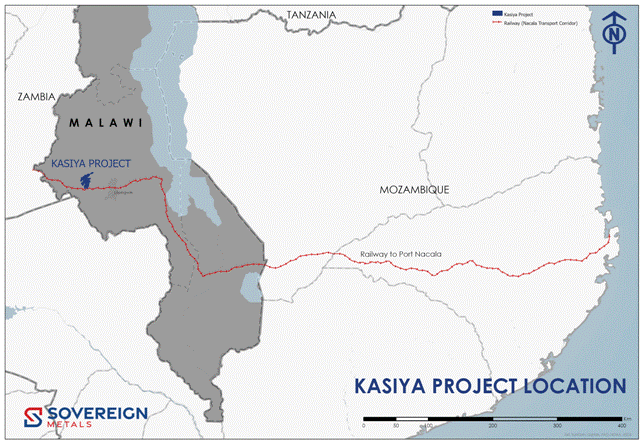
Figure 1: Kasiya Regional Project Location
Sovereign discovered Kasiya in 2019 after identifying the potential of a new rutile province in Malawi. Today, Kasiya stands out as the world’s largest known natural rutile deposit and second largest known flake graphite deposit and holds the accolade of one of only 11 Tier 1 mining projects discovered in the last decade (source MinEx Consulting, “Exploration: Australia vs The World, October 2023).
An Optimised Pre-Feasibility Study (OPFS), completed last year, reaffirmed Kasiya’s potential to become a large, low-cost producer of strategic minerals. Sovereign is now advancing the Definitive Feasibility Study (DFS).
OPERATIONS
Project Vault Participant Traxys Signs Offtake MOU For Kasiya Graphite
· Subsequent to the period end, non-binding Memorandum of Understanding (MOU) signed with Traxys North America for the marketing of graphite from Kasiya
· Traxys is one of only three trading houses appointed to procure critical minerals for the US Government’s US$12 billion Project Vault – the newly launched US Strategic Critical Minerals Reserve
· Graphite is designated a US Critical Mineral by the US Geological Survey and is among the 60 minerals targeted under the stockpiling initiative
· MOU targets 40,000 tonnes per annum of graphite concentrate for Stage 1 (Years 1-5) and up to 80,000 tonnes per annum thereafter
· Initial focus to be on high-value flake graphite for the refractory market, with potential to include flake graphite to serve battery anode supply chains
Strategic Rare Earths Recovered at Kasiya
· Sovereign recovers heavy rare earth monazite concentrate from Kasiya rutile tailings stream
· Preliminary analysis confirms Kasiya monazite to contain exceptionally elevated levels of heavy rare earth elements Dysprosium – Terbium (DyTb) and Yttrium, materially exceeding those of the five largest producers globally, which account for 70% of the world’s rare earth production
· DyTb and Yttrium are of paramount importance to nations seeking to secure and protect rare earth supply chains
o DyTb: heavy magnet rare earths essential for high-temperature permanent magnets used in advanced technology, including defence systems and precision weapons
o Yttrium: high-impact rare earth element critical for aerospace, thermal barrier coatings, radar and laser systems, alloy strengthening and semiconductor manufacturing
· Monazite by-product has potential to add third revenue stream to Kasiya for near-zero incremental cost, with basic monazite concentrate currently selling for over US$8,500/t delivered to China
World Bank Group’s IFC to Collaborate with Sovereign on Sustainable Development for Kasiya
· Collaboration Agreement signed with International Finance Corporation (IFC), a member of the World Bank Group, to support the sustainable development of Kasiya
· Collaboration with IFC – world’s largest global development institution – is expected to lay the foundation for international project financing for Kasiya
· IFC to provide Environmental & Social expertise, supplementing Rio Tinto’s significant input. The Kasiya DFS and Environmental and Social Impact Assessment (ESIA) will seek to integrate IFC’s Performance Standards on Environmental and Social Sustainability
· IFC secures financing rights to fund Kasiya: right to act as lender, mandated co-lead arranger, and/or investor in securities for project financing. IFC’s financing rights are subject to Rio Tinto’s rights under the Investment Agreement
Kasiya’s Growing Strategic Importance Emphasised During and Subsequent to Period
· During the period, the US State Department’s Deputy Assistant Secretary Nick Checker visited Sovereign’s facilities in Malawi as part of a broader engagement with strategically significant critical minerals projects in Africa
· The U.S. Government remains committed to partnering with Malawi to promote trade and investment for shared prosperity
· In January 2026, China announced strengthened export controls on dual-use items to Japan, effective immediately. Beijing is tightening export licensing for heavy rare earths including dysprosium, terbium, and yttrium
· Monazite by-product complements Kasiya’s rutile and graphite – three critical minerals serving Western defence and clean energy supply chains from a single operation
Various Critical Components of DFS now complete
· Geotechnical investigations successfully completed across all critical infrastructure locations with oversight from the Sovereign-Rio Tinto Technical Committee confirming favourable subsurface conditions aligned with regional geology
o Over 400 individual tests conducted covering mining infrastructure, tailings storage facility and raw water dam
o Consistent stratigraphy and suitable subsurface conditions to enable more standardised foundation designs and construction approaches across infrastructure areas
· Mining fleet specifically engineered for large-scale dry mining operations following the results of the successful Pilot Mining and Land Rehabilitation (Pilot Phase).
o No drilling, blasting, crushing or milling required at Kasiya resulting in low capital outlays and operating costs
o Equipment selection and supplier identification completed for all operational requirements across the proposed initial 25-year mine life
· Rehabilitation of land at Pilot Phase test pit site successfully completed during the period, further de-risking DFS
o Exceptional first-year results from its rehabilitation trials at the Kasiya, delivering critical data that will inform the progressive rehabilitation strategy for the ongoing DFS
o Rehabilitation trials achieved 5x crop yield improvement – demonstrating superior post-mining land productivity versus traditional farming
Next Steps
During the period, various new workstreams were incorporated into the DFS with completion of the DFS expected in the coming months. These included an enhanced focus on plant design and configuration, as well as environmental and social impact workstreams, including the integration of IFC’s Performance Standards to support delivery of a DFS that is bankable. These workstreams have been included in the DFS work program to ensure it meets many of the requirements of potential future lenders, including development finance institutions, export credit agencies and potential future offtakers.
Over the coming months, the Company will also continue to update stakeholders regarding progress at Kasiya, including:
· Mineral Resource Estimate update;
· Active discussions with US-based and “allied-nation” offtakers of rutile and graphite;
· Detailed mineralogical characterisation of monazite occurrence and distribution within the Kasiya orebody;
· Assessment of heavy rare earth concentrate recovery rates through the proposed Kasiya processing flowsheet;
· Evaluation of potential scale of rare earth production as a by-product and associated economics;
· Environmental and social impact assessments including the integration of IFC’s Performance Standards; and
· Infrastructure and logistics planning.
DIRECTORS
The names of Directors in office at any time during the financial period or since the end of the financial period are:
Mr Benjamin Stoikovich Chairman
Mr Frank Eagar Managing Director and CEO
Mr Ian Middlemas Non-Executive Director
Dr Julian Stephens Non-Executive Director
Mr Mark Pearce Non-Executive Director
Mr Nigel Jones Non-Executive Director
All Directors were in office from 1 July 2025 until the date of this report, unless otherwise noted.
OPERATING RESULTS
The net operating loss after tax for the half year ended 31 December 2025 was $8,986,797 (2024: $19,546,116) which is attributable to:
(i) Interest income of $902,176 (2024: $1,025,751) earned on cash term deposits held by the Group;
(ii) Exploration and evaluation expenditure of $16,098,372 (2024: $16,495,513) in relation to the Kasiya Project. This is attributable to the Group’s accounting policy of expensing exploration and evaluation expenditure incurred by the Group subsequent to acquisition of the rights to explore and up to the completion of feasibility studies;
(iii) Non-cash share based payment benefit of $7,750,775 (2024: expense $1,904,852) relating to performance rights. The fair value of incentive options and rights is measured at grant date and recognised over the period during which the performance rights holders become unconditionally entitled to the incentive securities. During the period it was determined that 4,992,500 and 6,190,000 performance rights that expire on 31 March 2026 and on 30 June 2026 respectively will lapse unvested on the relevant expiry date as the milestones have been determined to be unachievable prior to their expiry date which has resulted in the share based payment benefit being recognised in the period; and
(iv) Business development expenses of $815,461 (2024: $1,004,695) which includes the Group’s investor and shareholder relations activities including but not limited to public relations costs, marketing and digital marketing, broker and advisor fees, business development consultant fees and costs of the Group’s ASX and AIM listings.
FINANCIAL POSITION
At 31 December 2025, the Company had cash and cash equivalents of $33,937,352 (30 June 2025: $54,538,435) and no debt (30 June 2025: nil). The Company had net assets of $38,704,181 (30 June 2025: $55,387,701), a decrease of $16,683,520 or approximately 30% compared with the prior period. This is largely attributable to the decrease in cash reserves relating to exploration and evaluation spend on the Project to complete the DFS.
SIGNIFICANT POST BALANCE DATE EVENTS
(i) On 21 January 2026, Sovereign announced that it had recovered heavy rare earth monazite concentrate from Kasiya rutile tailings stream. Preliminary analysis confirmed Kasiya monazite to contain exceptionally elevated levels of heavy rare earth elements DyTb and Yttrium, materially exceeding those of the five largest producers globally, which account for 70% of the world’s rare earth production;
(ii) On 17 February 2026, Sovereign announced that it had signed non-binding MOU with Traxys North America for the marketing of graphite from Kasiya which targeted 40,000 tonnes per annum of graphite concentrate for Stage 1 (Years 1-5) and up to 80,000 tonnes per annum thereafter; and
(iii) Issue of 9,022,500 Bankable DFS Milestone Performance Rights, expiring on 30 June 2026, and 13,326,500 Finance Milestone Performance Rights, expiring on 30 June 2028, to directors, key employees and contractors.
Other than as disclosed above, there are no other matters or circumstances which have arisen since 31 December 2025 that have significantly affected or may significantly affect:
· the operations, in periods subsequent to 31 December 2025, of the Group;
· the results of those operations, in periods subsequent to 31 December 2025, of the Group; or
· the state of affairs, in periods subsequent to 31 December 2025, of the Group.
AUDITOR’S INDEPENDENCE DECLARATION
Section 307C of the Corporations Act 2001 requires our auditors, Ernst & Young, to provide the directors of Sovereign Metals Limited with an Independence Declaration in relation to the review of the half year financial report. This Independence Declaration is on page 15 and forms part of this Directors’ Report.
This report is made in accordance with a resolution of the directors made pursuant to section 306(3) of the Corporations Act 2001.
For and on behalf of the Directors
Frank Eagar
Managing Director and CEO
5 March 2026
Link here for the full financial statements
Sovereign Metals #SVML – December 2025 Quarterly Report

Sovereign Metals Limited (ASX:SVM, AIM:SVML, OTCQX:SVMLF) (Sovereign or the Company) is pleased to provide its quarterly report for the period ended 31 December 2025 including advances made at its Kasiya Rutile-Graphite Project (Kasiya or the Project) in Malawi.
HIGHLIGHTS DURING AND SUBSEQUENT TO THE QUARTER
Strategic Rare Earths Recovered at Kasiya
· Sovereign recovers heavy rare earth monazite concentrate from Kasiya rutile tailings stream
· Preliminary analysis confirms Kasiya monazite to contain exceptionally elevated levels of heavy rare earth elements Dysprosium – Terbium (DyTb) and Yttrium, materially exceeding those of the five largest producers globally, which account for 70% of the world’s rare earth production
· DyTb and Yttrium are of paramount importance to nations seeking to secure and protect rare earth supply chains
o DyTb: heavy magnet rare earths essential for high-temperature permanent magnets used in advanced technology, including defence systems and precision weapons
o Yttrium: high-impact rare earth element critical for aerospace, thermal barrier coatings, radar and laser systems, alloy strengthening and semiconductor manufacturing
· Monazite by-product has potential to add third revenue stream to Kasiya for near-zero incremental cost, with basic monazite concentrate currently selling for over US$8,500/t delivered to China
World Bank Group’s IFC to Collaborate with Sovereign on Sustainable Development for Kasiya
· Collaboration Agreement signed with International Finance Corporation (IFC), a member of the World Bank Group, to support the sustainable development of Kasiya
· Collaboration with IFC – world’s largest global development institution – is expected to lay the foundation for international project financing for Kasiya
· IFC to provide Environmental & Social expertise, supplementing Rio Tinto’s significant input. The Kasiya Definitive Feasibility Study (DFS) and Environmental and Social Impact Assessment (ESIA) will seek to integrate IFC’s Performance Standards on Environmental and Social Sustainability
· IFC secures financing rights to fund Kasiya: right to act as lender, mandated co-lead arranger, and/or investor in securities for project financing. IFC’s financing rights are subject to Rio Tinto’s rights under the Investment Agreement
Kasiya’s Growing Strategic Importance Emphasised During and Subsequent to Quarter
· During the quarter, the US State Department’s Deputy Assistant Secretary Nick Checker visited Sovereign’s facilities in Malawi as part of a broader engagement with strategically significant critical minerals projects in Africa
o The U.S. Government remains committed to partnering with Malawi to promote trade and investment for shared prosperity
· In January 2026, China announced strengthened export controls on dual-use items to Japan, effective immediately. Beijing is tightening export licensing for heavy rare earths including dysprosium, terbium, and yttrium
· Monazite by-product complements Kasiya’s rutile and graphite – three critical minerals serving Western defence and clean energy supply chains from a single operation
Next Steps
Over the quarter ending March 2026, Sovereign will:
· Continue to advance the Kasiya DFS;
· Advance rutile and graphite offtake discussions;
· Undertake further work to characterise the monazite mineralisation at Kasiya including detailed mineralogical characterisation of monazite occurrence and distribution within the Kasiya orebody;
· Evaluate the potential scale of rare earth production as a by-product and associated economics; and
· Continue the Company’s community and social development programs in Malawi.
|
Enquiries |
|
|
Frank Eagar, Managing Director & CEO South Africa / Malawi +27 21 140 3190 |
|
|
Sapan Ghai, CCO London +44 207 478 3900 |
|
|
Nominated Adviser on AIM and Joint Broker |
|
|
SP Angel Corporate Finance LLP |
+44 20 3470 0470 |
|
Ewan Leggat Charlie Bouverat |
|
|
|
|
|
Joint Broker |
|
|
Stifel |
+44 20 7710 7600 |
|
Varun Talwar |
|
|
Ashton Clanfield |
Sovereign Metals #SVML – Strategic Heavy Rare Earths Recovered at Kasiya
Sovereign Metals Limited (ASX:SVM; AIM:SVML; OTCQX:SVMLF) (Sovereign or the Company) is pleased to announce a significant and strategic rare earth value addition to its Kasiya Rutile- Graphite Project (Kasiya or the Project) in Malawi.
Highlights:
- Sovereign recovers heavy rare earth monazite concentrate from Kasiya rutile tailings stream
- Preliminary analysis confirms Kasiya monazite to contain exceptionally elevated levels of heavy rare earth elements Dysprosium – Terbium (DyTb) and Yttrium, materially exceeding those of the five largest producers globally, which account for 70% of the world’s rare earth production
- DyTb and Yttrium are of paramount importance to nations seeking to secure and protect rare earth supply chains
- DyTb: heavy magnet rare earths essential for high-temperature permanent magnets used in advanced technology, including defence systems and precision weapons
- Q4 2025 prices in Europe: US$850,000/t for Dy and $3,600,000/t for Tb
- Yttrium: high-impact rare earth element critical for aerospace, thermal barrier coatings, radar and laser systems, alloy strengthening and semiconductor manufacturing
- Q4 2025 price: $270,000/t; up 4,000% from Q1 2025, with the US importing 100% from China
- DyTb: heavy magnet rare earths essential for high-temperature permanent magnets used in advanced technology, including defence systems and precision weapons
- Monazite by-product has potential to add third revenue stream to Kasiya for near-zero incremental cost
- Basic monazite concentrate currently sells for over US$8,500/t delivered to China
- Kasiya’s growing strategic importance emphasised by recent US State Department visit to its Malawi operations and China’s recent restriction of heavy rare earth exports to Japan
The Company has successfully recovered a monazite product containing high-value heavy rare earth elements (REE) from the tailings stream generated during rutile processing at its upgraded Lilongwe laboratory facilities. The concentrate was recovered from material that would otherwise be discarded, i.e. the non-conductor tailings stream from electrostatic separation of a heavy mineral gravity concentrate of Kasiya ore. Producing a monazite concentrate would therefore require no additional complex processing. Chemical analysis of magnetic concentrates from processed resource drilling samples performed by Scientific Services South Africa confirmed the favourable rare earth oxide distributions produced from the monazite concentrate.
Preliminary analysis has confirmed the monazite concentrate contains exceptional heavy rare earth content averaging 2.9% (and up to 3.9%) combined DyTb and averaging 11.9% (and up to 17.3%) yttrium, and light rare earth content including 21.8% neodymium-praseodymium (NdPr).
This composition sets Kasiya apart from all major global rare earth producers. The five largest operations – which together account for over 70% of global production – are dominated by light rare earth elements. Strategically critical heavy rare earths urgently required by US, Japan and EU advanced technology, defence, and industrial supply chains are present only in trace amounts, or absent entirely, in these deposits.
Managing Director and CEO Frank Eagar commented: “This is an exceptional development that has the potential to fundamentally enhance Kasiya’s strategic significance. With simple processing, our upgraded laboratory has recovered a valuable monazite concentrate product from the rutile tailings stream, with heavy rare earth content that the world’s major producers simply cannot match. These are precisely the elements that matter most to nations seeking to protect and grow their critical mineral supply chains. Dysprosium and terbium enable permanent magnets to function in advanced technologies, including robotics, fighter jets, guided missiles, and naval propulsion systems. Yttrium protects jet engines and hypersonic vehicles from extreme temperatures. China imposed export controls on all three in April 2025, and Western supply chains are now acutely exposed.
What makes this value addition particularly significant is that this product was recovered from our rutile processing tailings stream. We are not currently contemplating a complex, standalone rare earth operation. We have recovered critically strategic rare earths from what would otherwise be discarded – a by-product of the processing route we will use for rutile and graphite production.
Kasiya’s rutile will feed aerospace-grade titanium production. Our graphite is essential for battery anodes and traditional industrial applications. And now Kasiya has the potential to also deliver critical heavy rare earths. We have an exciting workstream ahead of us as the potential of the heavy rare earth minerals is delineated. The recent visit by the US State Department to our Malawi operations, combined with our Collaboration Agreement with IFC, reflects the strategic importance that governments and institutions are beginning to attach to Kasiya.”
PRELIMINARY ANALYSIS VS MAJOR GLOBAL PRODUCERS
Global rare earth production is concentrated in five major operations: three in China (Bayan Obo, Weishan, Maoniuping), one in Australia operated by Lynas Rare Earths Ltd (Mt Weld), and one in the United States operated by MP Materials Corp (Mountain Pass). Together, these mines supply over 70% of the world’s rare earth production.
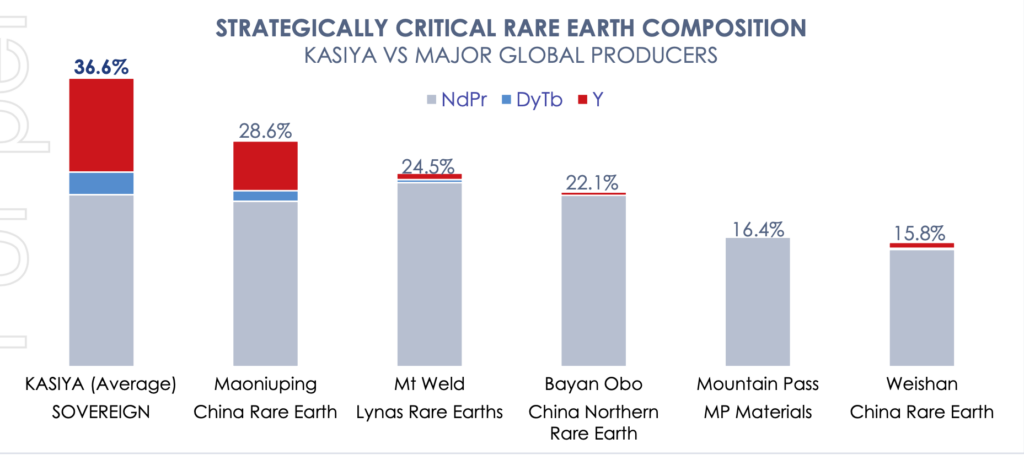
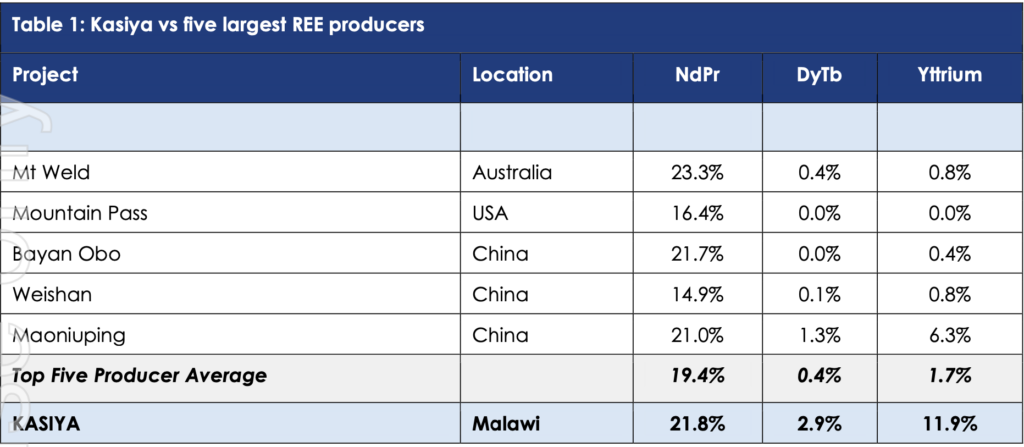
All five are dominated by light rare earths – principally lanthanum and cerium, which are abundant and low-value, and the magnet rare earths Neodymium and Praseodymium (NdPr). The strategically critical heavy rare earths – dysprosium, terbium, and yttrium – that underpin high- performance advanced technology, defence, industrial and renewable energy applications are present in much smaller amounts. Kasiya’s heavy rare earth content is approximately 7x higher for both DyTb and yttrium than found in the five largest rare earth producing mines. Mountain Pass – America’s only rare earth mine – contains no measurable DyTb or yttrium

Sources: Dy, Tb, NdPr: Energy Fuels Inc. January 2026 Company Presentation: “Building a Globally Significant Critical Mineral Company in the US”; Yttrium: Reuters news article “A new rare earth crisis is brewing as yttrium shortages spread” dated 17 November 2025)
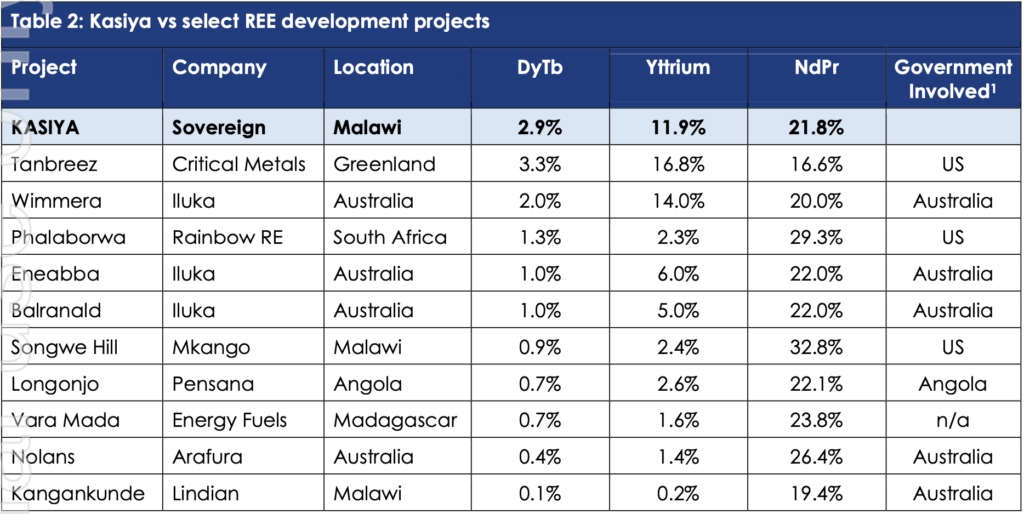
1. Government involvement includes financial, political, or commercial assistance from any government-related entity; Lindian’s partner, Iluka’s refinery, is being supported by the Australian Government; Vara Mada is included for comparability as a significant titanium-feedstock and monazite project.
Source: See Appendices 1 & 2
China’s April 2025 export controls on dysprosium, terbium, and yttrium have created acute supply shortages for Western manufacturers. On 6 January 2026, China announced strengthened export controls on dual-use items to Japan, effective immediately. Despite 15 years of diversification efforts, Japan remains approximately 60% dependent on Chinese rare earth imports. For heavy rare earths, Japan’s dependence on China approaches 100%. Meanwhile, the US is 100% reliant on imports for its yttrium requirements.
Preliminary analysis of Kasiya’s monazite REE content demonstrates one of the highest combined heavy rare earth profiles while maintaining NdPr levels comparable to many REE development projects that have received government backing.
The US State Department visited Sovereign’s operations in Malawi in late 2025 as part of a broader engagement with strategically significant critical minerals projects in Africa.
RARE EARTHS BY-PRODUCT FROM EXISTING PROCESS
Total rare earth oxide was analysed for in magnetic heavy mineral concentrates produced from aircore drilling samples during laboratory analysis for rutile. The magnetic concentrates were composited by depth interval (0-6m and 6-20m) to assess variation in mineralogy with depth associated with weathering units.
Separately, monazite concentrates were produced from bulk samples processed through the standard Kasiya flowsheet. Gravity concentrates were subjected to electrostatic separation, with the non-conductor stream then subjected to further gravity separation, followed by magnetic separation to produce a magnetic monazite concentrate. Duplicate analyses confirmed excellent repeatability. See Appendix 1 for details. Chemical analysis to determine the distribution of rare earth oxides was conducted by the Scientific Services South Africa laboratory.
No additional complex processing was required, so capital requirements will not include a parallel full rare-earth processing circuit, as required by primary REE miners. This represents potential by- product economics at near-zero incremental cost – rare earth recovery as an addition to existing rutile and graphite processing infrastructure.

Figure 3: Sample of Kasiya’s monazite concentrate containing high-value heavy rare earths
Refer to Appendix 1 below for disclosure of the laboratory metallurgical results from samples of Kasiya’s monazite concentrate
NEXT STEPS
Sovereign will now undertake further work to characterise the monazite mineralisation at Kasiya, including:
• Detailed mineralogical characterisation of monazite occurrence and distribution within the Kasiya orebody;
• Assessment of heavy rare earth concentrate recovery rates through the proposed Kasiya processing flowsheet; and
• Evaluation of potential scale of rare earth production as a by-product and associated economics.
Enquiries
Frank Eagar, Managing Director & CEO
South Africa / Malawi +27 21 140 3190
Sapan Ghai, CCO
London
+44 207 478 3900
Competent Persons Statement
The information in this report that relates to Metallurgical Test work is based on information compiled by Andries Willem Kruger, a Competent Person, who is a Member of the South African Council for Natural Scientific Professions, a Recognised Professional Organisation’ (RPO) included in a list promulgated by ASX from time to time. Mr Kruger is employed by Sovereign Metals Limited and is a holder of ordinary shares and unlisted performance rights in Sovereign Metals Limited. Mr Kruger has sufficient experience, which is relevant to the style of mineralisation and type of deposit under consideration and to the activity which he is undertaking, to qualify as a Competent Person as defined in the 2012 Edition of the ‘Australasian Code for Reporting of Exploration Results, Mineral Resources and Ore Reserves’. Mr Kruger consents to the inclusion in the report of the matters based on his information in the form and context in which it appears.
Forward Looking Statement
This release may include forward-looking statements, which may be identified by words such as “expects”, “anticipates”, “believes”, “projects”, “plans”, and similar expressions. These forward-looking statements are based on Sovereign’s expectations and beliefs concerning future events. Forward looking statements are necessarily subject to risks, uncertainties and other factors, many of which are outside the control of Sovereign, which could cause actual results to differ materially from such statements. There can be no assurance that forward-looking statements will prove to be correct. Sovereign makes no undertaking to subsequently update or revise the forward-looking statements made in this release, to reflect the circumstances or events after the date of that release.
This announcement has been approved and authorised for release by the Company’s Managing Director & CEO, Frank Eagar.
Time To ACT #TTA – CEO Chris Heminway talks to Alan Green
Time To ACT #TTA CEO Chris Heminway talks to Alan Green about to the Company’s mission to identify, develop and scale up undervalued and underperforming clean and renewable technology assets and companies. Chris talks about his move from Chairman to CEO, and outlines his and the Company’s mission statement for 2026. In particular we look at driving growth at Time to ACT companies Diffusion Alloys and GreenSpur, along with the proposed acquisition of parts of Versarien Plc, including Spanish company Nanomat. Chris finishes by summarising upcoming inflection points and timelines, and key takeaways for investors to remember.
Harena Resources #HREE – Ampasindava Rare Earths and the USA. Ivan Murphy talks to Alan Green
Alan Green CEO of Brand Communications talks to Harena Resources #HREE Executive Chairman Ivan Murphy. Ivan talks through the background of Ampasindava, an ionised clay resource for heavy rare earths, which provides an easy, low impact and environmentally friendly extraction method compared to conventional mineral extraction processes. The PFS submission is being updated for the 600,000 tonne project, which Ivan described as a ‘free dig opportunity’. The Heap Leaching process means the ground can be returned to it’s previous condition, and being on the coast provides salt water and easy access to market. The upcoming OTC listing is discussed, together with the interest from US lenders and Govt agencies to fund projects such as Ampasindava. Ivan covers the recent fundraise and the funding runway for the project, the institutional interest from RAB Capital, Wexford Capital and other organisations. We then discuss the rapid rise of robotics, and how key the rare earth metals produced by Ampasindava are key elements that form part of the technology. Ivan finishes with a summary of board shareholdings, a summary of upcoming milestones and key takeaway points.
#HREE Harena Resources – Proposed Fundraising to raise up to £1.2m
 Harena Resources Plc – Proposed fundraising to raise up to £1.2 million
Proposed Board changes and Appointment of Allenby Capital as Joint Broker and Financial Adviser
Harena Resources Plc (LSE: HREE), the rare earths company focused on the Ampasindava ionic clay rare earth project in Madagascar (the “Ampasindava Project“), today announces its intention to conduct a fundraising to raise gross proceeds of up to £1.2 million through a placing of up to 80,000,000 new ordinary shares of 0.5 pence each in the share capital of the Company to new and existing institutional and professional investors at an issue price of 1.5 pence per new Ordinary Share.
The Placing is being made available to certain institutional and professional investors but is not available to the public and will be conducted by way of an accelerated bookbuild (“Bookbuild“) which will open immediately following release of this Announcement in accordance with the terms and conditions set out in Appendix I.
In addition, the board of directors of Harena (the “Board” or the “Directors“) are pleased to announce the proposed appointment of Ivan Murphy and Paul Richards as Non-Executive Chairman and Non-Executive Director respectively, effective following the announcement of the results of the Bookbuild, with Cameron Pearce and Sam Quinn stepping down from the Board as Non-Executive Directors.
The Board is also pleased to announce the appointment of Allenby Capital Limited as the Company’s joint broker and financial adviser with effect from today and who will be sole bookrunner in respect of the Placing.
Summary
· Harena is conducting a Placing to raise up to £1.2 million (before expenses) through the proposed issue of up to 80,000,000 new Ordinary Shares at 1.5 pence per Placing Share.
· The Placing will enable the Company to advance the Ampasindava Project towards production by progressing a number of near-term and material milestones, as well as provide additional general working capital.
· The proposed appointment of Ivan Murphy as Non-Executive Chairman and Paul Richards as a Non-Executive Director will strengthen the Board as both possess extensive knowledge of the Ampasindava Project, having both been directors of the previous owner of the Ampasindava Project.
· It is proposed that Cameron Pearce and Sam Quinn will step down from the Board as Non-Executive Directors, effective following the announcement of the results of the Bookbuild.
· Appointment of Allenby Capital as the Company’s joint broker and financial adviser with immediate effect.
· The final number and allocation of the Placing Shares will be determined by the Bookrunner in consultation with the Company and the result of the Placing will be announced as soon as practical after the release of this Announcement.
The Placing will be implemented using the Company’s existing authorities to issue and allot equity securities on a non-pre-emptive basis, granted at the general meeting of the Company on 20 March 2025.
Details of the Placing and proposed Board changes are set out further below.
The terms and conditions of the Bookbuild are set out in Appendix I at the end of this Announcement.
For further information please contact:
|
Harena Resources Plc Allan Mulligan, Executive Technical Director
|
+44 (0)20 7770 6424 LEI: 213800TNHZOA4JIZK687 |
|
Allenby Capital Limited – Financial Adviser & Joint Broker Jeremy Porter / Vivek Bhardwaj (Corporate Finance) Amrit Nahal / Kelly Gardiner (Sales & Corporate Broking)
|
+44 (0)20 3328 5656 |
|
Tavira Financial Limited – Joint Broker Jonathan Evans / Oliver Stansfield |
+44 (0)20 7330 1833 |
|
Celicourt Communications – Public Relations Mark Antelme / Charles Denley-Myerson |
44 (0)20 7770 6424 celicourt@celicourt.uk |
ECR Minerals playing the big game – Andrew Scott talks to Andrew Haythorpe and Adam Jones
In a new June 2023 ‘on the ground’ interview, Andrew Scott talks to Andrew Haythorpe and Adam Jones about the exploration programme. Adam covers his schedule, boots on the ground at Hurricane (5-7 days) meeting the previous owner, and he will then be at Lolworth for the rest of June taking rock chips and sampling where the tantalum & niobium and rare earths were discovered last year. Andrew Haythorpe talks about the bigger picture for Lolworth in the back yard of Charters Towers, Pajingo etc, looks at the 1980s results, how the area is so unexplored and why the results, size and scale of the area offers so much potential. Both believe that very little would be needed to put the Lolworth discoveries on the scale of Charters Towers, given the 10km ridgeline, the specific area of interest 3.5 x 4km (12-20sq km), but there is also an overlap in the SE of the tenement with the same geology, which is totally untested, which could be 3x the size of the current ridgeline. Adam and Andrew then discuss the planning for Hurricane, putting in access tracks to the breccia veins with bulldozers and an initial RC drilling plan. Andrew explains how the current private landowners have been unable to exploit the asset, and how ECR are the first company with significant resources to get on the ground there.
Moving to Creswick, Adam touches on the underwhelming initial results, but points to the fact there is a 10k trend that remains to be tested, and the reasons why ECR has to work smarter. Adam looks at the geology of nearby Ballarat compared to Creswick – similar structure, narrow vein, anticlines etc, with some 30 veins already identified along the 10k strike. In summary, Andrew highlights the work Adam and the team have done with soil geochemistry and sampling and how they are ‘ranking’ the prospects to get the biggest bang for the ECR buck. In summary, the ECR team are are here to find good grades. Lolworth has some ‘smoking’ mineralisation and Andrew believes at Hurricane will deliver at 20-40-60m below surface, in other words a classicAustralian open cut mining start up which gives ECR a chance to play the big game.
#KDNC Cadence Minerals – Vox Market host an investor presentation and Q&A with Cadence CEO Kiran Morzaria

Kiran talks about:
~ Amapa ironore project, PFS, shipping, stockpiles etc
~ Yangibana rareearths
~ Lithium Technologies / Supplies & Sonora
~ investment returns & markets
Listen to the interview here
Kavango Resources #KAV – Ditau i10 target motivation & drilling commencement
 Kavango Resources plc (LSE:KAV) has commenced drilling the “i10” target (“Target i10”) at the Ditau Camp Project (“Ditau”), in southwestern Botswana. Target i10 is a discrete circular anomaly that is 2.2km in diameter and under an estimated 120m of sand cover. Kavango’s primary objective is to retrieve rock core to establish whether Target i10 is a carbonatite intrusive. Carbonatite complexes are the world’s primary source of rare earth elements (“REEs”) and other strategic/industrial commodities. REEs are strategically vital commodities in high-tech industries.
Ditau is held in a 50/50 Joint Venture (“Kanye Resources”) with Power Metal Resources plc (LSE:POW).
Ben Turney, Chief Executive Officer of Kavango Resources, commented:
“The drill motivation for Target i10 is a comprehensive piece of work. Kavango’s team has worked hard over the last two years refining the exploration methodology leading to the design of the current Ditau drill campaign. Using the latest remote sensing technologies, we have created sophisticated targeting models to guide our exploration.
We will now become the first explorers to test this area’s potential for carbonatites, which are the world’s primary source of rare earth elements (“REEs”). REEs are strategically critical minerals, crucial to all high-tech industries.
Given the fact that carbonatites and kimberlites often occur in clusters, controlled by regional geological structural trends, the Ditau property location could be significant. We know that Ditau is in a known kimberlite “corridor”, so the backdrop to drilling is favourable.
It is now down to the “truth detector” to tell us what is down there.”
Highlights
– Drill motivation
– Target i10 is a discrete circular anomaly, 2.2km in diameter
– Shallow depth, with Kalahari sediment and sand cover estimated at 120m, target zone directly underneath
– Kavango modelled Target i10 using inversions of Aeromagnetic data (“AEM”), combined with the interpretation of Audio-Magnetotelluric (“AMT”) data
– The targets have been independently verified to conform to an idealised model for carbonatite intrusives, based on their aeromagnetic signatures.
– Idealised Ore Deposit Model
– Target i10 is a “carbonatite pipe” type intrusive target
– Apparent concentric “ring-like” lithological zonation and structure, which could relate to mineralized horizons
– Target lies near the margin of the Kaapvaal Craton, a tectonic context common to mined carbonatites globally
– Comparison made with Kangankunde carbonatite in Malawi
– Drill operations
– First of two planned boreholes into Target i10 commenced 15 April, targeting the core of the magnetic high
– Camp secured & road access and drill pads completed
– Water borehole successfully drilled & solar powered water pump installed
– First hole is designated DITDD003
– DITDD003 Target End-of-Hole (“EOH”) depth 400m
– As of morning shift on 19 April (0600) DITDD003 has been drilled to 85.27m depth
– Drilling to be conducted by Mindea Exploration & Drilling Services (Pty) (“Mindea”)
– Plan to drill up to six 400m diamond core boreholes in current Ditau drill campaign, across 3 targets
Background to targeting
Kavango has identified 12 geophysical structures/targets at Ditau (targets i1 through i12), which the Company believes could be possible carbonatites and/or intrusive complexes that may host carbonatites. 9 of these targets are particularly well defined.
There are two target types at Ditau:
1) Discrete kilometre-scale carbonatite pipe targets, and
2) Larger multi-kilometre scale intrusive complex targets that may also be host to carbonatite intrusives and/or mafic associated mineralisation styles prospective for base metals
The 12 Ditau geophysical targets are not known to have been tested for either REEs or base metal mineralisation. Kavango identified these targets, which range in size from 1km to 20km in diameter, using modern geophysical interpretative techniques. Kavango has used combined and integrated Airborne Magnetics, Ground Magnetics and Audio-Magnetotelluric (“AMT”) surveys in the exploration of the area and for drill targeting.
Target i10
Kavango believes Target i10 could represent a discrete, kilometre-scale carbonatite pipe. This target is interpreted as a simple single phase carbonatite phase/pipe with a possible outer ring indicated by a weak magnetic low.
The geophysical anomaly is estimated to be 2.2km in diameter, with apparent concentric “ring-like” lithological zonation and structure. Kavango has surveyed Target i10 using Ground Magnetic and AMT technologies following from an initial modelling and interpretation of the regional Aeromagnetic data.
Kavango has provided a 3D inversion of the Target i10 Aeromagnetic data with an AMT section overlay on its website:
https://www.kavangoresources.com/media-library/news-release-media/rns19april2022
Based on analysis of the AMT section over Target i10, the sand cover is estimated to be roughly 120m deep. The magnetic inversion confirms that the primary target zone lies just underneath this cover.
To confirm the Company’s geophysical interpretation of Target i10, Kavango currently plans to drill two geological boreholes into i10 to confirm the presence of a carbonatite. The first hole will target the core of the magnetic high, while the second hole is designed to test the edge of the negative magnetic response.
Target i10 Idealised Ore Deposit Model
In its analysis of Target i10, Kavango has used the REE bearing Kangankunde carbonatite pipe (“Kangankunde”) in Malawi as a carbonatite model.
Kangankunde is one of the largest carbonatites in the Chilwa Alkaline Province (“Chilwa”) of Southern Malawi. Chilwa is a roughly 300km-diameter area, which comprises of Late Jurassic-Early Cretaceous alkaline rocks and clusters of carbonatites. Kangankunde is one of many carbonatites in Chilwa and is roughly 1.5km in diameter.
Kangankunde forms a low hill, 200m above the surrounding plain, with lower slopes composed of fenitised and locally fractured (brecciated) rocks with the upper slopes predominantly forming carbonatite.
Although Target i10 is buried under roughly 120m of Kalahari cover, its geophysical signatures are comparable to Kangankunde. Kavango’s interpretation of combined Aeromagnetic and AMT data of Target i10 indicates this geophysical anomaly could represent a simple, single phase carbonatite pipe, with a possible ring indicated by a weak magnetic low.
For comparison, Kavango has provided a geological map of Kangankunde on its website:
https://www.kavangoresources.com/media-library/news-release-media/rns19april2022
Carbonatites can exhibit significant lithological and structural variation, both between and within individual pipes. As such, to maximise the chances of success in exploring for carbonatite hosted REE deposits, it is common practice to drill multiple boreholes along fences into single targets. The geological map of Kangankunde illustrates the geological complexity and therefore the necessity for drilling multiple drillholes into carbonatite targets to elucidate the geology and locate potential indicators of mineralisation.
Drilling at Ditau
The drill camp is constructed and secure. All supporting equipment and personnel have been located to site.
Kavango has successfully drilled a 180m water borehole, which the Company believes should yield enough water to support drilling operations. A solar powered pump has been installed.
Road access between the drill camp, drill collar locations and water sources are also complete.
Drilling operations commenced on Friday 15 April. In total, Kavango expects to drill up to 6 diamond core holes in the current campaign (totalling 2,400m). Each hole has an anticipated target EOH depth of 400m, and the Company aims to test 3 of the 12 geophysical targets at Ditau.
The Company and its contractors have designed the current Ditau drill campaign to be flexible and guided by results. The plan is to test both possible carbonatite pipes and possibly related large-scale intrusive complexes (which may also be host to discrete carbonatite bodies).
Kavango will release a comprehensive report on the outcome of current planned 6-hole drill campaign once all data has been processed and verified.
Depending on the success of the current drill campaign, Kavango has identified a further 17 drill collar locations for future test-drilling across all 12 geophysical targets/structures.
Ditau regional geological setting
Carbonatites often occur in “swarms” or clusters, oriented along favourable and clearly defined deep continental scale geological, structural trends. The 12 Ditau geophysical structures occur along a southwest-northeast regional corridor, along the south-eastern edge of the trend that hosts the Mabuasehube and Kokong kimberlite groups. Desktop analysis of regional data by Kavango’s geologists suggests this trend is parallel to other corridors that host other kimberlite groups in Botswana and northwest Angola. In the latter these trends are known to host both kimberlite and carbonatite intrusives, meaning that the presence of one is a strong indicator for the other.
In addition to the known presence of kimberlites within the “Ditau trend” (in numerous published reports and maps), and supporting the possible presence of carbonatites, are an as yet small cluster of carbonatite intrusives (KW2, definite, and KS12 & KS36 possible bodies) in the vicinity of the project (the “Falconbridge Carbonatites”). The Falconbridge Carbonatites were drilled by Falconbridge Exploration Botswana (Pty) Ltd in the late 1970’s-early 1980’s, to the immediate north of and 30km along strike to the northeast of the Ditau project.
The POW/KAV Joint Venture at Ditau
Ditau is held in a 50/50 Joint Venture (“Kanye Resources”) with Power Metal Resources plc (LSE:POW) (“Power Metal”). Kavango is the operator. Mindea Exploration and Drilling Services (Pty) (“Mindea”) will conduct the drilling.
Further information in respect of the Company and its business interests is provided on the Company’s website at www.kavangoresources.com and on Twitter at #KAV.
For further information please contact:
Kavango Resources plc
Ben Turney
+46 7697 406 06
First Equity (Joint Broker)
+44 207 374 2212
Jason Robertson
SI Capital Limited (Joint Broker)
+44 1483 413500
Nick Emerson
Kavango Competent Person Statement
The technical information contained in this announcement pertaining to geophysics have been read and approved by Mr. Jeremy S. Brett, M.Sc., P.Geo., Senior Geophysical Consultant, Jeremy S. Brett International Consulting Ltd. in Toronto, Canada. Mr. Brett is a member of the Professional Geoscientists of Ontario, the Prospectors and Developers Association of Canada, the Canadian Exploration Geophysical Society, and the Society of Economic Geologists. Mr. Brett has sufficient experience that is relevant to geophysics applied the styles of mineralisation and types of deposits under consideration to act as a Qualified Person as defined under the Canadian National Instrument 43-101, Standards of Disclosure for Mineral Projects.
NOTES TO EDITORS
THE DITAU CAMP PROJECT
The Ditau Camp Project comprises two Prospecting Licences (“PLs”) (PL169/2012 & PL010/2019) that cover an area of 1,386km2. Geophysical and geochemical analyses by Kavango in the two PLs have identified 12 “geophysical structures” of which 9 have clear indications of being “ring structures”.
The “ring structures” have the potential to host carbonatite and other intrusive rocks.
Carbonatites are the principal source of rare earth elements (“REEs”) including the much sought-after elements Neodymium (Nd) and Praseodymium (Pr), which are used in the manufacture of the new generation of electric vehicles (EVs), magnets and other high-tech applications. Other elements/minerals associated with carbonatites include Niobium, Phosphates, Monazite, Strontium, Magnetite and Copper.
Mafic intrusives have potential to host base and precious metals, as seen in the Molopo Farms Project, Selebi Phikwe and Tati Nickel deposits in Botswana.
Power Metal Resources #POW – Diamond Drilling Commences at the i10 Target – Seeking Rare-Earth Element Carbonatite Intrusives
Power Metal Resources PLC (LON:POW) the London listed exploration company seeking large-scale metal discoveries across its global project portfolioannounces that diamond drilling has now commenced at the i10 Target (“i10” or the “Target”) located within the Ditau Camp Project (“Ditau”), southwestern Botswana.
The i10 Target is marked by a discrete, circular, geophysical anomaly that is 2.2km in diameter and under an estimated 120m of sand cover. Kanye’s primary objective is to retrieve diamond core to establish whether the Target’s geophysical anomaly is caused by a carbonatite intrusive. Carbonatites are the world’s primary source of rare-earth elements (“REEs”) and other strategic/industrial metals including copper.
The Ditau Camp Project is held by Botswana based Kanye Resources Pty Limited (“Kanye”), which is a 50/50 joint-venture partnership with Kavango Resources plc (LSE:KAV) (“Kavango”) – who are the operators.
Highlights
– Drill motivation
– The i10 Target is highlighted by a discrete circular magnetic anomaly, measuring 2.2km in diameter
– The Target is interpreted to lie at a shallow depth, below an estimated 120m of Kalahari sand cover – based on Audio-Magnetotelluric (“AMT”) data obtained over i10.
– Kanye has successfully completed aeromagnetic and AMT inversions over the Target.
– The Target has been independently verified to conform to an idealised model for carbonatite intrusives, based on its aeromagnetic signature.
– Idealised Ore Deposit Model
– I10 is a carbonatite pipe intrusive target
– Based on the magnetic signature, the Target has concentric “ring-like” lithological zonation, which could relate to rare-earth element mineralised horizons
– Target lies near the margin of the Kaapvaal Craton, a tectonic context common to other carbonatites globally
– Drill operations
– Camp secured, road access and drill pads completed
– Water borehole successfully drilled and solar powered water pump installed
– First of two planned drillholes at i10, hole DITDD003, commenced drilling on 15 April 2022, which is targeting the core of the magnetic high and has a target depth of 400m
– Drilling is being conducted by Mindea Exploration & Drilling Services (Pty) (“Mindea”)
– The plan is to drill up to six ~400m deep diamond drillholes at Ditau, including 2 drillholes at three separate magnetic anomlies, including i10.
Paul Johnson, Chief Executive Officer of Power Metal Resources plc, commented:
“I have talked previously about the confidence we hold in the geological prospectivity across our projects in Botswana. That confidence means within an 18 month period, with Molopo, Tati and now Ditau, we have launched three drill programmes.
The Molopo drill programme successfully confirmed the presence of nickel, Tati confirmed the presence of gold and now we seek confirmation of rare earth elements at Ditau.
To say we are excited about the prospects for our interests in Botswana is an understatement. Let’s see what this drill programme delivers.”
Background Targeting
The Ditau Camp Project is centred around 12 unique geophysical anomalies (targets i1 through i12), which Kanye believes could be caused by possible carbonatites and/or intrusive complexes that may host rare-earth element mineralisation.
Targets i1 – i12 are seperated into two main target types:
1) Discrete kilometre-scale carbonatite pipe targets, and
2) Larger, multi-kilometre scale intrusive complex targets that may also be host to carbonatites and/or mafic intrusive bodies prospective for base-metal mineralisation.
The 12 Ditau geophysical targets are not known to have been drill tested for either REEs or base-metal mineralisation historically. Kanye originally identified these targets, which range in size from 1km to 20km in diameter, using interpretation of airborne magnetic data. To date, Kanye has used combined airborne- and ground-magnetic, and AMT surveys in the exploration at Ditau.
Target i10
Kanye believes the i10 Target anomaly could be caused by a discrete, 2.2km wide carbonatite pipe. The Target is interpreted as a simple, single phase carbonatite pipe with a possible outer ring indicated by a weak magnetic low ringing the main magnetic high feature.
A 3D inversion of the aeromagnetic data with an AMT section overlay of the I10 Target can be found at Kavango’s website at the link below:
https://www.kavangoresources.com/media-library/news-release-media/rns19april2022
Based on analysis of the AMT data over i10, the Kalahari sand cover is estimated to be roughly 120m thick. The magnetic inversion results confirm that the primary target zone lies just underneath this sand cover.
To confirm the current geophysical interpretation of the i10 Target, Kanye is currently planning to drill two diamond drillholes into i10. The first drillhole, which is currently underway, will target the core of the magnetic high, while the second hole is designed to test the edge of the geophysical anomaly.
Target i10 Idealised Ore Deposit Model
In the analysis of geophysical data over i10, Kavango has used the rare-earth element bearing Kangankunde carbonatite pipe (“Kangankunde”) located in Malawi as a model.
Kangankunde is one of the largest carbonatites within the Chilwa Alkaline Province (“Chilwa”) at ~1.5km in diameter. Chilwa is a roughly 300km in diameter, and is comprised of Late Jurassic-Early Cretaceous alkaline rocks with clusters of carbonatite pipes – including Kangankunde.
At the surface, Kangankunde forms a low hill, which rises approximately 200m above the surrounding plains, with lower slopes composed of fenitised and locally fractured (brecciated) rocks with the upper slopes predominantly of carbonatite intrusive rocks.
Although the i10 target is buried under roughly 120m of Kalahari sand cover, Kanye’s geological team believe that the geophysical signatures are comparable to that of Kangankunde. The highlight the various similarities, a geological map of Kangankunde can be found on Kavango’s website at the link below:
https://www.kavangoresources.com/media-library/news-release-media/rns19april2022
Carbonatites can exhibit significant lithological and structural variation, both between and within individual pipes. As such, to maximise the chances of exploration success in exploring for carbonatite hosted REE deposits, it is common practice to drill multiple boreholes along a fence pattern into a single target. The geological map of Kangankunde illustrates its concentric geological complexity and therefore the necessity for drilling multiple drillholes within i10 to elucidate the geology and locate potential indicators of REE or base-metal mineralisation.
Ongoing Drilling Operations
The drill camp has been constructed. All supporting equipment and key personnel are currently located on site.
Kanye has successfully drilled a 180m deep water borehole, which should yield enough water to support ongoing drilling operations. A solar powered pump has been installed and is currently operational.
Road access between the drill camp, drill collar locations and water sources is also complete.
Drilling operations successfully commenced on Friday 15 April 2022. In total, Kanye expects to drill up to 6 diamond drillholes as part of the current campaign (totalling ~2,400m). Each hole has an anticipated target depth of 400m, and Kanye aims to test 3 of the 12 geophysical targets as part of the ongoing drilling campaign.
Kanye and its contractors have designed the current Ditau drill campaign to be flexible and guided by ongoing visual results. Kanye will release field and laboratory results on the current planned 6-hole drill campaign once all data has been received, processed and verified.
Contingent on results from the ongoing drilling campaign, Kanye has identified a further 17 drill collar locations for future drill testing across all 12 geophysical targets/structures at Ditau.
Regional Geological Setting
Carbonatite intrusives often occur in swarms or clusters, oriented along favourable and clearly defined deep continental scale geological and structural trends. The 12 geophysical structures at Ditau occur within a southwest-northeast oriented corridor, part of the same corridor that host the Mabuasehube and Kokong kimberlites. Desktop analysis of regional geological and geophysical data by Kanye’s geologists suggest that this trend is sub-parallel to other corridors that host other kimberlite groups in Botswana and northwest Angola. In the latter, these trends are known to host both kimberlite and carbonatite intrusives, meaning that the presence of one is a strong indicator for the other.
In addition to the known presence of kimberlites within the geological corridor where Ditau is located, and further enhancing the prospectivity for Carbonitites on the Project, there is a small known cluster of carbonatite intrusives including KW2, Definite, KS12 and KS36 (the “Falconbridge Carbonatites”) which are located near to the Project. The Falconbridge Carbonatites were drilled by Falconbridge Exploration Botswana (Pty) Ltd in the late 1970s and early 1980s, to the immediate north of and 30km along strike to the northeast of the Ditau Project.
COMPETENT PERSON STATEMENT
The technical information contained in this disclosure has been read and approved by Mr Nick O’Reilly (MSc, DIC, MIMMM, MAusIMM, FGS), who is a qualified geologist and acts as the Competent Person under the AIM Rules – Note for Mining and Oil & Gas Companies. Mr O’Reilly is a Principal consultant working for Mining Analyst Consulting Ltd which has been retained by Power Metal Resources PLC to provide technical support.
This announcement contains inside information for the purposes of Article 7 of the Market Abuse Regulation (EU) 596/2014 as it forms part of UK domestic law by virtue of the European Union (Withdrawal) Act 2018 (“MAR”), and is disclosed in accordance with the Company’s obligations under Article 17 of MAR.
For further information please visit https://www.powermetalresources.com/ or contact:
|
Power Metal Resources plc |
|
|
Paul Johnson (Chief Executive Officer) |
+44 (0) 7766 465 617 |
|
|
|
|
SP Angel Corporate Finance (Nomad and Joint Broker) |
|
|
Ewan Leggat/Charlie Bouverat |
+44 (0) 20 3470 0470 |
|
|
|
|
SI Capital Limited (Joint Broker) |
|
|
Nick Emerson |
+44 (0) 1483 413 500 |
|
|
|
|
First Equity Limited (Joint Broker) |
|
|
David Cockbill/Jason Robertson |
+44 (0) 20 7330 1883 |
|
|
NOTES TO EDITORS
Power Metal Resources plc – Background
Power Metal Resources plc (LON:POW) is an AIM listed metals exploration company which finances and manages global resource projects and is seeking large scale metal discoveries.
The Company has a principal focus on opportunities offering district scale potential across a global portfolio including precious, base and strategic metal exploration in North America, Africa and Australia.
Project interests range from early-stage greenfield exploration to later-stage prospects currently subject to drill programmes.
Power Metal will develop projects internally or through strategic joint ventures until a project becomes ready for disposal through outright sale or separate listing on a recognised stock exchange thereby crystallising the value generated from our internal exploration and development work.
Value generated through disposals will be deployed internally to drive the Company’s growth or may be returned to shareholders through share buy backs, dividends or in-specie distributions of assets.
Power Metal Exploration Programmes Underway/Results Awaited
Power Metal has exploration programmes completed or underway, with results awaited, as outlined below:
|
Project |
Location |
POW % |
Work Completed or Underway |
Results Awaited |
|
|
|
|
|
|
|
Alamo Gold Project |
USA |
Earn-in to 75% |
Excavation of multiple test pits and mapping & sampling. |
Field and assay results from on-site work programme. |
|
Athabasca Uranium |
Canada |
100% |
Data compilation across uranium properties |
Interpretation results from all Properties complete. Next steps upcoming. |
|
Authier North Lithium |
Canada |
Earn-in to 100% |
Soil & rock sampling completed |
Technical Review of exploration results & define next exploration steps. |
|
Ditau Project |
Botswana |
50% |
Drill programme focused on key targets notably drilling of potential carbonatites and targeting rare-earth elements. |
Field updates and receipt & review of laboratory assay results. |
|
Kalahari Copper Belt |
Botswana |
50% |
Exploration programme underway across the South Ghanzi Project and further exploration at the more recently acquired South Ghanzi Extension and Mamuno licence areas |
Field programme findings and defined drill targets for near term drilling. |
|
Molopo Farms |
Botswana |
53% |
Review of recent exploration findings. |
Determine next exploration steps and action plan. |
|
Haneti Project |
Tanzania |
35% |
Diamond drill programme completed |
Receipt & review of laboratory assay results. |
|
Victoria Goldfields |
Australia |
49.9% |
Diamond drill programme underway
|
Field updates and receipt & review of laboratory assay results. |
|
Paterson Projects |
Australia |
83.33% |
Wallal passive seismic and 2D seismic processing work programme completed. Review of historical data and target generation for Ripon Hills & Braeside West projects.
|
Findings from multiple work programmes including final approvals and preparations for planned deep diamond drilling. |
|
Selta Project |
Australia |
83.33% |
Field reconnaissance work now underway, including mapping and sampling. |
Field updates. |