
Home » Posts tagged 'operational'
Tag Archives: operational
#HREE Harena Rare Earths PLC – Completion of Pre-Feasibility Study
 Harena Rare Earths Plc (LSE: HREE) (OTCQB: CRMNF), the rare earths company focused on the Ampasindava ionic clay rare earth project in Madagascar (the “Ampasindava Project“), is pleased to announce the highlights from its completed pre-feasibility study (“PFS“). The PFS represents an important advancement in the development of the Ampasindava Project, confirming its technical viability and providing a robust economic and operational framework to support the next phase of project progression.
The PFS was compiled by the Company with leading global engineering group SGS engaged to support technical inputs to the PFS and also to conduct an update of the 2023 Mineral Resource Estimate to JORC 2012 standard.
PFS HIGHLIGHTS
Robust technical and economic viability for long life heap leach operation
|
• |
Total rare earth oxide (TREO1) of ~71kt, over a measured 20-year life of mine (LOM) |
|
|
• |
Plant throughput set at 5Mtpa (dry) at average grade at 1,500 ppm TREO supported by independent metallurgical test work |
|
|
• |
Pre-production capital cost estimate of US$142 million, including 25% in EPCM (engineering, procurement and construction management) and funding costs |
|
|
• |
Annual TREO production estimate of 4,000 tonnes per year |
|
|
|
° |
Annual oxide (NdPr + DyTb) production of 1,700t per year (29,670t for 20 years) |
|
° |
Ratio of magnetic rare earth oxide (Magnet REO2) yielded to TREO despatched at 41% |
|
Excellent economic returns modelled using analyst sourced long term pricing
|
• |
Undiscounted LOM free cashflow of US$1.0 billion post-tax |
|
• |
Pre Tax NPV10 of US$343.7 million |
|
• |
Pre Tax IRR of 34% |
|
• |
Post Tax NPV10 of US$249.6 million |
|
• |
Post Tax IRR of 30% |
|
• |
Payback period of 4 years |
Outstanding financial metrics based on current publicly sourced consensus rare earth pricing
|
• |
Undiscounted LOM free cashflow of US$2.6 billion post-tax |
|
• |
Pre Tax NPV10 of US$616.1 million |
|
• |
Pre Tax IRR of 30% (Consensus pricing more optimistic in later years) |
|
• |
Post Tax NPV10 of US$464.3 million |
|
• |
Post Tax IRR of 27% |
|
• |
Payback period of 5 years |
Economic outcome summary
The Company has modelled the Ampasindava Project’s economics using two sets of rare earth oxide price forecasts. The base case uses a price deck sourced from a recognised Minerals Analyst for the years between 2025 and 2044. The Consensus Price deck is sourced using artificial intelligence (AI) applications that scrape web information on publicly available REO pricing forecasts between 2030 and 2049. In addition, the Company has modelled a situation, called Ampas Plus, using the base case price deck with a 10% reduction in opex and capex applied throughout.
|
Pre Tax 20 Yr NPV10 and IRR |
NPV10 |
IRR |
Payback |
|
|||
|
Base Case using Long-term Analyst Prices |
USD 349 m |
34% |
4 Yrs |
|
|||
|
Base Case using Current AI Consensus Prices |
USD 616 m |
30% |
5 Yrs* |
|
|||
|
Ampas Plus – Opex and Capex Savings |
USD 439 m |
41% |
3 Yrs |
|
|||
|
|
|||||||
|
Post Tax 20 Yr NPV10 and IRR |
NPV10 |
IRR |
Payback |
||||
|
Base Case using Analyst Prices |
USD 249 m |
30% |
3 Yrs |
||||
|
Artificial Intelligence Consensus Prices |
USD 464 m |
27% |
6 Yrs* |
||||
|
Ampas Plus – Opex and Capex Savings |
USD 327 m |
36% |
3 Yrs |
||||
* Consensus pricing more optimistic in later years
1. All references to Oxides are based on the contained level of those Oxides within the MREC product, noting the TREO contains La2O3 + CeO2 +Pr6O11 + Nd2O3 + Sm2O3 + Eu2O3 + Gd2O3 + Tb4O7 + Dy2O3 + Ho2O3 + Er2O3 + Tm2O3 + Yb2O3 + Lu2O3 + Y2O3
2. Magnetic Rare Earth Oxides (Magnetic REO) = Pr6O11 + Nd2O3 + Tb4O7 + Dy2O3
20 Year Prices forecast sourced from AI tools scraping web information on REO pricing forecasts
Ampasindava Project rapidly advancing and progressively de-risked
|
• |
Planning for a phased “Proof of Concept” plant at site is underway: |
|
|
|
° |
Initial establishment of a permanent on-site laboratory |
|
|
° |
Establishment of on-site test cribs and columns |
|
|
° |
Opportunity to optimise flowsheet and test downstream rare earth separation at a pilot scale |
|
• |
Selection of specialists to compile DFS and upgrade PFS to reduce cost and process risk |
|
|
• |
Commence targeted cost reduction and optimisation initiatives including: |
|
|
|
° |
Selection of high-grade zones for initial inclusion in mine plan |
|
|
° |
Optimising supply chain options |
Strong national government support
|
• |
Strong engagement with Malagasy national and regional governments |
|
• |
Environmental and social studies continue to support permitting and local validation |
|
• |
Permitting on track to allow construction to commence in 2027 |
|
• |
Social programs will focus on suitable and appropriate land compensation, job creation, education of youth, individual technical skills development, and local business creation and readiness |
Allan Mulligan, Executive Technical Director of Harena, said:
“The completion of the PFS represents a significant step forward for Harena and the Ampasindava Project. With significant previous investment in resource development, process testwork and environmental programs, we have an excellent understanding of the Ampasindava Project where we can now further optimise the asset as we move into the final piloting and studies phase.
The Ampasindava Project hosts a world-class scale ionic absorption rare earths mineralisation, particularly amenable to low cost and high yield recoveries. The sustainable and rapid remediation heap leach extraction model will serve to enhance the local, regional and national economy with no lasting impacts on the environment.
Our confidence in the results of the PFS and the underlying PFS process more broadly is based on the enormous previous works and current understanding of the orebody, and the inclusion of the Proof-of-Concept plant in 2026 will allow a smooth and organised mobilisation into construction with reduced start up risk.”
Ivan Murphy, Executive Chairman of Harena, said:
“We are extremely pleased to be releasing the excellent results of this pre-feasibility study to the market. The key metrics presented here clearly highlight the exceptional scale, quality and strategic significance of the Ampasindava Project, reinforcing its position as a world-class heavy rare earth asset and marking a major milestone in its progression towards development.
I would like to sincerely thank Allan Mulligan, our Executive Technical Director, for his dedication over the recent months, as well as the wider internal and external teams whose expertise and commitment have been instrumental in delivering this important result.”
SUMMARY REPORT
Introduction
Harena Rare Earths Plc is pleased to present the Pre-Feasibility Study (“PFS“) outcomes for its Ampasindava Rare Earth Ionic Clay Project (the “Ampasindava Project” or “Project“), located in the province of Antsiranana in north eastern Madagascar.
Harena has engaged leading global engineering group SGS to support technical inputs to the PFS and also to conduct an update of the 2023 Mineral Resource Estimate to JORC 2012 standard.
The compilation of the PFS has been internally managed by Harena. The initial study was conducted in order to meet regulatory requirements for the conversion of the Permit Research licence to a Permit Exploitation licence.
Several programs of metallurgical testwork were conducted by SGS and results emanating from several bulk sample leaching programs have been employed into the PFS design.
In line with international standards for feasibility studies, the PFS is generally in line with AACE Class 4 estimates and accuracy is in range of -30/+40. The planned on-site Proof of Concept demonstration plant will allow these estimates to be greatly enhanced and derisked.
Key PFS Outcomes and Assumptions
The PFS confirms the robust technical and economic viability for development of a mining and processing operation to produce a MREC product at the Ampasindava Project.
This has included:
|
• |
An updated global Mineral Resource Estimate of 606,000 tonnes of TREO with: |
|
|
|
° |
41kt of TREO in Measured Resources, |
|
|
° |
Indicated Resources of 156kt of TREO, and |
|
|
° |
Inferred Resources totalling 410kt of TREO. |
|
• |
The hand-sinking of 4,474 vertical test pits up to 10m deep, |
|
|
• |
Some 31,000 pit samples across the pedolith and saprolite areas of the pits, |
|
|
• |
A total of 277 vertical diamond drill holes, |
|
|
• |
Maximum head grades of 2.24% TREO and a global average of 868 ppm TREO, |
|
|
• |
Substantial metallurgical testwork with SGS and other consultants over several years of testing, including at least two bulk sample programs, |
|
|
• |
A range of yield payability favouring higher demand TREOs and resulting in a nett of 75%, and |
|
|
• |
The use of 3 to 4 concurrent satellite mining pits to ameliorate risk and optimise grade recovery. |
|
A summary of the physical and financial evaluation of the Project utilising a heap leach farm with a 5.0 Mtpa throughput rate is shown in Table 1 below. Additional details are set out below in the descriptive summary.
Table 1: Production Outcomes and Assumptions – Base Case
|
|
Parameter |
Unit |
Amount |
|
LOM |
Years |
20 |
|
|
LOM Feed |
M tonnes |
88 |
|
|
LOM Waste |
M tonnes |
13 |
|
|
LOM Strip Ratio |
Avg |
1:6 |
|
|
LOM TREO Head Grade (static model) |
ppm |
1,525 |
|
|
Total REO Feed |
k tonnes |
134.6 |
|
|
Total REO Production |
k tonnes |
71.1 |
|
|
Average REO Production |
k tonnes / annum |
3.5 |
|
|
Average TREO Payability |
% |
75 |
|
|
Total LOM Revenue |
US$M |
4,481.7 |
|
|
REO Revenue |
US$ / kg REO |
63 |
|
|
Magnet REO (NdPr + DyTb) Ratio in Conc. |
% |
42% |
|
|
Magnet REO Value in Conc. |
% |
93% |
|
|
Total LOM OPEX |
US$M |
2,743 |
|
|
OPEX, average |
US$M / annum |
137.1 |
|
|
OPEX, average |
US$ / tonne Ore |
31.3 |
|
|
OPEX, average |
US$ / kg REO |
38.5 |
|
|
CAPEX, upfront |
US$M |
142 |
|
|
CAPEX, ongoing |
US$M |
19 |
|
|
EBITDA |
US$M |
1,502 |
|
|
Free Cash Flow (Post Tax) |
US$M |
1,015 |
|
|
Net Present Value (Post Tax) (Real) 10% |
US$M |
249.6 |
|
|
Internal Rate of Return (Real, Unlevered) IRR |
% |
30 |
|
|
Payback |
Years |
4 |
Mineral Resource Estimate Detail
SGS was commissioned by Harena to review and restate the 2023 MRE in accordance with the guidelines of the JORC 2012 Code. The restated MRE issued by SGS (Camus, 2023) summarised below has an Effective Date of 1 November 2023:
The relevance of this resource supports many important project enablers. The fact it is an ionic clay resource leads to low capital and low operating cost metrics. Simple, cheap salt washing is all that is required to liberate the ionised adsorption bond of rare earth minerals from the gangue material they are held with.
Well-structured ionic clay deposits are rare and the deposit at the Ampasindava Project is as good as any from a global perspective.
Table 2. Mineral Resource Estimate for Ampasindava Project Deposit at Cut-Off of 500 ppm TREO
|
Classification |
Tonnage |
Volume |
Area |
Density |
Thickness (m) |
TREO |
MREO |
MREO / |
Contained |
Contained |
||
|
Total |
PED |
SAP |
||||||||||
|
Measured |
42.5 |
38.1 |
7.0 |
1.11 |
5.46 |
2.85 |
2.60 |
958 |
221 |
23% |
40,700 |
9,400 |
|
Indicated |
184.0 |
167.1 |
25.0 |
1.10 |
6.70 |
2.65 |
4.04 |
842 |
178 |
21% |
154,800 |
32,700 |
|
Measured |
226.5 |
205.3 |
31.9 |
1.10 |
6.43 |
2.70 |
3.73 |
863 |
186 |
22% |
195,500 |
42,100 |
|
Inferred |
472.0 |
429.1 |
78.9 |
1.10 |
5.44 |
2.71 |
2.73 |
870 |
189 |
22% |
410,500 |
89,000 |
|
Total |
698.5 |
634.3 |
110.8 |
1.10 |
5.72 |
2.71 |
3.02 |
868 |
188 |
22% |
606,000 |
131,100 |
|
1. |
The Mineral Resource Estimate (MRE) has an effective date of the 1st of November 2023. The Competent Person for the MRE is Mr. Yann Camus, P.Eng., an employee of SGS. |
|
2. |
The classification of the current Mineral Resource Estimate is consistent with the 2012 Australasian Code for Reporting of Exploration Results, Mineral Resources and Ore Reserves (the JORC Code). |
|
3. |
All figures are rounded to reflect the relative accuracy of the estimate and numbers may not add due to rounding. |
|
4. |
All Resources are presented undiluted and in situ, constrained within a 3D model, and are considered to have reasonable prospects for eventual economic extraction. |
|
5. |
Mineral resources which are not mineral reserves do not have demonstrated economic viability. An Inferred Mineral Resource has a lower level of confidence than that applying to an Indicated Mineral Resource and must not be converted to a Mineral Reserve. It is reasonably expected that the majority of Inferred Mineral Resources could be upgraded to Indicated Mineral Resources with continued exploration. |
|
6. |
Bulk density values were determined based on physical test work from each part of the deposit. |
|
7. |
The base cut-off grade (500ppm) TREO considers a mining cost of US$1.40/t mined, processing cost of US$8.00/t mined, and G&A cost of US$0.75/t mined. |
|
8. |
TREO = Y2O3+Eu2O3+Gd2O3+Tb2O3+Dy2O3+Ho2O3+Er2O3+Tm2O3+Yb2O3+Lu2O3+La2O3+Ce2O3+Pr2O3+Nd2O3+Sm2O3 |
|
9. |
MREO = Pr2O3+Nd2O3+Tb2O3+Dy2O3 |
|
10. |
The estimate of Mineral Resources may be materially affected by environmental, permitting, legal, title, taxation, socio-political, marketing, or other relevant issues. |
Important note:
The Company advises that the PFS is based on the JORC 2012 Mineral Resource Estimate, however, a Mineral Reserve has not yet been estimated. There is no certainty that further economic assessment will result in the eventual conversion of Mineral Resources to Ore Reserves or that the production target itself, assumptions used in the Study and resulting economic outcomes will be realised. The stated production target is based on the Company’s current expectations of future results or events and should not be solely relied upon by investors when making investment decisions. Further evaluation work and appropriate studies are required to establish sufficient confidence that this target will be met. Engineering studies and estimates including peer works support capital and operating cost estimates and are based on standard extraction and processing techniques. Non‐binding discussions are underway with interested parties for offtake of planned production. Discussions with third party infrastructure providers are underway. Extensive environmental baseline studies have been completed and no social, environmental, legal or regulatory impediments to development have been identified. The Pre-Feasibility Study is based on 100% of Measured and Indicated Resource. A Mineral Reserve has not been estimated at this time.
Project Design and Philosophy
The Ampasindava Project is a large-scale, long-life, REE Project in north eastern Madagascar. REE will be extracted from a 20 km long near surface ionic adsorption clay ore-body spanning the peninsular of Ampasindava in the province of Antsiranana in northern Madagascar. According to the PFS, commencing at 2.5 million tonnes treated per annum, by year 5, the Project will be processing 5 million tonnes of ionic adsorption clay ore through two process plant modules producing an estimated 4,000 tonnes of TREO despatched as 6,700 tonnes of mixed rare earth carbonate concentrate (MREC) at 60% per annum with an annual value of approximately US$250 million.
Some 88 million dry tonnes of ionic clay ore are expected to be processed, extracted and returned to the mine cavities over the 20+ year Project life. The Project is expected to deliver estimated gross royalty payments to Madagascar of US$220 million plus corporate tax contributions of US$320 million over its life based upon the existing JORC Mineral Resource Estimate (MRE) as of November 2023.
The proposed mining and processing sequence which is labelled “A rapid remediation, zero harm mining system”, returns neutral and non-toxic clays back to the mining cavity within a very short timeframe, allowing for land re-use or natural rehabilitation to occur. The system involves:
|
• |
Operating from 3 or 4 concurrent satellite mining pits within the mining zone |
|
• |
Removal and temporary storage of a 0.6m thick surface layer of topsoil that will be replaced following complete backfill of the mining pit |
|
• |
Removal of an average 5-6 metre layer of ionic-adsorption REE clay ore using truck and shovel and hauling this material to the process plant |
|
• |
Transport of the material to a ring-fenced leaching farm which is environmentally isolated from natural water courses and the effects of excessive rainfall |
|
• |
Agglomerating the ionic-adsorption REE clay to increase its permeability before placing it in 3m high stacks on top of an impermeable lining |
|
• |
Placing mobile irrigating pipe systems on the heaps |
|
• |
Desorbing the ionically adsorbed REE first into natural sea water and then into an ammonium sulphate lixiviant at pH 4 that is percolated through the clay-ore heap onto the HDPE liner which directs it to a process liquor pond |
|
• |
Concentrating the REE within the ammonium sulphate lixiviant via an ion exchange process in a nano filtration membrane circuit. This step will consequently produce large volumes of clean and neutral water that will be available for use as process water, dust control and irrigation of crops |
|
• |
Returning the “spent-ore” to the mining pit once the REE has been desorbed from the clay and residual ammonium sulphate has been washed out |
|
• |
Returning the overburden to the mining pit which in combination with the returned “spent-ore” will completely fill the mining void. |
The full mining, processing and rehabilitation cycle is expected to be about 3 months and the moving mining footprint will be similar to the area disturbed by 3 months of mining which will be between 10 and 15 hectares.
The Project will preferentially employ local people with the appropriate skills and qualifications over the life of the Project and expects that almost all the 400-person workforce will be Malagasy by Year 5. Adult skills training and a focus on education support will develop local capacity and facilitate employment of local people including women into technical and managerial roles with the Project.
A comprehensive Environmental and Social Impact Assessment (ESIA) of the Project is being undertaken in accordance with Office of Natural Environment (ONE) requirements and following IFC standard best practices. The social program and procurement strategy is based on the mantra – Local First, Regional Second and National and International Third. The intention is to create sources of income and wealth centres for local, impoverished Malagasy and secure a sense of local ownership of the Project. This inspires commitment, protection and self-interest to protect and uplift the project.
Process Recovery Methods
Ionic adsorption clay deposits are known for their relatively simple low capital processing arrangements. REE adsorbed onto clays are simply desorbed using an ion-exchange-based elution process with eluants such as sodium chloride or ammonium sulphate.
Ore is agglomerated at the ROM pad before being stacked in heaps of 80m width and 240m length on a sealed impervious layered heap foundation. There will be 26 of these heaps for a 5 Mtpa production cycle.
Heaps are 3m high but can sometimes be built higher to increase production. Drip irrigation is used to minimize evaporation, provide more uniform distribution of the leach solution, and avoid damaging the exposed mineral.
The solution then percolates through the heap and desorbs both the target and other minerals. This process, called the “leach cycle,” generally takes from less than one month for simple oxide ores. The leach solution containing the dissolved rare earths is then collected, treated in a simple process plant to recover the mixed rare earth as a carbonate product. The mother liquor, now rich in ammonium sulfate is recycled to the heap after reagent levels are adjusted. Ultimate recovery of the target mineral can range up to 80%
Heap leaching does not produce large tailings dams and the amount of overall environmental impact caused by heap leaching is often lower than more traditional techniques and is therefore more environmentally friendly. It also requires less energy consumption to use this method, which many consider to be an environmental alternative.
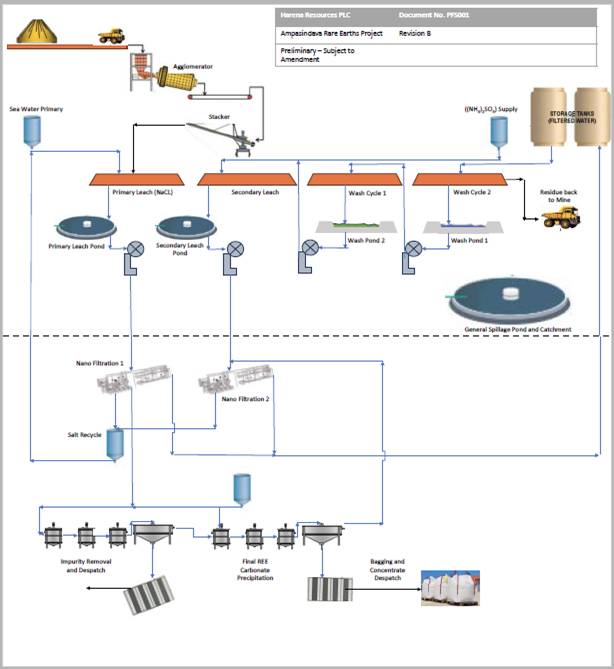
The indicative and conceptual process flow sheet is indicated below in Figure 1.
|
|
|
Figure 1. Conceptual Flow Sheet for the Ampasindava Project Heap Leach Ores |
Organisational Planning
The Ampasindava Project organisational chart is listed below in Figure 2. The organisational chart allocates operational responsibility amongst the functional contractors and service providers.
Each functional contractor and service provider will include their required personnel structures and staff numbers in the tender procurement process. This will allow the Company to scale the camp and personnel transport facilities accordingly.
|
|
|
Figure 2. Organisational Structure of Mine Operations |
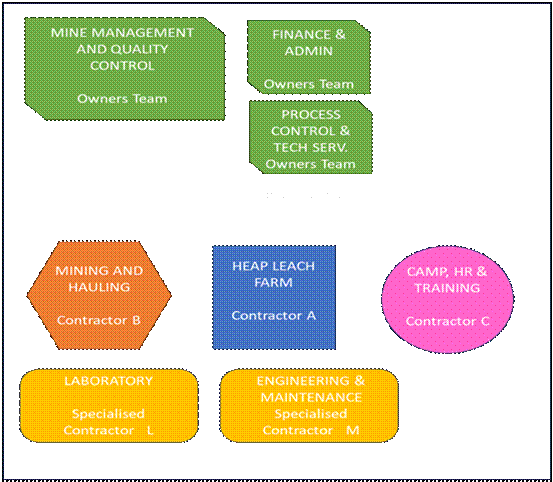
The fully-outsourced procurement model is functionally attractive for the construction and operation of remote mining operations. The specialist engineering and operations are left to functional experts and owner’s mine management can oversee and focus on the core mineral beneficiation function.
It is expected that at least 50% of the mine personnel will live in private accommodation in villages nearby.
Capital and Operating Costs
The capital cost estimate is broken down into the main areas of infrastructure, camp and offices, mining and processing plant and associated project costs, as shown in Table 3. The mining capital cost estimate was developed by Harena with input from contract mining service providers elsewhere in Africa and the general and plant capital cost estimate was developed by first order assessments from other projects located globally.
The capital estimate is subject to a study upgrade where the PFS will be enhanced to definitive level and the capital estimates will be supported by design criteria and a higher level of supplier enquiries and quotes.
Table 3. Ampasindava Project summary of CAPEX breakdown (in US$M).
|
Breakdown |
Area |
Est |
USDm |
|
|
Management |
Owners Cost |
Budget |
3.0 |
|
|
Design and Build |
Est % |
18.0 |
||
|
Funding Cost and Fees |
Est |
9.0 |
||
|
Contingency |
Total % |
4.0 |
||
|
Mining Fleet |
Mixed Plant |
Est |
8.5 |
|
|
Heap Farm & Process |
Earthworks and Engineering |
Est |
7.0 |
|
|
Leaching Infrastructure |
Eng |
10.1 |
||
|
Power and Water |
Est |
14.0 |
||
|
RO and Nano Filtration |
Est & Quote |
60.0 |
||
|
Other Infrastructure |
Roads and Camp |
Est |
5.2 |
|
|
Water Borne and Other |
Est |
0.8 |
||
|
Communication and FIFO |
Est |
2.7 |
||
|
Total |
|
|
142.34 |
|
|
Ongoing |
|
|
19.00 |
|
|
Total LOM
Closure Costs |
|
Est |
161.39
14.5 |
|
The operating cost estimates were developed in loose collaboration with mining contractors from other African projects, engineering consultants in Australia and other local cost indexes.
The operating costs were prepared using the WBS and some equipment lists generated for the project. These estimates were prepared in US$.
Table 4. A summary of the operating costs estimate broken down into respective components.
|
OPEX Breakdown |
LOM OPEX US$m |
Average Annual OPEX, US$m |
Average OPEX, US$/kg REO |
Average OPEX, US$/tonne ROM |
% of Total |
|
Mining |
844.8 |
42.2 |
11.5 |
9.6 |
30.8 |
|
Processing |
1,050.6 |
52.5 |
14.7 |
11.9 |
38.3 |
|
Other Direct Costs |
499.5 |
25.1 |
7.0 |
5.7 |
18.3 |
|
Overhead |
343.9 |
19.2 |
4.8 |
3.9 |
12.6 |
|
TOTAL |
2,743 |
136.9 |
38.5 |
31.1 |
100 |
1.14 Manning and Personnel
It is intended to source skilled and semi-skilled staff under the following guiding principles:
|
• |
Local First, |
|
• |
Regional Second, |
|
• |
National Third, and |
|
• |
International only for highly specialised and temporary assignments. |
The Paterson system of job ranking will be used and there will be no discrimination on the basis of gender, age, race or disability. Thus, all appointments will be merit based.
Approximately only 8 Expatriate Staff will be forecast to work at the operation during the initial years. These will be specialist Process and Engineering skills that will assist in reaching the demanding production rate of 5 million tonnes processed per annum.
On the job training and skills development of Malagasy professionals will allow these expatriate employees to retreat. Most staff will be encouraged to live in nearby towns and establish localised homes and encourage a family working environment.
Table 5. Operational Manning Estimate
|
Functional Element |
Number |
Owner |
|
Owners Management |
10 |
Owner |
|
Mining |
169 |
Contractors plus |
|
Processing |
62 |
Owner/Contractor |
|
Engineering |
66 |
Contractor |
|
SHEC |
42 |
Contractor |
|
Admin |
29 |
Contractors |
|
Total |
378 |
Please refer to the PFS announcement available on Harena’s website for an Employment Organigram for the Ampasindava Project Rare Earth Mine.
Next Steps – Proof of Concept Plant
The critical next step for all leach operations is the test and proof that the design process operates under ambient conditions in the field adjacent to the mineral source. Harena plans to permit and construct a Proof of Concept (PoC) plant at the mine processing site. This exercise will take approximately 9 months and will operate for as long is necessary to provide de-risked operating confirmation of the process and leach lixiviant requirements, the environmental outcomes and the economic and technical viability of the planned operation.
Following successful deployment of the PoC, the Company will move to further design and a Decision to Mine which would launch construction and project activities proper.
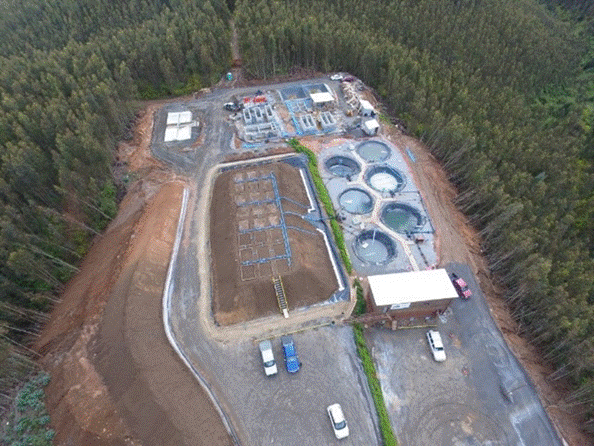
The image below in Figure 3 is a representative Project in Chile but is a good representation of a Proof of Concept heap leach and recovery mine plant. It appears that about 5,000 to 6,000 tonnes was heap leached here.
|
|
|
Figure 3. Representative image of a PoC plant operating in Chile |
Project planning for the PoC project includes the following steps:
The Company wishes to fast-track progress on the Proof of Concept Plant. Validation of an in-house metallurgical design flowsheet is essential for funding and market confidence. This process can take up to 12 months or more depending on results achieved.
The PoC plant development process will be staged. The first stage will be as follows:
|
1. |
Mining Permit for Extraction; |
|
2. |
Interim environmental approval from ONE; |
|
3. |
Social and regional approvals and acknowledgement from local stakeholders; and |
|
4. |
Construction commences to facilitate permanent laboratory. |
The process to be followed will be:
|
• |
Building of a life of mine shed at site which will accommodate suitable numbers of columns, small cribs and then larger cribs to be acquired in country; |
|
• |
Diesel power supply for lighting, pumps and fans; |
|
• |
Cement mixer type agglomerator and hand held material handling; |
|
• |
Suitable starter laboratory such that the works can be measured and assessed; |
|
• |
Small salts storage and mixing area with appropriate ventilation and handling facilities; |
|
• |
Small office and ablutions to provide support; and |
|
• |
Fit for purpose communications infrastructure. |
Based on success achieved operating the on-site facility, the PoC will be expanded into the main facility immediately upon activation thereof. This will be termed stage 2. The process to be followed will be:
|
a. |
Appointment of the technical team to lead mining, leaching and recovery. |
|
b. |
Brief level 1 design of the PoC mine and limited infrastructure – much can be disposable. |
|
c. |
Individual scopes of work for 4 packages representing the four areas of operation. These should reflect a minimalistic approach for limited services. |
|
d. |
Approval of program and budget from Ionic RE Executive. |
|
e. |
Submission of Environmental Amendment to ESIA. |
|
f. |
Follow on application to Mines Department for exemption to commence on small scale. |
|
g. |
Regulatory approval/exemption from Ministry. |
|
h. |
Procurement Inquiries to approved vendors for equipment and services as required. |
|
i. |
Procurement request for Interest on various contract works with local approved construction and engineering and earthworks companies. |
|
j. |
Communication and relocation of limited affected persons. |
|
k. |
Contractor approval and execution of main two contractors for primary construction, power supply, water and other services including base temporary roads. |
|
l. |
Operational plan from same two contractors, if possible. |
|
m. |
Development of technical and management control systems for Rwenzori RM and Ionic RE. |
|
n. |
Mobilisation to site and commencement of 1st pad and temporary infrastructure. |
Schedule
Initial planning for the demo plant to have completed its purpose was set at a time period of 240 days. Contingent issues affecting the schedule are:
|
• |
Effective planning and adequate scope inclusions; |
|
• |
Permissions from the Ministries and the possible need for exemptions/deferrals; |
|
• |
Logistic solutions and regulatory impacts; |
|
• |
Long Lead Time items, such as the RO plants and other, and |
|
• |
Re-iterations and the ease with which these can be commenced.
|
Budget for PoC
The budget for the demo plant currently stands at US$11.5m to be spent after award of the Mining Permit Exploitation and the rising of capital to construct.
The major cost unknown is not the construction cost and this amount may be adequate. However, the duration of operation of the PoC mine could require significant contingent provisions.
The approach would be that if an early enough confidence can be achieved with the initial 90 days plus 30 days operation of the leach pad and assuming that regulatory licences have been issued, an opportunity is created for an accelerated build of the mine can be commenced, making the extended operation of the PoC mine much more acceptable and somewhat more cost effective.
Please refer to the PFS announcement available on Harena’s website for a summary of the budget for Proof of Concept Construction Capital.
Permitting
The conversion of a mining exploration licence (PR) to a mining exploitation licence (PE) in Madagascar is primarily governed by Law No. 2023-007 (New Mining Code). This process is managed by the Bureau du Cadastre Minier de Madagascar (BCMM) under the authority of the Ministry of Mines.
Current requirements for conversion (transformation) include:
Environmental and Social Compliance
|
• |
Environmental Impact Study (EIE); |
|
• |
Social Responsibility Plan (PRSE): Applicants must submit a plan for social responsibility and contribute to the Mining Fund for Social and Community Investment (FMISC); and |
|
• |
Environmental Rehabilitation Plan. |
Technical and Financial Requirements
|
• |
Pre-Feasibility Study; |
|
• |
Cahier des Charges Minières (CCM): Every permit must include a specifications book detailing specific technical and financial obligations; and |
|
• |
Workforce Requirements |
Legal Status and Tenure
Eligibility where the applicant must be a legal entity registered under Malagasy law. Under the new code, a PE is valid for 25 years, renewable once for 15 years (reduced from the previous 40-year term). The permit holder must secure a lease agreement or prior agreement from the landowner for surface rights.
Applications for transformation are currently being processed by the BCMM following the lift of a previous moratorium, though a ministerial order from the Minister in charge of Mines is still required for each final approval.
Pricing Assumptions and Forecast Methodology
The economic model has been developed using long term pricing from a recognised market analyst and Artificial Intelligence forecast consensus pricing.
The base case economic indicators have been derived using the market analyst pricing which has been developed prior to the recently highly publicised interventions into the Rare Earths market by an alliance of Western Nations concerned by the dominant position of China in the processing and refining of these products.
In regard to the different forecasts for the magnet metals, prices forecast by AI are Nd (1/3rd), Pr (1/3rd), Dy (2/3rds) and Tb (1/3rd) higher than the more conservative and earlier forecast by the market analyst.
These forecasts are underpinned by open-sourced comprehensive analysis of global supply and demand trends. On the demand side, projections reflect anticipated growth in key sectors such as electric vehicle drive-trains, wind turbines, energy transition technologies, robotics, and particular military defence applications. Supply assumptions incorporate current global production levels and publicly announced future projects, offering a well-rounded view of the evolving market.
Sensitivity Analysis
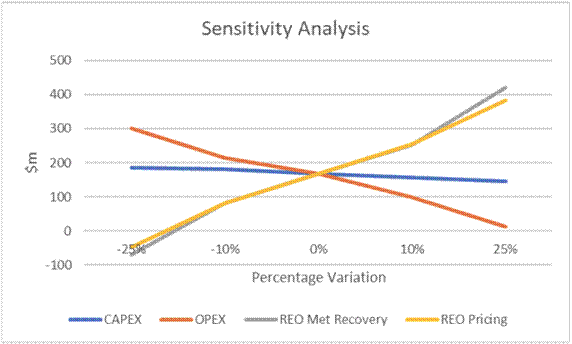
A sensitivity analysis was performed for the Project, highlighting its resilience to variations in capital costs, operating costs, REO recoveries and Prices.
The results of the sensitivity analysis variable intervals of +10%/-10% is indicated in the graph below, highlighting that the Project is particularly sensitive to REO prices received and metallurgical recoveries. This would imply that particular care will be taken during the operations of the afore-mentioned Proof of Concept plant to optimise these recoveries, even at the expense of some extra cost inputs.
|
|
|
Figure 4. Ampasindava Project Sensitivity Analysis for base case conditions. |
Forward Work Program
The forward work program has been allocated to three distinct estimated time related milestones.
|
Award of Mining Licence and further permitting requirements |
Q1 2026 |
|
Operations of Proof of Concept Plant and feed results into final design parameters |
Q2 2027 |
|
Detailed design and Financial Investment Decision (FID) |
Q4 2027 |
The Company has developed a Joint Roadmap to production as a communication and planning tool for the Project and financial stakeholders. The stakeholders of the Project have been identified as:
|
• |
Members of Harena Rare Earths PLC and investors; |
|
• |
Government of Madagascar in many regulatory and fiscal forms; |
|
• |
Local residents and stakeholders at the mine site and regionally; |
|
• |
Employees of various group companies; |
|
• |
Contractors and service providers; |
|
• |
Customers, other clients and buyers; and |
|
• |
Other interested Governments and product beneficiaries. |
Please refer to the PFS announcement available on Harena’s website for the Ampasindava project process flow mapping.
Material Assumptions and Outcomes
The PFS was completed with the following material assumptions:
|
• |
Clay winning will be via several (up to 5) satellite pits operating simultaneously and sharing the mining and trucking fleet. |
|
• |
Ore to be excavated through conventional mobile machine operations and trucked to the heap leach farm. No requirement for blasting. |
|
• |
Topsoil will be stockpiled in accessible piles near the mining area so it can be used for rehabilitation once a section of the pit has been backfilled and contoured to final landform. |
|
• |
The processing heap leach farm will be 5.2 Mtpa and the monthly requirement for material movement will on average be 280,000 cubic metres (bcm) of mineralised clay per month. An additional 35,000 bcm of topsoil and waste is to be moved and stored near the pits each month. |
|
• |
The mine grade has been assumed to be 75% of the average of two bulk samples excavated from the orebody. This aligns with a concerted effort to selectively mine high-grade areas of the orebody. |
|
• |
Overall metallurgical yield has been calculated at 53% TREO. Individual oxide elemental recoveries have been applied as per the test work results. |
|
• |
Revenue is based on individual REO prices as supplied by the market analyst multiplied by individual oxide recoveries. These values reflect gross forward looking revenue streams. An individual payability factor per metal is assumed where higher value/demand products can negotiate better differential payabilities. The highest payability assumed is 80% for Gd2O3 and the lowest is 40% for CeO2. The average basket payability achieved is 75%. |
|
• |
The economic model is denominated in US dollars (USD). |
|
• |
Transportation charges for MREC is estimated at $200/tonne concentrate shipped. Transport charges ex-Madagascar to the separation plant customer have been reflected within the estimated payability factor. |
|
• |
A mine life of 20 years has been assessed for practicality. The African, remote location has meant a discount factor 0f 10% has been used. The tax rate is 20% and the royalty rate is 5% of gross value. |
|
• |
Generally, sea-borne logistics will be used for off-mine transport and supplies/delivery of equipment. Air-borne logistics will be used for personnel travel outside the mine region. |
|
• |
Power consumption is moderate, at about 4MW and will be provided by hybrid solar supported by diesel generation. |
|
• |
Mine plant will initially be contractor owned with a support facility for local truck driver economic aide to purchase mine spec trucks and provide contract deliveries to the heap leach farm. |
|
• |
Camp operations will be outsourced, including the capital and construction. |
Material Modifying Factors
The following modifying factors were considered in relation to the assessment of this PFS:
Location
The Ampasindava Project is located in the eastern part of the Ampasindava Peninsula, Antsiranana Province on the northwest coast of Madagascar, approximately 500 km north of Madagascar’s capital city Antananarivo. The nearest major town and administrative centre of the region is called Ambanja and is located some 40 km to the northeast of the project area.
The PFS area has ample land for mine development, processing infrastructure, and future expansions.
The proposed pits and processing facility will be well-connected via a network of paved roads and private gravel roads, facilitating efficient ore transport. The entire mine zone and proposed heap leach farm will be within 10kms of each other.
Power Supply
Power is not readily available in the project area from the national grid. Power at the mine site, expected to require some 6MW, will be supplied by diesel generator units and supplemented by solar installation and battery storage for low critical applications.
The Company will supply the electrical generator equipment for the heap leach processing plant and a 11kV main substation including 2 incomer circuit breakers. In addition, diesel tanks, pump and piping from the tank to the gensets as well as the paralleling and synchronisation control system.
Generator specifications KH-1000GF set 6 Including diesel boxes, generator control units and 400V switchgear. Also installed will be a DMC 1500 power command paralleling system to balance loads from the power plant.
Water Supply and Management
The Project will incorporate advanced water recycling technologies, including ultrafiltration and reverse osmosis (RO) systems, to minimise freshwater consumption and ensure minimal industrial effluent discharge. Freshwater is available through on-site bores. Sea water is abundant and nearby as the project is within 3km of the coast. The ore beneficiation process is designed for high water efficiency, with >75% of process water recirculated within the plant.
Water consumption for the Ampasindava Project is expected to be low. This basis is derived from:
|
• |
Net positive water balance of the process; |
|
• |
The project areas high annual rainfall; |
|
• |
The process arrangement using heap leaching and maximised water recycling using membrane technology for reagent recovery, resulting in fresh water recovery; and |
|
• |
Given the low forecast water consumption, it is proposed that water for both processing operations and dust management is to be sourced by water harvesting ponds on site and from the mining pit. |
During periods of extended dry weather, it is proposed that water could be sourced from boreholes up to 10km from the project area, although local groundwater resources potentially also a source, however, limitation on drawing from local groundwater could limit this option.
Labour and Accommodation
The operation is to be staffed by a residential workforce. No fly in – fly out other than specialised technical and management skills is envisaged and the number of expatriates staff is intended to be low, and to be being phased out over the first 7 years of operations.
The region is poverty stricken and there is no shortage of unskilled and semi-skilled labour. A workforce of semi-skilled and artisanal workers is available in nearby townships and population centres. The closest major population centre is Ambanja, which has a population of 50,000.
The township of Anjiabory is approximately 10km from the project site and the intent is to source local operations staff from the immediate districts and train staff accordingly.
Environmental
The Company has submitted seven environmental monitoring reports. These reports were completed in order to be compliant to the regulation of the Office National de l’Environnement (ONE) and the Ministry of Mines of Madagascar.
From the point of view of environmental considerations, no sensitive area has yet been established within the exploration license for the period. However, the northeastern part of that exploration license, and an area of approximately 100 km2, is located in a priority area for the establishment of protected areas.
The environmental and social programs will strive to meet international IFC standards.
For further information please contact:
|
Harena Rare Earths Plc Ivan Murphy, Executive Chairman Allan Mulligan, Executive Technical Director
|
+44 (0)20 7770 6424
|
|
SP Angel – Joint Broker Ewan Leggat / Josh Ray (Corporate Finance)
|
+44 (0)20 3470 0470 |
|
Marex Financial – Corporate Advisor Angelo Sofocleous / Keith Swann / Matt Bailey (Broking) |
+44 (0)20 7655 6000 corporate@marex.com |
|
Allenby Capital – Financial Adviser & Joint Broker Jeremy Porter / Vivek Bhardwaj (Corporate Finance) Amrit Nahal / Kelly Gardiner (Sales & Corporate Broking) |
+44 (0)20 3328 5656 info@allenbycapital.com |
|
Muriel Siebert & Co. – US Financial Adviser & Broker Ajay Asija, Co-Head of Investment Banking |
+1 (917) 902 7823 aasija@siebert.com |
|
Celicourt Communications – Public Relations Mark Antelme / Charles Denley-Myerson |
+44 (0)20 7770 6424 harena@celicourt.uk |
#ECR ECR Minerals PLC – 2025 Operational Highlights
 ECR Minerals plc (AIM: ECR), the gold exploration and development company focused on Australia, is pleased to provide a year-end operational update on recent achievements across its Queensland portfolio, together with the key milestones that the Company aims to deliver in early 2026.
2025 Operational Highlights
Blue Mountain – Strong Alluvial Results & Visible Gold
ECR delivered some of its strongest alluvial drilling results to date, including visible coarse gold at Upper Kariboe Creek, high-grade intersections up to 6.52 grammes/bank cubic metre (g/bcm), and wash-plant trials at Lower Patterson, averaging 0.35 g/bcm under real-world conditions. Multiple unmined creek flats are now identified as potential start-up production zones.
Lolworth – Maiden Drilling Confirms Gold-Silver System
The maiden drilling programme returned multiple shallow gold and silver intercepts, including 2m @ 3.57 grammes/tonne (g/t) Gold and 4m @ 7.18 g/t Silver, indicating a broader mineralised system with strong upside and several follow-up drill targets now defined. Silver mineralisation has now been mapped well beyond the areas drilled.
Raglan – Acquisition Pending Completion & Production Pathway Secured
ECR has entered into a legally binding contract for the acquisition of the fully permitted Raglan alluvial gold project, securing a mining lease, 60-tonnes per hour wash plant, camp and mobile fleet. Following completion of the acquisition, Raglan is expected to enter production ahead of Blue Mountain and strengthen the Company’s broader Queensland production strategy. Completion of the acquisition remains expected to take place before the end of 2025.
As part of preparations for its next phase of growth, ECR has also launched a refreshed and updated website, reflecting the Company’s progression from a pure explorer towards gold production.
Expected 2026 Operational Milestones
ECR enters the new year with a focused and deliverable plan:
- Raglan: Commencement of first alluvial gold production, following completion of acquisition, site preparation and mobilisation of personnel.
- Blue Mountain: Progression towards early-stage production, building on visible gold, expanding mineable corridors and further wash-plant trials.
- Operational integration between Raglan and Blue Mountain, seeking to establish a scalable, repeatable alluvial production model.
- Lolworth: Ongoing exploration for gold, silver and REE targets.
- Progression of the proposed Creswick JV discussions with Bold Gold.
- Strategic use of the aggregate A$76m of ECR and Raglan tax losses, expected to materially enhance early-stage future profitability for Raglan and Blue Mountain.
ECR Chairman Nick Tulloch commented: “2025 has been a pivotal year for ECR. Across the portfolio we have delivered meaningful progress: Blue Mountain continues to outperform expectations with visible coarse gold and expanding mineable areas; Lolworth has confirmed itself as a multi-metal system with gold, silver and rare earth potential; and the forthcoming completion of our Raglan acquisition gives us a fully permitted, turnkey alluvial gold operation ready to move towards production. Together, we consider that these milestones place ECR in its strongest operational position in recent years.
“We believe that the year ahead will see ECR evolve from a pure explorer into a company with nearer-term production and cashflow potential, supported by two complementary alluvial projects and substantial tax losses that enhance early economics. We enter 2026 with alignment, momentum and a clear plan to deliver a step-change year for the business.
“On behalf of the Board, I would like to wish all our shareholders, partners and stakeholders a safe and happy Christmas. We greatly appreciate your continued support and look forward to a transformational year ahead for ECR Minerals.”
Review of Announcement by Qualified Person
This announcement has been reviewed by Adam Jones, Chief Geologist at ECR Minerals Plc. Adam Jones is a professional geologist and is a Member of the Australian Institute of Geoscientists (MAIG). He is a qualified person as that term is defined by the AIM Note for Mining, Oil and Gas Companies.
FOR FURTHER INFORMATION, PLEASE CONTACT:
|
ECR Minerals Plc |
Tel: +44 (0) 20 8080 8176 |
|
Nick Tulloch, Chairman Andrew Scott, Director |
info@ecrminerals.com |
|
Website: www.ecrminerals.com |
|
|
Allenby Capital Limited |
Tel: +44 (0) 3328 5656 |
|
Nominated Adviser and Joint Broker |
info@allenbycapital.com |
|
Alex Brearley / Nick Naylor / Vivek Bhardwaj (Corporate Finance) |
|
|
Kelly Gardiner (Sales and Corporate Broking) |
|
|
Axis Capital Markets Limited |
Tel: +44 (0) 203 026 0320 |
|
Joint Broker |
|
|
Lewis Jones |
|
|
SI Capital Ltd |
Tel: +44 (0) 1483 413500 |
|
Joint Broker |
|
|
Nick Emerson |
|
|
Brand Communications |
Tel: +44 (0) 7976 431608 |
|
Public & Investor Relations |
|
|
Alan Green |
ABOUT ECR MINERALS PLC
ECR Minerals is a mineral exploration and development company operating through two wholly owned Australian subsidiaries ECR Minerals (Australia) Pty Ltd (“ECR Australia”) and ECR Minerals (Queensland) Pty Ltd (“ECR Queensland”).
ECR Australia owns the Bailieston and Creswick gold projects in central Victoria, Australia as well as the Tambo gold project in eastern Victoria.
ECR Queensland has two approved exploration permits over the Blue Mountain alluvial gold project in central Queensland, Australia, which it is currently working to bring into production. It also has three approved exploration permits covering 946 km2 over a relatively unexplored area in Lolworth Range in northern Queensland. Furthermore, ECR Queensland has also submitted a licence application at Kondaparinga which is approximately 120km2 in area and located within the Hodgkinson Gold Province, 80km NW of Mareeba, North Queensland.
Following the sale of the Avoca, Moormbool and Timor gold projects in Victoria, Australia to Fosterville South Exploration Ltd (TSX-V: FSX) and the subsequent spin-out of the Avoca and Timor projects to Leviathan Gold Ltd (TSX-V: LVX), ECR Australia has the right to receive up to A$2 million in payments subject to future resource estimation or production from these projects.
ECR Australia also has approximately A$75 million of unutilised tax losses incurred during previous operations.
#AYM Anglesey Mining PLC – Half yearly report for the six months to 30 September 2025
 Chairman’s Statement and Management Report
During the half year period, we were pleased to publish a conceptual study of a high-density fluid hydro-power energy storage project at the mine.
The findings of the conceptual study led to the commencement of a pre-feasibility study (PFS) in the energy storage scheme and we have published the proposed operational methodology and revenue streams associated with the project in terms of both Long Duration Energy Storge (LDES) and how that might be the catalyst for the commencement of mining of the Parys Mountain VMS mineral deposits.
Our investigations show there is a positive business case for the energy project on a standalone basis, that the risks identified thus far can be reasonably overcome or mitigated. Elements of the energy storage project scope, for example: the de-watering and refitting of the Morris shaft for material and personnel hoisting, the dewatering of the workings emanating from the Morris shaft 280m below the surface, the upgrading of the power-line to site, the on-going environmental and social studies and the deployment of impact avoidance, mitigation and compensation strategies, are each synergistic with the first steps of establishing a modern underground mine on Parys Mountain.
It is an essential and clear intent of the energy project that Anglesey Mining retains all the optionality that it currently has for the construction and commissioning of an underground mine, and that the hydro energy pumped storage project should not detract from those options over the medium and long term.
In the period to the 30th September 2025, we unfortunately had to announce the termination of our management rights and obligations over Grangesberg Iron AB (GIAB). Under a shareholders’ agreement our 100% owned subsidiary, Angmag AB, and therefore Anglesey Mining, had management rights with the ability to appoint the majority of the Board of GIAB. The Agreement had an initial term of 10 years from 28 May 2014, extendable on a year-to-year basis, unless terminated on one year’s notice. On 28 May 2024, Eurmag AB, which holds the remaining 50.2% of GIAB, gave notice of termination of the Agreement.
As at 31 December 2024, GIAB had loans outstanding to its senior debt holder of approximately US$9.0 million. Despite the best efforts of the Company, revised terms and conditions for the senior debt could not be arrived at such that the Board of Anglesey Mining could then explore the raising of funds to facilitate a settlement of this debt and therefore management of GIAB reverted to Eurmag AB, GIAB’s 50.2% shareholder, with Anglesey retaining its 49.8% ownership interest.
Post the end of the half year period, on 5 December 2025 the Company announced that it had entered into a binding letter of intent with its largest shareholder and largest creditor Energold Minerals Inc. whereby Anglesey will eliminate approximately £4 million of debt in exchange for its interest in GIAB and holding of Labrador Iron Mines Holdings Limited, reducing total outstanding debt to approximately £100,000.
Energold has also provided immediate funding to Anglesey of £350,000 through the purchase of non-voting exchangeable warrants.
The Board believes that the restructuring of the Company’s balance sheet, in addition to the investment of fresh funds by Energold, will place the Company in a materially stronger position from which to pursue its primary objective of advancing Parys Mountain.
Finally, at the beginning of December 2025, we were delighted to welcome Brendan Cahill and Jim Williams to Anglesey’s board.
Financial
The group had no revenue for the period. The loss for the six months to 30 September 2025 was £334,699 (2024 comparative period £311,052) and expenditure on the mineral properties in the period was £50,955 compared to £125,479 in the same period in 2024.
Net current liabilities as at 30 September 2025 were £370,085 compared to net current liabilities of £182,582 at 31 March 2025.
Andrew King
Chairman
19 December 2025
Unaudited condensed consolidated income statement
| Notes | Unaudited six months ended 30 September 2025 | Unaudited six months ended 30 September 2024 | ||
| All operations are continuing | £ | £ | ||
| Revenue | – | – | ||
| Expenses | (236,591) | (213,575) | ||
| Equity-settled employee benefits | – | (4,230) | ||
| Investment income | 883 | 2,169 | ||
| Finance costs | (98,957) | (95,384) | ||
| Foreign exchange movement | (34) | (32) | ||
| Loss before tax | (334,699) | (311,052) | ||
| Taxation | 8 | – | – | |
| Loss for the period | 7 | (334,699) | (311,052) | |
| Loss per share | ||||
| Basic – pence per share | (0.1)p | (0.1)p | ||
| Diluted – pence per share | (0.1)p | (0.1)p | ||
Unaudited condensed consolidated statement of comprehensive income
| Loss for the period | (334,699) | (311,052) | ||
| Other comprehensive income | ||||
| Items that may subsequently be reclassified to profit or loss: | ||||
| Change in fair value of investment | 14 | (449,562) | 388,683 | |
| Foreign currency translation reserve | 13,912 | 17,654 | ||
| Total comprehensive (loss) for the period | (770,349) | 95,285 | ||
All attributable to equity holders of the company
Unaudited condensed consolidated statement of financial position
| Notes | Unaudited 30 September 2025 | 31 March 2025 | ||
| £ | £ | |||
| Assets | ||||
| Non-current assets | ||||
| Mineral property exploration and evaluation | 9 | 17,043,457 | 16,992,502 | |
| Property, plant and equipment | 204,687 | 204,687 | ||
| Investments | 10 | 777,119 | 1,226,681 | |
| Deposit | 129,727 | 128,857 | ||
| 18,154,990 | 18,552,727 | |||
| Current assets | ||||
| Other receivables | 35,358 | 36,988 | ||
| Cash and cash equivalents | 43,791 | 44,264 | ||
| 79,149 | 81,252 | |||
| Total assets | 18,234,139 | 18,633,979 | ||
| Liabilities | ||||
| Current liabilities | ||||
| Trade and other payables | (449,234) | (263,834) | ||
| (449,234) | (263,834) | |||
| Net current liabilities | (370,085) | (182,582) | ||
| Non-current liabilities | ||||
| Loans | (4,231,211) | (4,046,102) | ||
| Long term provision | (50,000) | (50,000) | ||
| (4,281,211) | (4,096,102) | |||
| Total liabilities | (4,730,445) | (4,359,936) | ||
| Net assets | 13,503,694 | 14,274,043 | ||
| Equity | ||||
| Share capital | 11 | 10,359,056 | 10,359,056 | |
| Share premium | 12,910,853 | 12,910,853 | ||
| Currency translation reserve | (68,797) | (82,709) | ||
| Retained losses | (9,697,418) | (8,913,157) | ||
| Total shareholders’ funds | 13,503,694 | 14,274,043 | ||
All attributable to equity holders of the company
Unaudited condensed consolidated statement of cash flows
| Notes | Unaudited six months ended 30 September 2025 | Unaudited six months ended 30 September 2024 | ||
| £ | £ | |||
| Operating activities | ||||
| Loss for the period | (334,699) | (311,052) | ||
| Adjustments for: | ||||
| Investment income | (883) | (2,169) | ||
| Finance costs | 98,957 | 95,384 | ||
| Share based payments charge | – | 4,230 | ||
| Foreign exchange movement | 34 | 32 | ||
| (236,591) | (213,575) | |||
| Movements in working capital | ||||
| Decrease/(increase) in receivables | 1,630 | 9,385 | ||
| Increase in payables | 182,627 | 4,041 | ||
| Net cash used in operating activities | (52,334) | (200,149) | ||
| Investing activities | ||||
| Investment income | 13 | 3 | ||
| Mineral property exploration and evaluation | (48,118) | (274,755) | ||
| Net cash used in investing activities | (48,105) | (274,752) | ||
| Financing activities | ||||
| Issue of share capital | – | 567,750 | ||
| Movements on loans | 100,000 | (29,207) | ||
| Net cash generated from financing activities | 100,000 | 538,543 | ||
| Net increase in cash and cash equivalents | (439) | 63,642 | ||
| Cash and cash equivalents at start of period | 44,264 | 219,685 | ||
| Foreign exchange movement | (34) | (32) | ||
| Cash and cash equivalents at end of period | 43,791 | 283,295 | ||
All attributable to equity holders of the company
Unaudited condensed consolidated statement of changes in group equity
| Share capital £ |
Share premium £ |
Currency translation reserve £ |
Retained losses £ |
Total £ |
|
| Equity at 1 April 2025 – audited | 10,359,056 | 12,910,853 | (82,709) | (8,913,157) | 14,274,043 |
| Total comprehensive loss for the period: |
|||||
| Loss for the period | – | – | – | (334,699) | (334,699) |
| Change in fair value of investment | – | – | – | (449,562) | (449,562) |
| Exchange difference on translation of foreign holding |
– | – | 13,912 | – | 13,912 |
| Total comprehensive loss for the period |
– | – | 13,912 | (784,261) | (770,349) |
| Shares issued | – | – | – | – | – |
| Share issue expenses | – | – | – | – | – |
| Equity-settled employee benefits | – | – | – | – | – |
| Equity at 30 September 2025 – unaudited |
10,359,056 | 12,910,853 | (68,797) | (9,697,418) | 13,503,694 |
| Comparative period | |||||
| Equity at 1 April 2024 – audited | 9,711,764 | 12,963,103 | (89,589) | (8,097,527) | 14,487,751 |
| Total comprehensive loss for the period: |
|||||
| Loss for the period | – | – | – | (311,052) | (311,052) |
| Change in fair value of investment | – | – | – | 388,683 | 388,683 |
| Exchange difference on translation of foreign holding |
– | – | 17,654 | – | 17,654 |
| Total comprehensive loss for the period |
– | – | 17,654 | 77,631 | 95,285 |
| Shares issued | 635,000 | – | – | – | 635,000 |
| Share issue expenses | – | (67,250) | – | – | (67,250) |
| Share issue expenses | – | – | – | 4,230 | 4,230 |
| Equity at 30 September 2024 – unaudited |
10,346,764 | 12,895,853 | (71,935) | (8,015,666) | 15,155,016 |
All attributable to equity holders of the company
Notes to the accounts
1. Basis of preparation
This half-yearly financial report comprises the unaudited condensed consolidated financial statements of the group for the six months ended 30 September 2025. It has been prepared in accordance with the Disclosure and Transparency Rules of the Financial Conduct Authority, the requirements of IAS 34 – Interim financial reporting (as adopted by the UK) and using the going concern basis. The directors are not aware of any events or circumstances which would make this inappropriate. It does not constitute financial statements within the meaning of section 434 of the Companies Act 2006 and does not include all of the information and disclosures required for annual financial statements. It should be read in conjunction with the annual report and financial statements for the year ended 31 March 2025 which is available on request from the company or may be viewed at www.angleseymining.co.uk/accounts.
The financial information contained in this report in respect of the year ended 31 March 2025 has been extracted from the report and financial statements for that year which have been filed with the Registrar of Companies. The report of the auditors on those accounts did not contain a statement under section 498(2) or (3) of the Companies Act 2006 and was not qualified. The half-yearly results for the current and comparative periods have not been audited or reviewed by the company’s auditor.
2. Significant accounting policies
The accounting policies applied in these unaudited condensed consolidated financial statements are consistent with those set out in the annual report and financial statements for the year ended 31 March 2025. There are no new standards, amendments to standards or interpretations that are expected to have a material impact on the group’s results.
The group has not applied certain new standards, amendments and interpretations to existing standards that have been issued but are not yet effective. They are either not expected to have a material effect on the consolidated financial statements or they are not currently relevant for the group.
3. Risks and uncertainties
The principal risks and uncertainties set out in the group’s annual report and financial statements for the year ended 31 March 2025 remain the same for this half-yearly period. They can be summarised as: development risks in respect of mineral properties, especially in respect of permitting and metal prices; liquidity risks during development; and foreign exchange risks. More information is to be found in the 2025 annual report – see note 1 above.
4. Statement of directors’ responsibilities
The directors confirm to the best of their knowledge that:
(a) the unaudited condensed consolidated financial statements have been prepared in accordance with the requirements of IAS 34 Interim financial reporting (as adopted by the UK); and
(b) the interim management report includes a fair review of the information required by the FCA’s Disclosure and Transparency Rules (4.2.7 R and 4.2.8 R).
This report and financial statements were approved by the board on 19 December 2025 and authorised for issue on behalf of the board by Andrew King, interim chairman and Rob Marsden, chief executive officer.
5. Activities
The group is engaged in mineral property development and currently has no turnover. There are no minority interests or exceptional items.
6. Earnings per share
The loss per share is computed by dividing the loss attributable to ordinary shareholders of £0.3 million by 484 million – the weighted average number of ordinary shares in issue during the period. The comparative figures were a loss to 30 September 2024 of £0.3m divided by 442 million shares. However where there are losses the effect of outstanding share options is not dilutive.
7. Business and geographical segments
There are no trading revenues. The cost of all activities charged in the income statement relates to exploration and evaluation of mining properties. The group’s income statement and assets and liabilities are analysed as follows by geographical segments, which is the basis on which information is reported to the board.
Income statement analysis
| Unaudited six months ended 30 September 2025 | |||||
| UK | Sweden – investment | Canada – investment | Total | ||
| £ | £ | £ | £ | ||
| Expenses | (242,701) | 6,110 | – | (236,591) | |
| Investment income | 883 | – | – | 883 | |
| Finance costs | (92,235) | (6,722) | – | (98,957) | |
| Exchange rate movements | – | (34) | – | (34) | |
| Loss for the period | (334,053) | (646) | – | (334,699) | |
| Unaudited six months ended 30 September 2024 | ||||
| UK | Sweden – investment | Canada – investment | Total | |
| £ | £ | £ | £ | |
| Expenses | (187,450) | (26,125) | – | (213,575) |
| Equity settled employee benefits | (4,230) | – | – | (4,230) |
| Investment income | 2,169 | – | – | 2,169 |
| Finance costs | (88,642) | (6,742) | – | (95,384) |
| Exchange rate movements | – | (32) | – | (32) |
| Loss for the period | (278,153) | (32,899) | – | (311,052) |
Assets and liabilities
| ` | Unaudited 30 September 2025 | |||
| UK | Sweden investment | Canada investment | Total | |
| £ | £ | £ | £ | |
| Non current assets | 17,377,871 | 633,170 | 143,949 | 18,154,990 |
| Current assets | 77,977 | 1,172 | – | 79,149 |
| Liabilities | (4,370,796) | (359,649) | – | (4,730,445) |
| Net assets | 13,085,052 | 274,693 | 143,949 | 13,503,694 |
| Audited 31 March 2025 | ||||
| UK | Sweden investment | Canada investment | Total | |
| £ | £ | £ | £ | |
| Non current assets | 17,326,046 | 633,170 | 593,511 | 18,552,727 |
| Current assets | 80,083 | 1,169 | – | 81,252 |
| Liabilities | (3,993,161) | (366,775) | – | (4,359,936) |
| Net assets | 13,412,968 | 267,564 | 593,511 | 14,274,043 |
8. Deferred tax
There is an unrecognised deferred tax asset of £1.6 million (31 March 2025 – £1.6m) which, in view of the group’s results, is not considered to be recoverable in the short term. There are also capital allowances, including mineral extraction allowances, of £14.5 million (unchanged from 31 March 2025) unclaimed and available. No deferred tax asset is recognised in the condensed financial statements.
9. Mineral property exploration and evaluation costs
Mineral property exploration and evaluation costs incurred by the group are carried in the unaudited condensed consolidated financial statements at cost, less an impairment provision if appropriate. The recovery of these costs is dependent upon the successful development and operation of the Parys Mountain project which is itself conditional on financing being available to fund such development. During the period activities were limited and no drilling took place.
10. Investments
| Labrador | Grangesberg | Total | |
| £ | £ | £ | |
| At 1 April 2024 | 771,564 | 633,170 | 1,404,734 |
| Net change during the period | (178,053) | – | (178,053) |
| At 31 March 2025 | 593,511 | 633,170 | 1,226,681 |
| Net change during the period | (449,562) | – | (449,562) |
| At Unaudited 30 September 2025 | 143,949 | 633,170 | 777,119 |
Labrador – Canada
The group has an investment in Labrador Iron Mines Holdings Limited, (LIM) a Canadian company which is carried at fair value through other comprehensive income. The group’s holding of 19,289,100 shares in LIM (12% of LIM’s total issued shares) is valued at the closing price traded on the OTC Markets in the United States. In the directors’ assessment this market is sufficiently active to give the best measure of fair value, which on 30 September 2025 was 1 US cent per share (2024 – 8 US cents). As at 19 December 2025 the share price was 2 US cents per share.
Grängesberg – Sweden
The group has, through its Swedish subsidiary Angmag AB, a 49.8% ownership interest in Grängesberg Iron AB an unquoted Swedish company (GIAB) which holds rights over the Grängesberg iron ore deposits.
The directors assessed the fair value of the investment in Grängesberg under IFRS 9 and consider the investment’s value at 30 September 2025 to be £633,170.
11. Share capital
| Ordinary shares of 1p | Deferred shares of 4p | Total | ||||
| Issued and fully paid |
Nominal value £ |
Number | Nominal value £ |
Number | Nominal value £ |
|
| At 31 March 2024 | 4,200,931 | 420,093,017 | 5,510,833 | 137,770,835 | 9,711,764 | |
| Issued in the period | 647,292 | 64,729,238 | – | – | 647,292 | |
| At 31 March 2025 | 4,848,223 | 484,822,255 | 5,510,833 | 137,770,835 | 10,359,056 | |
| Issued in the period | – | – | – | – | – | |
| At Unaudited 30 September 2025 | 4,848,223 | 484,822,255 | 5,510,833 | 137,770,835 | 10,359,056 | |
The deferred shares are non-voting, have no entitlement to dividends and have negligible rights to return of capital on a winding up.
12. Financial instruments
| Group | Financial assets classified at fair value through other comprehensive income | Financial assets measured at amortised cost | ||
| Unaudited 30 September 2025 | 31 March 2025 | Unaudited 30 September 2025 | 31 March 2025 | |
| £ | £ | £ | £ | |
| Financial assets | ||||
| Investments | 777,119 | 1,048,628 | – | – |
| Deposit | – | – | 129,727 | 128,857 |
| Other receivables | – | – | 35,358 | 36,988 |
| Cash and cash equivalents | – | – | 43,791 | 44,264 |
| 777,119 | 1,048,628 | 208,876 | 210,109 | |
| Financial liabilities measured at amortised cost | ||||
| Unaudited 30 September 2025 | 31 March 2025 | |||
| £ | £ | |||
| Trade payables | (179,123) | (107,559) | ||
| Other payables | (270,111) | (156,275) | ||
| Loans | (4,231,211) | (4,046,102) | ||
| (4,680,445) | (4,309,936) | |||
Anglesey Mining plc
Directors
Andrew King Chairman
Rob Marsden Chief executive
Douglas Hall Non executive
Brendan Cahill Non executive
Jim Williams Non executive
Registered office address – Parys Mountain, Amlwch, Anglesey, LL68 9RE
Phone 01407 831275 Email mail@angleseymining.co.uk
Registrars MUFG Corporate Markets, 29 Wellington Street, Leeds, LS1 4DL
Share dealing phone 0371 664 0445 Helpline phone 0371 664 0300
Company registered number 01849957
Web site www.angleseymining.co.uk
Shares listed AIM – AYM
#URU URU Metals Limited – Mining Right: Key Regulatory Milestone Met
 URU Metals Limited (“URU” or the “Company”) is pleased to announce that, Lesego Platinum Uitloop (Pty) Ltd (“LPU”), has initiated a share issuance process to comply with South Africa’s empowerment regulations under Mining Charter III. This significant step marks a crucial milestone in fulfilling the requirements for the granting of the mining right by the Department of Mineral Resources and Energy (DMRE) to URU, thereby positioning the Company to advance its exploration and further project development activities.
In alignment with Mining Charter III’s provisions for meaningful participation of Historically Disadvantaged South Africans (HDSA), LPU will allocate 10% of its equity as follows:
· 5% to an Employee Share Ownership Scheme (ESOP): This initiative ensures that the employees of LPU directly benefit from the company’s growth and success, fostering long-term engagement and inclusivity.
· 5% to a newly formed Non-Profit Company (NPC), Uitloop Communities NPC. The NPC will focus on community development and socio-economic upliftment, furthering the mandate to deliver tangible benefits to local stakeholders.
These measures, previously disclosed by the Company, reflect the Company’s commitment to operating in compliance with South African mining legislation and fostering sustainable relationships with employees and surrounding communities.
Clearing the Path for Exploration Progress
The share issuance marks a key regulatory milestone, significantly advancing the process for the Company to secure its mining right. Once granted, the mining right will enable the Company to proceed with the next phase of the exploration program, including:
· Infill Drilling Program: A focused campaign aimed at upgrading the existing resource classification at the Zebediela project.
· Declaration of a Maiden Resource: This phase will target the high-grade nickel-platinum group elements (Ni-PGE) mineralization in the footwall zone, building upon the substantial resource base already identified.
These advancements underline URU’s commitment to maximizing the value of its projects while adhering to regulatory and community-focused best practices.
A Milestone for Sustainable Growth
“We are thrilled to take this significant step towards regulatory compliance and operational progress,” said John Zorbas, CEO of URU.
“The issuance of shares by LPU not only demonstrates our commitment to supporting the principles of Mining Charter III but also solidifies our path toward securing the mining right. This milestone positions us to unlock the immense potential of our project while delivering value to all stakeholders, including our employees and local communities.”
Looking Ahead
As LPU progresses towards mining right issuance and exploration advancements, URU remains focused on operational excellence and stakeholder engagement. The Company looks forward to updating the market on its exploration milestones, including the anticipated maiden resource declaration, in due course.
URU is a mineral exploration and development company focused on advancing its high-potential critical metals projects in South Africa. The Company is committed to creating sustainable value through responsible mining practices, regulatory compliance, and engagement with stakeholders. For more information, visit www.urumetals.com.
Market Abuse Regulation (MAR) Disclosure
This announcement contains inside information for the purposes of Article 7 of the Market Abuse Regulation (EU) 596/2014 as it forms part of UK domestic law by virtue of the European Union (Withdrawal) Act 2018 (“MAR”), and is disclosed in accordance with the Company’s obligations under Article 17 of MAR.
For further information, please contact:
|
URU Metals Limited John Zorbas (Chief Executive Officer)
|
+1 416 504 3978
|
|
SP Angel Corporate Finance LLP (Nominated Adviser and Broker) Ewan Leggat / Jen Clarke |
+ 44 (0) 203 470 0470 |
#SVML Sovereign Metals LTD – September 2024 Quarterly Report
 SEPTEMBER 2024 QUARTERLY REPORT
Sovereign Metals Limited (ASX:SVM, AIM:SVML, OTCQX:SVMLF) (Sovereign or the Company) is pleased to provide its quarterly report for the period ended 30 September 2024.
HIGHLIGHTS DURING AND SUBSEQUENT TO THE QUARTER
Rio Tinto Invests Additional A$19m Increasing Shareholding to 19.9%
· In July 2024, Rio Tinto invested a further A$18.5 million via the exercise of options to increase its shareholding in Sovereign to 19.76%
· In September 2024, Rio Tinto made an additional investment of A$0.7 million to increase its shareholding to 19.9% pursuant to Rio Tinto’s first right of refusal on equity issues up to a maximum of 19.9%
Sovereign Presents at Minerals Security Partnership Event During UN General Assembly
· In September 2024, Sovereign presented at the inaugural 2024 MSP Finance Meeting during the UN General Assembly in New York following an invitation from the U.S. Department of State and SAFE Center for Critical Minerals
· Panel discussion titled “Mining Titans and New Horizons” took place between Rio Tinto CEO, Mr Jakob Stausholm, and Sovereign Chair, Mr Ben Stoikovich
Spiral Plant Successfully Installed for Graphite Offtake Discussions
· Industrial scale spiral concentrator plant successfully installed and commissioned at Sovereign’s expanded laboratory and testing facility in Lilongwe, Malawi
· Graphite pre-concentrate from spiral plant will facilitate ongoing testwork and offtake discussions with lithium-ion battery makers and traditional graphite markets
Hydraulic Mining Trial Commenced Following Successful Dry Mining Trial
· In July 2024, dry mining trial confirms Kasiya can be efficiently mined using standard mobile excavators and trucks, demonstrating operational alternatives
· In August 2024, hydraulic mining trial commenced at Kasiya Pilot Site test pit as part of ongoing PFS Optimisation Study
Outstanding Battery Anode Material Produced from Kasiya Graphite
· Very high quality Coated Spherical Purified Graphite (CSPG) anode material produced from Kasiya graphite concentrate with performance characteristics comparable to highest quality natural graphite battery material produced by dominant Chinese anode manufacturers
· Outstanding results are attributed to unique geological setting of highly weathered Kasiya orebody compared to fresh rock hosted graphite deposits including very low levels of sulphur and other impurities
Infill Drilling Program to Upgrade Kasiya Resource
· During the quarter, Sovereign undertook an infill drilling program designed to upgrade Kasiya’s Mineral Resource Estimate (MRE) and facilitate conversion of Ore Reserves from Probable to Proven category for upcoming study phase
· Program focused on southern Kasiya, which is the area intended to supply ore feed for first eight years of production; all planned drilling was completed subsequent to the quarter
Corporate Update
· Following increased U.S. investor and strategic interest in Kasiya, Sovereign commenced trading on OTCQX Market in the quarter providing access to broader eligible U.S. investor base
· Following the additional A$19 million invested by Rio Tinto, Sovereign remains in a strong financial position with cash at bank of approximately A$41 million and no debt
Classification 2.2: This announcement includes Inside Information
|
Enquires |
|
|
|
|
|
Frank Eagar, Managing Director & CEO South Africa / Malawi +27 21 065 1890 |
Sapan Ghai, CCO London +44 207 478 3900 |
|
Nominated Adviser on AIM and Joint Broker |
|
|
SP Angel Corporate Finance LLP |
+44 20 3470 0470 |
|
Ewan Leggat Charlie Bouverat |
|
|
|
|
|
Joint Brokers |
|
|
Stifel |
+44 20 7710 7600 |
|
Varun Talwar |
|
|
Ashton Clanfield |
|
|
|
|
|
Berenberg |
+44 20 3207 7800 |
|
Matthew Armitt |
|
|
Jennifer Lee |
|
|
|
|
|
Buchanan |
+ 44 20 7466 5000 |
Rio Tinto Invests Additional A$19 million Increasing Shareholding to 19.9%
In July 2024, Rio Tinto Mining and Exploration Limited (Rio Tinto) exercised all its share options for proceeds of A$18.5 million (before costs) to increase its shareholding in Sovereign to 19.76%.
In September 2024 and following the exercise of its options, Rio Tinto made an additional investment of A$0.7 million in Sovereign increasing its shareholding in Sovereign to 19.9%. Pursuant to the Investment Agreement between Rio Tinto and Sovereign, Rio Tinto has a first right of refusal on equity issues up to 19.9%
The Company will use the proceeds from Rio Tinto’s additional strategic investments to continue advancing Sovereign’s Tier 1 Kasiya Rutile-Graphite Project (Kasiya or the Project) in Malawi. This includes progressing the current PFS Optimisation Study for Kasiya which is focused on the development of a world-class mine capable of supplying critical minerals to the titanium pigment, titanium metal and lithium-ion battery industries. Under the Investment Agreement between Sovereign and Rio Tinto, Rio Tinto continues to provide assistance and advice on technical and marketing aspects of Kasiya.
Sovereign Presents at Minerals Security Partnership Event During UN General Assembly
In September 2024, Sovereign was invited to and participated in a panel discussion at the inaugural 2024 MINVEST / Minerals Security Partnership (MSP) Finance Meeting (Meeting) in New York, U.S., during the United Nations General Assembly (UNGA).
The panel titled “Mining Titans and New Horizons” was moderated by Dr Zainab Usman, Senior Fellow and Director, Carnegie Endowment for International Peace and participants were Mr Jakob Stausholm, CEO, Rio Tinto, and Mr Ben Stoikovich, Chair, Sovereign.
The discussion highlighted factors that attract major mining companies and investment, exploring how initiatives like the MSP can support investment flow into resource-rich countries, while spurring economic development.
Speaking at the Meeting on its importance, U.S. Deputy Secretary of State, The Hon. Kurt Campbell, commented: “If we are going to be successful ultimately not only in the clean energy revolution but generally in technology, it will be because of this pursuit.”

Figure 1 (Left to Right): Dr Zainab Usman, Senior Fellow and Director, Carnegie Endowment for International Peace, Rio Tinto CEO Jakob Stausholm, Sovereign Chair Mr Ben Stoikovich at the MSP Finance Meeting in New York
Sovereign attended the Meeting following an invitation to present, alongside Rio Tinto CEO Mr Jakob Stausholm, by the Minerals Investment Network for Vital Energy Security and Transition (MINVEST), a public-private partnership between the U.S. Department of State and SAFE Center for Critical Minerals. The Meeting took place during UNGA in New York, presenting an opportunity for convergence of several MSP government officials, as well as representatives from their development finance institutions, and export credit agencies.
About the MSP
In June 2022, the U.S. Government and key partner countries announced the establishment of the MSP – a collaboration of 14 countries and the EU to catalyse public and private investment in responsible critical minerals supply chains globally.
About MINVEST
MINVEST is a public-private partnership between the U.S. Department of State and The Center for Critical Minerals Strategy (SAFE) to promote public-private dialogue and spur investment in strategic mining, processing, and recycling opportunities that adhere to high environmental, social, and governance standards.
Spiral Plant Successfully Installed for Graphite Offtake Discussions
During the quarter, the Company successfully installed and commissioned an industrial-scale spiral concentrator plant at the Company’s laboratory and testing facility in Lilongwe, Malawi. The plant enables Sovereign to process material from the test pit mined as part of the ongoing Pilot Mining and Land Rehabilitation (Pilot Phase) at Kasiya.

Figure 2: Spiral Plant installed at Sovereign’s Lilongwe facility
The spiral plant will prepare a graphite gravity concentrate from the Pilot Phase test pit’s run of mine at a bulk scale. The concentrate will then be sent to specialised laboratories where flotation, purification, spheronisation and coating testwork for the battery anode segment in line with Sovereign’s strategy to commercialise Kasiya’s graphite by-product. Graphite concentrate will also be provided to traditional industrial graphite users, including refractories and foundries, expandable graphite, graphite foil, brake lining pads, and lubrication.
Hydraulic Mining Trial Commenced Following Successful Dry Mining Trial
In July 2024, Sovereign announced that as part of the Pilot Phase, the dry mining trial concluded with a test pit successfully excavated at the Pilot site. The test pit covered the planned area of 120 metres by 110 metres and was excavated to a depth of 20 metres through the weathered ore at Kasiya. The dry mining trial confirmed that Kasiya ore can be efficiently mined using conventional dry-mining techniques and a simple mobile excavator fleet. The dry mining fleet consisted of four excavators, 20 trucks and a support fleet including two bulldozers and a motor grader. Approximately 170,000 bench cubic metres of material was dry mined during the trial. Steady-state operations envisage 24 million tonnes of material being mined annually.
The saprolite-hosted mineralisation at Kasiya is largely homogenous and has relatively consistent physical properties throughout the 1.8 billion tonnes MRE that is reported in accordance with JORC (2012). Data collected from the pilot phase confirmed that no drilling, blasting, crushing, grinding or milling will be required prior to stockpiling material for processing into rutile and graphite products; an indication of potentially lower mining costs and a lower carbon footprint comparable to hard rock deposits.

Figure 3: Kasiya Pilot Phase Test Pit mined to 20 metres depth

Figure 4: Kasiya mining and front-end processing vs. hard rock peers
Subsequently, in August 2024, the Company commenced a hydraulic mining trial at the test pit. The temporary water storage pond, constructed and sealed with natural clay from excavated material, was filled with six million litres of groundwater, predominantly from eight water boreholes on site.
This water was used during the hydraulic mining trial and continuously recycled from the constructed holding cells, where sand and fine fractions are stored respectively prior to the planned deposition and rehabilitation testwork.

Figure 5: Hydraulic mined material (slurry) flowing freely to the collection point in the bottom of the sump
Outstanding Battery Anode Material Produced from Kasiya Graphite
In September 2024, Sovereign announced an update on the downstream testwork conducted at leading independent consultancy ProGraphite GmbH (ProGraphite) in Germany.
The test work program demonstrated that CSPG produced from Kasiya natural flake graphite has performance characteristics comparable to the leading Chinese natural graphite anode materials manufacturers such as BTR New Material Group (BTR). Electrochemical testing of the CSPG samples at a leading German institute achieved first cycle efficiencies (FCE) of 94.2% to 95.8%, with results above 95% a key specification for highest quality natural graphite anode materials under the Chinese standard.
Following spheronisation and purification testwork which produced spherical graphite with very high purities of 99.99%, the purified spherical graphite (PSG) samples were pitch coated and carbonised to produce CSPG.
The coating process produced CSPG with very low BET (low specific surface area) specific surface area of 2.0m2/g and lower and high tap densities of 1.11-1.18g/cm3 (Table 1). A low specific surface area is required for anode materials to minimise the loss of lithium in forming a secondary protective coating on the anode material known as the Solid Electrolyte Interphase (SEI). The pitch coating process also assists in increasing the density of the anode material as measured by the tap density – a higher density assists in storing more electrical energy in the lithium-ion battery.
|
Table 1: CSPG Results |
||||
|
|
CSPG Sample |
|||
|
Sample |
Units |
1 |
2 |
3 |
|
D10 |
µm |
11.05 |
11.08 |
14.86 |
|
D50 |
µm |
17.46 |
17.27 |
23.71 |
|
D90 |
µm |
26.75 |
27.5 |
36.72 |
|
Tap Density |
g/cm3 |
1.11 |
1.12 |
1.18 |
|
BET (low specific surface area) |
m2/g |
1.6 |
2.0 |
1.4 |
Electrochemical testing of the CSPG samples at a leading German institute achieved FCE of 94.2% to 95.8%, with results above 95% a key specification for highest quality natural graphite anode materials under the Chinese standard. A very high FCE minimises lithium losses in the initial formation cycles of a lithium-ion battery, supporting battery life. Kasiya CSPG also met the criteria for an initial discharge capacity of more than 360mAh/g (ampere-hours per gram) for highest quality anode materials, with initial capacities of 362-366mAh/g. These results will be used to fast-track discussions with potential offtakers.
|
Table 2: Electrochemical Results – China CSPG Standard |
||||||||||||||
|
|
CSPG Sample |
China Standard GB/T-24533-2019
|
||||||||||||
|
1 |
2 |
3 |
Grade I |
Grade II |
Grade III |
|||||||||
|
First Cycle Efficiency |
% |
95.8 |
94.2 |
95.8 |
≥95 |
≥93 |
≥91 |
|
||||||
|
Initial Capacity |
mAh/g |
362 |
364 |
366 |
≥360 |
≥360 |
≥345 |
|
||||||
Furthermore, the testwork demonstrated that CSPG produced from Kasiya natural flake graphite has initial performance characteristics comparable to the leading Chinese natural graphite anode materials manufacturers such as BTR. BTR has a 20-year track record in the production of lithium-ion battery anode materials, is a dominant player in the market and has recently concluded anode material offtake agreements with global automotive companies including Ford. BTR’s highest specification CSPG materials, that have low swelling, long cycle life, good processability and outstanding electrochemical performance include their GSN17 and LSG17 products (with D50 of 17.0+/- 1.5μm).
|
Table 3: Electrochemical Results – BTR CSPG products |
||||||||||
|
|
CSPG Sample |
BTR3
|
||||||||
|
1 |
2 |
GSN 17 |
LSG 17 |
|||||||
|
First Cycle Efficiency |
% |
95.8 |
94.2 |
≥95 |
≥94 |
|
||||
|
Initial Capacity |
mAh/g |
362 |
364 |
≥360 |
≥355 |
|
||||
|
D50 |
μm |
17.5 |
17.3 |
17.0+/- 1.5 |
17.0+/- 1.5 |
|
||||
Infill Drilling Program to Upgrade Kasiya Resource
An infill drilling program to infill the southern part of Kasiya commenced during the quarter and was completed in October 2024. The drilling was focused on the designated pits proposed to provide ore feed in the first eight years of the Project’s production schedule. Ore Reserves in these areas are expected to convert from the Probable to Proven category with an upgrade of the current MRE from Indicated to the Measured category under the JORC (2012) Code. Offsite laboratories in South Africa and Australia will assay all samples for rutile and graphite. The drilling program’s results and subsequent Resource upgrade are expected in early 2025. Kasiya is already the world’s largest rutile deposit and second-largest flake graphite deposit, with over 66% of the current MRE in the Indicated category.
An offset 200×200 metre program was designed, resulting in an average drill spacing of 142 metres. The offset spacing had the advantage of allowing analysis of geology and grade continuity in both orthogonal and diagonal directions.
The drilling program consisted of:
1. 281 aircore holes drilled over 5,607m, with an average depth of 20 metres
2. 309 hand auger holes drilled over 1,280m, with an average depth of 4 metres
3. 30 push tube and diamond core holes drilled over 663m, providing samples for verification twinning and geotechnical sampling with an average depth of 22 metres
The current MRE identifies broad and continuous high-grade rutile and graphite zones, extending over a vast area of more than 201 km². Rutile mineralisation is concentrated in laterally extensive, near-surface, flat “blanket” deposits in areas where the weathering profile remains intact and largely uneroded. Graphite is largely depleted near the surface, with grades generally improving at depths greater than 4 metres, down to the base of the saprolite zone, which averages around 22 metres.
Corporate Update
During the quarter, Sovereign’s shares commenced trading on the OTCQX® Best Market (OTCQX) under the ticker symbol SVMLF. The OTCQX is the highest market tier of OTC Markets on which over 12,000 U.S. and global securities trade. Sovereign previously traded on the OTC Pink Market and has been upgraded to the OTCQX as it meets high financial standards, follows best-practice corporate governance and has demonstrated compliance with applicable securities laws. Trading on OTCQX began on 5 July 2024 and will enhance the visibility and accessibility of Sovereign to U.S. investors.
Next Steps
Sovereign is currently conducting a PFS Optimisation Study, including the Pilot Phase, prior to advancing to the DFS. The Company aims to become the world’s largest, lowest cost and lowest-emissions producer of two critical minerals – titanium (rutile) and graphite. The Company plans to update the market on the progress of the following in coming months.
· Ongoing progression of the Pilot Phase, including:
o Completion of hydraulic mining trials;
o preparation of additional bulk samples for product qualification; and
o backfilling of test pits and soil rehabilitation.
· Further graphite testwork results as the Company continues to advance the qualification of its graphite product for the lithium-ion battery and traditional graphite sectors;
· Progress on the optimisation work streams alongside Rio Tinto via the project Technical Committee;
· MRE upgrade in early 2025; and
· Additional community and social development programs.
Competent Person Statement
The information in this announcement that relates to the Exploration Results is extracted from announcements dated 8 May 2024, 15 May 2024 and 4 September 2024, which are available to view at www.sovereignmetals.com.au. Sovereign confirms that a) it is not aware of any new information or data that materially affects the information included in the original announcement; b) all material assumptions included in the original announcement continue to apply and have not materially changed; and c) the form and context in which the relevant Competent Persons’ findings are presented in this report have not been materially changed from the announcement.
The information in this announcement that relates to the Mineral Resource Estimate is extracted from Sovereign’s 2024 Annual Report and is based on, and fairly represents information compiled by Mr Richard Stockwell, a Competent Person, who is a fellow of the Australian Institute of Geoscientists (AIG). Mr Stockwell is a principal of Placer Consulting Pty Ltd, an independent consulting company. Sovereign confirms that a) it is not aware of any new information or data that materially affects the information included in the original announcement; b) all material assumptions included in the 2024 Annual Report continue to apply and have not materially changed; and c) the form and context in which the relevant Competent Persons’ findings are presented in 2024 Annual Report have not been materially changed from the disclosure in the 2024 Annual Report.
The information in this announcement that relates to Ore Reserves is extracted from Sovereign’s 2024 Annual Report. Sovereign confirms that: a) it is not aware of any new information or data that materially affects the information included in the original announcement; b) all material assumptions included in the 2024 Annual Report continue to apply and have not materially changed; and c) the form and context in which the relevant Competent Persons’ findings are presented in 2024 Annual Report have not been materially changed from the disclosure in the 2024 Annual Report.
|
Ore Reserve for the Kasiya Deposit |
|
||||||
|
Classification |
Tonnes |
Rutile Grade |
Contained Rutile |
Graphite Grade (TGC) (%) |
Contained Graphite |
RutEq. Grade* |
|
|
Proved |
– |
– |
– |
– |
– |
– |
|
|
Probable |
538 |
1.03% |
5.5 |
1.66% |
8.9 |
2.00% |
|
|
Total |
538 |
1.03% |
5.5 |
1.66% |
8.9 |
2.00% |
|
* RutEq. Formula: Rutile Grade x Recovery (100%) x Rutile Price (US$1,484/t) + Graphite Grade x Recovery (67.5%) x Graphite Price (US$1,290/t) / Rutile Price (US$1,484/t). All assumptions are from the Kasiya PFS ** Any minor summation inconsistencies are due to rounding
|
Kasiya Total Indicated + Inferred Mineral Resource Estimate at 0.7% rutile cut-off grade |
|||||
|
Classification |
Resource |
Rutile Grade |
Contained Rutile |
Graphite Grade (TGC) (%) |
Contained Graphite |
|
Indicated |
1,200 |
1.0% |
12.2 |
1.5% |
18.0 |
|
Inferred |
609 |
0.9% |
5.7 |
1.1% |
6.5 |
|
Total |
1,809 |
1.0% |
17.9 |
1.4% |
24.4 |
Forward Looking Statement
This release may include forward-looking statements, which may be identified by words such as “expects”, “anticipates”, “believes”, “projects”, “plans”, and similar expressions. These forward-looking statements are based on Sovereign’s expectations and beliefs concerning future events. Forward looking statements are necessarily subject to risks, uncertainties and other factors, many of which are outside the control of Sovereign, which could cause actual results to differ materially from such statements. There can be no assurance that forward-looking statements will prove to be correct. Sovereign makes no undertaking to subsequently update or revise the forward-looking statements made in this release, to reflect the circumstances or events after the date of that release.
The information contained within this announcement is deemed by the Company to constitute inside information as stipulated under the Market Abuse Regulations (EU) No. 596/2014 as it forms part of UK domestic law by virtue of the European Union (Withdrawal) Act 2018 (‘MAR’). Upon the publication of this announcement via Regulatory Information Service (‘RIS’), this inside information is now considered to be in the public domain.
APPENDIX 1: SUMMARY OF MINING TENEMENTS
As at 30 September 2024, the Company had an interest in the following tenements:
|
Licence |
Holding Entity |
Interest |
Type |
Licence Renewal Date |
Expiry Term Date1 |
Licence Area (km2) |
Status |
|
EL0609 |
MML |
100% |
Exploration |
25/09/2026 |
25/09/2028 |
219.5 |
Granted |
|
EL0582 |
SSL |
100% |
Exploration |
15/09/2025 |
15/09/2027 |
141.3 |
Granted |
|
EL0492 |
SSL |
100% |
Exploration |
29/01/2025 |
29/01/2025 |
454.9 |
Granted |
|
EL0528 |
SSL |
100% |
Exploration |
27/11/2025 |
27/11/2025 |
16.2 |
Granted |
|
EL0545 |
SSL |
100% |
Exploration |
12/05/2026 |
12/05/2026 |
24.2 |
Granted |
|
EL0561 |
SSL |
100% |
Exploration |
15/09/2025 |
15/09/2027 |
61.9 |
Granted |
|
EL0657 |
SSL |
100% |
Exploration |
3/10/2025 |
3/10/2029 |
2.3 |
Granted |
|
EL0710 |
SSL |
100% |
Exploration |
1/02/2027 |
1/02/2031 |
38.4 |
Granted |
Notes:
SSL: Sovereign Services Limited, MML: McCourt Mining Limited
1 An exploration licence (EL) covering a preliminary period in accordance with the Malawi Mines and Minerals Act (No 8. Of 2019) (2019 Mines Act) is granted for a period not exceeding three (3) years. Thereafter two successive periods of renewal may be granted, but each must not exceed two (2) years. This means that an EL has a potential life span of seven (7) years. ELs that have come to the end of their term can be converted by the EL holder into a retention licence (RL) for a term of up to 5 years subject to meeting certain criteria. On 28 June 2024, the Mines and Minerals Act (2023) (New Act) was gazetted and came into force. As previously disclosed, The New Act introduces amendments to improve transparency and governance of the mining industry in Malawi. Sovereign notes the following updates in the New Act which may affect the Company going forward: (i) ELs will now be granted for an initial period of 5 years with the ability to extend by 3 years on two occasions (total 11 years); (ii) the Malawian Government maintains a right to free equity ownership for large-scale mining licences but the New Act has removed the automatic free government equity ownership with the right to be a negotiation matter; and (iii) A new Mining and Regulatory Authority will be responsible for implementing the objectives of the New Act.
APPENDIX 2: RELATED PARTY PAYMENTS
During the quarter ended 30 September 2024, the Company made payments of A$310,000 to related parties and their associates. These payments relate to existing remuneration arrangements (executive salaries, director fees, superannuation and bonuses (A$212,000)) and provision of serviced office facilities, company secretarial services and administration services (A$98,000).
APPENDIX 3: MINING EXPLORATION EXPENDITURES
During the quarter, the Company made the following payments in relation to mining exploration activities:
|
Activity |
A$’000 |
|
Optimisation, Pilot Phase, Reserve/Resource Estimation |
4,245 |
|
Drilling related |
602 |
|
Assaying and Metallurgical Test-work |
310 |
|
ESG related |
905 |
|
Malawi Operations – Site Office, Personnel, Field Supplies, Equipment, Vehicles and Travel |
1,684 |
|
Total as reported in Appendix 5B |
7,746 |
There were no mining or production activities and expenses incurred during the quarter ended 30 September 2024.
Appendix 5B
Mining exploration entity or oil and gas exploration entity
quarterly cash flow report
Name of entity |
||
|
Sovereign Metals Limited |
||
ABN |
|
Quarter ended (“current quarter”) |
|
71 120 833 427 |
30 September 2024 |
|
Consolidated statement of cash flows |
Current quarter |
Year to date |
|
|
1. |
Cash flows from operating activities |
– |
– |
|
1.1 |
Receipts from customers |
||
|
1.2 |
Payments for |
(7,746) |
(7,746) |
|
(a) exploration & evaluation |
|||
|
(b) development |
– |
– |
|
|
(c) production |
– |
– |
|
|
(d) staff costs |
(276) |
(276) |
|
|
(e) administration and corporate costs |
(644) |
(644) |
|
|
1.3 |
Dividends received (see note 3) |
– |
– |
|
1.4 |
Interest received |
381 |
381 |
|
1.5 |
Interest and other costs of finance paid |
– |
– |
|
1.6 |
Income taxes paid |
– |
– |
|
1.7 |
Government grants and tax incentives |
– |
– |
|
1.8 |
Other – Business Development |
(489) |
(489) |
|
1.9 |
Net cash from / (used in) operating activities |
(8,774) |
(8,774) |
|
2. |
Cash flows from investing activities |
– |
– |
|
2.1 |
Payments to acquire or for: |
||
|
(a) entities |
|||
|
(b) tenements |
– |
– |
|
|
(c) property, plant and equipment |
(736) |
(736) |
|
|
(d) exploration & evaluation |
– |
– |
|
|
(e) investments |
– |
– |
|
|
(f) other non-current assets |
– |
– |
|
|
2.2 |
Proceeds from the disposal of: |
– |
– |
|
(a) entities |
|||
|
(b) tenements |
– |
– |
|
|
(c) property, plant and equipment |
– |
– |
|
|
(d) investments |
– |
– |
|
|
(e) other non-current assets |
– |
– |
|
|
2.3 |
Cash flows from loans to other entities |
– |
– |
|
2.4 |
Dividends received (see note 3) |
– |
– |
|
2.5 |
Other (provide details if material) |
– |
– |
|
2.6 |
Net cash from / (used in) investing activities |
(736) |
(736) |
|
3. |
Cash flows from financing activities |
19,174 |
19,174 |
|
3.1 |
Proceeds from issues of equity securities (excluding convertible debt securities) |
||
|
3.2 |
Proceeds from issue of convertible debt securities |
– |
– |
|
3.3 |
Proceeds from exercise of options |
– |
– |
|
3.4 |
Transaction costs related to issues of equity securities or convertible debt securities |
(37) |
(37) |
|
3.5 |
Proceeds from borrowings |
– |
– |
|
3.6 |
Repayment of borrowings |
– |
– |
|
3.7 |
Transaction costs related to loans and borrowings |
– |
– |
|
3.8 |
Dividends paid |
– |
– |
|
3.9 |
Other (provide details if material) |
– |
– |
|
3.10 |
Net cash from / (used in) financing activities |
19,137 |
19,137 |
|
4. |
Net increase / (decrease) in cash and cash equivalents for the period |
||
|
4.1 |
Cash and cash equivalents at beginning of period |
31,562 |
31,562 |
|
4.2 |
Net cash from / (used in) operating activities (item 1.9 above) |
(8,774) |
(8,774) |
|
4.3 |
Net cash from / (used in) investing activities (item 2.6 above) |
(736) |
(736) |
|
4.4 |
Net cash from / (used in) financing activities (item 3.10 above) |
19,137 |
19,137 |
|
4.5 |
Effect of movement in exchange rates on cash held |
4 |
4 |
|
4.6 |
Cash and cash equivalents at end of period |
41,193 |
41,193 |
|
5. |
Reconciliation of cash and cash equivalents
|
Current quarter |
Previous quarter |
|
5.1 |
Bank balances |
4,153 |
253 |
|
5.2 |
Call deposits |
37,040 |
31,309 |
|
5.3 |
Bank overdrafts |
– |
– |
|
5.4 |
Other (provide details) |
– |
– |
|
5.5 |
Cash and cash equivalents at end of quarter (should equal item 4.6 above) |
41,193 |
31,562 |
|
6. |
Payments to related parties of the entity and their associates |
Current quarter |
|
6.1 |
Aggregate amount of payments to related parties and their associates included in item 1 |
(310) |
|
6.2 |
Aggregate amount of payments to related parties and their associates included in item 2 |
– |
|
Note: if any amounts are shown in items 6.1 or 6.2, your quarterly activity report must include a description of, and an explanation for, such payments. |
||
|
7. |
Financing facilities
|
Total facility amount at quarter end |
Amount drawn at quarter end |
|
7.1 |
Loan facilities |
– |
– |
|
7.2 |
Credit standby arrangements |
– |
– |
|
7.3 |
Other (please specify) |
– |
– |
|
7.4 |
Total financing facilities |
– |
– |
|
|
|||
|
7.5 |
Unused financing facilities available at quarter end |
– |
|
|
7.6 |
Include in the box below a description of each facility above, including the lender, interest rate, maturity date and whether it is secured or unsecured. If any additional financing facilities have been entered into or are proposed to be entered into after quarter end, include a note providing details of those facilities as well. |
||
|
8. |
Estimated cash available for future operating activities |
$A’000 |
|
8.1 |
Net cash from / (used in) operating activities (item 1.9) |
(8,774) |
|
8.2 |
(Payments for exploration & evaluation classified as investing activities) (item 2.1(d)) |
– |
|
8.3 |
Total relevant outgoings (item 8.1 + item 8.2) |
(8,774) |
|
8.4 |
Cash and cash equivalents at quarter end (item 4.6) |
41,193 |
|
8.5 |
Unused finance facilities available at quarter end (item 7.5) |
– |
|
8.6 |
Total available funding (item 8.4 + item 8.5) |
41,193 |
|
8.7 |
Estimated quarters of funding available (item 8.6 divided by item 8.3) |
5 |
|
Note: if the entity has reported positive relevant outgoings (ie a net cash inflow) in item 8.3, answer item 8.7 as “N/A”. Otherwise, a figure for the estimated quarters of funding available must be included in item 8.7. |
||
|
8.8 |
If item 8.7 is less than 2 quarters, please provide answers to the following questions: |
|
|
8.8.1 Does the entity expect that it will continue to have the current level of net operating cash flows for the time being and, if not, why not? |
||
|
Answer: Not applicable |
||
|
8.8.2 Has the entity taken any steps, or does it propose to take any steps, to raise further cash to fund its operations and, if so, what are those steps and how likely does it believe that they will be successful? |
||
|
Answer: Not applicable |
||
|
8.8.3 Does the entity expect to be able to continue its operations and to meet its business objectives and, if so, on what basis? |
||
|
Answer: Not applicable |
||
|
Note: where item 8.7 is less than 2 quarters, all of questions 8.8.1, 8.8.2 and 8.8.3 above must be answered. |
||
Compliance statement
1 This statement has been prepared in accordance with accounting standards and policies which comply with Listing Rule 19.11A.
2 This statement gives a true and fair view of the matters disclosed.
Date: 30 October 2024
Authorised by: Company Secretary
(Name of body or officer authorising release – see note 4)
Notes
1. This quarterly cash flow report and the accompanying activity report provide a basis for informing the market about the entity’s activities for the past quarter, how they have been financed and the effect this has had on its cash position. An entity that wishes to disclose additional information over and above the minimum required under the Listing Rules is encouraged to do so.
2. If this quarterly cash flow report has been prepared in accordance with Australian Accounting Standards, the definitions in, and provisions of, AASB 6: Exploration for and Evaluation of Mineral Resources and AASB 107: Statement of Cash Flows apply to this report. If this quarterly cash flow report has been prepared in accordance with other accounting standards agreed by ASX pursuant to Listing Rule 19.11A, the corresponding equivalent standards apply to this report.
3. Dividends received may be classified either as cash flows from operating activities or cash flows from investing activities, depending on the accounting policy of the entity.
4. If this report has been authorised for release to the market by your board of directors, you can insert here: “By the board”. If it has been authorised for release to the market by a committee of your board of directors, you can insert here: “By the [name of board committee – eg Audit and Risk Committee]”. If it has been authorised for release to the market by a disclosure committee, you can insert here: “By the Disclosure Committee”.
5. If this report has been authorised for release to the market by your board of directors and you wish to hold yourself out as complying with recommendation 4.2 of the ASX Corporate Governance Council’s Corporate Governance Principles and Recommendations, the board should have received a declaration from its CEO and CFO that, in their opinion, the financial records of the entity have been properly maintained, that this report complies with the appropriate accounting standards and gives a true and fair view of the cash flows of the entity, and that their opinion has been formed on the basis of a sound system of risk management and internal control which is operating effectively.
#AYM Anglesey Mining PLC – Fundraise to raise £220,000
 Anglesey Mining plc (AIM:AYM), the UK minerals development company, is pleased to announce that as follow up to the placing and subscription announced on 28 June 2024, the Company has raised £220,000 (before expenses) by way of a direct subscription of 22,000,000 ordinary shares at a price of 1pence per share (the “Subscription Shares”).
Fundraising Highlights
- Subscription to raise approximately £220,000 (before expenses).
- Issue Price of 1 pence per share
Reasons for the Fundraising
In line with the objectives outlined in the fundraising announced in June 2024, the Company has undertaken this Fundraise and its previous fundraise to progress its corporate and operational strategy and the net proceeds will therefore be applied towards:
- Developmental work at Parys Mountain
- Advancing development options at Grängesberg Iron Ore Mine
- Debt repayment; and
- General working capital purposes
The Company is advancing a number of initiatives with a view to supporting its cash position, however if these are not successful the Company will need to raise further funds towards the end of the calendar year to continue to progress its activities.
The Subscription is conditional only on Admission.
Admission
Application has been made to the London Stock Exchange for admission of the Subscription Shares to trading on AIM (“Admission”). It is expected that Admission will become effective and dealings in the Subscription Shares will commence at 8.00 a.m. on or around 30 September 2024.
The Subscription Shares will be issued fully paid and will rank pari passu in all respects with the Company’s existing Ordinary Shares.
Following Admission, the total number of Ordinary Shares in the capital of the Company in issue will be 483,593,017 with voting rights. This figure may be used by shareholders as the denominator for the calculations by which they will determine if they are required to notify their interest in, or a change to their interest in, the Company’s share capital pursuant to (i) the Company’s Articles, (ii) the Financial Conduct Authority’s Disclosure Guidance and Transparency Rules and/or (iii) the AIM Rules for Companies issued by the London Stock Exchange plc as amended from time to time.
For further information, please contact:
Anglesey Mining plc
Rob Marsden, Chief Executive Officer Tel: +44 (0)7531 475111
Andrew King, Interim-Chairman Tel: +44 (0)7825 963700
Davy
Nominated Adviser & Joint Corporate Broker
Brian Garrahy / Daragh O’Reilly – Tel: +353 1 679 6363
Zeus Capital
Joint Corporate Broker
Harry Ansell/Katy Mitchell – Tel: +44 (0) 203 829 5000