
Home » Posts tagged 'geological'
Tag Archives: geological
#URU URU Metals LTD – Ground Survey Refine Additional Zeb Nickel Targets
 URU Metals Limited is pleased to provide a further update from the recently completed ground geophysics programme at the Zeb Nickel Project in Limpopo, South Africa.
Following the confirmation of Target 1 as the Company’s priority follow-up target, the final interpretation of the ground survey data over Target 2 has refined additional targets within the broader Zeb Nickel feeder system.
Target 2 was selected as one of the priority airborne electromagnetic targets for ground follow-up. The objective of the ground programme was to determine whether the airborne targets could be confirmed from surface, to improve target definition, and to assist the Company in ranking targets ahead of the next phase of drilling.
The Target 2 results show a more complex picture that target 1 with the ground surveys also confirming underlying magnetic bodies associated with both the northern and southern Target 2 areas.
The Company considers Target 2 to remain of geological interest, but as a secondary follow-up area behind Target 1. The results will now be incorporated into the Company’s 3D geological model and ranked against the wider target pipeline at Zeb Nickel.
Highlights
· Target 2 remains prospective, but is now considered a secondary follow-up target behind Target 1.
· Independent magnetic bodies are present in both the northern and southern Target 2 areas.
· The southern Target 2 anomaly is weaker, but remains of interest due to its magnetic response and weak ground electromagnetic response.
· Target 2 lies within the broader interpreted feeder system at Zeb Nickel, which the Company considers prospective for higher-grade nickel-copper-PGE sulphide mineralisation.
· The results help the Company separate the cleanest drill targets from more complex targets, improving the discipline and focus of future drill planning.
· The next phase of drilling will remain flexible and will be designed to test the best-ranked targets across the Project.
Target 2 – Additional Follow-Up Targets Refined
Target 2 was originally identified from the airborne Spectrem electromagnetic survey flown in 2025. The ground survey work has now provided a clearer understanding of the target area.
The airborne magnetic data indicates that there are still distinct magnetic bodies below surface in both the northern and southern Target 2 areas. These features may represent ultramafic rocks or related geological bodies within the broader feeder system.
The Company will therefore treat Target 2 as a follow-up area rather than a primary target. Further work may include refined modelling, ground checking and possible scout drilling, depending on how Target 2 ranks against Target 1 and other targets across the Project.
Way Forward
The Company will now integrate the Target 1 results into the Zeb Nickel 3D geological model and use the updated model to rank drill targets across the Project.
The next phase of drilling will remain flexible and will be designed to test the best-ranked targets across the Project. This may include both Platreef-style nickel-copper-PGE targets and higher-grade massive sulphide targets associated with the interpreted feeder system. Final drill-hole locations, depths and sequencing will be determined after the new ground geophysical data has been integrated into the Company’s 3D geological model.
This approach is consistent with the Company’s stated work programme, which includes updating the Leapfrog 3D model, defining the number and position of drill holes, planning Ni-Cu-PGE resource drilling in Zone 2, testing high-grade nickel targets in Zone 3 and drilling overlapping conductor and density anomalies.
Final drill-hole locations, depths and sequencing will be determined after completion of target ranking, land access planning and contractor engagement.
The Company is in the process of sourcing and finalising drill contractors and looks forward to updating the market in due course once the contractor has been finalised.
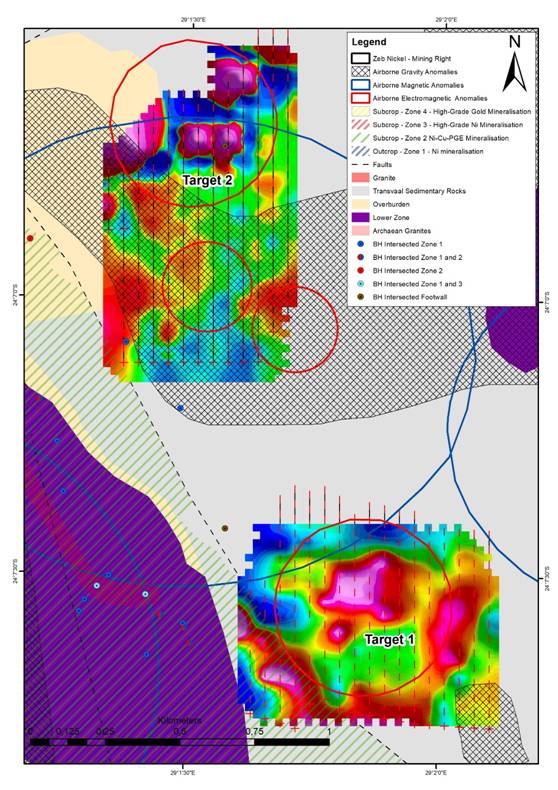
Figure 1: Maps showing the ground-based frequency-domain electromagnetic results for the two target areas overlaid on the interpreted geological map. The results align well with the results from the airborne data and provide higher resolution compared to the airborne Spectrem electromagnetic survey.
Exploration Manager Comment
Richard Montjoie, Exploration Manager of URU Metals, commented:
“The Target 2 results are important because they help us better understand and rank the wider target pipeline at Zeb Nickel. This target is more complex than Target 1 however, the presence of underlying magnetic bodies means the area remains geologically interesting and will warrant follow-up testing.
This is why the Company carried out the ground survey programme before drilling. The work has helped us reduce uncertainty, rank the targets and focus future capital on the strongest opportunities.
Our broader exploration model remains unchanged. Zeb Nickel contains a large, underexplored feeder system, and previous drilling has already confirmed higher-grade sulphide mineralisation within this setting. The next step is to integrate the new data into our 3D model and design a flexible, staged drill programme focused on the best-ranked targets across the Project.”
About the Company
URU Metals is a mineral exploration and development company focused on advancing high-potential critical metals projects in South Africa. The Company is committed to creating sustainable value through responsible mining practices, regulatory compliance, and active stakeholder engagement. For more information, visit www.urumetals.com
Competent Person Statement
The technical information contained in this announcement has been reviewed by Richard Montjoie, Exploration Manager of URU Metals Limited. Mr Montjoie is a registered member of the South African Council for Natural Scientific Professions, membership number 400131/09. Mr Montjoie holds an M.Sc. in Economic Geology from the University of the Witwatersrand, South Africa, and is a Fellow of the Geological Society of South Africa. Mr Montjoie is not independent of the Company.
Market Abuse Regulation (MAR) Disclosure
This announcement contains inside information for the purposes of Article 7 of the Market Abuse Regulation (EU) No. 596/2014 as it forms part of United Kingdom domestic law by virtue of the European Union (Withdrawal) Act 2018 (“UK MAR”). Upon the publication of this announcement via a Regulatory Information Service, this inside information is now considered to be in the public domain.
For further information, please contact:
URU Metals Limited
John Zorbas
(Chief Executive Officer)
+1 416 504 3978
SP Angel Corporate Finance LLP
(Nominated Adviser and Broker)
Ewan Leggat / Caroline Rowe + 44 (0) 203 470 0470
Axis Capital Markets Limited (Joint Broker)
Richard Hutchison
+44 (0) 203 026 0320
#URU URU Metals Ltd – Completion of Gravity Survey
 URU Metals Limited (“URU” or the “Company”) is pleased to announce the completion of the ground-based gravity survey over priority targets at the Zeb Nickel Project, with results demonstrating strong correlation with previously identified airborne electromagnetic and magnetic anomalies.
Gravity Survey Programme
The gravity survey was completed over Targets 1 and 2, previously identified as the highest-priority anomalies from the Spectrem airborne electromagnetic survey. The programme was conducted on a 50 m x 50 m grid using high-precision CG5 gravimeters, with data quality reported as ‘very good’ following full Bouguer correction and processing.
The objective of the ground-based gravity survey was to enhance the resolution of the airborne datasets and improve the definition of potential drill targets associated with semi-massive nickel sulphide mineralisation.
Gravity Results
The results of the gravity survey are highly encouraging and provide improved confidence in the geological interpretation:
Target 1
· The Spectrem electromagnetic anomaly correlates closely with a residual gravity high, confirming that the target is both conductive and relatively dense.
· The gravity anomaly extends beyond the electromagnetic (“EM”) footprint, suggesting the presence of dense ultramafic rocks and/or sulphide accumulation zones.
· This strong coincidence of conductivity and density is considered highly prospective for nickel sulphide mineralisation.
Target 2
· A weak but distinct gravity high (~0.1 mGal) coincides with the southern portion of the northern EM anomaly.
· This gravity feature also aligns well with a first vertical derivative (1VD) magnetic anomaly, reinforcing the validity of the target.
· While the response may represent a dense ultramafic unit such as a harzburgite pulse, the combined conductive, dense, and magnetic signature is also consistent with potential sulphide mineralisation.
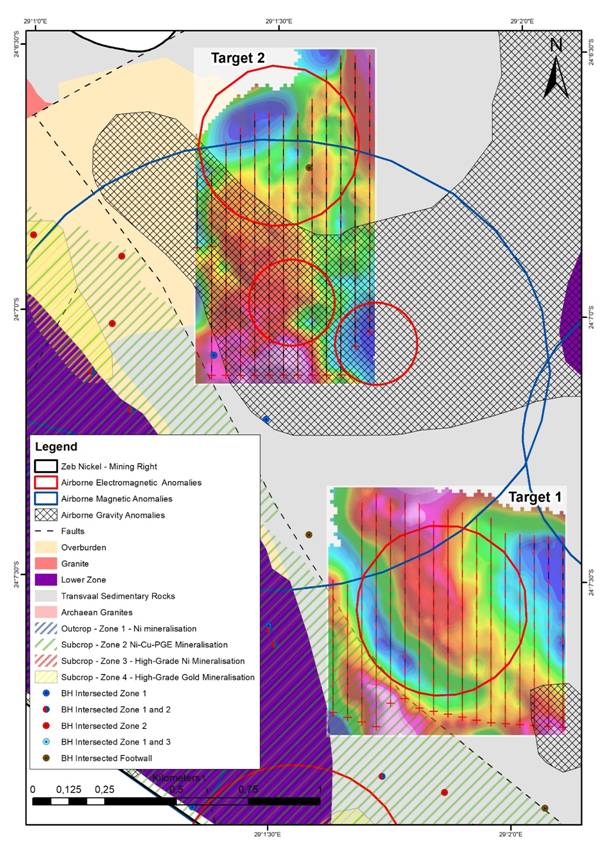 Figure 1: Maps showing the ground-based gravity results for the two target areas overlain on a mapped and interpreted geological map. The results align well with the results from the airborne data and provide higher resolution compared to the airborne gravity survey.
Interpretation and Next Steps
The ground-based gravity results align closely with the airborne datasets but provide a significantly higher level of resolution, allowing for better definition of anomaly geometry and depth.
These results:
· Confirm the presence of coincident conductive and dense targets
· Improve confidence in the interpreted magmatic conduit system
· Provide a stronger technical basis for drill targeting
The frequency-domain electromagnetic survey is expected to commence shortly, which will further refine the conductive responses and support final drill target prioritisation.
The Zeb Nickel Project is strategically located on the Northern Limb of the Bushveld Complex, adjacent to the Ivanplats Platreef Project, which is expected to become one of the largest underground platinum group metal operations globally once fully operational.
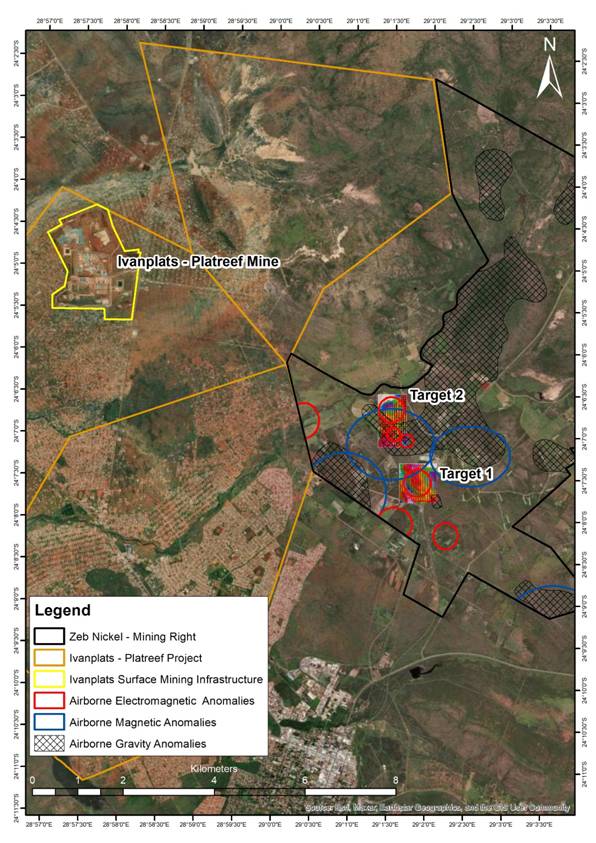
Figure 2: Maps showing the Zeb Nickel Project area and the geophysical targets adjacent to the Ivanplats “Platreef Mine,” which is expected to become one of the largest underground platinum mines globally once in full production.
CEO John Zorbas commented:
“We are very encouraged by the results of the ground-based gravity survey, which show strong correlation with the airborne electromagnetic and magnetic datasets. The improved resolution of the ground survey provides greater confidence in the interpretation of these anomalies and enhances our ability to focus on the most prospective semi-massive and massive nickel sulphide targets.
“The responses observed at Targets 1 and 2 are particularly compelling, displaying the coincident conductive and dense signatures often associated with sulphide mineralisation. With the EM survey set to commence shortly, we look forward to further refining these targets ahead of drilling.
“We are very excited about the progress being made and the momentum building at the Zeb Nickel Project. We look forward to the coming weeks and months and will continue to update shareholders regularly as results become available.”
About the Company
URU Metals is a mineral exploration and development company focused on advancing high-potential critical metals projects in South Africa. The Company is committed to creating sustainable value through responsible mining practices, regulatory compliance, and active stakeholder engagement. For more information, visit www.urumetals.com
Market Abuse Regulation (MAR) Disclosure
This announcement contains inside information for the purposes of Article 7 of the Market Abuse Regulation (EU) No. 596/2014 as it forms part of United Kingdom domestic law by virtue of the European Union (Withdrawal) Act 2018 (“UK MAR”). Upon the publication of this announcement via a Regulatory Information Service, this inside information is now considered to be in the public domain.
For further information, please contact:
URU Metals Limited
John Zorbas
(Chief Executive Officer)
+1 416 504 3978
SP Angel Corporate Finance LLP
(Nominated Adviser and Broker)
Ewan Leggat / Caroline Rowe / Devik Mehta + 44 (0) 203 470 0470
#FCM First Class Metals PLC – Bonanza Gold Intercept at Roy, Sunbeam
 First Class Metals PLC (“First Class Metals”, “FCM” or the “Company”) the UK listed company focused on the discovery of economic metal deposits across its exploration properties in Ontario, Canada, is pleased to report initial drill results for holes 1-4 and provisionals for holes 5 and 6 from the drilling at the Roy prospect on the Sunbeam Property.
Highlights
- Bonanza-grade gold intersected in drill hole SUN-26-05, with visible gold observed, highlighting the presence of a high-grade mineralising system
- Provisional Fires assays (“FA”) results have been received from holes SUN-26 01 to 04
- Provisional Photon assay results confirm high-grade gold in holes SUN-26-05 and 06, including the standout bonanza intercept
- Results prove that the Roy lineament is a gold bearing structure, validating the Company’s geological model.
- The drilling has demonstrated geological continuity over >250m of strike, supporting potential for scale along the structure.
- Logging is completed and drill hole interpretation started.
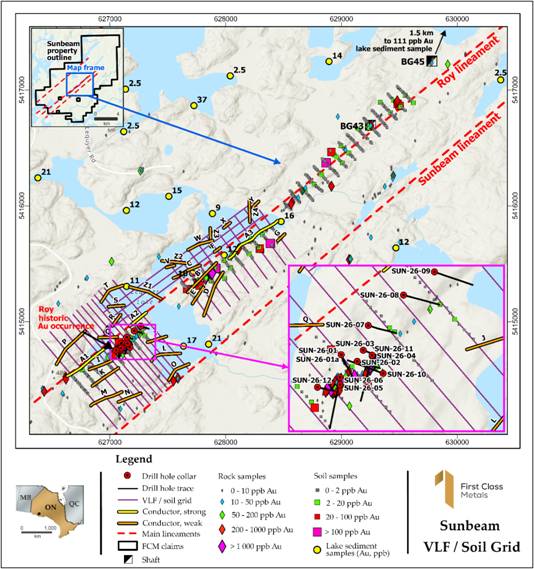
- Very Low Frequency (“VLF”) survey identifies multiple additional conductive targets along strike at Roy.
- The Roy VLF survey to be extended to the northeast to test further strike extensions and unlock additional potential
- VLF survey to commence at Pettigrew early May, targeting a parallel mineralised structure
- Additional assay results pending, with further updates to follow as results are received
Marc J. Sale CEO First Class Metals Commented:
“The initial assay results from the drilling at Roy have vindicated our belief that the Sunbeam property contains significant gold potential. The drilling at Roy has tested only 1% of the known strike extent of the mineralised lineaments. To put Roy in perspective one must recall that Hammond Reef, only 10km to the northwest, has an average grade of 0.84g/t gold, with no reported ‘high grade’. At Roy we have identified low grade zones as well as importantly bonanza grade gold values. I feel confident that, as we grow our understanding based on the information generated by FCM’s new approach at Roy we can not only upgrade the Roy values but mirror this across the property.”
https://firstclassmetalsplc.com/link/Pmddar
Roy structure
The lineament that the Roy occurrence / development is located on is a district scale structure. It has now been traced through historic work and prospecting by Emerald Geological Services (“EGS”) towards the 111ppb lake sediment sample, some 5km northeast along strike of the Roy mine shaft. The structure also hosts historic shafts B43 and B45. The recent VLF interpretation shows multiple conductors sub parallel to the Roy trend, which further enhances the potential, see Figure 1.
Figure 1 Showing the soil (and coincident VLF) grid, locations of historic shafts, including Roy, and drill holes around the Roy shaft as well as the strike extension to the NE.
Drill results
The Fire Assay for the first four drill holes have been received.
The initial hole which attempted to twin the historic drill hole (SP-11-12 4g/t Au over 1.85m) contained ~2m @1.3g/t Au; the second hole contained 1.1m @ 2.3g/t. Holes three and four both contained a metre at roughly 0.5g/t Au.
The photon assay results have also been received for the three sections of core with reported VG.
Hole 06 (second reported dual occurrence of VG) contained two consecutive samples giving 0.6m @ 2.2g/t Au. Significantly hole 05 which contained the initial report of VG, returned 0.3m @ 45g/t gold which would equate to almost 5 ounces of gold over one metre, 150g/m (gram metres).
Figure 2 Showing the initially reported VG in hole 05, with strong association to galena (lead mineral).
The fire assays for holes 05 and 06 are still to be received, given the coarse nature of the gold and the different quite distinctive assay methods some discrepancy with the photon assays are expected.
Initial plots of the anomalous gold assay result confirm the continuity of the mineralised package over >150m, see Figure 3.
All 12 holes intersected the targeted ‘structure’ or the potentially mineralised package which is now confirmed over a strike length exceeding 300m, see Figure 3 and remains open along strike to the northeast and southwest.
Figure 3 showing the 12 drill holes at Roy with initial interpretation of the potentially mineralised package which extends over 300m.
The initial 4 drill hole results, all contain anomalous to +2g/t Au and are considered encouraging. Even more so give the bonanza value in the photon assay of almost one and a half ounces in hole 05.
The strike extent of the drilling covers ~300m but the soil sampling (and in part VLF) grid extends over 1,500m to the northwest. A highly anomalous lake sediment sample collect in 2023 containing 111ppb Au is a further 1,500m along strike from the end of the soil grid. There is also a string of grab samples along strike to the southwest with a +1ppm samples 5 km along strike. All these factors continue to build up the expectation of a +10km mineralised structure. The Roy lineament is one of three structures on the Sunbeam property with proven gold occurrences.
The initial results from the LiDAR study have shown the Roy lineament is a very robust structure. It is intended to extend the VLF grid to cover the northern soil survey area and potentially. Provisionally both could be extended further to the northeast.
The visible gold is seen in association with galena, potentially an important pathfinder. The lead (Pb) and gold when plotted on the soil grid indicate several ‘bullseyes’ along strike where highly anomalous Au and Pb assay results are recorded, see Figure 4
Figure 4 showing the coincident Pb and Au anomalism.
Work is ongoing integrating the VLF, LiDAR and geochemistry with the local geology and structure.
As the weather is steadily improving in northwest Ontario, the ‘thaw’ heralds the start of the field season. Work will continue at Roy as described above and it is intended to undertake work on the parallel lineament that hosts the Pettigrew development. Historic drilling by TerraX produced 19.4 g/t Au over 0.63m and 15.17 g/t over 1.37m in two zones separated by 15m in hole 57751. Channel and grab samples from FCM exploration have returned significant gold grades, including:13.0 g/t Au grab sample from quartz rubble dug up beside the stripped outcrop. 3.5 g/t Au in a channel over 0.2m in a quartz vein (with galena and chalcopyrite); 1.82 g/t Au in a channel over 0.75m in sheared porphyry.
The growing understanding of the structural controls to the mineralisation gleamed from the ongoing work at Roy will be used to explore the area immediately around the Pettigrew shafts and pits as this zone is all-weather accessible.
Qualified Person
The technical disclosures contained in this announcement have been drafted in line with the Canadian Institute of Mining, Metallurgy and Petroleum standards and guidelines and approved by Marc J. Sale, who has more than 30 years in the gold exploration industry and is considered a Qualified Person owing to his status as a Fellow of the Australian Institute of Mining and Metallurgy.
Glossary of Technical Terms
| Term | Explanation |
| Alteration | Chemical changes to rock caused by mineralising fluids, often associated with ore-forming processes. |
| Bonanza Gold | A Bonanza gold grade refers to exceptionally high-concentration gold ore, typically exceeding 34 grams per tonne (g/t) or over 1 troy ounce per ton (opt). These rare, high-value deposits often feature visible gold |
| Core | Cylindrical rock recovered during diamond drilling, used to examine geology and mineralisation. |
| Drill Hole | A hole drilled into the ground to obtain rock samples (core) for geological logging, sampling and analysis. |
| Galena | A lead sulphide mineral (PbS) that can be associated with precious metal mineralisation in some geological systems. |
| Logging | The detailed geological description and recording of drill core, including rock type, alteration and mineralisation. |
| Mineralised Package | A sequence of rocks containing minerals associated with potential economic metal deposits. |
| Schist | A metamorphic rock characterised by strong foliation and alignment of minerals. |
| Sampling | The process of cutting and collecting sections of drill core for laboratory analysis to determine metal content. |
| Structure / Structural Zone | A geological feature such as a fault or shear zone that may control the movement of mineralising fluids and the location of mineral deposits. |
| Assay | Laboratory analysis used to determine the concentration of metals within a rock sample. |
| Quartz Vein | A fracture or crack in rock that has been filled with quartz. Quartz veins are commonly associated with gold mineralisation. |
| Strike Length | The horizontal distance over which a geological structure or mineralised zone can be traced. |
| Tonalite | A coarse-grained intrusive igneous rock similar to granite, commonly found in mineralised geological terranes. |
| Visible Gold (VG) | Gold that can be seen with the naked eye in drill core or rock samples. Visible gold does not necessarily indicate economic grades but is considered a positive indicator in gold exploration. |
For Further Information:
Engage with us by asking questions, watching video summaries, and seeing what other shareholders have to say. Navigate to our Interactive Investor hub here:
https:www.firstclassmetalsplc.com
For further information, please contact:
James Knowles, Executive Chair
Email: JamesK@Firstclassmetalsplc.com
Tel: 07488 362641
Marc J Sale, CEO
Email: MarcS@Firstclassmetalsplc.com
Tel: 07711 093532
AlbR Capital Limited
David Coffman / Dan Harris
Website: www.albrcapital.com
Tel: (0)20 7469 0930
Axis Capital Markets (Broker)
Lewis Jones
Website: Axcap247.com
Tel: (0)203 026 0449
#FCM First Class Metals PLC – Additional Visible Gold at Roy, Sunbeam
 First Class Metals PLC (“First Class Metals”, “FCM” or the “Company”) the UK listed company focused on the discovery of economic metal deposits across its exploration properties in Ontario, Canada, is pleased to report further visible gold has been identified in core from the drilling at the Roy prospect on the Sunbeam Property.
Highlights
· Visible gold (‘VG’) observed in two separate sections of core from a second drill hole at Roy, further confirming the presence of gold mineralisation within the targeted structure
· The planned drill programme has now been successfully completed with 12 holes drilled at Roy.
· Total meterage exceeded the 1,000m contractual minimum.
· Current drilling has confirmed the mineralised structure over a strike extent exceeding 300m.
· Detailed geological logging and sampling is ongoing with the logging of 6 holes now complete.
· Eight drill holes remain to be cut and sampled.
· Holes 1-2 have been dispatched to the laboratory in Thunder Bay for assaying.
Marc J. Sale CEO First Class Metals Commented:
“The drill programme at Roy has to date been a resounding success. I was fortunate to be on site when the first visible gold was identified. The identification of a second occurrence, in two sections of core, while we are still barely halfway through the logging and sampling is incredibly encouraging and furthers the credibility of the Sunbeam property as a whole.”
Roy structure
The lineament that the Roy occurrence / development is located on is a district scale structure and has now been traced through historic work and Emerald Geological Services (“EGS”) prospecting towards the 111ppb lake sediment sample some 5km northeast along strike of the mine shaft. The structure also hosts historic shafts B43 and B45, which further enhances the potential see Figure 1.
Figure 1 illustrating the soil (VLF) grid and locations of historic shafts, including Roy, drilling has focussed on the area immediately around the Roy shaft and the strike extension to the NE.
Drilling
The planned 1,000m minimum programme has been successfully completed with 12 holes drilled for a total of 1,030m, see Figure 2
Figure 2 showing the location of the locations of the 12 drill holes at Roy, note hole 26-01 was abandoned at 26m.
All holes intersected the targeted ‘structure’ or the potentially mineralised package which is now confirmed over a strike length exceeding 300m, see Figure 2 and 3
Figure 3 boxes of core from drill hole SUN-26-06, drilled on an azimuth of 200o, in order to test the plunge of the mineralsied structure. It shows the mineralised ‘package’ of altered (variously quartz veined) tonalite on the margins of deformed chloritic schist containing / alternating with quartz veins and veinlets. This hole contains two separate occurrences of VG.
The observation of further visible gold in the core in two separated locations is extremely significant, see Figure 4-8.The gold grains are scattered throughout a small area of the quartz vein and again associated with galena.
Figure 4 showing the quartz vein with the visible gold
Figure 5 showing closer view of the visible gold grains in one of the quartz veins.
Figure 6 showing visible gold grains in the quartz vein.
Figure 7 showing visible gold grains and galena in the quartz vein.
The gold is intimately associated with a lead mineral, galena, which appears a slightly metallic grey in the images.
Figure 8 showing a second occurrence of visible gold grains and galena in the quartz vein, less than a metre from the initial observation.
The EGS team will continue to diligently log and sample the remaining six holes and keep keen eyes open for further instances of VG.
Qualified Person
The technical disclosures contained in this announcement have been drafted in line with the Canadian Institute of Mining, Metallurgy and Petroleum standards and guidelines and approved by Marc J. Sale, who has more than 30 years in the gold exploration industry and is considered a Qualified Person owing to his status as a Fellow of the Australian Institute of Mining and Metallurgy.
Glossary of Technical Terms
Term
Explanation
Visible Gold (VG)
Gold that can be seen with the naked eye in drill core or rock samples. Visible gold does not necessarily indicate economic grades but is considered a positive indicator in gold exploration.
Drill Hole
A hole drilled into the ground to obtain rock samples (core) for geological logging, sampling and analysis.
Core
Cylindrical rock recovered during diamond drilling, used to examine geology and mineralisation.
Strike Length
The horizontal distance over which a geological structure or mineralised zone can be traced.
Mineralised Package
A sequence of rocks containing minerals associated with potential economic metal deposits.
Quartz Vein
A fracture or crack in rock that has been filled with quartz. Quartz veins are commonly associated with gold mineralisation.
Galena
A lead sulphide mineral (PbS) that can be associated with precious metal mineralisation in some geological systems.
Structure / Structural Zone
A geological feature such as a fault or shear zone that may control the movement of mineralising fluids and the location of mineral deposits.
Logging
The detailed geological description and recording of drill core, including rock type, alteration and mineralisation.
Sampling
The process of cutting and collecting sections of drill core for laboratory analysis to determine metal content.
Assay
Laboratory analysis used to determine the concentration of metals within a rock sample.
Alteration
Chemical changes to rock caused by mineralising fluids, often associated with ore-forming processes.
Schist
A metamorphic rock characterised by strong foliation and alignment of minerals.
Tonalite
A coarse-grained intrusive igneous rock similar to granite, commonly found in mineralised geological terranes.
For Further Information:
Engage with us by asking questions, watching video summaries, and seeing what other shareholders have to say. Navigate to our Interactive Investor hub here:
https:www.firstclassmetalsplc.com
For further information, please contact:
James Knowles, Executive Chair
Email: JamesK@Firstclassmetalsplc.com
Tel: 07488 362641
Marc J Sale, CEO
Email: MarcS@Firstclassmetalsplc.com
Tel: 07711 093532
AlbR Capital Limited
David Coffman / Dan Harris
Website: www.albrcapital.com
Tel: (0)20 7469 0930
Axis Capital Markets (Broker)
Lewis Jones
Website: Axcap247.com
Tel: (0)203 026 0449
#URU URU Metals LTD – Peer publications strengthen model at Zeb Nickel
 URU is pleased to announce that two peer-reviewed publications by Mapiloko et al. (2025), published in Geological Society of America’s journal of Geology (Contribution of the oldest Paleoproterozoic marine sulfate evaporite to Bushveld Complex Lower Zone mineralization) and the South African Journal of Geology (Chromite formation in the Lower Zone and Platreef sequences on Uitloop, northern limb of the Bushveld Complex), provide new independent scientific evidence relevant to the Company’s Zeb Nickel Project in Limpopo, South Africa.
The papers provide additional third-party support for the Company’s exploration model and offer new technical insight into the processes that promote sulphide saturation and nickel sulphide mineralisation in the district. The publications do not constitute, and should not be interpreted as, a change to the Company’s previously reported Mineral Resource Estimates or economic assumptions.
Highlights
· Independent scientific support for the Company’s sulphur-assimilation thesis: the papers present evidence consistent with Palaeoproterozoic sulphate contributing to the formation of immiscible magmatic sulphides in the Uitloop system, a process that can enhance magma “fertility” for Ni-Cu-PGE mineralisation.
· A clearer vector for exploration reinforcing our current exploration model: results reinforce the importance of structural pathways, conduit architecture and the magmatic transport history through (or proximal to) sulphate-bearing stratigraphy, helping to refine targeting beyond the historically drilled footprint.
· Direct integration into the 2026 exploration plan: these insights are being incorporated into ongoing interpretation of recent airborne datasets and current ground programmes, feeding into drill-ready target ranking and programme design.
The publications interpret sulphur isotope systematics and local stratigraphic relationships to support a model in which oxidised, crustal sulphur (sulphate) can be assimilated by mafic-ultramafic magmas, promoting sulphide saturation and allowing Ni-Cu-PGE to partition into sulphide liquids.
For the Company, the practical exploration implication is that the most prospective parts of the system are those that combine:
1. a long-lived magma plumbing system capable of focusing flow and upgrading metal content in sulphides,
2. effective sulphur addition (direct or indirect) from wallrocks during emplacement/transport, and
3. physical traps (embayments, constrictions, contacts, offsets) where sulphides can accumulate.
URU believes these findings are supportive of the Company’s current exploration concept at Zeb Nickel and provide an additional peer-reviewed basis to prioritise feeder-style targets and conductor/density coincidence zones for drilling.
Consistent with URU’s previously disclosed exploration strategy, the Company’s near-term work programme is focused on progressing from interpretation to drill execution:
1. Ground-based geophysics
Ground electromagnetic and gravity surveys are underway to refine airborne interpretations and improve drill vectoring. Results from this phase are being used to enhance and tighten the overall drill target set, including prioritising coincidence conductor and density zones and refining the planned drill collar locations, orientations and target depths.
2. Geological & resource modelling
Update the 3D model integrating geology with new geophysical datasets, and complete target ranking to define the priority drill pattern.
3. Drilling programme design
Finalise drillhole number, position, orientation and depth to test:
o Ni-Cu-PGE resource drilling priorities (Zone 2-style mineralisation); and
o high-grade Ni targets (Zone 3-style feeder/conduit mineralisation), particularly where conductors and density anomalies overlap.
Richard Montjoie, VP Exploration commented: “Peer-reviewed publications that independently support key elements of our geological model are valuable for any exploration company. We view these findings as strengthening the scientific basis for our sulphur-assimilation and conduit-focused targeting approach at Zeb Nickel, i.e. the plumbing system that I have frequently spoken of. Importantly, the work informs where sulphide saturation and accumulation are most likely to have occurred, and we are incorporating this into our ground geophysics, 3D modelling and drill planning as we move toward the next phase of drilling.”
|
URU Metals Limited John Zorbas (Chief Executive Officer)
|
+1 416 504 3978
|
|
SP Angel Corporate Finance LLP (Nominated Adviser and Broker) Ewan Leggat / Jen Clarke |
+ 44 (0) 203 470 0470 |
#FCM First Class Metals PLC – Progress Update on Drilling at North Hemlo
First Class Metals PLC (“First Class Metals”, “FCM” or the “Company”) the UK listed company focused on the discovery of economic metal deposits across its exploration properties in Ontario, Canada, is pleased to announce that the drilling on the North Hemlo property, whilst currently paused, will recommence next week.
Highlights
· Nine drillholes completed across the Dead Otter trend, marking strong progress in the Company’s maiden programme on this property.
· Four priority target areas tested along the 3.5 km trend, providing early geological coverage across multiple prospective zones.
· Approximately 200 core samples dispatched to the Thunder Bay laboratory for assay analysis.
· Drilling to recommence next week to complete the planned programme
· Several logged intersections exhibit visually encouraging geological features, consistent with the Company’s exploration model and supporting the decision to advance drilling. A video of a representative cut core section displaying multiple deformed structures, contact, clasts veining and sulphide mineralisation is available via the link below.
https://firstclassmetalsplc.com/link/yOO9ky
Marc J. Sale CEO First Class Metals commented:
“To date, the maiden drill programme on the Dead Otter trend has been both technically and logistically successful, particularly given the inclement as well as challenging weather conditions. The Emerald Geological Services team has executed the plan efficiently, and early indications from the core are encouraging.
While assays will ultimately determine the significance of these intervals, the geological features observed to date reinforce our confidence in the Dead Otter trend as a compelling gold target within the North Hemlo Project. We look forward to receiving the first assay results in the New Year and to completing the balance of the programme before the Christmas break.”
Location & Strategic Context
The North Hemlo Project is situated within the world-class Hemlo Greenstone Belt, a district that has produced more than 23 million ounces of gold since discovery. In early December 2025, Barrick Gold Corporation completed the sale of its Hemlo Mine to Hemlo Mining Corporation (“HMC”) in a transaction valued at up to US$1.09 billion. That transaction signaled a renewed and focused investment into the Hemlo district and reflects continued interest in evaluating the region’s exploration potential. First Class Metals’ Dead Otter trend lies contiguous with HMC’s regional exploration holdings.
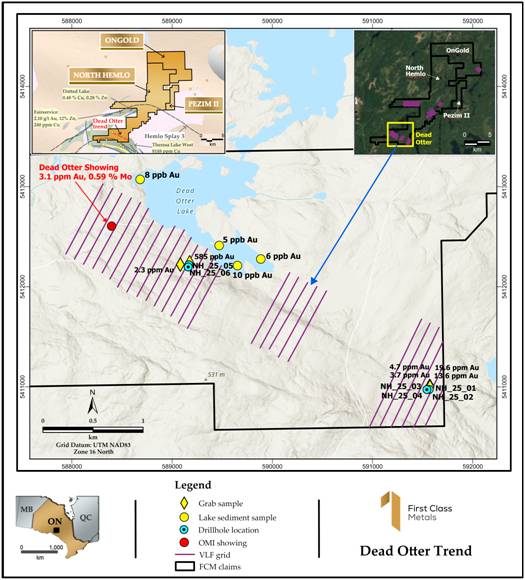
Figure 1 showing the Dead Otter trend with locations of the initial 6 drillholes which are logged and sampled. Also shown are the VLF grids and positions of significant grab samples
|
NH 2025 DDH Collars |
|||||
|
Hole_ID |
Easting |
Northing |
Elevation |
Az_deg |
Dip_deg |
|
NH-25-01 |
591566 |
5410975 |
366 |
10 |
-45 |
|
NH-25-02 |
591566 |
5410975 |
366 |
10 |
-70 |
|
NH-25-03 |
591542 |
5410973 |
367 |
10 |
-45 |
|
NH-25-04 |
591542 |
5410973 |
367 |
10 |
-70 |
|
NH-25-05 |
589167 |
5412220 |
416 |
25 |
-45 |
|
NH-25-06 |
589161 |
5412198 |
420 |
25 |
-45 |
The initial drillholes targeted the location of the previously reported 19.6 g/t high grade Au grab sample, as well as zones of pronounced structural deformation (“messed up rocks”) delineated in mapping conducted by Professor Mary Louise Hill (Professor Emerita, Lakehead University). These areas represent key focal points of gold anomalism and structural complexity along the trend.
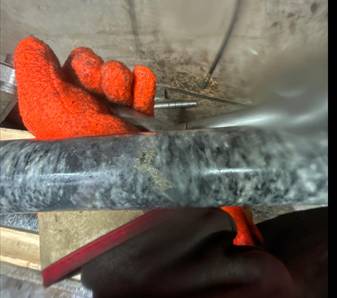
Figure 2 showing a section of uncut core from the Dead Otter trend displaying sulphides which could indicate potential mineralisation.

Figure 3 showing cut core displaying quartz veining and course pyrite.
A second target area, including the site of the 2.3 g/t Au sample and the interpreted granite contact, has also been tested with two additional holes.
Emerald Geological Services (‘EGS’) continue to oversee and manage all drill-site geological operations, including core logging, sampling, and photography at their Manitouwadge facility.
The drilling contract minimum of 700m drilling will be surpassed at the completion of the programme.
Given the seasonal volume of samples being processed across the region, combined with the Christmas-New Year period, assay turnaround times are difficult to estimate accurately at this stage.
Environmental, Social and Corporate Governance (‘ESG’)
FCM takes its ESG responsibilities seriously and this attitude is imparted to all contracted personnel. The Company is proud that Rugged Aviation, the drill contractor, as well as EGS, are taking this responsibility seriously to in ensuring that drill sites, as much as feasible are left in an environmentally responsible state.
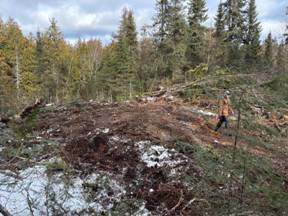
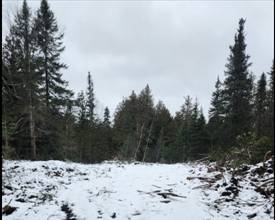
Figure 4 showing drill holes 01 and 02, cleared before drilling and after drilling completed and the rig moved.
ENDS
Qualified Person
The technical disclosures contained in this announcement have been drafted in line with the Canadian Institute of Mining, Metallurgy and Petroleum standards and guidelines and approved by Marc J. Sale, who has more than 30 years in the gold exploration industry and is considered a Qualified person owing to his status as a Fellow of the Australian Institute of Mining and Metallurgy.
For Further Information:
Engage with us by asking questions, watching video summaries, and seeing what other shareholders have to say. Navigate to our Interactive Investor hub here: https://firstclassmetalsplc.com/link/yOO9ky
For further information, please contact:
James Knowles, Executive Chair
Email: JamesK@Firstclassmetalsplc.com
Tel: 07488 362641
Marc J Sale, CEO and Executive Director
Email: MarcS@Firstclassmetalsplc.com
Tel: 07711 093532
AlbR Capital Limited (Financial Adviser)
David Coffman/Dan Harris
Website: www.albrcapital.com
Tel: (0)20 7469 0930
Axis Capital Markets (Broker)
Lewis Jones
Website: Axcap247.com
Tel: (0)203 026 0449
#FCM First Class Metals PLC – First Class Metals Attendance Resourcing Tomorrow
 First Class Metals PLC (“First Class Metals”, “FCM” or the “Company”), the UK-listed exploration company advancing high-grade, district-scale gold opportunities in Ontario, Canada, as well as critical metals, is pleased to announce its attendance at Resourcing Tomorrow, taking place from 2-4 December 2025 in London.
Chief Executive Officer, Marc Sale, Executive Chairman, James Knowles, and Company Secretary, Siddharth Muricken, will be on-site throughout the event at the Business Design Centre, engaging with investors, industry leaders, and potential strategic partners.
Opportunity to Experience FCM’s Ontario Portfolio First-Hand
First Class Metals will be exhibiting at stand C30, where attendees will be able to explore and discuss the Company’s technical progress, strategic development plans and exploration catalysts for 2026.
Core from Three High-Impact Projects on Display
In a major highlight for the event, FCM will be showcasing drill core and geological samples from three projects. For those unable to attend, high-resolution photographs of the core samples are included below, ensuring full visibility for all shareholders.
· North Hemlo (Gold) – A large, well-positioned gold-prospective land package where drilling is currently under way, supported by multiple identified targets and ongoing geological interpretation.
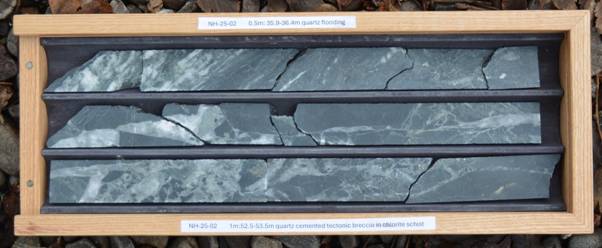
Figure 1 – North Hemlo
· Sunbeam Gold Project (Gold) – A historically producing district scale gold property hosting documented high-grade vein occurrences, with recent work highlighting areas that remain under-explored.
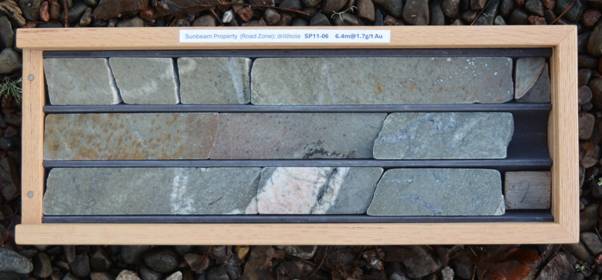
Figure 2 – Sunbeam
· Zigzag (Lithium & Critical Metals) Project – A lithium-bearing project where drilling completed in 2023 returned high-grade Li₂O intercepts, alongside additional critical-metal indicators that continue to be evaluated.
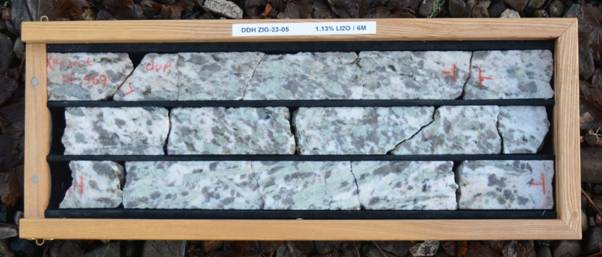
Figure 3 – Zigzag
These physical displays provide investors and stakeholders with a rare opportunity to examine the mineralisation style, geological setting, and technical quality driving FCM’s exploration confidence.
James Knowles Executive Chairman commented:
“Our team is genuinely looking forward to connecting with the wider industry at Resourcing Tomorrow. It’s an ideal moment to present the advances across our projects and to give attendees a first-hand look at core from North Hemlo, Sunbeam and Zigzag.”
An Ideal Moment to Engage with First Class Metals
The Company continues to build momentum across its Ontario portfolio, and management welcomes the opportunity to meet shareholders, analysts and potential collaborators during the conference.
To arrange a meeting, please contact info@firstclassmetalsplc.com
For further information, please contact:
James Knowles, Executive Chair
Email: JamesK@Firstclassmetalsplc.com
Tel: 07488 362641
Marc J Sale, CEO, Executive Director
Email: MarcS@Firstclassmetalsplc.com
Tel: 07711 093532
AlbR Capital Limited (Financial Adviser)
David Coffman
Website: www.albrcapital.com
Tel: (0)20 7399 9400
Axis Capital Markets (Broker)
Lewis Jones
Website: Axcap247.com
Tel: (0)203 026 0449
#AYM Anglesey Mining PLC – Conditional Equity Financing Facility – Proposed Capital Reorganisation – Notice of General Meeting
 Anglesey Mining plc (AIM:AYM), the UK minerals development company, is pleased to announce it has entered into a conditional Equity Financing Facility (the “Equity Financing Facility” or the “Facility”) with Alumni Capital Limited (“Alumni” or the “Investor”) pursuant to which Alumni has agreed, on the terms and subject to the conditions set out in the Subscription Agreement, to provide the Company with equity funding of up to £2 million.
The Facility and the Company’s existing cash resources will be directed towards the further development of the Company’s primary asset, the 100% owned Parys Mountain Cu-Zn-Pb-Ag-Au VMS deposit in Anglesey, North Wales (“Parys Mountain”), as well as providing additional working capital.
The Facility is, inter alia, conditional on the Company implementing a proposed Capital Reorganisation, pursuant to which, inter alia, the issued share capital of the Company will be consolidated and sub-divided such that every twenty Existing Ordinary Shares will result in one New Ordinary Share and one Deferred C Share.
Shareholders should note that, if the Resolutions are not passed, the Company will not be able to drawdown any amounts under the Facility. In this scenario, the Board believes it would be left with a limited pool of alternative options and there would be material uncertainty over the going concern status of the Company. Against this background, the Company is, therefore, requesting that Shareholders vote in favour of the Resolutions at the General Meeting.
The Company will shortly post a circular to Shareholders in connection with the Facility and the Capital Reorganisation which is available on its website at www.angleseymining.co.uk (the “Circular”). The Circular contains further information about the background to and reasons for the proposed Facility and Capital Reorganisation and why the Directors recommend that Shareholders vote in favour of the Resolutions to be proposed at a general meeting to be held at The Geological Society, Burlington House, Piccadilly, London, W1J 0BG at 11.00 a.m. on 23 October 2025.
Capitalised terms used in this announcement, unless otherwise defined, have the same meanings as set out in the Circular.
Background to and reasons for the proposals
On 15 August 2025, the Company provided an update to Shareholders on recent corporate activities undertaken by the Board. This included, inter alia, updates in respect of the Grängesberg Iron Ore Project and the reversion of management control of Grängesberg Iron AB (“GIAB”), the Swedish company which holds rights over the Grängesberg iron ore deposits, to the majority owner of GIAB, as well as Anglesey’s decision to actively seek to dispose of its 11.9% holding in Labrador Iron Mines Holdings Limited (“LIMH”) and realise that investment. These actions were undertaken to support the Board’s current objective of focusing efforts on the Parys Mountain project and in order to support the Company’s current financial position.
As noted in that announcement, the Company continued to advance a number of initiatives with a view to supporting its cash position and noted, however, that the continued progress of the Company’s activities remained contingent on its ability to raise further funds and the Board was therefore exploring fundraising options on that basis.
The Company is therefore pleased to announce that, following discussions and negotiations with Alumni, it has entered into the conditional Equity Financing Facility. Prior to entering into the Facility, the Directors explored a number of financing options for the Company, including an equity raise. However, having assessed the options reasonably available, the Board believes that the Facility represents the best outcome available at this time in order to further fund its progress and support its working capital position.
The Key Terms of the Facility
Alumni have committed to provide equity funding of up to £2 million (the “Commitment Amount”) conditional upon, inter alia, the passing of the Resolutions.
The term of the Facility shall commence on the date of the Facility becoming unconditional (being the “Effective Date”) and shall continue until the earlier of (i) the date on which Alumni shall have subscribed for New Ordinary Shares pursuant to the Subscription Agreement in the aggregate amount of the Commitment Amount; (ii) the date the Subscription Agreement is terminated in accordance with the terms thereof; and (iii) the date occurring eighteen (18) months after the Effective Date (the “Commitment Period”).
The Company can draw down funds from the Facility from time to time during the Commitment Period at the Company’s discretion by providing a notice to Alumni (a “Subscription Notice”). Subject to the satisfaction (or waiver by Alumni) of certain conditions precedent and the terms of the Facility, a Subscription Notice obliges Alumni to subscribe in cash for the number of New Ordinary Shares in the Company specified in the notice, with such shares priced at the lowest daily volume weighted average price (“VWAP”) during the 5 days of trading following the date that the Subscription Notice is deemed to be received by the Investor (the “Reference Price”) multiplied by 80%.
The Company is under no obligation to deliver any Subscription Notice during the Commitment Period.
Alumni will also be granted Warrants to subscribe for New Ordinary Shares on the basis of one warrant share for every two New Ordinary Shares subscribed by Alumni under the Facility. The exercise price for the purchase of shares pursuant to the Warrants, payable to the Company, will be the Reference Price multiplied by 120%. Warrants are exercisable for a period of 3 years from their date of grant. The Warrants are freely transferable.
Each Subscription Notice submitted by the Company is limited to a minimum size of 50,000 New Ordinary Shares and a maximum size of 750,000 New Ordinary Shares (note: these figures are with reference to New Ordinary Shares, that is, ordinary shares of the Company post the implementation of the proposed Capital Reorganisation).
Alumni is entitled to a commitment fee equal to 1% of the Commitment Amount, i.e. £20,000, payable in cash (the “Commitment Fee”).
In addition, a fee of £10,000 is payable to Alumni for every quarter during the term of the Facility in which a Subscription Notice is not submitted by the Company (the “Unused Line Fee”). The maximum aggregate amount of the Unused Line Fee, being £50,000, is to be paid upfront in cash upon the Facility becoming unconditional. Alumni will refund to the Company £10,000 for every quarter (other than the first quarter of the Facility) in which a Subscription Notice is in fact submitted.
It is agreed that the obligation to pay the Commitment Fee and the upfront Unused Line Fee will be satisfied by the allotment and issue by the Company to Alumni of 750,000 New Ordinary Shares (the “Fee Shares”) fully paid for an aggregate subscription price of £70,000 (approximately 9.3 pence per New Ordinary Share) with Alumni’s obligation to pay such amount being satisfied by the release of the Company from its obligation to pay the Unused Line Fee and Commitment Fee to the Investor. Subject to the passing of the Resolutions, the Fee Shares are expected to be admitted to trading on 24 October 2025 (or such later date as is agreed in writing between the Company and the Investor).
The Company will contribute up to £35,000 (plus any applicable VAT) towards Alumni’s legal costs in negotiating and implementing the Facility with the Company’s obligation to pay such amount being satisfied by the release of Alumni, in respect of the first Subscription Notice served by the Company (and, if not sufficient, subsequent Subscription Notices), from its obligation to pay the relevant subscription amount to the Company in accordance with the terms thereof by an equivalent amount.
The Facility automatically terminates once the Facility is drawn down in full, and may be terminated by Alumni in certain other circumstances, including inter alia: the de-listing of the Company’s shares, or their suspension from trading, on AIM; the Company materially failing to comply with the terms of the Facility, or being in material breach of any warranty under the Facility; certain insolvency events; and/or a material adverse change which is continuing.
Other Terms and Conditions of the Facility
The Facility is conditional on the Company passing the Resolutions. Therefore, Shareholders should note that, if the Resolutions are not passed, the Company will not be able to drawdown any amounts under the Facility.
The Facility is also conditional on, inter alia the allotment, issue and admission of the Fee Shares, and the Company complying with all covenants and agreements required to be complied with or satisfied prior to the Facility becoming effective.
The Company has given certain warranties and representations to Alumni concerning its business and affairs. The Facility becoming effective, and each individual drawdown under the Facility, is conditional upon there being no breach of these warranties which is continuing.
Individual drawdowns are also subject to additional conditions precedent, including inter alia: the allotment and issue of the resulting shares being legally permitted by applicable laws; the allotment and issue of the shares not resulting in Alumni, or any persons acting in concert with Alumni, being required to make mandatory offer for the Company in accordance with Rule 9 of The City Code on Takeovers and Mergers, and there being no material adverse change which is continuing.
The Company has also agreed to pay a placing agent commission of 6% of the amount that may be drawn down pursuant to each Subscription Notice.
The Capital Reorganisation
At 6.00 pm on 25 September 2025 (being the date immediately prior to the date of publication of this announcement) there were 484,822,255 Ordinary Shares in issue.
As noted above, the Equity Funding Facility is conditional on the Company implementing the proposed Capital Reorganisation. Therefore, Shareholders should note that, if the Resolutions are not passed to implement the Capital Reorganisation, the Company will not be able to draw down any amounts under the Facility.
More generally, it is the Board’s view that the Capital Reorganisation, on the proposed terms set out in the Notice of General Meeting, will have a positive impact on the liquidity of the shares in issue following implementation, by reducing the number of ordinary shares in issue and raising the resulting trading price per ordinary share, which may result in a narrowing of the bid-offer spread.
The Company proposes to undertake the Sub-division as part of the Capital Reorganisation as, under the Companies Act, a company is prohibited from issuing new shares at a price less than their nominal value. Most immediately, an inability to undertake the Sub-division step as part of the Capital Reorganisation would mean the Company would be unable to issue new shares to Alumni pursuant to the conditional Facility, as it would be restricted from doing so while the prevailing trading price per share was less than the nominal value.
The Capital Reorganisation comprises the consolidation of every twenty Existing Ordinary Shares into one Consolidated Ordinary Share, and the sub-division of every such Consolidated Ordinary Share into one New Ordinary Share and one Deferred C Share.
Pursuant to the Consolidation, the 484,822,260 Existing Ordinary Shares expected to be in issue at the Record Date would be consolidated into 24,241,113 Consolidated Ordinary Shares. Each such Consolidated Ordinary Share would then be sub-divided into one New Ordinary Share and one Deferred C Share, pursuant to the Sub-division.
The New Ordinary Shares will have identical rights, and be subject to identical restrictions, as the Existing Ordinary Shares had and were subject to, immediately prior to the Capital Reorganisation (including but not limited to, in respect of voting, dividend, and return of capital).
The Company proposes to amend the Articles such that the Deferred C Shares are included within the definition of “Deferred Shares” thereunder (and to ensure that the New Ordinary Shares are clearly differentiated from the Deferred C Shares and the Existing Deferred Shares), with the result that the Deferred C Shares shall have the same rights and be subject to the same restrictions (save as to nominal value) as the Existing Deferred Shares. Accordingly, the Deferred C Shares will have very limited rights and will effectively carry no value as a result.
Application will be made for the New Ordinary Shares to be admitted to trading on AIM in place of the Existing Ordinary Shares. Subject to Shareholder approval of the Resolutions, it is expected that Admission will become effective and that dealings in the New Ordinary Shares will commence at 8.00 am on 24 October 2025. Following the Capital Reorganisation, the ISIN Code for the New Ordinary Shares will be GB00BVTDCS88 and the SEDOL Code will be BVTDCS8.
Financial Position
The Company plans to release its audited financial statements for the financial year ended 31 March 2025 by 30 September 2025. As per the most recent unaudited interim financial statements for the half-year ended 30 September 2024, the Company had cash and cash equivalents of £283,295. As at 31 August 2025, the unaudited cash and cash equivalents position of the Company had fallen to £26,271. As a result, the Board now anticipates a significant challenge managing working capital over the next 12 months, and the Board recognises that there will be material uncertainty over the going concern status of the Company if it is unable to avail of the proposed Equity Financing Facility.
Therefore, Shareholders should be aware of the material uncertainty surrounding the potential need for additional funding to remain a going concern and the associated risks involved, including the ability to successfully execute on such initiatives. The Company will continue to actively monitor and assess its financial position.
Action to be taken, Importance of the Vote and Recommendation
Shareholders are strongly encouraged to read the Circular in full. It contains the Resolutions to be voted on at the General Meeting. Explanatory notes on eligibility to vote and other matters concerning the conduct of the General Meeting are contained in the Notice of General Meeting.
The Board believes that the successful implementation of the Capital Reorganisation and the ability to then raise funds under the Equity Financing Facility will help stabilise the Company’s financial position and provide it with additional working capital in the short term. The successful implementation of the Capital Reorganisation would also provide the Company with a revised capital structure from which it would be better placed to continue to explore other potential methods of future funding, including other sources of equity funding.
The Board is committed to carefully managing the Company’s cash, however, wishes to reiterate that should the Company be unable to complete the Capital Reorganisation and therefore avail of the Equity Financing Facility, it would be left with a limited pool of alternative options and there would be material uncertainty over the going concern status of the Company. Against this background, the Company is, therefore, seeking Shareholder approval now for the Capital Reorganisation as set out in the Circular.
The Directors unanimously consider that the Capital Reorganisation is in the best interests of the Company and the Shareholders as a whole.
Accordingly, the Directors unanimously recommend that you vote in favour of the Resolutions to be proposed at the General Meeting, as they intend to do in respect of their own beneficial holdings which as at 6.00 pm on 25 September 2025 (being the date immediately prior to the date of publication this announcement), in aggregate, amounted to 3,251,103 Existing Ordinary Shares, representing approximately 0.67 per cent. of the Company’s existing issued ordinary share capital.
For further information, please contact:
Anglesey Mining plc
Rob Marsden, Chief Executive Officer – Tel: +44 (0)7531 475111
Andrew King, Chairman – Tel: +44 (0)7825 963700
Davy
Nominated Adviser & Joint Corporate Broker
Brian Garrahy / Daragh O’Reilly – Tel: +353 1 679 6363
Zeus Capital Limited
Joint Corporate Broker
Katy Mitchell / Harry Ansell – Tel: +44 (0)161 831 1512
LEI: 213800X8BO8EK2B4HQ71
About Anglesey Mining plc:
Anglesey Mining is traded on the AIM market of the London Stock Exchange and currently has 484,822,255 ordinary shares in issue.
Anglesey is developing the 100% owned Parys Mountain Cu-Zn-Pb-Ag-Au VMS deposit in North Wales, UK with a reported resource of 5.3 million tonnes at over 4.0% combined base metals in the Measured and Indicated categories and 10.8 million tonnes at over 2.5% combined base metals in the Inferred category.
Anglesey also holds a 49.8% interest in the Grängesberg iron ore project in Sweden and 11.9% of Labrador Iron Mines Holdings Limited, which through its 52% owned subsidiaries, is engaged in the exploration and development of direct shipping iron ore deposits in Labrador and Quebec.
Appendix:
EXPECTED TIMETABLE OF PRINCIPAL EVENTS
Publication and posting to Shareholders of the Circular
26 September 2025
Latest time and date for receipt of proxy appointment
11.00 a.m. on 21 October 2025
General Meeting
11.00 a.m. on 23 October 2025
Latest time and date for dealings in Existing Ordinary Shares
Close of business on 23 October 2025
Record Date
6.00 p.m. on 23 October 2025
Admission effective and commencement of dealings in the New Ordinary Shares
8.00am on 24 October 2025
CREST accounts credited with the New Ordinary Shares in uncertificated form
24 October 2025
Despatch of definitive certificates for New Ordinary Shares (in certificated form)
Week commencing 3 November 2025
Notes:
1) References to times are to London time (unless otherwise stated).
2) The dates set out in the timetable above may be subject to change (including without limitation, if the General Meeting is adjourned).
3) If any of the above times or dates should change, the revised times and/or dates will be notified by an announcement to an RNS.
STATISTICS RELATING TO THE CAPITAL REORGANISATION
Ordinary Shares in issue at 6.00 pm on the date immediately prior to the date of publication of this announcement
484,822,255
Number of Existing Ordinary Shares expected to be in issue immediately prior to the Capital Reorganisation
484,822,260
Conversion ratio
1 New Ordinary Share and 1 Deferred C Share for every 20 Existing Ordinary Shares
Total expected number of New Ordinary Shares in issue following the Capital Reorganisation
24,241,113
Total expected number of Deferred C Shares in issue following the Capital Reorganisation
24,241,113
ISIN code for the New Ordinary Shares
GB00BVTDCS88
SEDOL for the New Ordinary Shares
BVTDCS8
#GRX GreenX Metals Limited – Historical Database Discovered From the 1930s
TANNENBERG – MAJOR HISTORICAL DRILL DATABASE DISCOVERED FROM 1930s EXPLORATION
HIGHLIGHTS
· Historical Tannenberg drilling database comprising 95 drillholes from 1930s exploration discovered in German archives, providing data that represents significant cost and time savings for the ongoing Tannenberg exploration program
· Drillholes formed geological basis for construction of the Richelsdorf Mining District, comprised of a smelting complex and three Kupferschiefer copper mines that were developed within GreenX’s Tannenberg licence area between the late 1930s and the end of World War 2: the Reichenberg, Wolfsberg, and Schnepfenbusch mines
· The discovery of the 95 drillhole database significantly increases GreenX’s confidence in the potential for delineating sedimentary-hosted copper resources at the Tannenberg Project
· Original detailed geological documentation recovered for 43 drillholes to date, including lithological descriptions, stratigraphic interpretations and other comprehensive data
· Historical assay results located so far for 35 drillholes covering copper, silver, lead, and zinc, with additional sporadic assays for nickel, cobalt, molybdenum, and vanadium
· Archive search program expanded to locate additional drillhole data including German national archives, provincial archives in former East German states and private collections
· Integration of digitised drill logs into GreenX drillhole database and 3D geological models underway to support ongoing exploration activities
GreenX Metals Limited (ASX:GRX, LSE:GRX, GPW:GRX, Germany – FSE:A3C9JR) (GreenX or Company) is pleased to announce that 95 historical drillhole records covering the Tannenberg Copper Project (Tannenberg or Project) have been identified in historical archives.
These 1930s drillholes are significant because they provided the geological foundation for opening three previously operated Kupferschiefer copper mines – Reichenberg, Wolfsberg, and Schnepfenbusch (Figure 1). The National Socialist government opened these mines during the late 1930s to provide domestic copper supply for the Second World War. These 95 drill logs from the National Socialist era are separate and distinct from the modern era 47 historical cores (typically drilled post 1970) that the Company is in the process of re-logging and sampling (refer to announcement dated 16 June 2025).
GreenX’s Chief Executive Officer, Mr Ben Stoikovich, commented: “There is tremendous value to be gained from this historical drill database, which had up until very recently been lost to history. These holes were drilled between 1935 and 1938 to establish increased domestic production of copper in the lead-up to the Second World War. Alongside the modern 47 cores from the Hessen state geological archive that are currently being re-logged and sampled by GreenX, this additional 95-hole 1930s drill database represents a significant saving in both cost and time to advance our geological understanding of the Tannenberg Project and further emphasises that Tannenberg is a highly compelling brownfields opportunity.”
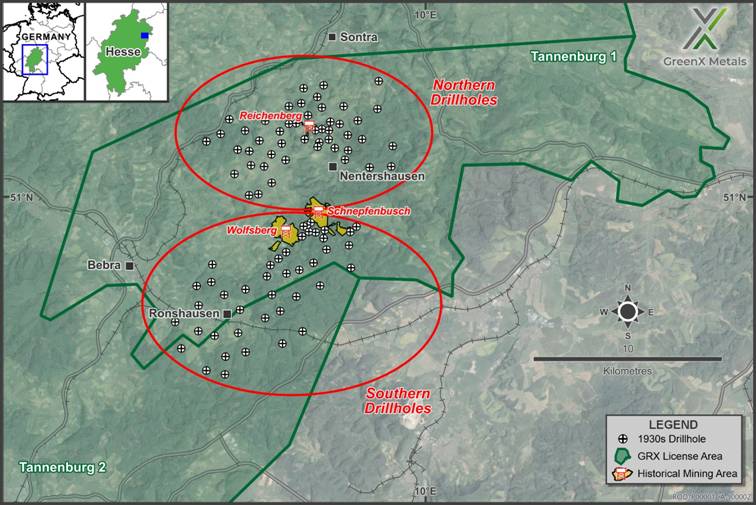
Figure 1: Location map of the 95 drill holes from the 1930s drill database at Tannenberg
1930s Drill database
Drilled between 1935 and 1938, the 95 holes tested two concepts (Figure 1). The southern holes tested the downdip continuation of known Kupferschiefer mining sites from the mid-1800s and led to the opening of the Wolfsberg and Schnepfenbusch mines. In the northern area, drilling revealed previously unknown down-faulted Kupferschiefer that does not outcrop and had not previously been exploited. This discovery led to the opening of the Reichenberg mine (Figure 2). The three mines formed the “Richelsdorf Mining District” and are located on the Tannenberg exploration licences.
Some of the original records of these drill holes were recently found by GreenX in a regional archive. To date, of the 95 holes indicated to exist in the 1930s database, the Company has found logs for 43 holes, including historical assay results for 35 of these. The archives have not been digitised, and the search process involves manually reviewing the database and scanning relevant records. GreenX is continuing its archive search to recover further data within the database.
Drilling up to 95 holes today is estimated to cost in excess of €25 million and take several years, given modern permitting requirements. The discovery of the historic drill database not only represents a significant saving in both time and money for GreenX, but it also provides valuable data points for its current exploration work program including exploration targeting and 3D modelling. Combined with the modern era 47 drill cores GreenX is currently re-logging and sampling (Figure 2), the quantity of previous exploration data available at Tannenberg is quickly growing, and underscores Tannenberg as a significant brownfield exploration opportunity.
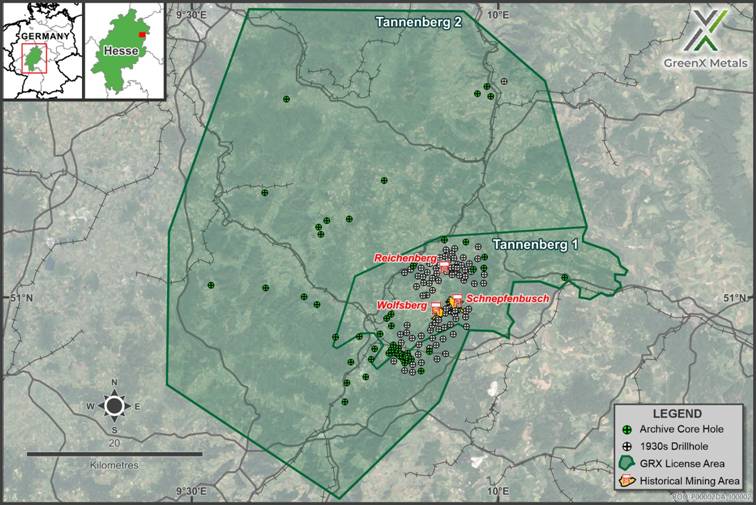
Figure 2: Location Map of GreenX’s Tannenberg project area showing the newly discovered 95 1930s drillholes, the location of the three underground copper/ silver mines opened during the late 1930s, and the location of the modern era 47 archive core holes that GreenX now has access to for re-logging and sampling
HISTORICAL CONTEXT
In an effort to bolster domestic supply of strategic metals, copper exploration was initiated by the National Socialist regime in the Richelsdorf District in the mid-1930s. The Richelsdorf District was chosen as the primary focus for exploration because copper, silver, cobalt and baryte mining was known in the region since the Middle Ages up until the mid-1800s. This earlier extraction of Kupferschiefer copper ores in the Richelsdorf District had taken place at surface outcrop and progressively gotten deeper with isolated bell pits until that point in time. The 1930s exploration program and the subsequent development of the three Richelsdorf district copper mines are believed to have been part of the government’s Four-Year plan (see below). Historical production from the Richelsdorf District is estimated at 416,500 tonnes of copper and 1,050 tonnes (33.7 million ounces) of silver.
In 1936, the National Socialist regime announced a Four-Year Plan for Germany, gearing its economic policy towards rearmament and preparing the country for industrial independence by 1940. The primary purpose of the Four-Year plan was to prepare the nation for war by achieving self-sufficiency in raw materials like copper and reducing reliance on international trade. This strategy was adopted because many believed that trade embargoes and naval blockades against Germany were a key reason for defeat during the First World War. To mitigate the impacts of future trade blockades and embargoes, the 1936 Four-Year Plan called for increasing domestic production of non-ferrous metals, developing synthetic substitutes, promoting conservation, stockpiling materials, and regulating imports to ensure Germany had the resources needed for rearmament.
Up until the 1930s, German domestic copper production was centred on the Mansfeld region in Sachsen-Anhalt, where Kupferschiefer copper had been mined for more than 800 years. As a result of the Great Depression, in 1933, the government amalgamated numerous Mansfeld mining and smelting operations into one company, Mansfelder Kupferschieferbergbau AG (Mansfeld AG). This company encapsulated the geological, exploration, mining and metallurgical expertise of the German copper mining industry. The ore deposit of the Mansfeld District was becoming depleted, which necessitated exploration in new regions including Richelsdorf and Sangerhausen. Due to historic production from the district, Mansfeld AG was tasked with conducting the copper exploration drilling in the Richelsdorf District, which was completed between 1935 and 1938 and funded by the government.
Following the partition of West and East Germany at the end of the Second World War, the Mansfeld copper mining district was located in Soviet-controlled East Germany. East Germany, officially the German Democratic Republic (GDR), was a communist state that existed from 1949 to 1990 (Figure 3). Copper mining continued in the former East Germany at Sangerhausen up until 1990. It is also understood that the pre-war administrative centre for the Richelsdorf District became part of the neighbouring state of Thuringia, which was part of the GDR.
This offers one explanation as to why the 95 hole 1930s historical drill database was lost to history since 1945, as much of the knowledge of the drill database for the Richelsdorf mines existed behind the Iron Curtain in former East Germany, whereas the Richelsdorf mines were located just over the West German side of the border (Figure 3). Under these circumstances, the drillhole database and knowledge of exploration and mining of the Richelsdorf Mining District appear to have been mainly forgotten by industry and academia until now. Accordingly, GreenX is continuing its archival search in out-of-state archives of the former East Germany and in private collections. It is likely that these documents have not been looked at since they were archived decades ago.
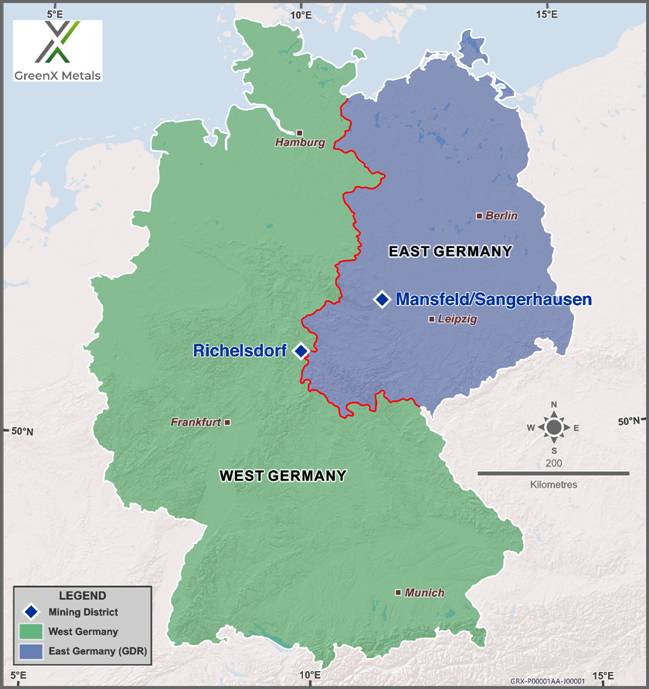
Figure 3: Political map of Germany post Second World War, divided into West and East Germany (GDR), and showing the relative locations of Mansfeld and Richelsdorf copper mining districts
Upcoming Work Programs
The discovery of the National Socialist era drill database is part of the Company’s continued search for historical mining and production data in German archives, which are part of a broader exploration program at Tannenberg, which includes:
· Logging, assaying, and hyperspectral scanning of historical core;
· Reprocessing and analysis of historical geophysical data; and
· Collation of historic geological, mine development and production data.
ENQUIRIES
|
+44 207 478 3900 info@greenxmetals.com |
Sapan Ghai Chief Commercial Officer – UK
|
|
Kim Eckhof Investor Relations – UK / Germany
|
Kazimierz Chojna Investor Relations – Poland
|
#URU URU Metals Limited – Higher-Grade Nickel Sulphides Confirmed at Zeb
URU Metals Limited (“URU” or the “Company”) is pleased to report assay results and geological interpretations from a two-hole drilling programme at the Zeb Nickel Project in Limpopo, South Africa. Drilled vertically, the holes validate the Zeb geological model, and confirms the presence of thicker, higher-grade nickel-copper-PGE (“Ni-Cu-PGE”) horizons beneath the historic open-pit resource and demonstrates that mineralisation remains open both along strike and at depth.
Key Value Highlights
· Two drillholes plus two deflections completed intersected mineralised material in both Zone 1 and Zone 2.
· Zone 2 Ni-Cu-PGE mineralisation confirmed to be present in a previously untested area beneath Zone 1, confirming the geological model.
· Thicker, higher-grade intervals beneath the historical resource
o Zone 2: up to 2.27 m @ 0.27 % Ni, 0.17 % Cu, 2.27 g/t 3PGE+Au and 4.06 m @ 0.23 % Ni, 0.14 % Cu, 1.36 g/t 3PGE+Au
o Zone 3: up to 0.70 m @ 0.65 % Ni, 0.40 % Cu within a broader 2.73 m @ 0.39 % Ni
· Multiple semi-massive sulphide hits confirm the geological model and strengthen the analogy with world-class feeder conduit systems.
· Mineralisation remains open along strike and at depth, highlighting meaningful scale-up potential for both tonnage and grade.
The Zeb mineral system is divided into four stacked horizons: Zone 1 forms the near-surface, bulk-tonnage nickel-bearing unit of the Lower Uitloop body that underpins the historical Ni resource.
Zone 2, immediately beneath and adjacent to Zone 1, contains Ni-Cu-PGE mineralisation similar to that found at Ivanhoe Mines’s Platreef Mine and Valterra Platinum’s (formally known as Anglo American) Mogalakwena Mining Complex.
Zone 3 is a feeder-style ultramafic chonolith, the geometry of which was recently confirmed in an airborne gravity and magnetic survey.
Zone 4 broadly encompasses areas of gold mineralisation intersected in drillholes.
Two holes (Z031 and Z033) where drilled, both at a vertical angle, and were designed to test the true vertical depth of the mineralised sequences and test for down-dip continuity of Zone 2 beneath Zone 1. Two deflections, Z031D1 and Z031D2, were drilled off Z031. No deflections were drilled off Z033. Boreholes and deflections were drilled using a NQ core diameter size. The locations of these holes are shown in Figure 1 below.
Boreholes Z031 and Z033 successfully intersected Ni and Ni-Cu-PGE mineralisation in Zones 1 and 2 respectively, while Z031 and its deflections also intersected what is interpreted as Zone 3 mineralisation. The assay results confirm the presence of thick, higher-grade Ni-Cu-PGE mineralised intervals of varying grade beneath the historical resource envelope and confirm the continuity of mineralisation in line with previous intersections along strike.
Importantly, the data provides strong evidence that the Ni-Cu-PGE mineralisation in Zone 2 continues below Zone 1 and may fully extend beneath Zone 1, meaning that the area holds increased potential to host a significant Ni-Cu-PGE resource. This is shown in the cross sections in Figure 2 and Figure 3.
The boreholes also intersected Zone 3 semi-massive Ni-PGE sulphide mineralisation, further validating the presence of semi massive to massive sulphides associated with the chonolith and supporting the potential for a large, continuous magmatic system that hosts massive nickel sulphide, targets of which were identified in the recent airborne magnetic and gravity survey.
Highlights of results
Zone 2
· 2.27 m @ 0.27 % Ni, 0.17 % Cu, 2.27 g/t 3PGE+Au
*including 0.77 m @ 0.31 % Ni, 0.18 % Cu, 2.19 g/t 3PGE+Au (346.23 – 348.50 m; Z031D1).
· 4.06 m @ 0.23 % Ni, 0.14 % Cu, 1.36 g/t 3PGE+Au (342.44 – 346.50 m; Z031D0)
*including 1.56 m @ 0.30 % Ni, 0.18 % Cu, 1.72 g/t 3PGE+Au.
Zone 3
· 1.03 m @ 0.60 % Ni, 0.14 % Cu, 0.57 g/t 3PGE+Au (330.97 – 332.00 m; Z031D0).
· 0.70 m @ 0.65 % Ni, 0.40 % Cu, 0.36 g/t 3PGE+Au within 2.73 m @ 0.39 % Ni (338.53 – 341.26 m; Z031D0).
The mineralised zones remain open both along strike and at depth, and the geological model proposes that further down-dip drilling may intersect significantly higher-grade Ni-Cu-PGE mineralisation. This interpretation is supported by analogous mineralisation styles and grades observed at neighbouring world-class deposits, including Ivanhoe Mines’ Platreef Project and Valterra Platinum’s Mogalakwena Mining Complex.
Of particular significance is the consistent intersection of semi-massive sulphide mineralisation associated with Zone 3 in the central part of the Uitloop body, where a potential chonolith structure may link the Uitloop I and II bodies. This is an exciting development, as such a chonolith could host a larger, more continuous sulphide accumulation due to its structural setting and potential to channel enriched magmatic pulses during emplacement and develop a Ni-PGE rich massive sulphide, as discussed in RNS dated 21 May 2025 and 3 June 2025 (https://urumetals.com/index.php/2025/06/03/zeb-nickel-project-3-d-geophysical-modelling/) and (https://urumetals.com/index.php/2025/05/21/zeb-nickel-identifies-high-priority-drill-targets/).

Figure 1: Location of the boreholes overlain on the geological map of the project area. Assay results are from the two boreholes shown in bold (Z031D0 and Z033D0), while the other labelled boreholes are included in the cross-sections shown in Figure 2 below.
Table 1: Newly reported Assay Results from Z031 and Z032

*3PGE+Au equals platinum + palladium + rhodium + gold by fire assay with ICP-AES Finish;
^Total Ni assay by complete digestion, representing the silicate and sulfide portion of Ni;
Additional drilling is required to determine true thickness;
“Depth From”, “Depth To” and “Sample Thickness” reported are depths from surface down the drill hole.

Figure 2: Cross-section along lines A – C demonstrating the continuity of Ni-Cu-PGE mineralisation within Zone 2 beneath the Lower Uitloop body.

Figure 3: Cross-section along lines A – B demonstrating the continuity of Ni-Cu-PGE mineralisation within Zone 2 beneath the Lower Uitloop body. The central portion of the section highlights consistent intersections of semi-massive Ni-PGE mineralisation. Notably, historical boreholes Z03 and Z017 were terminated prematurely, before intersecting the full extent of the Ni-Cu-PGE mineralised package.
Photographs of the sulphide mineralisation are shown in Figure 4, which demonstrates that the mineralising systems are working in line with the geological model and that the area holds significant potential for further Ni-Cu-PGE mineralisation.

Figure 4: The photographs illustrate examples of blebby to semi-massive sulphide mineralisation intersected during the recent drilling program. (A) and (B) show coarse blebby sulphides composed of pyrrhotite, pentlandite, and chalcopyrite from borehole Z031D0. (C) displays a semi-massive, net-textured sulphide zone dominated by the same sulphide assemblage, with an assay grade of 0.59 g/t 3PGE+Au and 1.00% Ni over a 0.56 m interval.
John Zorbas, CEO, commented:
“These results validate our geological model and confirm that Zeb Nickel has the scale and grade to become a significant critical-metal asset. With mineralisation open in multiple directions, and several exciting targets identified from the recent airborne magnetic and gravity survey, we are as excited as ever about the growth runway ahead and look forward to updating the market on further exploration plans.”
Qualified Person and Quality Control/Quality Assurance
Richard Montjoie has supervised the preparation of the scientific and technical information that forms the basis for this news release and has approved the disclosure herein. Mr. Montjoie is not independent of the Company. Mr. Montjoie is a registered member of the South African Council for Natural Scientific Professions (SACNASP) membership number 400131/09. Mr. Montjoie holds a M.Sc. Honors in Economic Geology from the University of Witwatersrand, South Africa, and is fellow of the Geological Society of South Africa (GSSA).
The analytical work reported on herein was performed by SGS South Africa Proprietary Limited, based in Mokopane, Rustenburg and Randfontein, South Africa, an internationally recognized analytical services provider. Samples are analysed for Ni using a nitric acid leach and sodium peroxide fusion, followed by an ICP-AES finish; and Au, Pt, Pd by Fire Assay followed by an ICP-OES finish; and for Rh using palladium collection followed by ICP-OES finish.
About the Company
URU Metals is a mineral exploration and development company focused on advancing its high-potential critical metals projects in South Africa. The Company is committed to creating sustainable value through responsible mining practices, regulatory compliance, and engagement with stakeholders. For more information, visit www.urumetals.com.
Market Abuse Regulation (MAR) Disclosure
This announcement contains inside information for the purposes of Article 7 of the Market Abuse Regulation (EU) 596/2014 as it forms part of UK domestic law by virtue of the European Union (Withdrawal) Act 2018 (“MAR”), and is disclosed in accordance with the Company’s obligations under Article 17 of MAR.
For further information, please contact:
URU Metals Limited
John Zorbas
(Chief Executive Officer)
+1 416 504 3978
SP Angel Corporate Finance LLP
(Nominated Adviser and Broker)
Ewan Leggat / Jen Clarke + 44 (0) 203 470 0470