
Home » Posts tagged 'dfs'
Tag Archives: dfs
#SVML Sovereign Metals Ltd – SVM Advances U.S. Strategy as Rio Collab Concludes
HIGHLIGHTS
· Rio Tinto has not ified Sovereign that it will not exercise its right to elect to become operator of Sovereign’s Kasiya Rutile-Graphite Project under the Investment Agreement
· Rio Tinto has advised the Company, in its formal notice, that its decision reflects its change in corporate strategy regarding its Titanium business
· Accordingly, certain rights that Rio Tinto had in the Investment Agreement have now lapsed, including:
o exclusive marketing rights to market 40% of the annual production of all products
o pre-emptive right over any offer from a third party to acquire an interest in the Project
· Rio’s decision does not reflect any change in the fundamentals, economics or strategic importance of Kasiya as highlighted in the Kasiya DFS, which was completed with technical input from Rio Tinto
· Since the completion of the DFS, Sovereign has had deepening engagement with the U.S. Government, major U.S. companies, and industry stakeholders
· Sovereign can now prioritise a U.S.-focused critical-minerals strategy, positioning Kasiya as a secure, non-Chinese source of titanium feedstock and natural graphite for the U.S. and allied supply chains
· Commercial workstreams will include:
o advancing rutile and graphite offtake discussions toward binding agreements with Mitsui, Traxys and other strategic U.S. and U.S.-allied counterparties
o continued engagement with potential offtake partners and U.S. government stakeholders in relation to the heavy rare earth co-product opportunity
· Kasiya provides exposure to three minerals designated critical by the U.S. – titanium (via natural rutile), graphite and heavy rare earths (via a Heavy Rare Earth Concentrate by-product) – each feeding U.S. and allied supply chains, including Japan, being the dominant supplier of titanium metal to the U.S.
Mr Ben Stoikovich, Chairman, commented:
“As the Sovereign-Rio Tinto collaboration concludes, we would like to acknowledge and thank Rio Tinto for its significant contribution to the advancement of Kasiya.
Since 2023, Rio Tinto has invested over A$60 million in the Project and has provided valuable technical input through its participation on the Sovereign-Rio Tinto Technical Committee. This expertise has contributed to the successful delivery of the unique Pilot Mining and Rehabilitation program, which generated real-world operating and mining data that was incorporated into the tier-1 DFS completed earlier this year.
Sovereign looks forward to Rio Tinto continuing as a supportive shareholder as it builds on this important period of technical and operational progress, with the Company now well positioned to prioritise a U.S.-focused critical minerals strategy, positioning Kasiya as a secure, non-Chinese source of titanium feedstock and natural graphite for the U.S. and allied supply chains.”
Sovereign Metals Limited (ASX:SVM; AIM:SVML; OTCQX: SVMLF) (Sovereign or the Company) confirms that pursuant to the terms of the Investment Agreement between the Company and Rio Tinto Mining and Exploration Limited (Rio Tinto), Rio Tinto has notified Sovereign that it will not exercise its option to elect to become operator of the Kasiya Rutile-Graphite Project (Kasiya or the Project) in Malawi. Accordingly, Sovereign will continue as operator and will advance Kasiya directly.
In its notice to Sovereign, Rio Tinto advised that its decision not to elect operatorship reflects its change in corporate strategy and the strategic review of its Iron and Titanium business. This is consistent with Rio Tinto’s publicly outlined strategy under which it is narrowing its portfolio focus to iron ore, copper, aluminium and lithium. Accordingly, the decision does not reflect any change in the fundamentals, economics or strategic importance of the Project.
As a result of Rio Tinto’s decision not to elect operatorship, certain rights conferred on Rio Tinto under the Investment Agreement, including its operatorship, product marketing rights, consent and pre-emption rights in respect of the Project, cease, and Rio Tinto continues to hold a shareholding of approximately 18.2% in Sovereign. Rio Tinto will continue to hold a right to appoint a nominee director to the board of the Company (for as long as Rio Tinto holds at least a 15% shareholding in the Company) and a right to be notified of future equity issues (for as long as Rio Tinto holds at least a 10% shareholding in the Company).
Sovereign can now advance its commercial workstreams directly.
Sovereign intends to prioritise a US-focused strategy for Kasiya. The Project is positioned to supply natural rutile and natural graphite into supply chains serving the U.S. and allied economies, addressing acute gaps in secure, non-Chinese sources of critical minerals feedstock. Sovereign will deepen its engagement with the U.S. Government and industry stakeholders and focus its offtake and partnership efforts where Kasiya’s strategic value is greatest.
The Company intends to advance its existing rutile and graphite offtake MOUs, including those with its established counterparties, Mitsui & Co., Ltd., and Traxys North America, from non-binding arrangements to binding agreements, subject to negotiation.
Sovereign’s existing Collaboration Agreement with the International Finance Corporation (IFC), a member of the World Bank Group – of which the U.S. Government is the single largest shareholder – positions the Company to advance a development financing strategy for Kasiya alongside a globally recognised development-finance partner. With the Investment Agreement having fallen away, Sovereign is now able to progress its financing workstreams directly and on its own terms. The Company intends to pursue partnerships and financing arrangements for Kasiya, drawing on its engagement with the IFC and with development-finance and export-credit institutions across U.S. and allied economies, consistent with the Project’s role in secure, non-Chinese critical-minerals supply.
Sovereign thanks Rio Tinto for its investment, funding and technical contribution, which have been instrumental in advancing Kasiya to a world-class DFS.
|
Enquiries |
|
|
|
Frank Eagar, Managing Director & CEO South Africa / Malawi +27 21 140 3190
Sapan Ghai, CCO London +44 207 478 3900
|
|
|
|
Nominated Adviser on AIM and Joint Broker |
|
|
|
SP Angel Corporate Finance LLP |
+44 20 3470 0470 |
|
|
Ewan Leggat Charlie Bouverat |
|
|
|
|
|
|
|
Joint Broker |
|
|
|
Stifel |
+44 20 7710 7600 |
|
|
Varun Talwar |
|
|
|
Ashton Clanfield |
|
|
#BRES Blencowe Resources PLC – Orom Cross Graphite DFS NPV10 up 15% to US$1.254bn
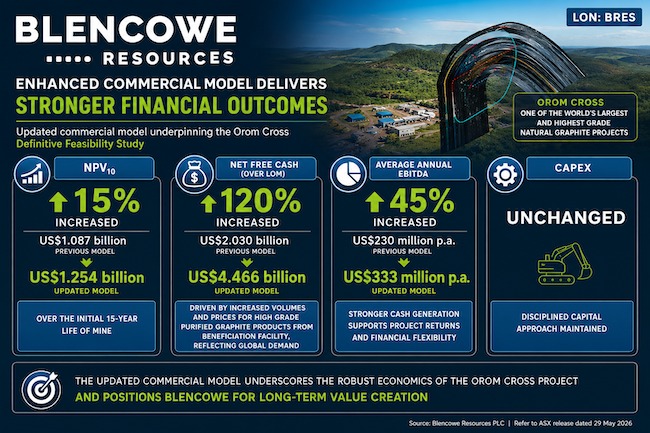 Blencowe Resources Plc (LSE: BRES) is pleased to announce an update to the commercial model underpinning the Definitive Feasibility Study (“DFS”) for the Orom-Cross graphite project in Uganda, reflecting a number of developments since the initial DFS was published in December 2025.
The updated model incorporates revised assumptions and inputs since the initial DFS, including new high value offtakers, updated pricing, costings and timings, expanded reserves incorporated into the mine plan, and increased confidence in product mix and saleability based on ongoing testwork and commercial engagement. Importantly, these improvements have been achieved without any increase in capital spend to deliver the project.
The revised commercial model increases Net Present Value10 (“NPV10“) by 15%, from US$1.087 billion to US$1.254 billion over the initial 15-year life of mine (“LOM”). While IRR has moderated versus the initial model due to updated inputs (specifically timing of capital spend), the revised DFS model continues to demonstrate robust economics with increased free cash generation.
Highlights
· NPV10: +15% to US$1.254 billion (initial 15-year LOM); IRR10: 51%.
· Net Free Cash: +120% to US$4.466 billion over LOM with increased volumes and prices for high grade purified graphite products from beneficiation facility, reflecting global demand.
· Average Annual EBITDA: +45% to US$333 million p.a.
· Capex: unchanged for both phases (P1 US$45m; P2 US$125m). Competitive internationally given infrastructure proximity.
· Commercial progress: several new offtake agreements, including high value niche sales, now reflected within revised DFS model.
· Market shift: western markets actively seeking purified products ex-China supports higher volume sales expected in highest value products.
· Expandables included: additional downstream processing pathway for expandable graphite and associated sales incorporated.
· Tenders submitted: applications submitted into several sizeable graphite tenders; outcomes expected to become clearer in Q3 2026.
· Strategy: downstream beneficiation / higher-value upgraded products remains core (including USPG and expandables).
Commercial Model and Scaling
Orom-Cross is expected to scale-up production in line with expected increased demand from offtakers for both concentrates and purified products. The Company’s view is that the project is less constrained by what it can produce than by what it can contract and sell into higher-value pathways, particularly as all upgraded products are now qualified and commercial terms for these are more evident.
Blencowe believes demand for natural flake graphite and upgraded products will continue to grow, specifically from Western markets seeking non-Chinese supply, while supply growth may remain constrained, thus supporting the opportunity for new entrants with scalable, high-quality product pathways and beneficiation.
Following successful bulk sample testing in 2025, the Company has continued engagement across multiple markets and sectors. Several new offtake agreements have been signed (including higher-value niche sales) and these are now reflected in the revised DFS model. Growth in net cash flow and NPV is largely the result of increased volumes of purified products sold as well as higher pricing for these as expected from Western markets. The Company expects to provide updates as further milestones are reached and disclosure is permitted.
The revised model reflects improved reserve confidence from the Stage 7 programme and incorporates the updated mine plan assumptions, providing greater assurance around production volumes and scalable operations over time.
Capital Framework and Phasing
Importantly, the revised DFS model reflects updated operating inputs (including fuel and equipment assumptions) without any increase in anticipated capital spend required to deliver the project:
· Phase 1 Production (P1): US$45 million (project equity-led pathway; faster start-up)
· Phase 2 Production (P2): US$125 million (scale-up and in-country downstream capability; predominantly debt-led)
This phasing supports a staged approach to de-risk execution while maintaining the long-term vision to deliver upgraded products in-country.
Blencowe notes the capital requirements are in the lowest percentile internationally and are highly competitive by industry standards, particularly as they cover both the Orom-Cross mining and processing operation and the beneficiation facility near Gulu.
Downstream Pathway and Non-China Demand
The Company’s long-term strategy to deliver upgraded purified products remains core, including uncoated spheronised purified graphite (“USPG”) and expandables. Where appropriate, the Company expects to utilise third-party processing partners to upgrade in the interim while progressing in-country capability.
Demand for non-Chinese graphite products (particularly purified products) continues to build as Western markets seek supply chain resilience. The Company believes Orom-Cross’ expanding inventory, product options and developing commercial pathway significantly strengthen the project’s strategic relevance.
Uganda Value-Add and In-Country Beneficiation
Blencowe’s long-term strategy is to maximise in-country value-add in Uganda through the production of upgraded graphite products, including USPG and expandables, supported by beneficiation capacity near Gulu. This approach aligns with Uganda’s broader objectives around local processing and value addition, skills transfer and industrial development, while strengthening Orom-Cross’ positioning within resilient, non-China supply chains.
Infrastructure and On-Site Progress
· Upgrade and sealing works have commenced on the road from Kitgum to Orom-Cross, managed and paid for by the UK Government, improving logistics to Mombasa port. This project is expected to be completed ahead of ramp up of Orom-Cross (P2 Production) and thus supports higher volumes moved from site.
· A first permanent camp was completed at Orom-Cross in 1Q 2026 to house contractors during mine construction, which will commence following funding.
Next Steps
The Company will continue to pursue value enhancement across Orom-Cross as further test work is delivered, tenders are completed, and as strategic relationships progress.
· Tenders:
The Company has submitted applications into several sizeable, strategic graphite tenders and expects greater clarity on outcomes in the next quarter (Q3 2026). Successful outcomes will underpin expected volume growth for both concentrate and upgraded product streams.
· SAFELOOP:
Significant progress has been made within the EU’s SAFELOOP initiative (developing a Gen3 lithium-ion battery for deployment in standardised EV buses across the European continent) but no sales for this initiative have been included in any DFS modelling to date.
· Price and product mix: continued improvements from higher-value niche sales and upgraded products.
Additional upside under evaluation but not yet modelled include industrial diamonds, further micronisation, speciality defence/energy applications, ultra-high purity (99.99% TGC) products, tenders underway and Project SAFELOOP (all subject to commercial terms).
As the project advances, the Company is focused on ensuring Orom-Cross is understood by a broader pool of sophisticated capital, supported by improved research coverage and institutional engagement. This will become a central part of Blencowe’s corporate strategy over forthcoming months as the Company seeks to bring more institutional shareholders onto the register.
Funding Strategy and Near-Term Priorities
The combination of low upfront capex, staged development, and downstream exposure positions Orom-Cross within a limited subset of graphite projects capable of meeting both return-thresholds and strategic supply chain requirements to attract the required capital.
Blencowe continues to progress two complementary funding pathways alongside ongoing commercial and development activity:
1. Phase 1 Production (P1) – US$45m (project-level focus):
· Primary focus is securing P1 equity funding, with a preference for project-level funding to minimise dilution at the plc level.
· The Company notes that several interested P1 investment partners have signed NDAs and are conducting due diligence in the data room as part of their internal financial decision-making processes.
· P1 is designed to establish an operating and sales track record and support downstream qualification from site, and to deliver pricing visibility which is critical to debt funding.
2. Phase 2 Production (P2) – US$125m (predominantly debt):
· P2 funds ramp-up mining to scale as well as in-country downstream processing capability near to Orom-Cross and is expected to be funded predominantly via debt.
· Expressions of interest and diligence pathways for debt providers are underway as they typically take longer than equity-led funding.
· DFI-style routes, including DFC, continue to be considered as potential debt funding pathways for P2 (not considered within P1 equity).
Several interested P1 funding parties have signed NDAs and are conducting due diligence in the data room. The Company is progressing all parties as efficiently as possible and will provide updates when there is substantive progress suitable for announcement.
Updated Production Pathway (as reflected in the model)
The updated DFS incorporates a refined staged plan:
· P1: delivers up to 20,000tpa of 97% TGC concentrate at Orom-Cross plus up to 3,000tpa spheronised graphite from in-country beneficiation at a proposed facility near to Gulu.
· P2: delivers up to 70,000tpa of 97% TGC concentrate plus up to 10,000tpa USPG and expandables from in-country beneficiation.
The Company notes that all subsequent phases of growth beyond P2 Production are driven by demand and contracted sales, with Orom-Cross not constrained by potential production so much as by sell-through of higher-value product streams.
Blencowe CEO Mike Ralston discusses the updated DFS with Vox in the interview below:
www.voxmarkets.com/articles/interview-with-blencowe-resources-0de98ba
Executive Chairman Cameron Pearce commented:
“This DFS model update reflects tangible progress across Orom-Cross. NPV10 increases to US$1.254 billion and net free cash rises to US$4.466 billion, while capital spend remains unchanged across both Phase 1 and Phase 2. While IRR has moderated versus the prior model due to updated inputs, the economics remain highly robust and the uplift in NPV and cash generation is the key outcome for project funding and delivery.
Just as importantly, the revised model now reflects additional commercial inputs, including new offtake agreements and the inclusion of expandables. We have also submitted into several sizeable graphite tenders and expect greater clarity on outcomes for these in the next quarter.
Funding remains the key gatekeeper. We continue to progress Phase 1 equity discussions, alongside longer-dated Phase 2 debt pathways, and we will update the market as and when appropriate.
Additionally, as Orom-Cross advances, we are also focused on ensuring the enlarged investment case is understood by a broader pool of sophisticated capital, supported by improved research coverage and institutional engagement.”
For further information please contact:
|
Blencowe Resources Plc |
|
|
Sam Quinn (Director) |
Tel: +44 (0)1624 681 250
|
|
Sasha Sethi (Investor Relations) |
Tel: +44 (0) 7891 677 441 |
|
Tavira Financial (Joint Broker):
Jonathan Evans |
Tel: +44 (0)20 3192 1733 |
|
Oak Securities (Joint Broker):
Calvin Man / Mungo Sheehan / Jerry Keen |
Tel: +44 (0)20 3973 3678 |
|
Cavendish (Joint Broker):
Neil McDonald / Peter Lynch / Hanna Leijonmarck |
Tel: +44 (0) 20 7908 6000 |
|
|
|
|
|
#BRES Blencowe Resources PLC – Beehive Deposit Maiden JORC Resource
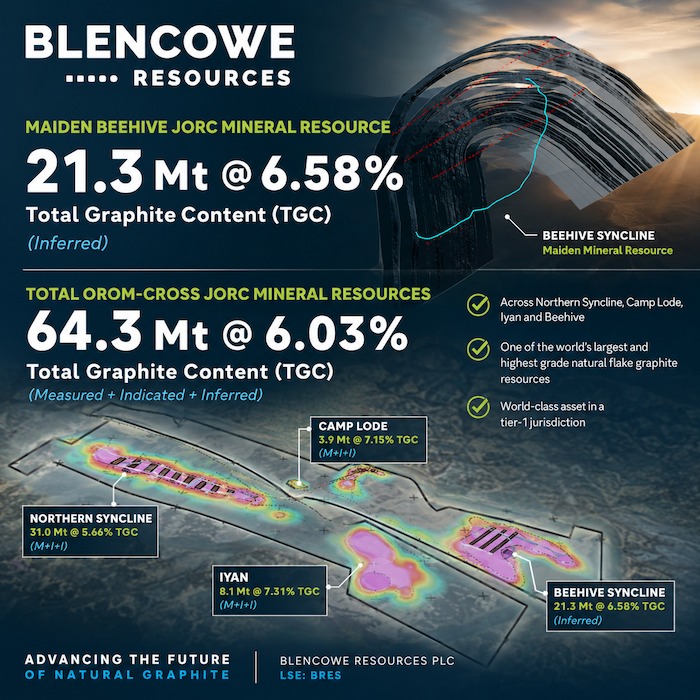 Blencowe Resources Plc (LSE: BRES) is pleased to announce a maiden JORC (2012) Mineral Resource Estimate for the Beehive deposit, part of the Company’s 100% owned Orom-Cross graphite project in Uganda.
Beehive is one of two substantial new discoveries (together with Iyan) made through the Company’s most recent drilling programme and represents another major step change in Orom-Cross scale. Following the maiden Iyan JORC Mineral Resource (which lifted the Orom-Cross resource base by 66% to 43.0 Mt), the maiden Beehive JORC Mineral Resource adds 21.3 Mt @ 6.58% TGC (Inferred) and increases total Orom-Cross JORC Mineral Resources to 64.3 Mt @ 6.03% TGC (Measured + Indicated + Inferred) across Northern Syncline, Camp Lode, Iyan and Beehive.
This further demonstrates Orom-Cross as a multi-deposit, long-life, large-scale graphite development with total Orom-Cross JORC Mineral Resources up 168% since commencement of the Stage 7 programme.
Importantly, the current Beehive JORC Resource has been modelled over only circa 22% of the Beehive anomaly and largely within the upper 25-30 metres tested by shallow drilling. Combined with previously reported deep drilling demonstrating mineralisation continuing to approximately 100 metres depth, the Company believes Beehive retains significant upside potential beyond the current modelled area.
With a materially expanded resource base now defined, the Company has been progressing further DFS optimisation work to incorporate the enlarged inventory, evolving downstream pathways, and ongoing commercial discussions. This work is well advanced and a further update is expected prior to the end of Q2 2026.
Highlights:
Beehive Maiden JORC Mineral Resource update;
· Beehive JORC Mineral Resource: 21.3 Mt @ 6.58% TGC (Inferred) at a 3.5% TGC cut-off
· Higher-grade component defined: 17.5Mt @ 7.0% TGC
· Total Orom-Cross JORC Mineral Resources (revised): 64.3Mt @ 6.03% TGC (Measured + Indicated + Inferred) at a 3.5%TGC cut-off
o Measured Resource: 1.20 Mt @ 5.13% TGC
o Indicated Resource: 16.41 Mt @ 5.7% TGC
o Inferred Resource: 46.70 Mt @ 6.17% TGC
· Stage 7 drill programme impact: total Orom-Cross JORC Mineral Resources have increased by 168% since commencement of the Stage 7 programme
· Depth continuity: deep drilling previously demonstrated mineralisation continuing to >100m at both Iyan and Beehive deposits
· Beehive scale: the current model covers just 22% of the total Beehive target anomaly and is largely confined to the upper 25-30 metres of the deposit
· Cost Efficiency: these exceptional results have been achieved at a cost of under US$10/tonne, which is very low by industry standards
· DFS optimisation update: expected prior to the end of Q2 2026
· Strategic and funding workstreams: discussions with counterparties remain ongoing, supported by the increased scale and deposit pipeline as development planning progresses
Figure 1: Beehive location plan showing drill coverage, modelled area and anomaly outline.
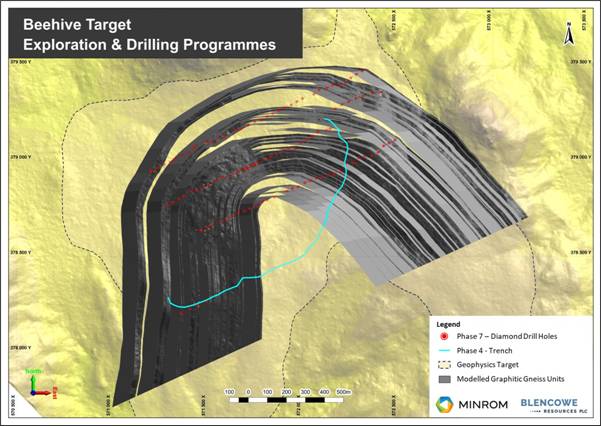
Figure 2: Beehive block model / grade model illustrating continuity within the modelled area.
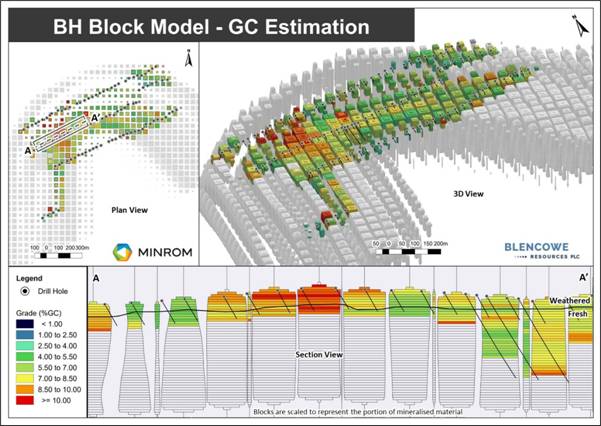
Block model of the Beehive Deposit. Mineralisation remains open along strike and at depth; multiple drill holes end in mineralisation.
Table 1: Orom-Cross JORC Mineral Resource Summary by Deposit (JORC 2012; 3.5% TGC cut-off).
Northern Syncline + Camp Lode + Iyan + Beehive = 64.3 Mt.
|
Deposit |
Measured (Mt) |
Indicated (Mt) |
Inferred (Mt) |
Total (Mt) |
Grade |
|
Northern Syncline |
1.20 |
14.19 |
8.14 |
23.53 |
5.4% |
|
Camp Lode |
– |
2.22 |
0.36 |
2.58 |
6.9% |
|
Iyan |
– |
– |
16.90 |
16.90 |
6.0% |
|
Beehive |
– |
– |
21.30 |
21.30 |
6.6% |
|
Total Orom-Cross |
1.20 |
16.41 |
46.70 |
64.30* |
6.0% |
*Totals subject to rounding. Category splits and grade weighting are as reported by the Competent Person.
Ore Reserves remain unchanged and are presented separately below.
Table 2: Orom-Cross Ore Reserve Summary (unchanged, JORC 2012)
Northern Syncline + Camp Lode only.
|
Deposit |
Ore Reserve (Mt) |
Grade (%TGC) |
|
Northern Syncline |
20.59 |
4.99 |
|
Camp Lode |
2.49 |
6.74 |
|
Total Ore Reserve |
23.08 |
5.18 |
Ore Reserves are a subset of Mineral Resources and are not additive to the JORC Mineral Resource total. Both Iyan and Beehive deposits are currently reported as a maiden JORC Mineral Resource only and have not yet been converted to Ore Reserves. Further infill drilling is required to bring a portion of both Iyan and Beehive Resources into Reserves.
JORC Mineral Resource Upgrade Confirms Scale and Upside
The maiden Beehive JORC Mineral Resource confirms a thick graphite system at shallow depths within the modelled area, while previously reported deep drilling demonstrates mineralisation continuing to approximately 100 metres depth. Beehive has been modelled largely within the upper 25-30 metres and over only part of the target anomaly, and the Company believes there is clear scope for resource growth through step-outs and further modelling.
Key implications of the upgrade:
· Step-change in scale: Beehive lifts total Orom-Cross JORC Mineral Resources to 64.3 Mt; reinforcing a multi-deposit, long-life, large-scale graphite development
· Resource growth runway: mineralisation remains open beyond the current modelled area, with step-out and depth upside indicated by drilling to date
· Development and mineability: continuity and near-surface thickness support open-pit development assumptions and low strip potential, consistent with a low-cost mining profile
· Metallurgical alignment: grade profile and mineralisation style remain consistent with prior testwork and current processing assumptions
· Efficient conversion: conversion expenditure remains comparatively low, supporting continued definition of additional tonnes and the potential to upgrade classifications as modelling progresses
With a materially expanded inventory now defined, the Company has been progressing further DFS optimisation work to incorporate the enlarged resource base, evolving downstream pathways, and ongoing commercial discussions.
Strategic offtake and funding discussions also continue alongside development planning, and the Company will provide updates as and when disclosure is permitted and appropriate, in line with its regulatory obligations.
CEO Interview
Blencowe Resources CEO, Mike Ralston discusses today’s JORC Resource upgrade and the Company’s current workstreams in an interview linked below:
https://media.focusir.com/BlencoweRes_Orom-Cross_Resource_Growth_Update
Blencowe Resources Executive Chairman, Cameron Pearce commented:
“Today’s maiden Beehive JORC Mineral Resource is another major step forward for Orom-Cross. Beehive adds 21.3 million near-surface tonnes at 6.6% TGC, lifting total Orom-Cross JORC Mineral Resources to 64.3 million tonnes across Northern Syncline, Camp Lode, Iyan and Beehive.
Importantly, Beehive has been modelled over only 22% of the target anomaly and largely within the upper 25-30 metres, while deep drilling has demonstrated mineralisation continuing to below 100 metres depth. We believe this provides a clear growth runway beyond the current modelled area.
With a materially expanded inventory now defined, we have been progressing further DFS optimisation work and expect to update the market prior to the end of Q2 2026. Strategic, offtake and funding discussions remain ongoing and we will update the market as appropriate.”
Competent Person’s Statement
The information in this release, which is related to Mineral Resource estimation, was compiled under the supervision of Mr Oscar Van Antwerpen who is the CEO of Minrom Consulting (Pty) Ltd; he is Member of the Geological Society of South Africa (GSSA) and a Registered Professional Natural Scientist (Pr.Sci.Nat) with the South African Council for Natural Scientific Professions (SACNASP).
Mr Oscar Van Antwerpen has sufficient experience relevant to the style of mineralisation and type of deposit under consideration and to the activity that he has undertaken to qualify as a Competent Person as defined by the JORC (2012) Code. Mr Oscar Van Antwerpen consents to the inclusion in this report of the matters based on his information in the form and context in which it appears.
Appendix
(Independent Geologist – Minrom – tables and figures)
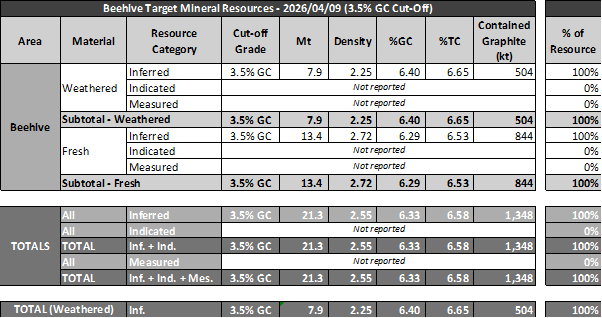
· GC – Graphitic carbon, TC – Total carbon.
· No geological losses applied.
· A conservative cut-off grade of 3.5% GC has been applied based on metallurgical testing & preliminary mining parameters.
· Mineralised tonnes have been rounded off and contained graphite tonnages have been rounded off to the nearest 1000 (Kt).
· Contained graphite has been reported without the application of cut-off grades, loss factors, or beneficiation yields.
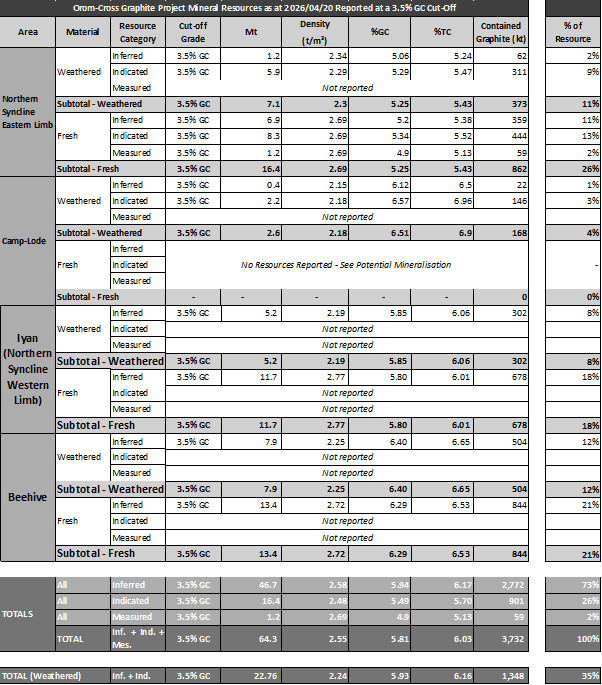
· GC – Graphitic carbon, TC – Total carbon.
· No geological losses applied.
· A conservative cut-off grade of 3.5% GC has been applied based on metallurgical testing & preliminary mining parameters.
· Mineralised tonnes have been rounded off and contained graphite tonnages have been rounded off to the nearest 1000 (Kt).
· Contained graphite has been reported without the application of cut-off grades, loss factors, or beneficiation yields.
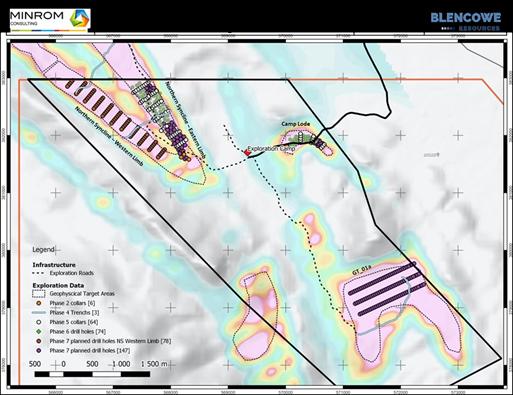
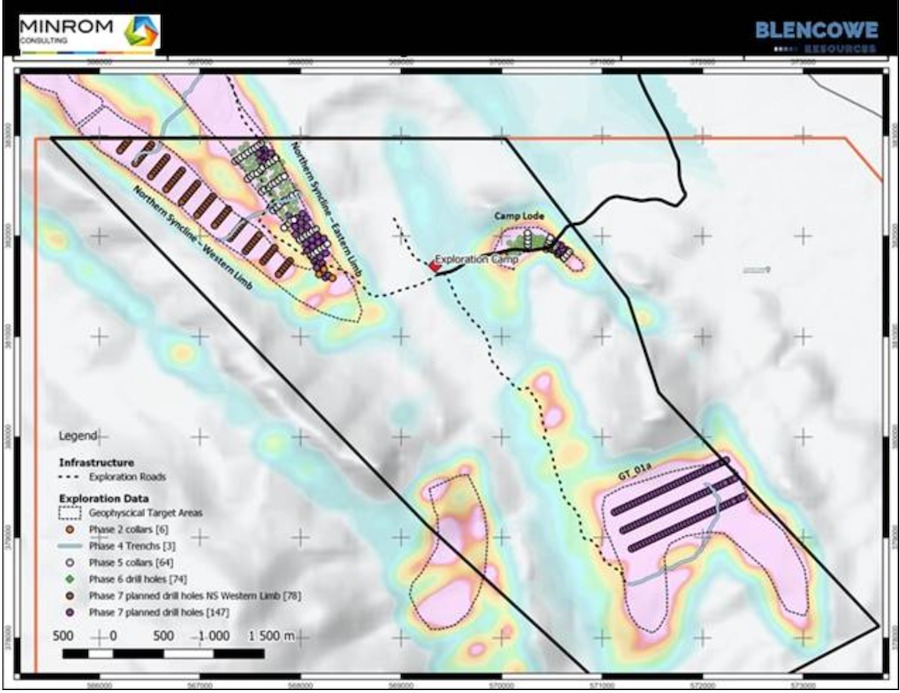
Map 1: Showing the 4x Orom-Cross deposits, including Camp Lode, Northern Syncline, and new Iyan (NS western limb) and Beehive (GT 01a) deposits.
**ENDS**
For further information please contact:
|
Blencowe Resources Plc |
|
|
Sam Quinn (Director) |
Tel: +44 (0)1624 681 250
|
|
Sasha Sethi (Investor Relations) |
Tel: +44 (0) 7891 677 441 |
|
Tavira Financial (Joint Broker):
Jonathan Evans |
Tel: +44 (0)20 3192 1733 |
|
Oak Securities (Joint Broker):
Calvin Man /Mungo Sheehan / Jerry Keen |
Tel: +44 (0)20 3973 3678 |
|
|
|
|
|
#SVML Sovereign Metals Limited – Successful Rehabilitation Trials
KEY HIGHLIGHTS
· Critical DFS workstream de-risked – Mine Closure and Rehabilitation Plan based on empirical field data from Sovereign’s successful pilot mining and rehabilitation trial.
· Second year of rehabilitation trials near completion – Extended programme builds on proven first-year results and demonstrates that land can be rehabilitated post mining, with refined rehabilitation methods improving crop yields by 520% over multiple seasons.
· Community partnership deepens – Participating farmers to establish a farming co-operative, a central pillar of Sovereign’s post-closure social transition strategy, to ensure sustainable results well beyond the completion of the trial.
· Supports IFC collaboration – Multi-year rehabilitation outcomes provide irrefutable empirical evidence of alignment with IFC Performance Standards, closure and rehabilitation planning incorporated in the DFS and ESIA.
Sovereign Metals Limited (ASX:SVM; AIM:SVML; OTCQX:SVMLF) (Sovereign or the Company) is pleased to announce that its second year of rehabilitation trials at the Kasiya Rutile-Graphite Project (Kasiya or the Project) is nearing completion during the upcoming harvest season in Malawi. The pilot mining, backfilling, and rehabilitation program is a key workstream and input into the Definitive Feasibility Study (DFS), which is being completed under the oversight of the Sovereign-Rio Tinto Technical Committee.
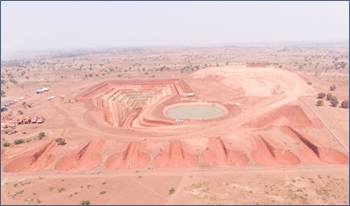
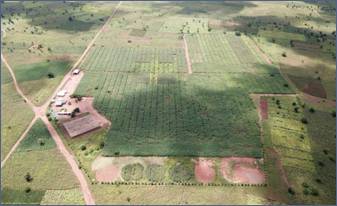
Figures 1 & 2: Pilot mining site post-mining and following rehabilitation.
The rehabilitation trials provide practical, multi-year evidence demonstrating Sovereign’s alignment with international rehabilitation, environmental, and community good-practice standards. Empirical data from the trials has been used to prepare the Mine Closure and Mine Rehabilitation Plans, which are now integrated into the mining, backfilling and post-mining closure planning – critical components for project bankability and alignment with the standards required by development finance institutions.
The rehabilitation programme has also contributed to a significant community development outcome. After two years of close collaboration, the 28 local farmers involved in the trials have formally requested that Sovereign remains at the trial site and support them in establishing a farming co-operative. This represents a strong community endorsement of the program’s value and is a central pillar of Kasiya’s post-closure social transition strategy – demonstrating that the Project can deliver lasting economic benefits to local communities well beyond the mine life.
The outcomes directly complement the recently announced collaboration with the International Finance Corporation (IFC), a member of the World Bank Group, which is supporting integration of IFC Performance Standards into the Project’s DFS and Environmental and Social Impact Assessment (ESIA), and strengthening Kasiya’s pathway to bankable development and international project financing.
Sovereign Metals Managing Director and CEO Frank Eagar commented:
“Sovereign’s primary objective is to deliver sustainable returns for all stakeholders, including shareholders and local communities. Not only will the overwhelming success and empirical data collected through this pilot mining and rehabilitation trial underpin the DFS accuracy, but it also demonstrates that land post mining can be successfully rehabilitated and our ability to improve agricultural productivity. The 5-fold increase in maize yields will enable unprecedented and immediate secondary economic benefits. The emerging co-operative model is a practical example of our commitment in action – transforming mined land into more productive farmland while equipping local communities with the skills and infrastructure to thrive independently.”
PROVEN REHABILITATION RESULTS
The second year of trials builds on the success of the first year, which delivered maize yields of 5.2 tonnes per hectare versus the regional average of 1 tonne per hectare – a fivefold increase that confirmed post-mining land can achieve superior agricultural productivity compared to pre-mining land, which loses crop carrying capacity at 3 to 4% per annum.
Sovereign’s rehabilitation approach is designed to use agricultural inputs while maximising long-term agricultural sustainability. Lime, fertiliser and biochar were applied during the first year of rehabilitation, with only targeted supplementation in the second year where specific deficiencies in basic nutrients were identified. Rehabilitation activities are conducted under a no-tillage, minimal soil disturbance principle. No heavy machinery is permitted on rehabilitated soils; all activities are undertaken by hand to preserve soil structure and the effectiveness of applied ameliorants. This simple, replicable approach is specifically designed to be adopted and maintained by local farming communities beyond mine closure.
DIVERSIFIED CROPPING SYSTEM
The second year of trials has expanded the rehabilitation approach into a diversified multi-cropping system, combining maize with bamboo (Giant Bamboo – Dendrocalamus asper), winter beans, grass fodder and groundnuts. First-year results confirmed that bamboo and maize co-exist with minimal competition, functioning in a symbiotic manner that supports long-term land productivity. Through the intercropping approach, local farmers were able to exceed their usual crop yields, while, in parallel, the Bamboo has been allowed to mature as a long-term carbon and soil remediation solution. The multi-cropping approach provides participating communities with a wider range of food, cash and fodder crops – supporting year-round agricultural viability and the transformation from subsistence to commercial farming on rehabilitated land.
Second-year crop yields are expected to reach the first-year benchmark of 5.2 tonnes per hectare when harvested in mid-2026.
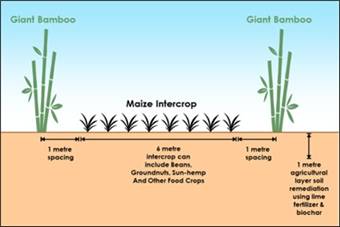
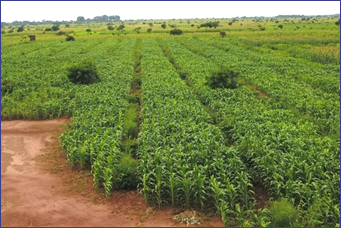
Figures 3 & 4: Bamboo and maize intercropping system & Sovereign’s rehabilitation showing maize intercropped with bamboo (February 2026).
COMMUNITY PARTNERSHIPS
Farmer engagement and participation are central to the long-term success of Kasiya’s rehabilitation strategy. The rehabilitation approach uses simple agronomic methods carried out largely by hand, ensuring that local communities can sustain and build on the improved farming practices beyond mine closure.
Sovereign has worked closely with local farmers over the past two years, who have been integral to the success of the rehabilitation program. This deepening partnership has resulted in participating farmers formally requesting that Sovereign remains involved at the trial site and provide support in establishing a farming co-operative – a strong endorsement of the program’s value to the local communities. The development of community-led farming co-operatives forms a central pillar of Sovereign’s post-closure social transition strategy. The Company plans to continue working with local farmers throughout 2026, with a view to establishing a replicable model that can be scaled across the broader Kasiya project area as mining progresses.
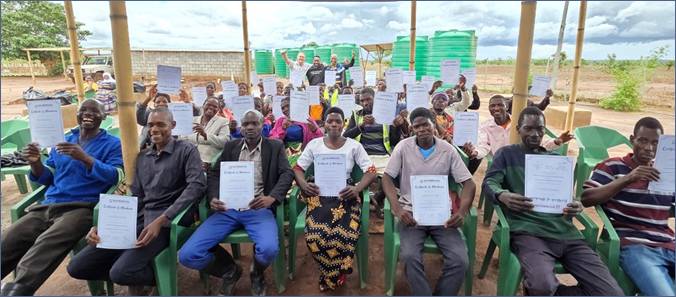
Figure 5: Rehabilitation site farmers with agreements on setting up a farming co-operative.
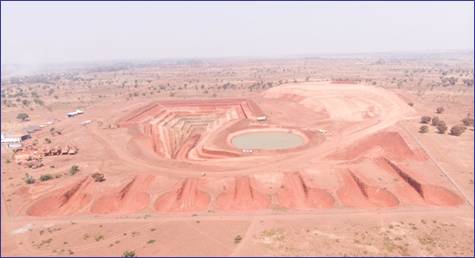
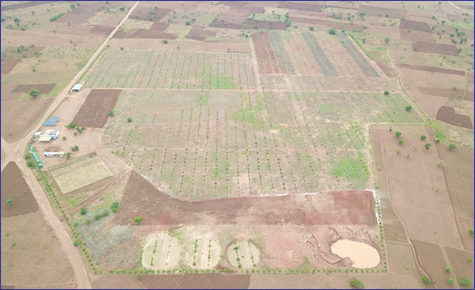
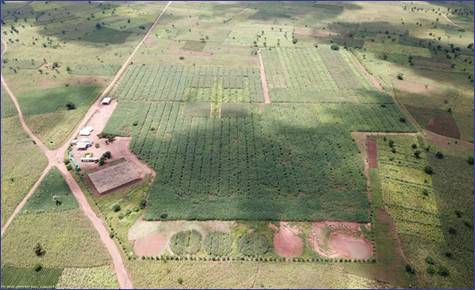
Figures 6-8: Images showing the progression of mining, backfilling and rehabilitation at
Sovereign’s Rehabilitation Trail Site.
|
Enquiries |
|
Frank Eagar, Managing Director & CEO South Africa / Malawi +27 21 140 3190 Sapan Ghai, CCO London +44 207 478 3900 |
|
Nominated Adviser on AIM and Joint Broker |
|
|
SP Angel Corporate Finance LLP |
+44 20 3470 0470 |
|
Ewan Leggat Charlie Bouverat |
|
|
|
|
|
Joint Broker |
|
|
Stifel |
+44 20 7710 7600 |
|
Varun Talwar |
|
|
Ashton Clanfield |
|
#SVML Sovereign Metals LTD – Kasiya MRE Significantly Upgraded Ahead of DFS
 KEY HIGHLIGHTS
· Total Rutile Mineral Resource increases to 2.1 billion tonnes at 0.96% rutile for 20.3Mt contained rutile with 0.95% TGC for 20.0Mt contained graphite (M,I&I)
· Measured and Indicated (M&I) contained rutile surges 32% to 16.1Mt (1.6 billion tonnes at 0.98% rutile) – a material increase in resource confidence ahead of DFS
· Measured Resource planned to be mined and processed in first six years of operations – highest confidence JORC Code category, achieved at Kasiya for the first time
· Resource upgrade delivers the classification standard required for bankable DFS – a critical milestone on the path to project financing
Sovereign Metals Limited (ASX:SVM; AIM:SVML; OTCQX:SVMLF) (Sovereign or the Company) is pleased to announce an updated Mineral Resource Estimate (MRE) for its flagship Kasiya Rutile-Graphite Project (Kasiya or Project) in Malawi.
The updated MRE will serve as the resource base for the Kasiya Definitive Feasibility Study (DFS) mine schedule, replacing the previous April 2023 MRE (Previous MRE).
Combined Measured and Indicated rutile Resources have grown 38% to 1,652Mt, now representing 77% of the total Resource base. This material improvement in Resource confidence reflects the extensive infill drilling programs completed and provides a robust foundation for the forthcoming DFS. Importantly, Kasiya has achieved a Measured Resource for the first time, which represents at least the first six years of planned operations.
Managing Director and CEO Frank Eagar commented:
“This updated MRE is a significant milestone for Sovereign as we advance Kasiya through the Definitive Feasibility Study. The 32% increase in Measured and Indicated contained rutile, together with our first-ever Measured Resource, reflects both the quality of our geological dataset and the exceptional nature of this deposit. The rigour of the updated resource estimation gives our strategic and commercial partners and us high confidence in the resource base underpinning our potential mine schedule. Kasiya remains unmatched globally as a source of natural rutile, and this MRE update reinforces its potential as a long-life, low-cost supplier to critical global supply chains.”
UPDATED MINERAL RESOURCE ESTIMATE
Table 1: Kasiya Rutile Mineral Resource Estimate (March 2026)
|
Class |
Tonnes (Mt) |
Rutile Grade (%) |
Rutile (Mt) |
TGC (%) |
TGC (Mt) |
Rutile Eq. (%) |
|
Measured |
107 |
1.05 |
1.12 |
1.56 |
1.67 |
1.94 |
|
Indicated |
1,545 |
0.97 |
14.99 |
1.05 |
16.26 |
1.57 |
|
Total M&I |
1,652 |
0.98 |
16.12 |
1.09 |
17.93 |
1.60 |
|
Inferred |
452 |
0.91 |
4.12 |
0.45 |
2.02 |
1.17 |
|
Total Rutile MRE |
2,105 |
0.96 |
20.24 |
0.95 |
19.95 |
1.51 |
Note: Rutile Mineral Resource defined from a pit shell with mineralisation defined as >= 0.75% Rut95 for the pit shell optimisation run. A rutile concentrate net price of US$1,400 was used to determine economic value. Graphite had no value for this run. The Rutile MRE is reported based on all rutile mineralisation >=0.4% Rut95 within the optimised pit shell. Any apparent differences in totals are due to rounding.
Table 2: MRE Comparison – Previous vs. Updated
|
Metric |
Previous MRE |
Updated MRE |
Change |
|
Total Resource Tonnes (Mt) |
1,809 |
2,105 |
+16% |
|
Measured & Indicated Tonnes (Mt) |
1,200 |
1,652 |
+38% |
|
M&I Contained Rutile (Mt) |
12.2 |
16.1 |
+32% |
|
Total Contained Rutile (Mt) |
17.9 |
20.2 |
+13% |
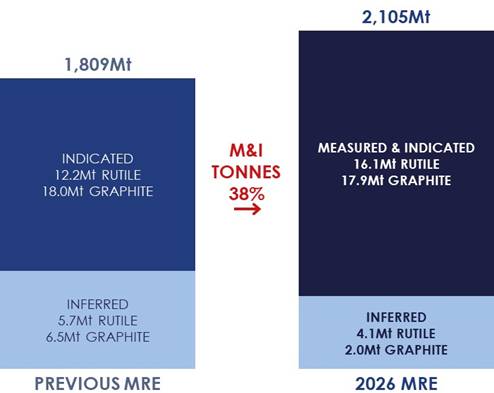
Figure 1: Increase in Kasiya MRE across categories
The updated MRE provides the resource foundation for the upcoming DFS mine schedule and mine optimisation study. The step-up in Measured and Indicated resource confidence is a critical input for the DFS, enabling the Company to present a resource base with the classification level required for bankable project financing and offtake discussions.
Sovereign’s DFS is progressing across all workstreams including mining, processing, infrastructure, environmental and social studies, and commercial arrangements.
MRE EMPHASISES SOVEREIGN’S STRATEGIC SIGNIFICANCE FOR GLOBAL SUPPLY CHAINS
Kasiya is a uniquely diversified source of critical minerals essential to defence, industrial and energy security. The updated MRE demonstrates Kasiya’s potential to supply titanium-bearing rutile and graphite for several decades and its position as the world’s single most strategically important source of rutile.
Natural rutile is a critical mineral essential to titanium metal production for aerospace, defence and medical applications. According to leading titanium consultants TZ Minerals International Pty Ltd (TZMI), demand for rutile from the titanium metals industry is forecast to grow 3% annually, while global supply is expected to decline by 7% per year over the next decade. The market faces a widening structural deficit.
Natural rutile commands a significant premium over alternative titanium feedstocks due to its superior grade (95%+ TiO₂), lower processing costs, and smaller environmental footprint. With no meaningful domestic production in key consuming nations, Kasiya‘s scale and quality position it as the single most strategically important source of natural rutile outside of current producing regions.
With the updated MRE, Kasiya is positioned to address this critical supply gap at a time when new sources of natural rutile are urgently needed.
The graphite resource further enhances Kasiya’s strategic value with a second critical mineral. With graphite demand forecast to grow 9% annually across battery and industrial applications (Benchmark Mineral Intelligence), the Project’s 20.0Mt contained graphite provides significant exposure to a valuable by-product.
KASIYA MRE TECHNICAL DETAILS
The Kasiya MRE has been prepared by Sovereign under guidance by MSA Group and is reported in accordance with the JORC Code (2012) (JORC).
Rutile mineralisation lies in laterally extensive, near-surface, flat “blanket” style bodies in areas where the weathering profile is preserved and not significantly eroded. The high-grade zones are relatively geologically consistent with limited variability along and across strike. The mineralisation style is illustrated best in Figure 2 below.
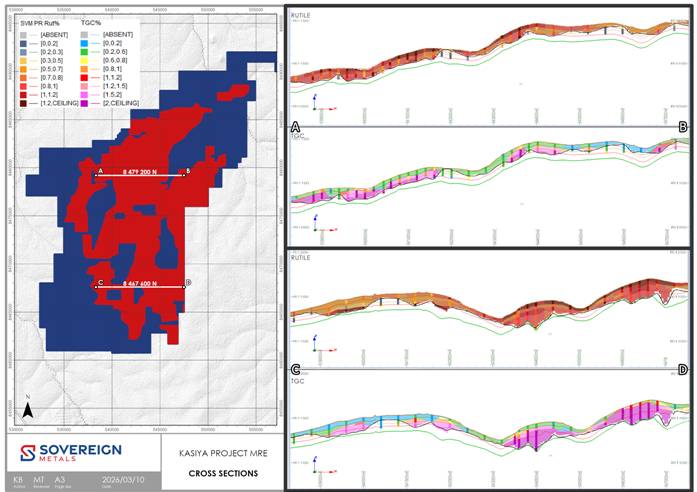
Figure 2: MRE with E-W Cross Sections 8,479,200N (A-B) and E-W Cross Sections 8,467,600N (C-D) (cross section are at +/- 100m with 30x vertical exaggeration)
SUMMARY OF RESOURCE ESTIMATE REPORTING CRITERIA
As per ASX Listing Rule 5.8 and the JORC reporting guidelines, a summary of the material information used to estimate the MRE is detailed below.
Geology
Regional Geology
The greater part of Malawi is underlain by crystalline Precambrian to lower Palaeozoic rocks referred to as the Malawi Basement Complex. In some parts, these rocks have been overlain unconformably by sedimentary and volcanic rocks ranging in age from Permo-Triassic to Quaternary. The Basement complex has undergone a prolonged structural and metamorphic history dominated by uplift and faulting, resulting in the formation of the Malawi Rift Valley.
Kasiya is located on the Lilongwe Plain, which is underlain by the Basement Complex paragneisses and orthogneisses, which are part of the Mozambique Belt. The bulk of the gneisses are semi-pelitic, but there are bands of psammitic and calcareous rocks that have been metamorphosed under high pressure and temperature conditions to granulite facies.
Interspersed within the paragneiss units are lesser orthogneisses, often cropping out as conspicuous tors, as well as amphibolites, pegmatites and minor mafic to ultramafic intrusions. Foliation and banding in the gneisses have a broad north-south strike over the general area. Thick residual soils and pedolith with some alluvium overlie the gneisses and include sandy, lateritic and dambo types.
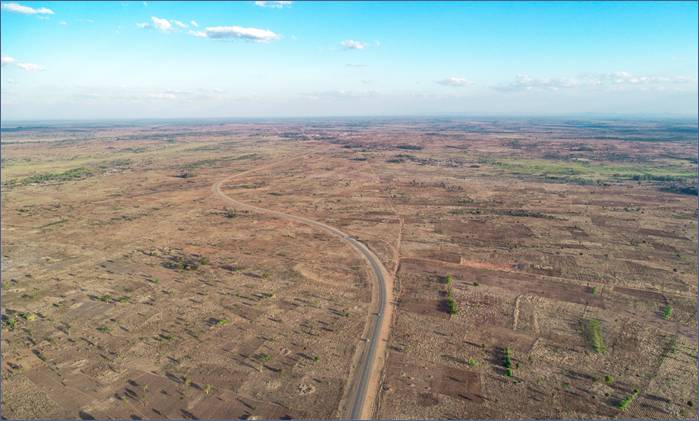
Figure 3: Drone photo above the Kasiya Deposit showing the open, flat terrain
Project Geology
Sovereign’s tenure covers 644 km2 over an area to the north, west and south of Malawi’s capital city, covering the Lilongwe Plain. The topography is generally flat to gently undulating, and the underlying geology is dominated by paragneiss with pelitic, psammitic and calcareous units.
A particular paragneiss unit is rich in rutile and graphite and is the primary source of both minerals in the area. This area was deeply weathered during the Tertiary, and rutile concentrated in the upper part of the weathering profile, forming residual placers, such as the Kasiya deposit. Once this material is incised and eroded, it is transported and deposited into wide, regional braided river systems, forming alluvial heavy mineral placers such as the Bua Channel.
Kasiya Deposit Geology
The high-grade rutile deposit at Kasiya is best described as a residual placer, or otherwise known as an eluvial heavy mineral deposit. It is formed by weathering of the primary host rock and concentration in place of heavy minerals, as opposed to the high-energy transport and concentration of heavy minerals in a traditional placer.
The presence of abundant kyanite and graphite in the host material suggests a meta-sedimentary protolith. The protolith likely started with a 0.5-1.5Ga basin that also experienced a consistent influx of titanium minerals.
These sedimentary rocks were subject to granulite facies metamorphism under reduced conditions in the Pan-African Orogeny. The metamorphic facies, reduced environment, relatively high titanium content and low iron content resulted in rutile being the most stable titanium mineral under these conditions. Slow exhumation and cooling then resulted in re-crystallisation as paragneisses containing coarse rutile and graphite.
The final and most important stage of rutile enrichment came as tropical weathering during the Tertiary depleted the top ~8m of physically and chemically mobile minerals. This caused significant volume loss and concurrent concentration of heavy resistate minerals, including rutile and kyanite.
Rutile mineralisation therefore lies in laterally extensive, near-surface, flat “blanket” style bodies in areas where the weathering profile is preserved. The Kasiya deposit shows widespread, high-grade mineralisation commonly grading 1.2% to 2.0% rutile in the top 3-5m from surface. Moderate grade mineralisation, generally grading 0.5% to 1.2% rutile, commonly extends from 5m to the base of the soft saprolite unit to typically 20-30m depth, where it terminates on the hard saprock basement.
Graphite generally occurs in broad association with rutile. However, it is depleted in the top 3-5m and therefore can often show an inverse grade relationship with rutile in the near-surface zones. At depths generally greater than 5m, graphite is not depleted, and rutile is not particularly enriched, so a more consistent grade relationship exists.
Drilling Techniques
Spiral hand-auger (HA) drilling, Push-tube and/or diamond core (PTDD), and Air core (AC) drilling methods have been used extensively at the Kasiya deposit by Sovereign to define mineralisation and to obtain quantitative rutile and graphite (TGC) assay information.
HA drilling was executed by Sovereign field teams using a manually operated enclosed-flight Spiral Auger (SP / SOS) system produced by Dormer Engineering in Queensland, Australia. The HA bits are 62mm and 75mm in diameter with 1m long steel rods. Each 1m of drill advance is withdrawn and the contents of the auger flight removed into bags and set aside. An additional 1m steel rod is attached and the open hole is re-entered to drill the next metre. This is repeated until the drill hole is terminated often due to the water table being reached or due to bit refusal. The auger bits and flights are cleaned between each metre of sampling to avoid contamination.
PTDD drilling is undertaken using a drop hammer Dando Terrier MK1 and a drop hammer DL650 by Geo-consult and Thompsons Drilling. The drilling generated 1m runs of 88mm PQ core in the first 2m and then transition to 61mm core for the remainder of the hole. Core drilling is oriented vertically by spirit level.
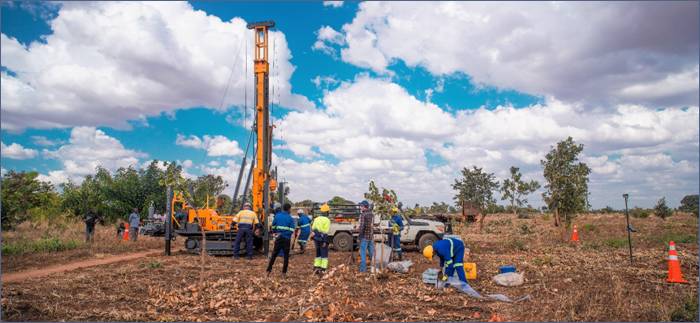
Figure 4: Core drilling (push tube) in action at Kasiya
AC drilling was completed by Thompson Drilling utilising a Smith Capital 10R3H compact track-mounted drill. The drilling is vertical and generates 1m samples with care taken in the top metres to ensure good recoveries of the high-grade surface material. The AC sample is collected by the on-board cyclone into heavy-duty RC sample bags. Drilling continues until bit refusal onto basement ~20-30m. Sample bags are immediately transported back to Sovereign’s field laydown yard where they are processed. AC drilling is on a nominal 200m by 200m pattern.
The drilling programs to date show a surface mineralised extent, defined nominally by a 0.7% rutile cut-off, of approximately 268.6 km2 with numerous areas of high-grade rutile and graphite defined.
The PTDD and AC twin and density sample holes are selectively placed throughout the deposit to ensure a broad geographical and lithological coverage for the analysis.
MSA has reviewed Standard Operating Procedures (SOPs) for HA, SA, PTDD and AC drilling and found them to be fit for purpose and support the resource classifications as applied to the MRE.
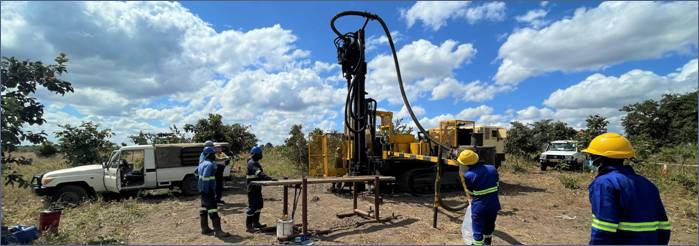
Figure 5: Air-core (AC) drilling at Kasiya in May 2022.
Sampling Techniques
HA samples are obtained at 1m intervals generating on average approximately 2.5kg of drill sample. HA samples are manually removed from the auger bit and sample recovery is visually assessed in the field. As samples become wet at the water table and recovery per metre declines, the drill hole is terminated. Each 1m sample is sun dried, logged and weighed. HA samples are composited based on regolith weathering boundaries defined by geology logging. Each 1m of sample is dried, lightly pressed to remove soft aggregates and riffle-split to generate a total sample weight of 3kg for analysis, generally at 2 – 5m intervals. This primary sample is then riffle split again to provide a 1.5kg sample each for rutile and graphite analyses.
SA samples are bulk spiral auger samples primarily designed to collect a large sample for metallurgical and pilot plant testwork. Bit sizes range from 300 mm to 700mm diameter. The samples are collected on 1m intervals, laid out on a large tarpaulin to be sun dried before using a cone and quarter method (for the 700mm diameter) to produce a roughly 100kg sample which is then riffle split to produce a 3kg sample, with the file split providing 1.5 kg each for rutile and graphite analysis. Samples are analysed in 1m intervals.
PTDD samples are predominantly from HQ sized core (61mm diameter). Half core 1m samples are sun dried, logged and weighed. Samples are then lightly pressed and composited over 2m intervals. An equal mass is taken from each contributing metre to generate a 1.5kg composite sample. Individual recoveries of core samples are recorded on a quantitative basis. Core recovery is very good overall at >95%.
AC samples are collected in 1m increments. AC samples are dried, riffle split, lightly pressed and composited. Samples are collected and homogenised prior to splitting to ensure sample representivity. ~1.5kg composite samples were defined by the regolith boundaries in earlier drilling. More recent AC drilling utilised regular 2m downhole composites. An equivalent mass is taken from each primary sample to make up the composite.
During 2024 twin drilling campaigns, samples were processed at 1m intervals to get a better understanding of drilling and deposit variability.
The sampling and compositing methods described are considered appropriate and reliable based on accepted industry practice. MSA completed an on-site audit of sampling and sample processing and deemed the processes fit for purpose.
Sample Analysis Methodology
All samples arrive at Sovereign’s Malawi laboratory where they are sorted and checked in. Graphite samples are identified and prepared for export, while the equivalent rutile samples begin the sample workflow to generate the rutile non-magnetic concentrate (NM) for export for TiO2 and multi-element XRF analysis. Prior to June 2024 XRF analysis was completed at ALS Perth, Western Australia, currently Scientific Services South Africa (SS) laboratory in Cape Town, South Africa is being used. Umpire checks have shown good correlation between the two external laboratories. Audit of Sovereign’s laboratory premises, staff, sample analysis and QA procedures was completed by MSA during two site visits in 2024 and 2025.
SVM Malawi Laboratory Rutile Workflow
· Samples are dried in a commercial oven for 1 hour at 105℃ and a dry raw samples mass is recorded.
· Samples are soaked in 1% Tetrasodium pyrophosphate (TSPP) solution overnight and then lightly agitated prior to wet screening.
· Wet screening occurs at 5mm, 600µm and 45µm to remove oversize and slimes (-45µm) material. Each +45µm retained fraction is dried, logged and weighed.
· The resulting sand fraction +45µm -600mm is oven dried for 1 hour at 105℃ after which its dry weight is recorded.
· The sand fraction is then passed over a Gemeni wet shaking table at a constant feed rate to generate a heavy mineral concentrate (HMC).
· Heavy Liquid Separation (HLS) at Diamantina Laboratories in Perth was initially trialled as a preferred separation method but was quickly superseded (supported by QA analysis) by wet-table separation on account of substantial near-density gangue material reporting to the HM sink for the HLS technique. The HLS analyses represent 6% of the MRE assay dataset.
· The wet-tabled HMC is then subject to magnetic separation @ 16,800G (2.9Amps), producing a magnetic (Mag) and non-magnetic (NMag) fraction. The separation is performed using a Mineral Technologies Reading Pilot IRM (Induced Roll Magnetic) purchased by Sovereign and located at the Company’s laboratory in Malawi. Pre-2022, this step was completed by Allied Mineral Laboratories Perth (AML) in Perth, Western Australia.
The Malawi onsite laboratory sample preparation methods are considered quantitative to the point where the NMag concentrate (containing the rutile) is produced. Several generations of QEMSCAN analysis of the NMag and Mag fractions performed at ALS Metallurgy show dominantly clean and liberated rutile grains and confirm that rutile is the only titanium species in the NMag fraction.
Recovered rutile is defined and reported here as: TiO2 recovered in the SAND +45 to -600um range to the NMag concentrate fraction as a % of the total primary, dry, raw sample mass divided by 95% (to represent an approximation of final product specifications). i.e recoverable rutile within the whole sample.
Graphite Testwork
Once secured the 1.5kg graphite sample are delivered to Intertek Group plc (Intertek) in Johannesburg, South Africa, 750g of each 1.5kg graphite sample is pulverised to -75um with a 150g dissolved in dilute hydrochloric acid to liberate carbonate carbon. The solution is filtered using a filter paper, and the collected residue is then dried to 425°C in a muffle oven to drive off organic carbon.
The 150g dried sample is transported to Perth, Australia where it is then combusted in an Eltra CS-800 induction furnace infra-red CS analyser to yield total graphitic or elemental carbon (TGC).
QAQC
Accuracy monitoring is achieved through submission of certified reference materials (CRM’s). Sovereign uses internal and externally sourced wet screening reference material inserted into samples batches at a rate of 1 in 20.
SS, ALS and Intertek both use internal CRMs and duplicates on XRF and TGC analyses. Sovereign also inserts its customised CRMs into all sample batches at a rate of 1 in 20.
Analysis of sample duplicates is undertaken by standard statistical methodologies (Scatter, Pair Difference and QQ Plots) to test for bias and to ensure that sample splitting is representative. Standards determine assay accuracy performance, monitored on control charts, where failure (beyond 2SD from the accepted mean value of the standard) initiates investigation and may trigger re-processing of the affected batch.
Examination of the QA/QC sample data indicates satisfactory performance of field sampling protocols and assay laboratories providing acceptable levels of precision and accuracy. Rutile determination by alternate methods showed no material bias.
Estimation Methodology
Datamine Studio RM, LeapFrog and Supervisor software are used for the data analysis, variography, geological interpretation and resource estimation.
A 3D block model honouring the geology boundaries which included weathering horizons; barren mafic intrusives; surface clay horizons and presence of barren or low grade amphibolite was created. The model was also coded with the tenement EL codes, rock in-situ dry bulk density and moisture content.
Rutile mineralisation was defined as the last intercept >=2m down hole exceeding 0.4% rutile. Generally, rutile grade is highest at the surface gradually reducing in grade with depth. Using this guideline very little internal low grade/waste is introduced. The resulting sample point data was used to create the bounding lower surface digital terrane model (DTM) for a rutile mineralisation, topography DTM is the upper surface. Additional manual points were interpreted section by section to ensure consistency especially in areas with wider spaced drilling.
Graphite mineralisation was defined as the highest up hole intercept >=2m exceeding 0.6% TGC. Generally TGC grade is highest at depth gradually reducing in grade closer to the surface. Using this guideline very little internal low grade/waste is introduced. A graphite mineralisation upper limit DTM was constructed following a similar process to that used for the Rutile DTM. The lower limit of graphite mineralisation was either the base of drilling or the top of SAPR if drilling intersected SAPR.
Eight grade domains were created, 4 mineralised and 4 low grade / waste for both rutile and graphite. The domains are derived from the combination of weathering type inside or outside the mineralisation DTM’s. Samples were composited to 1 sample per drillhole per domain. Rutile and TGC samples were treated independently as there is no correlation between rutile and TGC grades.
The composite populations generally approximated normal distributions with some -ve and/or +ve skewness relating to the imposed mineralisation boundary.
Ordinary Kriging (OK) was considered the best grade estimator for both rutile and graphite due to the near normal grade populations and adequate variograms. Variography analysis was used to determine domain nugget effect and OK search and neighbourhood parameters.
Each grade domain was treated as a 2D seam and estimated using OK with dynamic anisotropy which followed the broad mineralisation continuity trends. No declustering or removal of twin data was required, as OK is an efficient declustering algorithm, and the post OK checks demonstrated no negative weights in the mineralised zones. Any areas not estimated were set to waste grades.
The parent cell size used is equivalent to the average drill hole spacing within the Indicated Resource (200m*200m). XY sub-celling to 50m*50m is adequate resolution for horizontal boundaries. Seam modelling ensured the mineralisation, weathering and topography layers were vertically accurate (within the 50m horizontal resolution). Grade was estimated using the parent cell panel size.
Grade estimation was constrained by hard boundaries (domains) that result from the geological interpretation and mineralisation interpretation.
Top Capping was applied to the composites considered to be outliers to reduce local high grade bias. Generally <1% of samples had a grade cap applied.
Validation of the grade estimate was completed both visually and statistically. Visual validation by loading the model and drill hole files and annotating, colouring and using filtering to check for the appropriateness of the estimate. Distributions of section line averages (swath plots) for drill holes and models were prepared for each zone and orientation for comparison purposes.
The resource model has appropriately averaged the informing drill hole data and is considered suitable to support the resource classifications applied to the estimate.
In-situ dry bulk density was calculated from 400 core samples taken from geographically and lithologically representative sites across the deposit. Dry bulk density is calculated from PT drill core using a cylinder volume wet and dry method performed by Sovereign in Malawi. Shelby tube core samples collected from the 2024 PTDD drill program were analysed by CIVILAB in South Africa.
Bulk density data was coded by weathering horizon. Population distributions were then reviewed and obvious outlies removed. Either the mean or median were used as the average for each weathering and/or rock type domain.
The average in-situ dry bulk density of the total MRE is 1.60 t/m3. This is derived from using an average density of 1.39 t/m3 for the SOIL; 1.58 t/m3 for the FERP, 1.66 t/m3 for the MOTT; 1.68 t/m3 for the PSAP; and 1.77 t/m3 for SAPL. (Definitions provided in Appendix 1 below).
Mining and Metallurgy Factors
Dry-mining has been determined as the optimal method of mining for the Kasiya Rutile deposit. The materials competence is loose, soft, fine and friable with no cemented sand or dense clay layers, allowing for a free dig mining method. It is considered that the strip ratio would be zero or near zero. Dilution is minimal as rutile mineralisation occurs from surface and mineralisation is generally gradational with few sharp boundaries.
Recovery parameters have not been factored into the estimate. However, the valuable minerals are readily separable due to their density differential and flotation characteristics and are expected to have high recoveries through the proposed conventional wet concentration plant for rutile and flotation for graphite, as demonstrated by metallurgical test work. Graphite losses occur predominantly in the desliming and wet gravity circuit, with flotation recoveries above 95% in variability testing.
Sovereign has announced three sets of metallurgical results to the market (24 June 2019, 9 September 2020 and 7 December 2021), relating to the Company’s ability to produce a high-grade rutile product with a high recovery via simple conventional processing methods. Subsequent to this Sovereign has reported results related to metallurgical testwork within the following market announcements:
· “Kasiya Scoping Study Confirms Globally Significant Natural Rutile Project” dated 16 December 2021;
· “Kasiya Expanded Scoping Study Results” dated 16 June 2022; and
· “Kasiya Pre-Feasibility Study Results” dated 28 September 2023.
Sovereign engaged AML to conduct the metallurgical test work on the rutile circuit inclusive of the ongoing DFS to provide input for metallurgy and engineering process design. The work has consistently shown a premium quality rutile product of 95.0%+ TiO2 with low impurities could be produced with recoveries of up to 98% and with favourable product sizing.
Sovereign has also received third-party confirmations for the quality of its rutile product, including validation from one of Japan’s premier titanium metal (sponge and ingot) producers, Toho Titanium Company Limited (Toho). Toho has confirmed the suitability of natural rutile from Kasiya for manufacturing high-specification titanium products.
Gravity separation was effective at concentrating graphite to a “light mineral pre-concentrate” due to its low specific gravity (~2.2 t/m³), providing an upgrade of graphite grade to the flotation circuit to about three times the run-of-mine grade.
The “light tailings” from processing the 45-600 micron ore to generate the rutile-enriched HMC is combined with “light tailings” from wet table gravity processing the 600 micron to 1mm size fraction of the ore to maximise coarse graphite recovery.
Graphite testwork programs were conducted at SGS Canada – Lakefield, ALS Limited, and Core Resources Pty Ltd in Australia at benchtop and pilot scales, including variability testwork, with pilot-scale programs supported by rougher flotation at Maelgwyn Mineral Services Africa (Pty) Ltd in South Africa to reduce shipment masses. A conventional graphite flotation and milling flowsheet was used, except for no milling prior to rougher flotation.
Classification
The Kasiya MRE has been classified as Measured, Indicated or Inferred.
JORC classification considered geological understanding; mineralisation continuity; drilling and sampling quality and spacing; OK estimation efficiency (KE) and confidence (SoR); with consideration of the proposed mining method and scale.
The dominant control on grade distribution within the mineralised zone is intensity of weathering. Rutile is a mineral resistant to weathering and is concentrated by depletion of less resistant minerals during the weathering process resulting in higher grades near the surface where more intense weathering has taken place. The weathering profiles are consistent and readily defined by logging of drill samples.
Both rutile and graphite mineralisation have been well defined by drilling with appropriate sample analysis to determine recovered rutile in-situ grade and in-situ TGC. Both mineralisation zones are broad and continuous with rutile dominant in the Soil, FERP and MOTT horizons, and graphite in the MOTT, PSAP and SAPL horizons. There is significant overlap of the two mineralisation zones. The mineralisation is truncated either by changes in the protolith or displaced by mafic intrusives. Recent drainage has also impacted mineralisation continuity. Minor near surface clay lenses and metamorphic ‘pegmatitic’ zones also displace mineralisation. These very minor internal ‘waste’ zones are readily visually identifiable during mining (as seen during the 2024 trial mining exercise) and can be selectively either mined or bypassed. The dominant zones of mineralisation exceed 10km of strike continuity and range from 1 to 4 km in width.
Regional exploration was completed on a nominal 800m square grid, with infill to 400m followed by either 200m square or 200m offset grid. Twin holes plus some close spaced geostatistical drilling, close spaced channel sampling during the trial mining and open pit sampling have all demonstrated the robustness of the geology interpretation and mineralisation continuity.
KE generally exceeds 0.6 with SoR exceeding 0.85 in the appropriately drilled mineralised zones.
On the basis of the high confidence geology interpretation; mineralisation scale and continuity including taking into account the bulk mining method; and very tight grade distributions within the estimation domains, the Competent Person is comfortable classifying all of the rutile and graphite mineralisation which lies above the base of drilling as either Measured, Indicated or Inferred.
Measured was defined using a nominal KE >=0.7 to 0.75 and a SOR >=0.9, which generally matches areas with a drill spacing closer than 200m. A boundary was used to define the Measured Mineral Resource. At Kingfisher south of 8,467,700N, infill drilling was only completed to the base of FERP (to support minimum 5 year mine plan), so Measured was assigned to Soil+FERP and Indicated to material below FERP.
Indicated was defined using a nominal KE >=0.4 to 0.5 and a SOR >=0.8, which generally matches areas with a nominal drill spacing of 200 to 400m. A boundary was used to define the Indicated Mineral Resource. All mineralisation outside the Indicated boundary was classed as Inferred Mineral Resource.
The parameters used to define Indicated classification are different from the previous MRE. The changes are primarily due to the improved grade modelling methodology, which is based on treating each mineralisation domain as a single 2D seam model. This method supports the bulk dry mining process and improves the grade confidence at wider drill spacings, as no selective mining is anticipated within each seam.
The MRE was constrained to a potentially economic open pit shells to reflect the JORC Code requirement for Reasonable Prospects for Eventual Economic Extraction (RPEEE). The shell was defined using Whittle Open Pit Optimisation with the following parameters:
Rutile: Net concentrate revenue US$1,400/t; Process recovery 97.6%;
Graphite: Net revenue US$1,200/t ; Process recovery 70.4%s;
Mining OPEX US$1.35/t; Process OPEX US$5.44/t.
The MRE is presented in three tables (see Tables 3-5).
Sensitivity options were run on graphite basket price from US$1,200/t to US$2,000/t – the MRE is not sensitive to graphite price.
Cuf-off grades
All results reported are of a length-weighted average of in-situ grades.
A nominal bottom cut of 0.7% rutile is used, based on preliminary assessment of resource product value and anticipated cost of operations.
MRE TABLES
Table 3: Kasiya March 2026 Model – Rutile Mineral Resource
Table 3 presents the rutile dominant mineral resource based on a higher rutile cut-off pit shell – optimised using the $1,400 rutile price using a mineralisation cutoff of 0.75% rutile. All material with a rutile grade >=0.4% (the nominal mining breakeven grade) within the pit shell was reported. This pit shell was generated to maximise high grade rutile as a direct comparison with the previously reported MRE. The pit shell includes a small proportion of internal waste <0.4% rutile which is shown in the tabulation.
|
Category |
Class |
Tonnes (Mt) |
Rutile Grade (%) |
Rutile (Mt) |
TGC (%) |
TGC (Mt) |
Rutile Eq. (%) |
|
Rutile Mineralisation >=0.4% Rut95 |
Measured |
107 |
1.05 |
1.12 |
1.56 |
1.67 |
1.94 |
|
Indicated |
1,545 |
0.97 |
14.99 |
1.05 |
16.26 |
1.57 |
|
|
Inferred |
452 |
0.91 |
4.12 |
0.45 |
2.02 |
1.17 |
|
|
Total Rutile MRE |
2,105 |
0.96 |
20.24 |
0.95 |
19.95 |
1.51 |
|
|
Internal Waste |
Measured |
1 |
0.24 |
0 |
1.88 |
0.02 |
1.32 |
|
Indicated |
40 |
0.25 |
0.10 |
1.92 |
0.77 |
1.35 |
|
|
Inferred |
7 |
0.22 |
0.02 |
1.69 |
0.12 |
1.19 |
|
|
Total internal waste in RPEEE |
48 |
0.24 |
0.12 |
1.88 |
0.91 |
1.32 |
|
|
Total Rutile in Pit Shell |
2,153 |
0.95 |
20.35 |
0.97 |
20.86 |
1.50 |
|
Note: Rutile Mineral Resource defined from an optimised pit shell with mineralisation defined as >= 0.75% Rut95. A rutile concentrate net price of US$1,400 was used to determine economic value. Graphite had no value for this run.
Table 4: Kasiya March 2026 Model – Graphite Mineral Resource
Table 4 presents the remaining mineral resource within the primary pit shell but outside (mainly below) the rutile-dominant pit shell. This table is further subdivided to show the high-grade graphite material >=0.6% TGC (primarily at depth) and the lower-grade rutile material (primarily at the edges of the deposit). The 0.6% TGC cut-off was selected as the statistically ‘natural’ value separating higher grade from lower grade.
|
Category |
Class |
Tonnes (Mt) |
TGC (%) |
TGC (Mt) |
Rutile Grade (%) |
Rutile (Mt) |
Rutile Eq. (%) |
Dry BD |
|
TGC>=0.6% |
Measured |
30 |
1.99 |
0.59 |
0.52 |
0.15 |
1.67 |
1.74 |
|
Indicated |
629 |
1.86 |
11.69 |
0.4 |
2.53 |
1.47 |
1.69 |
|
|
Inferred |
201 |
1.7 |
3.42 |
0.3 |
0.61 |
1.28 |
1.7 |
|
|
Subtotal HG |
860 |
1.83 |
15.7 |
0.38 |
3.29 |
1.43 |
1.69 |
|
|
TGC<0.6% |
Measured |
0.6 |
0.23 |
0 |
0.68 |
0 |
0.81 |
1.66 |
|
Indicated |
195 |
0.23 |
0.45 |
0.65 |
1.27 |
0.78 |
1.6 |
|
|
Inferred |
220 |
0.15 |
0.33 |
0.65 |
1.42 |
0.73 |
1.57 |
|
|
Subtotal MG |
415 |
0.19 |
0.78 |
0.65 |
2.69 |
0.76 |
1.59 |
|
|
Total Graphite MRE |
1,275 |
1.29 |
16.48 |
0.47 |
5.98 |
1.21 |
1.66 |
|
Note: Graphite Mineral Resource is all material inside the total MRE pit shell after depletion of the Rutile Mineral Resource.
Table 5: Kasiya Combined Rutile-Graphite Mineral Resource Estimate within the RPEEE pit shell (March 2026)
Table 5 presents the entire MRE constrained to the combined rutile and TGC RPEEE Open Pit shell. No cutoff is applied.
|
Class |
Tonnes (Mt) |
Rutile Grade (%) |
Rutile (Mt) |
TGC (%) |
TGC (Mt) |
Rutile Eq. (%) |
Dry BD |
|
Measured |
139 |
0.93 |
1.3 |
1.65 |
2.3 |
1.87 |
1.67 |
|
Indicated |
2,409 |
0.78 |
18.9 |
1.21 |
29.2 |
1.48 |
1.62 |
|
Inferred |
881 |
0.70 |
6.2 |
0.67 |
5.9 |
1.08 |
1.59 |
|
Total |
3,428 |
0.77 |
26.3 |
1.09 |
37.3 |
1.39 |
1.62 |
Note: The Total MRE includes all rutile and graphite mineralisation within an optimised open pit shell using a 95%+TiO2 rutile (Rut95) concentrate revenue price of net US$1,400/t and a Graphite product price of net US$1,200/t; Mine OPEX US$1.35/t; Process OPEX US$5.44/t; Rutile recovery of 97.6%; Average Graphite recovery of 70.4%. Figures are rounded and may not sum exactly.
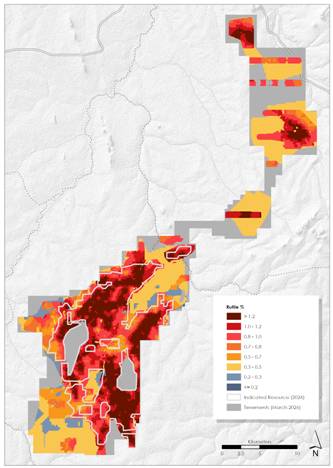
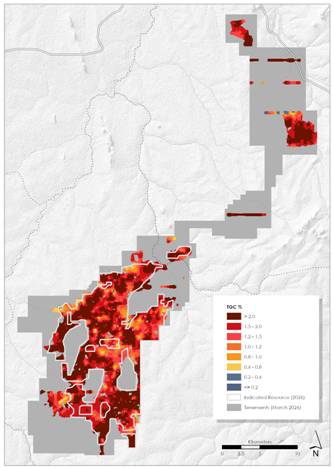
Figures 6 & 7: Kasiya March 2026 Model – Rutile (Rut94) Mineral Resource and Kasiya March 2026 Model – Graphite Mineral Resource
|
Enquiries |
|
Frank Eagar, Managing Director & CEO South Africa / Malawi +27 21 140 3190 Sapan Ghai, CCO London +44 207 478 3900 |
|
Nominated Adviser on AIM and Joint Broker |
|
|
SP Angel Corporate Finance LLP |
+44 20 3470 0470 |
|
Ewan Leggat Charlie Bouverat |
|
|
|
|
|
Joint Broker |
|
|
Stifel |
+44 20 7710 7600 |
|
Varun Talwar |
|
|
Ashton Clanfield |
|
Full data and statements here.
#BRES Blencowe Resources PLC – Further Strong Deep-Hole Results at Iyan
 Blencowe Resources Plc (LSE: BRES) is pleased to report the remaining deep-hole assay results from the newly identified Iyan Deposit, located immediately adjacent to the Northern Syncline at the Orom-Cross graphite project in Northern Uganda.
Following Iyan’s exceptional debut hole (L909B), assays from two further deep holes L908B and L910B confirm continuous, thick graphite mineralisation from or near surface to ~100 metres, with all deep holes ending in graphite. This indicates a robust, open system with clear multi-decade production potential, extending well beyond the initial 15-year mine life defined in the DFS.
Highlights
· Remaining deep holes at Iyan deliver thick, continuous graphite from surface to ~100m, with all holes ending in mineralisation.
· Results strongly support multi-decade production potential, far beyond current 15-year DFS mine life.
· Iyan confirmed as a major new deposit, not included in the current Orom-Cross JORC Resource.
· High-grade internal zones up to 13.9% TGC strengthen overall grade and development quality.
· First deep-hole assays from Beehive, the second new deposit identified in Stage 7, are expected by Christmas, with first Iyan shallow and step-out assays expected early into the New Year.
· 186 remaining shallow and step-out assays from both Iyan and Beehive prospects are pending, and these will underpin a JORC Resource upgrade in early 2026.
Iyan is a major new deposit adjacent to existing mineable deposit at Northern Syncline and not included in our recent JORC Resource reported in November 2025. Iyan will be included in the forthcoming 2026 JORC resource upgrade. 74 holes of the remaining 186 shallow and step-out holes completed in Stage 7 were drilled at Iyan, and these assays will help define further near-surface tonnage required to expand life of mine and project scale.
Assays from the three deep holes at the Beehive Deposit, the second newly identified mineralised zone in this programme, are expected shortly.
Iyan Deep Holes: L908B and L910B Confirm Continuity and High-Grade Zones
Hole L908B (Iyan):
· 12.05m (TW) @ 5.61% TGC from surface to 16.63m,
including 2m @ 9.56% TGC and 3m @ 11.55%TGC
· 54.50m (TW) @ 4.54% TGC from 46.1m to 118m,
including 5m @7.89%TGC and 6m @7.34%TGC (higher-grade internal zones)
These long mineralised intervals demonstrates both scale and grade consistency at depth, with multiple high-grade internal zones. The thickness and continuity closely match the structural trends observed within the Northern Syncline, reinforcing Iyan as its western extension.
Hole L910B (Iyan):
· 14.27m @ 4.22% TGC from 19.46-38.07m,
including 6m @ 6.97%TGC and 2m @ 8.57%TGC
· 16.15m (TW) @ 5.56% TGC from 99.98m to end-of-hole,
including 2m @ 13.92% TGC and 3.6m @ 9.74%TGC
The presence of repeated high-grade internal zones, including a standout 2m @ 13.92% TGC, highlights the high quality of the Iyan mineralisation. As with the other Iyan deep holes, L910B ended in graphite, confirming that the system remains open at depth and extends beyond current drilling limits.
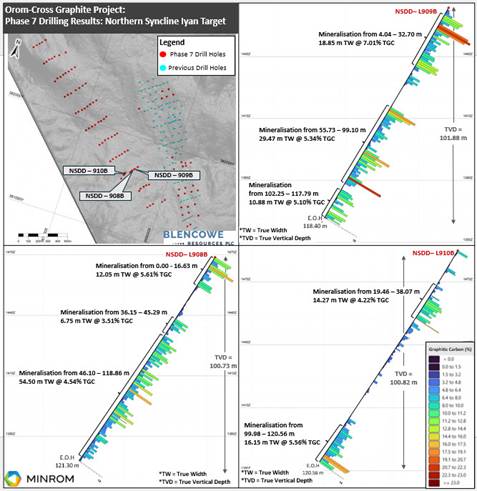
Executive Chairman Cameron Pearce commented:
“These follow-up deep-holes confirm Iyan as a major new graphite deposit alongside Northern Syncline, with continuous mineralisation to ~100 metres and every hole ending in graphite. This points clearly to multi-decade production potential which is a key message in ongoing discussions with strategic groups seeking secure long-term supply.
The presence of high-grade zones, including 2m at 13.92% TGC, underlines the quality of this discovery. Iyan sits within our 21-year Mining Licence and close to the proposed plant site, making it a strategically located addition to our development pipeline.
With more than 180 shallow and step-out holes still being processed, we anticipate significant newsflow ahead and remain confident of a material resource upgrade in early 2026.
The Beehive deep holes are next in line, and we are hopeful they will mirror the exceptional continuity and grade seen at Iyan. Orom-Cross is fast emerging as one of the most significant long-life graphite projects globally, and these results further enhance engagement with strategic groups focused on multi-decade supply security.”
For further information please contact:
|
Blencowe Resources Plc Sam Quinn |
www.blencoweresourcesplc.com Tel: +44 (0)1624 681 250
|
|
Investor Relations Sasha Sethi |
Tel: +44 (0) 7891 677 441 |
|
Tavira Financial Jonathan Evans |
Tel: +44 (0)20 3192 1733 |
#BRES Blencowe Resources PLC – Fundraise of £3m
 Blencowe Resources Plc (LSE: BRES), the natural resources company advancing the Orom-Cross graphite project in Uganda, is pleased to announce that it has raised funds of £3.0 million through the placing of 42,857,140 new ordinary shares at a placing price of 7p (the “Placing”), representing no discount to the closing market price on 10 December 2025.
The Placing was undertaken by the Company’s joint brokers, Tavira Financial Limited and Oak Securities.
Strategic Context
The Placing follows the successful completion of the Company’s Definitive Feasibility Study (“DFS”), which confirmed Orom-Cross as a Tier-1 graphite project and formally transitioned the Company into the financing and development phase.
The Company continues to progress P1 project financing discussions with development finance institutions, strategic industry partners and government-backed funding bodies, and expects this funding to be structured predominantly outside of Blencowe plc equity.
These funds raised provide near-term working capital and operational flexibility, supporting execution, commercial momentum and project readiness while these financing processes progress in parallel.
Use of Funds
As reported in the Prospectus dated 25 November 2025, the Company held a cash balance of £1,062,500 and has since received a further £360,000 from the exercise of warrants and options.
The net Proceeds from the Placing and existing cash resources will be used to:
· Advance Orom-Cross project toward Phase 1 (P1) production readiness
· Progress additional in-flight commercial and offtake discussions
· Support financing due diligence, site visits and engagement processes with development finance institutions, strategic partners and government-backed funding bodies
· Secure key personnel and specialist capability, and progress early execution workstreams
· Provide additional working capital during the P1 financing phase
Broker Warrants
The Company has granted Tavira Financial Limited and Oak Securities an aggregate of 2,571,428 broker warrants, exercisable at 7p for a period of three years from Admission, as part of their remuneration for arranging the Placing.
Cameron Pearce, Executive Chairman commented:
“This fundraise provides Blencowe with additional flexibility and momentum as we move decisively into the financing and development phase following completion of our Definitive Feasibility Study.
The DFS has materially strengthened the Company’s position, broadening our access to capital and counterparties and enabling us to raise funds on improved terms. The proceeds will support early execution activities, advance existing commercial and offtake discussions, and support the financing engagement and preparatory work typically required as discussions with development finance institutions and strategic partners advance.
Importantly, this funding complements our primary strategy of securing structured and strategic P1 financing. We believe Orom-Cross is now well positioned to progress through the next stage of development with a strengthened balance sheet and growing interest from a wide range of funding and commercial partners.“
Admission of Shares and Total Voting Rights
Application has been made for an aggregate of 42,857,140 new ordinary shares to be admitted to trading on the Equity (Transition) category of the Official List and the main market of the London Stock Exchange, with admission expected at 8.00 a.m. on 16 December 2025 (“Admission”).
In accordance with the FCA’s Disclosure Guidance and Transparency Rules, the Company confirms that following Admission, the Company’s issued share capital will comprise 454,603,978 Ordinary Shares. The Company does not hold any Ordinary Shares in Treasury.
Therefore, following Admission, the above figure may be used by shareholders in the Company as the denominator for the calculations to determine if they are required to notify their interest in, or a change to their interest in the Company, under the FCA’s Disclosure Guidance and Transparency Rules.
For further information please contact:
|
Blencowe Resources Plc Sam Quinn |
www.blencoweresourcesplc.com Tel: +44 (0)1624 681 250
|
|
Investor Relations Sasha Sethi |
Tel: +44 (0) 7891 677 441 |
|
Tavira Financial Jonathan Evans |
Tel: +44 (0)20 3192 1733 jonathan.evans@tavira.group
|
|
OAK Securities (a trading name of Merlin Partners LLP) Calvin Man /Mungo Sheehan / Jerry Keen |
Tel: +44 (0)20 3973 3678
|
Twitter https://twitter.com/BlencoweRes
LinkedIn https://www.linkedin.com/company/72382491/admin/
#BRES Blencowe Resources PLC – DFS Results Confirms Outstanding Economics
 Blencowe Resources Plc (LSE: BRES) is pleased to announce results of the recently completed Definitive Feasibility Study (“DFS”) for its 100%-owned Orom-Cross graphite project in Uganda. The DFS assesses an initial 15 year Life of Mine (“LOM”); with only ~2% of the deposit drilled, the Company expects significant Life of Mine extensions as further drilling converts additional resources to reserves.
The DFS has been managed and signed off by Independent consultants, CPC Engineering (“CPC”), one of the world’s leading graphite technical experts responsible for feasibility work on tier-one developments such as ASX listed Syrah Resources’ Balama project and ASX listed Black Rock Mining’s Mahenge project.
The DFS showcases Orom-Cross as a Tier-1 graphite project, delivering strong margins from a low capital base, and incorporating a downstream beneficiation facility to produce uncoated spheronised purified graphite product (“USPG”) in-country.
Completion of this independent DFS marks the single most important technical milestone in the Company’s history and formally transitions Orom-Cross into the financing and development phase.
DFS Highlights:
· Net Present Value (NPV10): US$1.087 Billion
· Internal Rate of Return (IRR10): 96%
· All in Sustaining Costs (AISC): US$485/t over LOM (lowest quartile globally)
· Free Cash Flow: US$2.034 Billion over initial 15 years LOM
· Average Annual EBITDA: US$230 million per annum over LOM
· Phase 1 Production (“P1”): Smaller scale, fast-track operation targeting first production in 1H-2027 (20,000 tpa concentrate with micronised products)
· Downstream Value-Add: In-country beneficiation facility to produce purified graphite.
· Phase 2 Production (“P2”): Expansion to 70,000 tpa concentrate and 20,000 tpa USPG nearby.
· Scalability: Long-term pathway to 175,000 tpa concentrates and 80,000 tpa purified products.
· Offtake: Non-binding offtake agreements already in place for all planned P1 Production.
· Lowest Quartile Total Capital Requirement of US$160 million comprising:
o US$40 million for P1, delivering up to 20,000 tpa concentrate
o US$120 million for P2, lifting up to 70,000 tpa concentrate and up to 20,000 tpa USPG
o Significant contingency included within these capital estimates.
· All further expansions post-P2 to be funded entirely from internal cash flow
Project Strategy
Orom-Cross will commence with P1 Production, a smaller-scale, fast-track development delivering up to 20,000tpa of 96% TGC concentrates by 1H-2027. P1 is designed to be profitable from first production, materially reducing financial risk. Offtake agreements covering all planned P1 volumes are already in place.
With the DFS now complete, the immediate next step is securing the P1 project financing package, which becomes the Company’s primary corporate focus. This funding package will initiate ordering, construction and commissioning. Once P1 production begins and product quality is demonstrated at scale the Company expects additional offtake interest, particularly given the scarcity of new high-quality graphite projects coming online.
Within two years of P1 commissioning, Blencowe intends to implement P2 Production, expanding mine output up to 70,000tpa of concentrate. A downstream beneficiation facility will be built near to Orom-Cross to upgrade small flake concentrate to 99.95% TGC USPG, initially producing up to 20,000tpa. This facility will expand in sync with mine scale-up and will serve as a long-term captive offtaker for Orom-Cross concentrates over life of mine. This will position Orom-Cross among the few commercial-scale producers of 99.95% USPG outside of China, and the first in Africa.
Beyond P2 Production, Orom-Cross is expected to expand in stages toward 175,000tpa concentrate and 80,000tpa USPG, funded entirely by internally generated cash flow and marking a pathway to becoming an industry leading producer of both concentrates and high-value purified graphite, aligning with accelerating global demand for ex-China graphite supply.
Sales and Marketing
· Blencowe continues to use leading global graphite sales and marketing specialists, expanding commercial networks and progressing additional offtake opportunities.
· In 2025, 700 tonnes of Orom-Cross raw material was processed and bulk sample end products were delivered to graphite end users worldwide for extensive test work and evaluation.
· Non-binding offtakes covering all P1 volumes will convert to binding agreements on P1 financing.
· SAFELOOP (EU Gen3 battery initiative) volumes remains outside the DFS as the programme remains under development; however, a substantial additional Tier-1 offtake opportunity will likely emerge from 2028 onwards once SAFELOOP commercialises.
· Continued interest from battery, industrial and specialty-materials sectors reinforces the strategic importance of reliable, high-quality ex-China graphite supply.
Orom-Cross will continue to scale in line with contracted market demand, ensuring disciplined and commercially led expansion. Ongoing engagement with a broad global end-user network remains central to the expansion strategy.
Next Steps: Pathway to P1 Funding and First Production
Completion of the DFS provides Blencowe with a fully defined, independently verified and finance-ready project, marking the transition into the execution phase of development.
Together with its corporate advisor WaterBorne Capital, the Company is advancing a financing solution for P1 Production with active engagement underway with:
· Development finance institutions (DFIs)
· Strategic industry partners
· Institutional investors
· Government and quasi-government funding bodies
Several promising structures are under evaluation. Blencowe’s target is to secure P1 financing by end-1Q 2026, enabling ordering, shipping and construction through 2026, and first production targeted for 1H 2027.
Importantly, the Company expects P1 financing to be primarily funded through non-Blencowe plc equity structures. The combination of strong DFS economics, low capex, secured offtake and integrated downstream value-add support a balanced funding package designed to minimise plc equity dilution.
P2 financing is expected to adopt a more traditional debt-plus-strategic-partner approach. With the DFS complete, formal engagement will now begin with groups that have shown interest, including the US Development Finance Corporation (DFC), the African Finance Corporation (AFC), and other Tier-1 institutions. P2 financing will run in parallel with P1 execution, supporting a rapid scale-up to commercial production.
All expansions beyond P2 are expected to be funded entirely from internally generated cash flow. Blencowe believes that demand for all its products will rise substantially over the next few years, especially once Orom-Cross is in production, and the Company needs to prepare for scaled growth.
SPG Beneficiation Facility
The downstream graphite beneficiation facility will be constructed near Gulu, approximately 150 kms from Orom-Cross and adjacent to existing hydropower infrastructure. The facility will:
· Process Orom-Cross concentrate into battery-ready 99.95% TGC USPG.
· Utilise low-cost, renewable hydroelectricity available through Ugandan national grid.
· Produce both high-value USPG and saleable by-products.
· Expand modularity in line with mine output.
· Function as a long-term captive offtaker for up to 50% of Orom-Cross concentrate (small flake concentrate).
This integrated upstream-downstream model positions Blencowe as one of the very few ex-China suppliers capable of providing high-specification purified graphite to global battery and industrial markets.
Key Performance Indicators
The following represents the KPIs for Orom-Cross initial operations as envisaged within the DFS:
|
KPI |
Value |
Comments |
|
Initial Life of Mine |
15 years |
Further infill drilling will extend this LOM substantially |
|
NPV10 |
US$1.087 Bn |
Compares favourably to PFS (NPV8 US$482M) including a higher discount rate used Incorporates both Orom-Cross and downstream beneficiation facility |
|
IRR10 |
96% |
Strong IRR indicates significant returns on capital |
|
Capital required – P1 Production
Capital required – P2 Production |
US$40M
US$120M |
Initially produce up to 20,000tpa concentrate and micronised products Ramp up to 70,000tpa concentrate and up to 20,000tpa USPG Most key infrastructure already at site |
|
Average Operating cost over LOM (AISC) |
US$485/t |
Lowest quartile costs in graphite market ensures less dependency on graphite prices having to increase for success |
|
Average Selling price over LOM |
US$1,240/t US$2,310/t |
Average for all concentrates sold from Orom-Cross Average for USPG and waste sold from beneficiation facility |
|
Average annual production over LOM |
97,000tpa 56,500tpa |
All concentrates from Orom-Cross Uncoated spheronised purified graphite (USPG) |
|
Average EBITDA over LOM |
US$230M pa |
High profitability once commercial scale is reached |
|
Net Free Cash over LOM |
US$2.034 Bn |
Significant free cash delivered from full project with mine life likely to extend well beyond the initial 15 years |
Capital Comparison (PFS vs DFS)
Whilst the full capital requirement has risen since the PFS (2022) there are several important factors to consider in making comparisons:
· Orom-Cross will have a smaller, lower risk initial phase (P1) production which was not part of the PFS scope.
· Orom-Cross will deliver 70,000tpa concentrates by P2 in the DFS, versus 50,000tpa at startup within the PFS.
· The DFS includes micronisation plant and equipment which was not part of the PFS scope.
· The DFS also incorporates a 20,000tpa downstream beneficiation facility, compared to zero downstream production in the PFS.
· Inflation since 2022 has increased capital and operating cost inputs across the sector.
Despite these factors, Orom-Cross delivers a significantly more profitable operation for the capital deployed, as demonstrated by the increase in valuation metrics:
· NPV10: US$1.087Bn in DFS vs NPV8: US$482M in PFS
· IRR10 96% in DFs vs 49% in PFS
· Higher discount rate used in (10% DFS versus 8% PFS)
Project Benchmarking
Orom-Cross compares extremely favourably with global graphite peers, demonstrating:
· Lowest-quartile capital and operating costs.
· Robust margins and over US$2 billion in free cash flow over initial 15-year mine life.
· With only ~2% of the licence drilled, substantial additional reserve growth and life of mine extensions is anticipated as new graphite deposits are incorporated.
· Premium product quality supporting strong pricing and long-term demand.
A further updated JORC resource is anticipated in 1Q 2026, incorporating results from an additional 192 step-out holes, including new deposits at Iyan and Beehive.
De-Risking
The DFS together with its world class KPIs, materially de-risks Orom-Cross across technical, financial and commercial dimensions. All capital and operating assumptions have been generated using current input costs validated by technical experts CPC Engineering.
Local infrastructure is largely already in place, and preparatory works can begin immediately following completion of P1 financing.
Non-binding offtake agreements cover all planned P1 Production and these will transition to binding status post-financing. Additional offtake interest is expected post-DFS, particularly given the diverse mix of Western and Asian end-users currently testing Orom-Cross products, including Tier-1 groups such as US DoW, and the EU SAFELOOP initiative.
The Company’s Community Agreement and strong Ugandan Government support provide a stable local operating platform, and key technical relationships (AET, TaiDa Graphite, ADT and others) remain in place, while Orom-Cross’s Minerals Security Partnership accreditation continues to support engagement with strategic funders and offtakers.
As the project advances toward construction, Blencowe will expand its executive and operational teams to support the transition to P1 production.
Market Outlook
Blencowe believes that demand for natural flake graphite, particularly high-purity anode material such as that produced at Orom-Cross and the SPG facility, will grow materially over the medium term. Graphite remains an essential, non-substitutable component of lithium-ion batteries used for energy storage and EVs. Supply is forecast to tighten sharply as global decarbonisation accelerates.
Orom-Cross is exceptionally well positioned as a near-term producer with a defined development pathway. Once in production, the Project will be highly leveraged to rising graphite prices, with its low operating costs ensuring strong margins across a wide range of market conditions. Any future supply deficits or price increases would further amplify the already robust DFS economics.
With a diverse network of relationships across Western and Asian markets, Blencowe intends to prioritise niche and premium applications to maximise returns – a strategy that will strengthen further as purified USPG output commences. The Project also benefits from additional drilled but undeveloped deposits (Beehive and Iyan) that can be rapidly converted to support higher production if required.
Cameron Pearce, Executive Chairman commented:
“I would like the thank the entire Blencowe team and all our associated consultants for their exceptional work over the past two years to deliver this outstanding DFS. Achieving such strong NPV and IRR metrics from a relatively low capital base is a world-class outcome. It is rare to see a project with such consistently strong fundamentals across scale, cost structure, margins and downstream potential.”
“This Study marks a transformational moment for Blencowe clearly demonstrating the scale, quality and longevity of Orom-Cross as we move into the financing and development phase. The DFS confirms Orom-Cross as a Tier-1 graphite project and our focus now turns to the financing process and delivering first production as our next major goals.”
“With the Project now considerably de-risked, graphite markets improving, and a clear pathway to become a major ex-China supplier, we believe Blencowe is exceptionally well positioned for a meaningful re-rating as investors realise the scale of the opportunity ahead.”
For further information please contact:
|
Blencowe Resources Plc Sam Quinn |
www.blencoweresourcesplc.com Tel: +44 (0)1624 681 250
|
|
Investor Relations Sasha Sethi |
Tel: +44 (0) 7891 677 441
|
|
Tavira Financial Jonathan Evans |
Tel: +44 (0)20 3192 1733
|
Twitter https://twitter.com/BlencoweRes
LinkedIn https://www.linkedin.com/company/72382491/admin/
#BRES Blencowe Resources PLC – JORC Resource Upgrade
 Blencowe Resources Plc (LSE: BRES) is pleased to announce the completion of the updated JORC 2012 Mineral Resource and Ore Reserve Statement (“JORC”) for its 100%-owned Orom-Cross Graphite Project in Uganda. This upgrade incorporates all the infill drilling undertaken in 2025 across the Camp Lode and Northern Syncline/Eastern Limb deposits and represents the final key technical input into the Company’s Definitive Feasibility Study (“DFS”), to be published shortly.
The updated JORC confirms a substantial increase in Ore Reserves and a meaningful uplift in Indicated Resources, further validating Orom-Cross as a large-scale, long-life, low-cost graphite project with significant future expansion potential. This upgrade comes at a strategically important time for the graphite sector as global demand for secure ex-China supply accelerates.
This update covers only infill drilling results from 39 holes at Camp Lode and Northern Syncline.
A further 192 step-out holes, drilled across the wider mining license area at the new Iyan and Beehive deposits, including the six deep drillholes (each of which terminated in graphite mineralisation at depths of ~100 metres), are yet to be incorporated. These results collectively demonstrate the broader system scale potential and are expected to support an additional JORC expansion post-DFS in 2026, providing a powerful growth runway for the Project.
JORC Resource & Reserve Statement (2025 Update)
Total JORC Ore Reserves (Proven + Probable):
· Proven Reserve: 1.29 Mt @ 5.13% TGC
· Probable Reserve: 21.78 Mt @ 5.18% TGC
· Total Ore Reserves: 23.08 Mt @ 5.18% TGC
This represents a significant uplift of 47% or 7.36Mt versus previous JORC Ore Reserve Estimate reported in 2022
Total JORC Mineral Resource (Measured + Indicated + Inferred at a 3.5%GC cut-off):
· Measured Resource: 1.20 Mt @ 5.13% TGC
· Indicated Resource: 16.40 Mt @ 5.70% TGC
· Inferred Resource: 8.50 Mt @ 5.41% TGC
· Total Resource: 26.10 Mt @ 5.58% TGC
This represents a 7% increase on previous JORC estimate, including a 33% (4.1Mt) in Indicated Resources. A detailed breakdown of Reserves and Resources by deposit (Camp Lode and Northern Syncline) is provided in the further below.
Key Results and Significance of the Upgrade
· 47% uplift in Ore Reserves – major de-risking milestone for DFS.
· 33% increase in Indicated Resources – improves early-life mine confidence and enhances project bankability.
· Strong geological continuity across both primary deposits, reaffirming Orom-Cross as a rare, large-scale, low-strip, shallow graphite system.
· High-quality metallurgical consistency fully aligned with prior test work, supporting both concentrate quality and downstream USPG processing.
Exceptional growth runway remains, with:
· 192 step-out holes (83% of full Stage 7 drill program) ready to be integrated into second major JORC upgrade post-DFS in 2026.
· Majority of remaining holes drilled across new Iyan and Beehive deposits.
· Geology at the new Iyan and Beehive deposits closely mirror Northern Syncline and Camp Lode deposits respectively, signalling potential to double the JORC Resource once incorporated.
· Deep drilling to ~100 metres, with all hole sending in mineralisation, indicating significant vertical expansion potential.
· Only ~2% of the licence area at Orom-Cross is drilled to date.
This JORC update marks the most significant technical advancement to date and sets the stage for the DFS to present a robust, scalable development pathway.
Strategic Context
The strengthened JORC underpins Orom-Cross at a strategically important moment for the graphite sector:
· Western governments (UK, USA, EU) are accelerating efforts to secure non-China graphite supply.
· The UK Government’s new Critical Minerals Strategy – Vision 2035 classifies graphite as a Critical and Growth mineral with sharply rising demand forecast.
· Global supply is tightening, with very few advanced projects nearing financing and construction.
The upgraded Reserve base is expected to significantly enhance financing momentum for the Company’s P1 Production. The DFS, which integrates both the mining operation and the in-country USPG purification facility, will now reflect the improved long-term feedstock base.
This JORC together with the upcoming DFS, will provide the technical platform from which Blencowe will engage with development finance institutions, strategic partners and MSP-aligned organisations as it moves toward construction and first production.
Cameron Pearce, Executive Chairman commented:
“This upgraded JORC is transformational for Orom-Cross. The substantial increase in Ore Reserves and Indicated Resources confirms the quality, scale and longevity of the project as we move into the DFS and financing phase. The remaining 192 exploration holes and the deep drilling results, which all ended in mineralisation, highlight the huge potential for further JORC Resource upgrades still ahead of us in early 2026. With the DFS due to be published shortly, we will be able to demonstrate the strengthened technical and economic foundations of Orom-Cross at a time when secure, high-quality graphite supply is becoming increasingly important to Western governments.”
Next Steps
· DFS release (imminent) incorporating the upgraded Reserve base.
· Launch of the P1 Production financing process.
· Assessment and integration of the remaining 192 step-out holes into a future JORC expansion.
· Integration of deep mineralisation into long-term expansion scenarios.
· Further updates on downstream USPG development and offtake progression.
APPENDIX
Deposit Breakdown
Camp Lode:
· Ore Reserves: 2.49 Mt @ 6.74% TGC
· Indicated Resource: 2.22 Mt @ 6.96% TGC
· Inferred Resource: 0.36 Mt @ 6.50% TGC
Notes: Excellent near-surface continuity, consistent grades, and strong metallurgical performance reinforce Camp Lode as the core source of early mine feed.
Northern Syncline – Eastern Limb:
· Ore Reserves: 20.59 Mt @ 4.99% TGC
· Measured Resource: 1.20 Mt @ 5.13% TGC
· Indicated Resource: 14.19 Mt @ 5.50% TGC
· Inferred Resource: 8.14 Mt @ 5.36% TGC
Notes: Broad mineralised zones, shallow dip and thick intersections strengthen the long-term mine schedule. As the majority of the Inferred material is internal to the lodes it is well placed for upgrade through additional grade control drilling.
MINERAL RESOURCE TABULATION
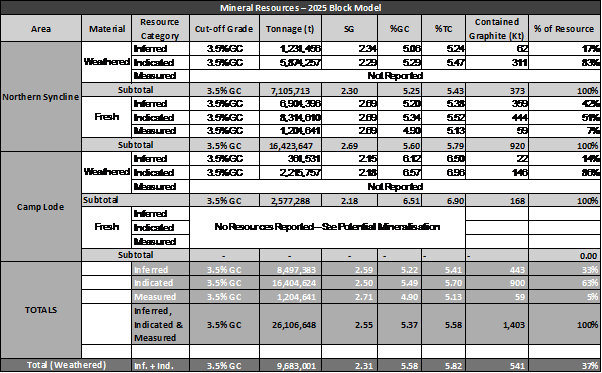
· GC – Graphitic carbon, TC – Total carbon.
· No geological loses applied.
· A conservative cut-off grade of 3.5% GC has been applied based on metallurgical testing & preliminary mining parameters.
· Mineralised tonnes have been rounded off and contained graphite metal tonnages have been rounded off to the nearest 1000 (Kt).
· Contained graphite has been reported without the application of cut-off grades, loss factors, or beneficiation yields.
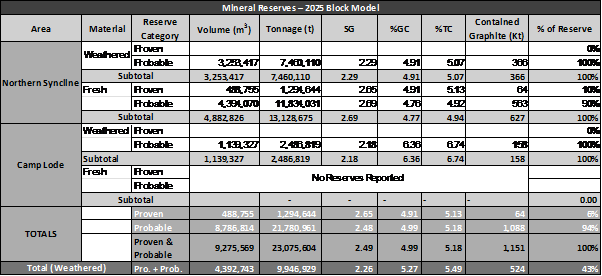
· GC – Graphitic carbon, TC – Total carbon.
· Mining dilution of 5% applied.
· Mineralised tonnes have been rounded off and contained graphite metal tonnages have been rounded off to the nearest 1000 (Kt).
· Contained graphite has been reported without the application of cut-off grades, loss factors, or beneficiation yields.
Competent Person’s Statement
The information in this release, which is related to Mineral Resource estimation, was compiled under the supervision of Mr Sean Nieman who is an employee of Minrom Consulting (Pty) Ltd; he is Member of the Geological Society of South Africa (GSSA) and a Certified Professional Natural Scientist (Pr.Sci.Nat) with the South African Council for Natural Scientific Professions (SACNASP).
Mr Sean Nieman has sufficient experience relevant to the style of mineralisation and type of deposit under consideration and to the activity that he has undertaken to qualify as a Competent Person as defined by the JORC (2012) Code. Mr Sean Nieman consents to the inclusion in this report of the matters based on his information in the form and context in which it appears.
The information in this release, which is related to Mineral Reserves estimation, was compiled under the supervision of Mr Iain Wearing who is an employee of Blencowe Resources Plc; he is Member of the Australian instate of Mining and Metallurgy (AusIMM) and a Certified Professional Engineer.
Mr Iain Wearing has sufficient experience relevant to the style of mineralisation and type of deposit under consideration and to the activity that he has undertaken to qualify as a Competent Person as defined by the JORC (2012) Code. Mr Iain Wearing consents to the inclusion in this report of the matters based on his information in the form and context in which it appears
**ENDS**
For further information please contact:
|
Blencowe Resources Plc Sam Quinn |
www.blencoweresourcesplc.com Tel: +44 (0)1624 681 250
|
|
Investor Relations Sasha Sethi |
Tel: +44 (0) 7891 677 441 |
|
Tavira Financial Jonathan Evans |
Tel: +44 (0)20 3192 1733
|
Twitter https://twitter.com/BlencoweRes
LinkedIn https://www.linkedin.com/company/72382491/admin/
Background
Orom-Cross Graphite Project
Orom-Cross is a potential world class graphite project both by size and end-product quality, with a high component of more valuable larger coarse flakes within the deposit.
A 21-year Mining Licence for the project was issued by the Ugandan Government in 2019 following extensive historical work on the deposit. Blencowe has now completed a successful Definitive Feasibility Study phase as the first major step towards initial production.
Orom-Cross presents as a large, shallow open-pitable deposit, with an initial JORC Indicated & Inferred Mineral Resource of 26.11Mt @ 5.58% TGC (Total Graphite Content). This Resource has been defined from only ~2% of the total tenement area which presents considerable upside potential ahead. Development of the resource is expected to benefit from a low strip ratio and free dig operations together with abundant inexpensive hydro-electric power off the national grid, thereby ensuring low operating costs. With all major infrastructure available at or near to site the capital costs will also be relatively low in comparison to most graphite peers.
#SVML Sovereign Metals LTD – Lapse of Performance Rights and September 2025 Quarterly Report
 LAPSE OF PERFORMANCE RIGHTS
Sovereign Metals Limited (ASX:SVM; AIM:SVML; OTCQX:SVMLF) (Sovereign or the Company) advises that 10,977,500 unlisted performance rights that were subject to the “Definitive Feasibility Study Milestone” have lapsed today without exercise or conversion.
Following the lapse of these unlisted performance rights, the Company has the following securities on issue:
· 646,938,703 fully paid ordinary shares (of no par value);
· 4,992,500 unlisted performance rights subject to the “Grant of Mining Licence Milestone” expiring on or before 31 March 2026; and
· 6,190,000 unlisted performance rights subject to the “Final Investment Decision Milestone” expiring on or before 30 June 2026.
Change of Directors’ Interest Notices in relation to the lapse of unlisted performance rights have been provided below.
Link here to view the full announcement
Sovereign Metals Limited (ASX:SVM, AIM:SVML, OTCQX:SVMLF) (Sovereign or the Company) is pleased to provide its quarterly report for the period ended 30 September 2025 including advances made at its Kasiya Rutile-Graphite Project (Kasiya or the Project) in Malawi.
HIGHLIGHTS DURING AND SUBSEQUENT TO THE QUARTER
Japanese Government Launches New Nacala Logistics Corridor Development Initiative
· Japan commits US$7 billion in development funding – $5.5 billion through joint program with African Development Bank, plus $1.5 billion in public-private impact investment through Japan’s development agency.
· Initiative focuses on capacity expansion, refurbishment, and resilience upgrades to increase throughput, enhance reliability, and reduce bottlenecks, positioning Kasiya as a key beneficiary of Japan’s mineral security strategy.
· Nacala Corridor is Kasiya’s preferred transport route – providing lowest-cost pathway from Kasiya to international markets via a deep-water port.
Various Critical Components of DFS now complete
· Geotechnical investigations successfully completed across all critical infrastructure locations with oversight from the Sovereign-Rio Tinto Technical Committee confirming favourable subsurface conditions aligned with regional geology
o Over 400 individual tests conducted covering mining infrastructure, tailings storage facility and raw water dam
o Consistent stratigraphy and suitable subsurface conditions to enable more standardised foundation designs and construction approaches across infrastructure areas
· Mining fleet specifically engineered for large-scale dry mining operations following the results of the successful Pilot Mining and Land Rehabilitation (Pilot Phase).
o No drilling, blasting, crushing or milling required at Kasiya resulting in low capital outlays and operating costs.
o Equipment selection and supplier identification completed for all operational requirements across the proposed initial 25-year mine life
· Rehabilitation of land at Pilot Phase test pit site successfully completed during the quarter, further de-risking DFS
o Exceptional first-year results from its rehabilitation trials at the Kasiya, delivering critical data that will inform the progressive rehabilitation strategy for the ongoing definitive feasibility study (DFS).
o Rehabilitation trials achieved 5x crop yield improvement – demonstrating superior post-mining land productivity versus traditional farming.
New Graphite Tariff Environment Underscores Kasiya’s Global Significance
· In July 2025, the U.S. Commerce Department announced 93.5% preliminary anti-dumping duties on Chinese graphite imports, fundamentally altering the economics for battery manufacturers seeking secure, cost-competitive supply chains.
· The new tariff environment highlights Kasiya’s potential as the world’s largest and lowest-cost non-Chinese graphite producer with industry-leading US$241/t incremental cost of production.
Latest Testwork Validates Kasiya Graphite’s World-Class Quality to Anode Manufacturers
· Latest coating optimisation testwork achieved successful coated spherical purified graphite (CSPG) production characteristics with superior performance metrics.
· Samples of Kasiya fine flake graphite concentrate have been distributed to leading natural graphite anode producers and anode project developers to support development of offtake agreements while validating market demand for Kasiya’s high-quality battery-grade graphite
Kasiya Unaffected by Malawi Raw Mineral Export Order
· Subsequent to the quarter, His Excellency President Peter Mutharika, the newly elected President of Malawi, announced an Executive Order regarding the prohibition of the export of raw minerals from the country.
· This prohibition does not apply to the Company or to Kasiya as the ban only relates to minerals that have not been processed, refined, or value-added in Malawi.
o With regards to its future planned Kasiya operations, Sovereign has no plans to export run-of-mine Heavy Mineral Sands as defined in the Executive Order. All future mineralisation will be extracted and beneficiated in country to a final premium quality rutile (+95% TiO2) product. The high-quality Kasiya rutile product is planned to be a direct feedstock for titanium sponge production for high-end titanium metal products, including aerospace and defence applications.
o Similarly, Sovereign intends to process the run-of-mine Graphite as defined in the Executive Order in-country to produce a high-quality graphite product (96% C) suitable for major industry end markets including battery producers and refractory manufacturers.
Next Steps
Over the quarter ending December 2025, Sovereign will:
· continue to advance the Kasiya DFS, for completion in the first quarter of 2026, including finalising mining fleet design, process plant configuration, and mine gate-to-vessel logistics solutions;
· advance rutile and graphite offtake discussions; and
· further the Company’s community and social development programs in Malawi.
|
Enquiries |
|
|
Frank Eagar, Managing Director & CEO South Africa / Malawi +27 21 140 3190 |
|
|
Nominated Adviser on AIM and Joint Broker |
|
|
SP Angel Corporate Finance LLP |
+44 20 3470 0470 |
|
Ewan Leggat Charlie Bouverat |
|
|
|
|
|
Joint Broker |
|
|
Stifel |
+44 20 7710 7600 |
|
Varun Talwar |
|
|
Ashton Clanfield |