
Home » Posts tagged 'deposit'
Tag Archives: deposit
#AYM Anglesey Mining PLC – Parys Mountain Investment Case
 Anglesey Mining plc (AIM: AYM), the UK-based mineral exploration and development company and the 100% owner of the Parys Mountain Cu-Zn-Pb-Ag-Au VMS project in Anglesey, North Wales, today outlines the investment case for Parys Mountain, the primary focus for Anglesey and one of the UK’s most advanced brownfield mine development opportunities.
Parys Mountain is not merely an exploration project; it has been built on decades of investment in geology, engineering, metallurgy, infrastructure and permitting. Under renewed leadership, the Company’s strategy is to build on those foundations, further reduce development risk and unlock the significant value already within the asset.
What defines Anglesey & Parys Mountain:
· An advanced, well-established asset – over 70km of drilling across 359 diamond drill holes supports a JORC-compliant Mineral Resource exceeding 16 million tonnes (1.3 Mt Measured, 4.0 Mt Indicated and 10.8 Mt Inferred) of copper, zinc, lead, silver and gold – one of the UK’s largest undeveloped polymetallic VMS deposits, open along strike and at depth, particularly within the Northern Copper Zone.
· Metallurgically de-risked – multiple testwork phases, including continuous pilot-plant operation on approximately 2,000 tonnes of Run-of-Mine (“ROM”) bulk sample, confirm that conventional differential flotation produces separate marketable copper, lead and zinc concentrates; modern technology offers further upside in recoveries and pre-concentration.
· Infrastructure already in place – a 300m deep production shaft, approximately 1km of underground development, road access, grid electricity, water supply and proximity to the deep-water Port of Holyhead materially reduce future capital requirements and execution risk.
· A recapitalised and restructured company in a stronger economic market – approximately £4 million debt eliminated over the past year and a complete refocus on Parys Mountain as the sole strategic asset. The Company has undertaken an internal review of the assumptions underpinning the 2021 Preliminary Economic Assessment (“PEA”), which indicates that stronger commodity prices have the potential to improve project economics despite inflationary pressures.
· Strategically timed – the UK Government’s Critical Minerals Strategy (the “Strategy”), published in November 2025, identifies zinc as a UK Critical Mineral and copper as a Growth Mineral, while targeting 10% of the UK’s overall critical mineral demand to be met through domestic production by 2035. The Strategy specifically highlights copper-zinc exploration in Anglesey, while UK copper demand is forecast to almost double, reinforcing the strategic importance of secure domestic supplies
A Defined Resource with District-Scale Upside
Parys Mountain has been mined intermittently since the Early Bronze Age, with the key phase occurring in the 18th Century when it became Europe’s premier copper producer, a mine whose output was significant enough to influence the global copper price. Parys Mountain copper was used to clad the hulls of the Royal Navy to deter organic growth. Decades of diamond drilling have defined one of the country’s largest undeveloped polymetallic volcanogenic massive sulphide deposits, delivering an exceptional dataset and a strong platform for future resource growth. The resulting JORC-compliant Mineral Resource exceeds 16 million tonnes and carries significant copper, zinc, lead, silver and gold.
The resource provides the foundation for mine development while leaving considerable exploration upside. Mineralisation remains open along strike and at depth, particularly within the Northern Copper Zone, offering clear opportunities to increase both the scale and confidence of the Mineral Resource. Importantly, Anglesey controls the key mineral rights and land required for the future development of Parys Mountain, together with additional leased ground covering known resource and prospective exploration targets. This gives the Company control not only of today’s Mineral Resource, but also significant potential for future resource growth and exploration success.
Advanced Metallurgical Understanding
Metallurgy is among the most significant technical risks in any polymetallic development project, and at Parys Mountain it has already been addressed extensively. Multiple phases of metallurgical testwork, including continuous operation of a pilot plant processing approximately 2,000 tonnes of ROM bulk sample, have demonstrated that Parys Mountain ores can be successfully processed using conventional differential flotation to produce separate copper, lead and zinc concentrates. The 2021 PEA was founded on this substantial body of metallurgical evidence.
More recent work has indicated the potential for further improvements in recoveries and in pre-concentration technologies. Modern processing technology therefore offers scope to improve on the performance achieved during the original testwork – value that has already been tested rather than value still to be discovered.
Existing Mine Infrastructure and Logistics
Parys Mountain already benefits from a 300m deep production shaft and approximately 1km of underground development – infrastructure that would cost many tens of millions of pounds and several years to recreate today and which significantly de-risks future development. Surface infrastructure is equally advanced: excellent road access, grid electricity, water supply and proximity to the deep-water Port of Holyhead provide the essential requirements for future mine development, substantially reducing both capital requirements and execution risk.
Improved Economics and a Simplified Balance Sheet
The Company has undertaken an internal review of the assumptions underpinning the 2021 PEA, which indicates that, despite increases in capital and operating costs, the current commodity price environment has the potential to improve the project’s economic outlook compared with that reflected in the 2021 PEA. The corporate position has been simplified in parallel. Over the past year, the Company has transformed its balance sheet, eliminating approximately £4 million of debt while refocusing entirely on advancing Parys Mountain as its sole strategic asset.
Jurisdiction, Leadership and Shareholder Support
The UK combines political stability, regulatory clarity and secure mineral tenure with an increasingly supportive government policy environment. The Strategy, published in November 2025 and backed by up to £50 million of initial funding, targets 10% of UK critical mineral demand to be met through domestic production and a further 20% through recycling by 2035, up from around 6% today, while also seeking to reduce reliance on any single overseas supplier to no more than 60% for each critical mineral. Within this framework, zinc is recognised as a UK Critical Mineral, reflecting its strategic importance to industrial supply chains, while copper is designated a Growth Mineral – a category created for minerals that, although not formally classified as critical, are considered essential to the UK’s future economic growth. UK copper demand is forecast to almost double by 2035, driven by electrification, grid investment and Artificial Intelligence (“AI”) data-centre construction.
The Strategy expressly identifies copper and zinc exploration in Anglesey as one of the UK’s important mineral interests. That policy shift has been sharpened by the use of export controls elsewhere in critical mineral supply chains, which has moved security of supply from a commercial consideration to a question of national industrial resilience. New mine developments across Scotland, Northern Ireland, Cornwall, Devon, North Yorkshire, County Durham and North Wales are rebuilding the UK’s mining ecosystem – strengthening technical capability, regulatory experience, specialist supply chains and investor confidence.
The Company has assembled a refreshed Board and Executive team to fully dedicate to the advancement of Parys Mountain, including the recent appointment of James McFarlane as Principal Geologist, who brings extensive international experience across exploration, resource evaluation, mine development, operations, and project delivery, providing the technical and commercial capability required to unlock the value of Parys Mountain. The Company’s largest shareholder, Energold Minerals Inc., continues to provide long-term support, reflecting confidence in both the asset and the Company’s development strategy.
Commenting, Andrew Fulton, Anglesey’s Chief Executive Officer, said:
“Parys Mountain has been drilled, sunk, developed and, critically, metallurgically tested. Decades of investment have already answered the questions that many projects at this stage are still funding: we know the geology, we own the ground, we have a shaft and underground development in place. Our task now is to build on those foundations rather than start from them.
“With a simplified balance sheet, a single strategic focus, substantially higher metal prices than in 2021 and modern processing technology offering further recovery upside, we believe there is greater upside in Parys Mountain than the market currently recognises. Parys Mountain supplied the world with copper previously, and it can contribute to UK supply again: with the Government now targeting a step-change in domestic critical mineral production, the strategic case for Parys Mountain to develop, grow and discover has never been stronger.”
For further information, please visit the Company’s website: www.angleseymining.co.uk
Qualified/Competent Person
Eur. Ing. Jim Williams, BSc, MSc, D.I.C., FIMMM, CEng., CGeol., the Executive Chairman of Anglesey Mining, a “Competent Person” as defined in the AIM guidelines of the London Stock Exchange, and a “Qualified Person” as defined in the Canadian National Instrument 43-101 (“NI 43-101”), has reviewed and approved the information in this release.
-Ends-
For further information, please contact:
Anglesey Mining plc (via Yellow Jersey PR Limited)
Jim Williams, Executive Chairman
angleseymining@yellowjerseypr.com
Yellow Jersey PR Limited
Financial & Media Relations
Dominic Barretto/Shivantha Thambirajah
Tel: +44 (0)20 3004 9512
#GRX GreenX Metals Limited – Quarterly Activities Report June 2026
 GreenX Metals Limited (ASX:GRX, LSE:GRX, GPW:GRX, Germany-FSE:A3C9JR) (GreenX or the Company) is pleased to present its Quarterly Activities Report for the period ending and subsequent to 30 June 2026.
SUMMARY
· TANNENBERG COPPER PROJECT (GERMANY)
o EXPLORATION TARGET:
o Exploration Target announced demonstrates potential for a globally significant copper endowment at Tannenberg.
o Exploration Target captures hanging wall and footwall mineralisation above and below the Kupferschiefer shale: a modern view of the deposit that the 1940 historical estimate did not contemplate.
o Validated by Kupferschiefer mining in Poland, where up to 95% of mineable copper at KGHM Polska Miedź S.A’s operations is hosted in the same footwall sandstone and hanging wall limestone units that host the Tannenberg Exploration Target.
o Built on validated historical foundations: the Exploration Target builds on the 1940 National Socialist historical estimate area; the 1984 St Joe historical estimate; validation via resampling and logging of 1980’s core by GreenX and digitised archive material collected since August 2024.
o An inflection point for Tannenberg: with the Exploration Target estimated, GreenX now transitions from archive synthesis to active exploration, including Scoping Study-level metallurgical test work, a seismic survey and commencement of an initial drill program.
o Work completed by Palsatech in a specialist logging facility in Sweden with MSA Mining Consulting UK Ltd’s independent competent person compiling the Exploration Target.
o MINERALOGY AND PROCESSING STUDY:
o Subsequent to the Exploration Target, GreenX completed an early-stage mineralogy and processing study for Tannenberg.
o Mineralogy study confirms Tannenberg mineralisation is consistent with producing Polish Kupferschiefer mines
o Independent metallurgical review by MSA Mining Consulting UK confirms Tannenberg confirms potential suitability for a conventional flotation-based processing route, as used at KGHM’s (WSE:KGH) long-running operations and planned for Lumina Metals’ (TSE:LMCU) Nowa Sól project.
o Established Kupferschiefer flowsheet provides a baseline processing route for Tannenberg. KGHM’s operations process 30 Mtpa at 1.6% Cu and 45 g/t Ag, achieving 89% copper and 86% silver aggregate recovery from a blended feed of Kupferschiefer shale, sandstone and carbonate-hosted mineralisation using crushing, two-stage grinding, rougher flotation, fine regrinding and multi-stage cleaning.
o Modern processing technologies offer potential to enhance recoveries. Advances, including high-pressure grinding rolls, fine-particle flotation systems and advanced reagent schemes, will be investigated, with potential to improve liberation and recovery of fine-grained copper sulphides relative to legacy flowsheets developed decades ago for KGHM.
o The mineralogy study, completed by SGS Lakefield on ten drill core samples, shows that the copper is predominantly hosted in chalcocite with additional bornite, chalcopyrite and covellite, typical of Kupferschiefer deposits.
o Bi-modal copper sulphide grain size distribution identified, with both coarse (>25 to 30 µm) and very fine disseminated material (<5 to 10 µm), informing comminution and flotation circuit design.
o Historical extraction at Tannenberg materially de-risks metallurgy. The Tannenberg mines produced 416,500 tonnes of copper and 33.7 Moz of silver predominantly during the 1930’s to 50’s, when mineral processing technology was not as advanced as it is in modern times.
o Supports progression to scoping-level metallurgical testwork on representative samples of each lithology to seek to confirm initial mineralogical findings, assess comminution characteristics and evaluate flotation performance.
· ELEONORE NORTH PROJECT (GREENLAND)
o Fieldwork is currently underway at Eleonore North, targeting gold, tungsten and antimony mineralisation.
o A Reduced Intrusion-related Gold System specialist evaluating the Noa Pluton prospect as well as untested targets
o Bulk sampling of tungsten and antimony-mineralised material at North and South Margeries deposits is expected to support scoping-study level metallurgical sighter test work.
o Archive core from North and South Margeries deposits was sampled prior to fieldwork and are currently being assayed with results expected in the coming months.
o Aim of fieldwork in 2026 is to confirm drill ready targets at both North and South Margeries and Noa Pluton.
o Multiple walk-up surface anomalies identified along strike and adjacent to the existing high-grade tungsten and antimony historical estimates previously identified.
o A 2 km-long prospectivity anomaly at North Margeries sits adjacent to a major east-west fault structure, with multiple additional anomalies surrounding the South Margeries historical estimate.
o Targets were generated by applying modern processing techniques to a heritage dataset acquired from an airborne hyperspectral survey flown in 2000 across the East Greenland Licences.
o Tungsten and antimony are both listed as critical raw materials by the European Union and the United States, with global supply heavily concentrated in China.
· ARBITRATION SET-ASIDE PROCEEDINGS
o As previously announced, the Singapore Court rejected, in its entirety, Poland’s application to set aside the Company’s ECT award, thereby upholding GreenX’s previously announced right to compensation under the ECT.
o A redacted judgment has been released by the Singapore Court, and the Company has brought the judgment to the attention of the English courts as part of the BIT set-aside proceedings. Under the English Arbitration Act 1996, the threshold to succeed on a set-aside application in the courts of England and Wales is exceptionally high, and courts typically reject these challenges unless there has been a serious procedural irregularity.
o Poland has applied to the Singapore Court of Appeal to challenge the rejection of the first ECT set-aside motion. This appeal is being heard in September 2026 by the Court of Appeal, following which Poland will have no further rights of appeal within the Singapore courts.
o The Company will continue to defend its awards and update the market in line with its continuous disclosure requirements.
ENQUIRIES
|
Ben Stoikovich Chief Executive Officer
+44 207 478 3900 |
Kazimierz Chojna Investor Relations – Poland
Kim Eckhof Investor Relations – UK / Germany |
Link here to view the full announcement
#FCM First Class Metals PLC – Share Placing & Total Voting Rights
 First Class Metals PLC (“First Class Metals”, “FCM” or the “Company”) the UK listed company focused on the discovery of economic metal deposits across its exploration properties in Ontario, Canada, announces that it has raised gross proceeds of £1,000,000 before related costs through a placing (the “Placing“) of 26,315,790 new ordinary shares (“Shares“) at a price of 3.8 pence per Share (the “Placing Price“), . The Company’s Broker, Axis Capital Markets, acted as the Company’s sole placing agent in respect of the Placing, introducing new institutional investment to the Company’s share register
The Placing Price represents a 9.5% discount to the bid closing price of the Company’s shares on 8 June 2026, being the last trading day prior to completion of the Placing. The proceeds from the Placing, are intended to be used to continue the Company’s activities across its portfolio aimed at enhancing value, including:
- expansion of the company’s exploration activities on the Sunbeam Project. Work on which, subject to obtaining the necessary government approvals, will include:
o An exploratory drill programme at the Pettigrew Prospect in H2 2026, with possible expansion or follow up programme;
o follow up drilling at the Roy prospect;
o intensive exploration and structural study around the Sunbeam mine;
o Exploration on the extension of the three main lineaments to the north-east at the Sunbeam Property.
- exploration activities on FCM’s other core and non-core projects in Northern Ontario; and
- for general working capital purposes.
Reflecting the Company’s increasing confidence in the prospectivity of the Sunbeam Project, a revised three-year Exploration Permit Application covering the whole property has now been submitted to the Ontario Ministry of Mines. The application is designed to support a substantially expanded exploration programme and provide operational flexibility as the Company advances the project.
James Knowles, CEO of First Class Metals, commented:
“We are pleased to have secured £1 million of new funding through Axis Capital Markets. While the Company is already funded for the foreseeable future, this additional capital further strengthens the balance sheet and provides the flexibility to expand exploration activity across our Ontario portfolio.
Whilst completed at a modest discount to the prevailing market price, the Placing represents a premium of approximately 150% to our March 2026 fundraising price of 1.52 pence per share. We believe this reflects the progress made by the Company and the growing recognition of the value within our assets.
The current funding enables the Company to advance it’s key exploration initiatives without delay, ensuring we are well positioned to deliver meaningful news flow throughout the remainder of 2026 while continuing to pursue opportunities that enhance shareholder value.”
Broker Warrants
In connection with the Placing, the Company has agreed to grant warrants over 909,090 new ordinary shares to Axis Capital Markets. The warrants are exercisable at a price of 5.5 pence per warrant for a period of 36 months from the placing date.
Total Voting Rights
Application will be made to the London Stock Exchange for the 26,315,790 Shares to be admitted to trading on the Main Market for listed securities (“Admission“) and it is expected that Admission will take place at 8.00 a.m. on or around on 23 June 2026.
In accordance with the provision of the Disclosure Guidance and Transparency Rules of the Financial Conduct Authority, the Company confirms that, following the issue of the Shares, the Company’s issued ordinary share capital will comprise 416,276,349 Ordinary Shares. All the Ordinary Shares have equal voting rights and none of the Ordinary Shares are held in Treasury. The total number of voting rights in the Company will therefore be 416,276,349. The above figure may be used by shareholders as the denominator for the calculations to determine if they are required to notify their interests in, or a change to their interest in, the Company.
Please visit our InvestorHub for more information
https://firstclassmetalsplc.com/link/P2KZwy
For further information, please contact:
James Knowles, Executive Chair
Email: JamesK@Firstclassmetalsplc.com
Tel: 07488 362641
Marc J Sale, CEO
Email: MarcS@Firstclassmetalsplc.com
Tel: 07711 093532
AlbR Capital Limited
David Coffman / Dan Harris
Website: www.albrcapital.com
Tel: (0)20 7469 0930
Axis Capital Markets (Broker)
Richard Hutchinson
Website: Axcap247.com
Tel: (0)203 026 0449
#FCM First Class Metals PLC – FCM Completes Zigzag Earn-In
 First Class Metals PLC (“First Class Metals”, “FCM” or the “Company”) the UK listed company focused on the discovery of economic metal deposits across its exploration properties in Ontario, Canada, is pleased to announce that it has completed all obligations under the Zigzag Option Agreement originally entered into with Nuinsco Resources Limited (“Nuinsco”) in March 2023.
Completion of the final option requirements results in FCM earning an 80% interest in the Zigzag Lithium-Critical Minerals Project (“Zigzag” or “Zigzag Project”) located within the highly prospective Seymour-Falcon pegmatite corridor of northwestern Ontario. As provided for under the terms of the agreement, Zigzag will now transition into a Joint Venture between FCM (80%) and Nuinsco (20%).
Highlights
- FCM has completed all cash, share and exploration expenditure commitments required under the Zigzag earn-in agreement.
- FCM has earned an 80% interest in the Zigzag Project and now assumes control of the asset.
- Project ownership now transitions into an 80:20 Joint Venture between FCM and Nuinsco.
- Zigzag hosts drill-confirmed lithium mineralisation with intersections including:
- 4.3m @ 1.65% Li₂O
- 5.0m @ 1.50% Li₂O
- 6.5m @ 1.09% Li₂O
and remains open along strike and at depth. - Drilling has also confirmed the presence of significant multiple critical minerals including tantalum, rubidium, caesium and gallium.
- FCM is now evaluating a bulk sampling programme and metallurgical test work to better define potential recoveries.
- The project is situated approximately 10km from Green Technology Metals’ Seymour Project (ASX-GT1) and proposed lithium processing infrastructure.
- Improving lithium market fundamentals continue to support renewed interest in quality hard-rock lithium assets.
Strategic Importance of Zigzag
Since acquiring the option in March 2023, FCM has systematically advanced the Zigzag Project through surface sampling, channel sampling, geochemical surveys and its inaugural drilling programme.
The results confirmed significant spodumene-bearing pegmatite mineralisation, validated historic exploration data and demonstrated the potential for additional discoveries along strike and within parallel structures identified through geochemical surveys.
Importantly, Zigzag is not solely a lithium project. Drilling confirmed elevated levels of tantalum, rubidium, caesium and gallium, all recognised critical minerals with strategic importance to advanced technologies, energy storage systems and defence applications. These minerals have the potential to provide meaningful by-product value in any future development scenario.
The project is located within one of Canada’s emerging hard-rock lithium districts and benefits from proximity to Green Technology Metals’ Seymour Project, where development activities continue to advance. The Board believes this regional development significantly enhances the strategic value of the Zigzag Project through the potential future availability of shared infrastructure, processing solutions and regional expertise.
Next Steps
With the earn-in phase now complete and operational control established, FCM intends to focus on metallurgical test work on a large representative sample to better understand lithium and critical metal recovery characteristics
The objective of this work programme will be to better understand lithium recoveries, evaluate the contribution of associated critical minerals and assess potential development pathways for the project.
The Board believes the combination of confirmed lithium mineralisation, multiple critical metal credits, strategic location and improving lithium market conditions provide a compelling platform from which to unlock additional value at Zigzag.
James Knowles, Executive Chairman of First Class Metals, commented:
“”The completion of the Zigzag earn-in secures FCM’s 80% interest and operational control of a strategically located lithium and critical minerals asset. With drill-confirmed lithium mineralisation, valuable critical metal credits, improving lithium market fundamentals and proximity to planned regional processing infrastructure, we believe Zigzag has significant untapped potential. Our immediate focus is advancing metallurgical test work on a large representative sample to better understand lithium and critical metal recovery characteristics and further evaluate the opportunity at Zigzag.”
For Further Information:
Engage with us by asking questions, watching video summaries, and seeing what other shareholders have to say. Navigate to our Interactive Investor hub here:
https://firstclassmetalsplc.com/link/r6gDMP
For further information, please contact:
James Knowles, Executive Chair
Email: JamesK@Firstclassmetalsplc.com
Tel: 07488 362641
Marc J Sale, CEO
Email: MarcS@Firstclassmetalsplc.com
Tel: 07711 093532
AlbR Capital Limited
David Coffman / Dan Harris
Website: www.albrcapital.com
Tel: (0)20 7469 0930
Axis Capital Markets (Broker)
Richard Hutchinson
Website: Axcap247.com
Tel: (0)203 026 0449
#BRES Blencowe Resources PLC – Beehive Drilling Results
 Blencowe Resources Plc (LSE: BRES) is pleased to provide an update on further assay results from shallow drilling at the company’s new Beehive deposit. Both Beehive and Iyan are substantial new exploration finds within the most recent 2025 drill programme and both will contribute significantly to the size and scale of the Orom-Cross graphite project.
As part of the Stage 7 drilling programme, the Company completed 110 shallow drill holes at Beehive, designed to test the continuity, thickness and near-surface extent of graphite mineralisation. This announcement reports further assay results from 36 holes (including additional coverage toward the northern extent), following the Company’s previous Beehive assay update.
The shallow programme was designed to define near-surface, bulk mineable graphite mineralisation, with holes drilled to a planned depth of approximately 30 metres. The majority of reported holes intersected graphite mineralisation from near surface to end-of-hole, with many holes ending in mineralisation, highlighting potential for continuation below the current shallow drilling depth. This is consistent with previously reported deeper drilling at Beehive, which demonstrated graphite mineralisation continuing to approximately 100 metres depth.
Whilst the drilling was intended to close out the northern extent of the deposit, results also indicate potential for additional extensions of up to ~400m – particularly toward the northern and western end of the deposit – within the broader target area.
Beehive Drilling Highlights
An additional 36 assay results were received and compiled from the Stage 7 programme:
· Thick near-surface mineralisation: multiple holes deliver ~30-32 meters mineralisation from surface, supporting depth continuity and bulk mining potential.
· Strong bulk grades across the batch: 12 holes average ≥5.0% TGC and 8 holes average ≥6.0% TGC over the drilled intervals highlighting strong in situ grades within Beehive.
· High-grade frequency: all holes are mineralised and grades are consistently higher than overall average grades for other deposits within Orom-Cross.
Selected Beehive Significant Shallow Intercepts Include:
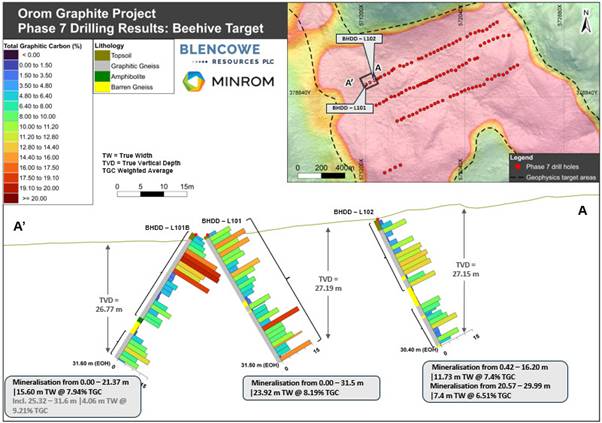
o BHDD-L101: 31.5 meters @ 8.19% TGC from surface
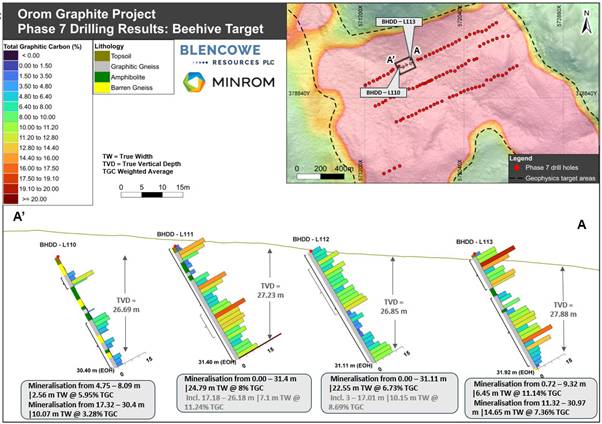
o BHDD-L111: 31.4 meters @ 8.00% TGC from surface
o BHDD-L327: 31.2 meters @ 7.67% TGC from surface
o BHDD-L113: 31.92 meters @ 7.59% TGC from surface, including 9.32m @ 11.14% TGC
o BHDD-L133: 31.4 meters @ 6.83% TGC from surface
o BHDD-L102: 29.61 meters @ 6.11% TGC from surface
o BHDD-L325: 31.3 meters @ 6.21% TGC from surface
Interpretation and Next Steps
These additional shallow results continue to support a thick graphite system at shallow depths, while previously reported deeper drilling has demonstrated mineralisation continuing to approximately 100 metres depth. Together, this work is building the dataset required to define the near-surface component and progress modelling toward a maiden Beehive JORC Mineral Resource scheduled for Q2 2026.
Further Beehive assay batches are being passed directly to the Company’s independent geological consultants, Minrom, for validation and quality assurance. Results will be reported progressively as batches are cleared and, subject to modelling, are intended to support a future Beehive JORC Mineral Resource update and provide further clarity on overall scale and development readiness as Blencowe continues to progress strategic and funding discussions in parallel.
Beehive has been defined over approximately 1,200 metres of strike and 480 metres of width to date, with scope for extensions beyond the current drill lines.
Blencowe Resources Executive Chairman, Cameron Pearce commented:
“We are pleased to report a further batch of Beehive assay results and appreciate shareholders’ patience as results move through laboratory reporting and independent validation. We expect a further set of assay results to become available shortly and will provide updates as batches are cleared.
Beehive continues to build momentum. This further batch reinforces continuity at shallow depths, with multiple plus-30 meter intercepts from surface and standout results including 31.5m @ 8.19% TGC and 31.4m @ 8.00% TGC.
Following the recent maiden Iyan JORC Mineral Resource of 16.9 million tonnes, which increased total Orom-Cross JORC Mineral Resources by 66% to 43.0 million tonnes, Beehive remains the next clear growth lever as we progress toward a maiden Beehive JORC Mineral Resource update this quarter. We would expect the continuity and thickness being demonstrated at Beehive to translate into a material increase in overall tonnage, subject to completion of assay flow, modelling and JORC reporting.
With access to renewable hydroelectric power and an expanding resource base, Orom-Cross continues to be positioned as an integral part of the western markets’ drive for secure, non-China critical mineral supply chains, supporting downstream pathways and longer-term offtake discussions.”
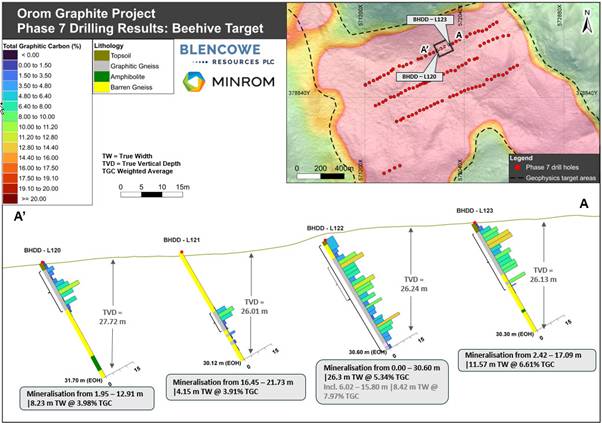
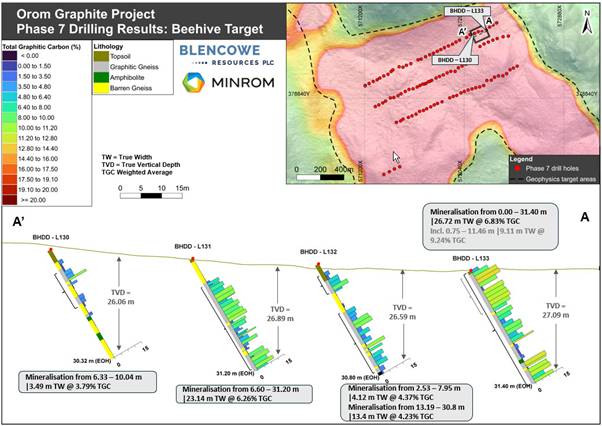
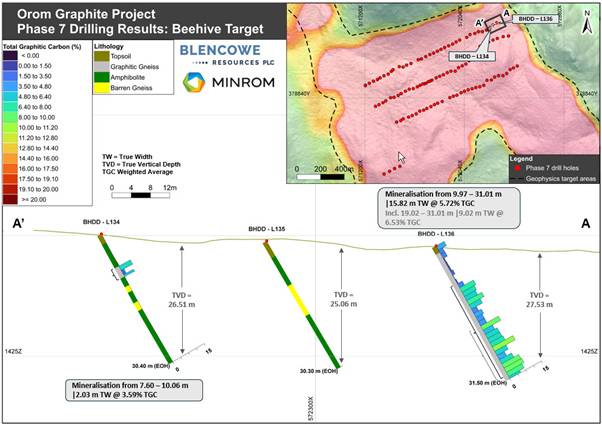
Beehive Deposit – Key Drill Results
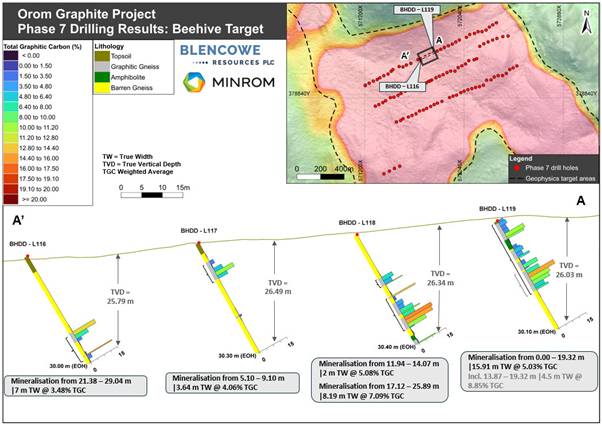
Figures 1-2: Beehive Deposit drill sections showing thick, continuous graphite mineralisation remaining open at depth.
|
Blencowe Resources Plc |
|
|
Sam Quinn (Director) |
Tel: +44 (0)1624 681 250
|
|
Sasha Sethi (Investor Relations) |
Tel: +44 (0) 7891 677 441 |
|
Tavira Financial (Joint Broker)
Jonathan Evans |
Tel: +44 (0)20 3192 1733 |
|
Oak Securities (Joint Broker)
Calvin Man /Mungo Sheehan / Jerry Keen |
Tel: +44 (0)20 3973 3678 |
|
|
|
|
|
#FCM First Class Metals PLC – SUNBEAM PROPERTY DRILLING UPDATE
 First Class Metals PLC (“First Class Metals”, “FCM” or the “Company”) the UK listed company focused on the discovery of economic metal deposits across its exploration properties in Ontario, Canada, is pleased to provide a drilling update for drilling at the Roy prospect on the Sunbeam Property (“Roy”).
Highlights
- To date, 5 holes have been completed for approximately 490m
- A minimum of 1,000m is anticipated to be drilled on the Sunbeam property
- The drill programme currently consists of 11 holes
- LiDAR(Light Detecting and Ranging) interrogation ongoing with initial feedback most encouraging
- The results from the Very Low Frequency (“VLF”) magnetic survey are still being reprocessed
- Prime strategic location between Agnico Eagle’s (NYSE:AEM) Hammond Reef and regional holdings
- Sunbeam lies directly between, and is contiguous with, two Agnico Eagle properties and just ~15km from the Hammond Reef gold deposit, with open pit probable mineral reserves estimated to be 3.3 million oz. of gold (123.5 million tonnes grading 0.84 g/t gold (Au), underscoring its exceptional position within a highly endowed, infrastructure-accessible gold district.
Marc J. Sale CEO of First Class Metals Commented:
“The drilling at Roy has progressed very satisfactorily with five holes completed all of which to date have intersected potential mineralised structure(s). Visually I am very encouraged by the deformation and associated veining. Obviously without the benefits of assays, we are reliant on the visual assessment of the prospectivity by the technical crew. However, we all remain enthusiastic and positive at this juncture.“
Roy structure
The lineament where the Roy occurrence / development is located is a district scale structure and has now been traced through historic work and Emerald Geological Services, (“EGS”) prospecting towards the 111ppb lake sediment sample some 5km northeast along strike of the mine shaft. The structure also hosts historic shafts B43 and B45, which further enhances the potential.
Drilling
The planned 1,000m programme has paused for the Prospectors and Developers Association of Canada (“PDAC”) convention and will recommence on or about the 7th March.
Drilling has commenced with hole SUN-26-01 which is a twin of historic hole SP-11-12, see Figure 2for a snapshot of the core.
Figure 2 showing the core from the drill hole twining’ SP-11-12, on an azimuth of 150o as per historical drilling.
Importantly, the majority of the holes drill will adopt a new azimuth at variance to the historical one of 150o, see Figure 3, this we believe is a far better azimuth / angle to intersect the mineralisation based on the structural understanding FCM has developed through ground observations and thorough review of the historical geological and drill data.
Figure 3 showing core from the newly adopted drill azimuth
A further hole to test geology, mineralisation and structure has been trialled, see Figure 4.
Figure 4 showing core from the drill hole drilled at a significantly different azimuth to this programme and previous drilling.
In early March, these holes will include a new (to previous drilling) azimuth as well as a ‘structural hole’ to test the hypothesis of the intersecting structures. The proposed drill programme was supported by the ‘brainstorming’ panel.
All the drilling at Roy is centred around the historic shafts in the vicinity of the 18.8g/t channel samples as well as the outcrop containing visible gold.
VLF / magnetic survey
In parallel with the soil sampling, a combined VLF and magnetic survey was undertaken. The ‘central grid’ has been completed for 192 stations over a combined 3.8km of line survey. This data is being reprocessed given the initial processing was deemed unsatisfactory.
LiDAR
The LiDAR information for the Sunbeam property and environs is still under interpretation by a third-party consultant. The initial findings are most encouraging and support the concept of gold ‘hotspots’ and structural intersections.
OJEP (Ontario Junior Exploration Programme)
FCM remains optimistic in respect of its application for a fourth consecutive for the maximum grant under the OJEP.
Sunbeam Property background
The Sunbeam property, which now extends to almost 100km2, is situated between two Agnico Eagle properties both of which have gold discoveries, including the Hammond reef resource of 3.3Mozs gold. The mineralisation on all three properties is associated with northeast orientated structures interpreted as splays off the Quetico fault to the south, see Figure 5
Figure 5 showing the similar orientations of the mineralised structures on the three properties emanating from the Quetico fault to the south.
The property contains three historic development sites: i) Sunbeam, the most exploited and the only site with recorded production, ii) Roy and iii) Pettigrew; these all sit on previously identified mineralised, district scale, structures, see Figure 6.
In addition, along these three mineralised structures a number of other significant gold bearing sites have been identified, such as Road zone and AL 308. A potential fourth lineation, the Burger structure, has not yet been explored by FCM.
The historic developments as well as the widespread occurrence of gold emphasises the gold endowment of the property and the potential for a major discovery.
Figure 6 showing the mineralised trends on the Sunbeam property and with the locations of the lake sediment samples, the area of soil / VLF survey as well as the recently staked and optioned claims.
Regionally the property is located about 230km west of Thunder Bay, roughly 30km northeast of Atikokan and is accessible 40km north off highway 11 by the Premier Lake (gravel) road, which transects the property and runs within one mile of the Roy shaft.
Qualified Person
The technical disclosures contained in this announcement have been drafted in line with the Canadian Institute of Mining, Metallurgy and Petroleum standards and guidelines and approved by Marc J. Sale, who has more than 30 years in the gold exploration industry and is considered a Qualified Person owing to his status as a Fellow of the Australian Institute of Mining and Metallurgy.
For Further Information:
Engage with us by asking questions, watching video summaries, and seeing what other shareholders have to say. Navigate to our Interactive Investor hub here:
https://firstclassmetalsplc.com/link/rDG2Ge
For further information, please contact:
James Knowles, Executive Chair
Email: JamesK@Firstclassmetalsplc.com
Tel: 07488 362641
Marc J Sale, CEO
Email: MarcS@Firstclassmetalsplc.com
Tel: 07711 093532
AlbR Capital Limited
David Coffman / Dan Harris
Website: www.albrcapital.com
Tel: (0)20 7469 0930
Axis Capital Markets (Broker)
Lewis Jones
Website: Axcap247.com
Tel: (0)203 026 0449
#BRES Blencowe Resources PLC – Iyan Deposit Delivers Multiple Intercepts over 30M
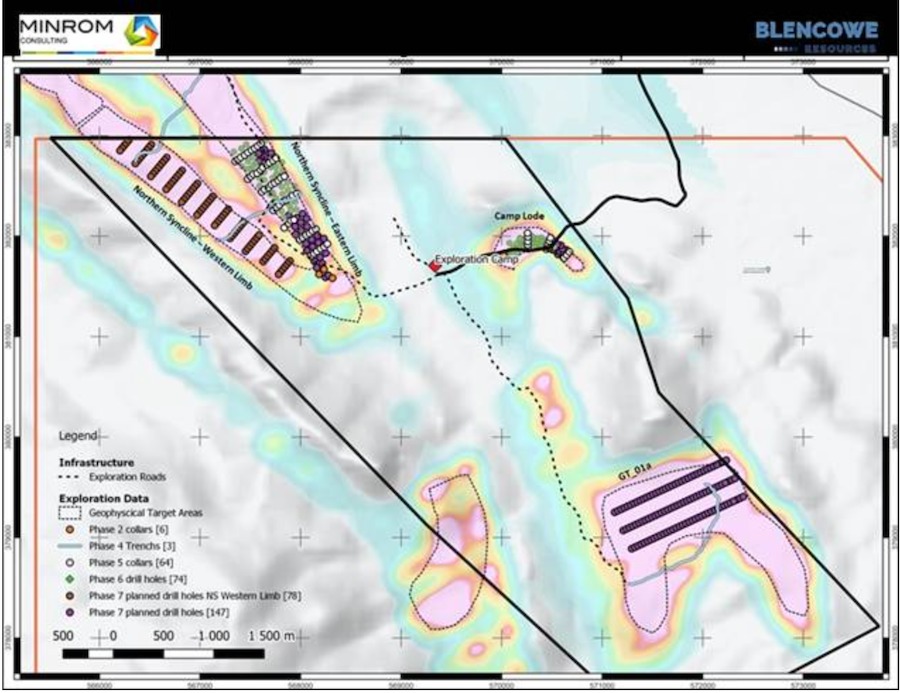 Blencowe Resources Plc (LSE: BRES) is pleased to provide an update on assay results from shallow drilling at the Iyan deposit, one of the two new deposits recently discovered at the Company’s Orom-Cross graphite project in Uganda. The Iyan deposit (named after the local indigenous peoples) represents the western extension of the Company’s Northern Syncline graphite system.
As part of the Stage 7 drilling programme, the Company completed 72 shallow drill holes at Iyan, designed to test the continuity, thickness and near-surface extent of graphite mineralisation across the deposit. This announcement reports assay results received to date from an initial 15 holes, which are considered representative of the broader drilling programme.
The shallow Iyan drilling was deliberately designed to define near-surface, bulk mineable graphite mineralisation, with holes drilled to a planned depth of approximately 30 metres. Importantly, the majority of reported holes intersected graphite mineralisation from near surface to end-of-hole, with many holes ending in mineralisation, highlighting clear potential for continuation below the current drilling depth. This continuation was underlined by the results as previously reported for the deeper holes completed at Iyan which indicated strong mineralisation all the way to 100 metres.
Iyan Drilling Highlights
· Initial results from 15 of 72 shallow holes confirm thick, continuous near-surface graphite mineralisation at Iyan.
· The majority of reported holes are mineralised to end-of-hole at the planned ~30m depth, supporting depth continuity.
· Drilling confirms a laterally continuous graphite system well suited to bulk, low-strip mining.
· Average grades are consistent with DFS assumptions, with multiple higher-grade zones within bulk mineralisation.
· Selected holes demonstrate 30-31 metres of continuous mineralisation from surface.
· Results reinforce potential to add meaningful near-surface tonnage within trucking distance of planned processing facilities.
· Outcomes support near-term resource growth as the Company advances funding discussions in parallel.
While graphite deposits are typically assessed on a bulk-tonnage basis, the Orom-Cross system continues to demonstrate that even its bulk mineralisation contains numerous higher-grade zones, providing flexibility for mine planning, blending and value optimisation. This combination of scale, consistency and quality is increasingly relevant for downstream processing pathways and long-term offtake discussions.
The Company notes that further Iyan assay results are expected shortly, with laboratory results being passed directly to the Company’s independent geological consultants, Minrom for validation and quality assurance procedures. Results will be reported progressively following completion of this work, ultimately supporting an updated resource estimate and providing further clarity on scale, mine life and development readiness as Blencowe advances funding discussions.
Selected Significant Shallow Intercepts – Iyan Deposit
(Downhole intervals; mineralisation from surface unless stated otherwise)
• NSDD-L1003: 30.27m @ 6.27% TGC,
o including 6.0m @ 8.59% TGC,
o including 8.0m @ 8.29% TGC, and
o including 5.27m @ 7.13% TGC (ended in mineralisation)
• NSDD-L705: 31.20m @ 6.84% TGC,
o including 12.16m @ 10.89% TGC (ended in mineralisation)
• NSDD-L707: 30.20m @ 7.55% TGC,
o including 5.0m @ 11.74% TGC (ended in mineralisation)
• NSDD-L1104: 25.20m @ 5.90% TGC,
o including 7.00m @ 7.54% TGC, and
o including 4.08m @ 8.15% TGC (ended in mineralisation)
• NSDD-L706: 30.76m @ 5.27% TGC,
o including 8.56m @ 6.54% TGC,
o including 8.01m @ 8.55% TGC, and
o including 5.00m @ 6.16% TGC (ended in mineralisation)
These results are representative of the broader shallow drilling programme and highlight a desirable combination of thickness, continuity and grade, with bulk-tonnage mineralisation at Orom-Cross continuing to deliver multiple higher-grade zones, a favourable characteristic for mine planning and blending.
The Iyan deposit has currently been identified over a strike length of approximately 1,800 metres, with drilling and supporting geophysical interpretation indicating potential extensions of 200-300 metres to the south and 100-200 metres to the west. While some areas present terrain challenges for drilling, geological continuity is supported by both assay results and geophysical overlays.
Blencowe Resources Executive Chairman, Cameron Pearce commented:
“We are seeing even the Orom-Cross’s bulk-tonnage mineralisation deposits delivering multiple higher-grade zones, which is a standout characteristic for a graphite project of this scale and consistency. These initial Iyan results reinforce the underlying quality of the Orom-Cross asset and its suitability for long-life, low-cost production.
I would also like to acknowledge the excellent work of the Blencowe technical team, our drilling contractors ADT and our independent geological consultants Minrom. The shallow drilling programme was deliberately designed to test near-surface continuity rather than depth, yet as with our Beehive deposit many holes still ended in mineralisation, clearly highlighting upside beyond the current drilling limit.
The exceptional results in all of the six deep holes we drilled underline the massive potential for depth extensions across the system, which could contribute to additional resources and further extension of mine life as the geological limits to this project continue to be evaluated.
With further results progressing through independent validation and a resource update to follow, these outcomes come at an important time as we advance funding and downstream discussions. In a market increasingly focused on securing sustainable, high grade, non-Chinese graphite via new critical mineral supply chains, Orom-Cross stands out for both scale and product quality, supported by renewable hydroelectric power.”
Interview
A recorded interview with Blencowe Resources’ CEO Mike Ralston, is available at the following link:
https://media.focusir.com/BlencoweResourcesQ12027
Iyan Deposit – Key Drill Results
Figures 1-2: Iyan Deposit drill sections showing thick, continuous graphite mineralisation remaining open at depth.
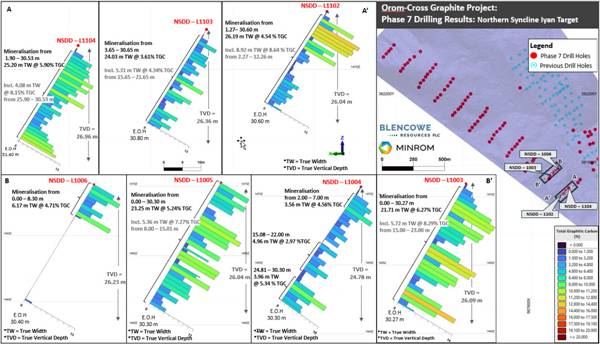
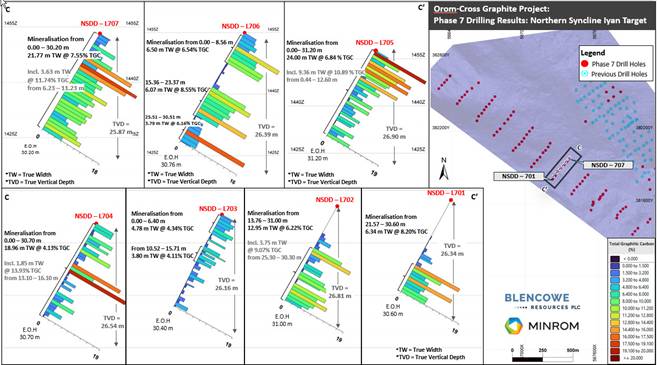
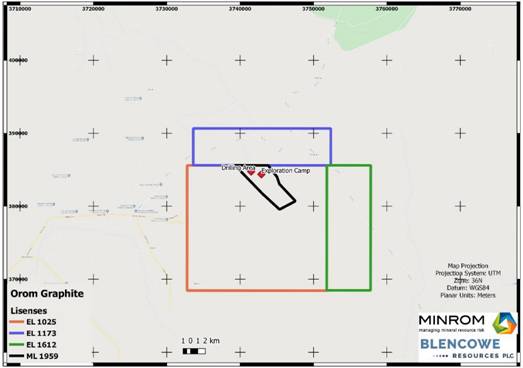
Figure 3: Orom-Cross graphite project showing ML1959 as a part of the overall licensed area.
|
Blencowe Resources Plc |
|
|
Sam Quinn (Director) |
Tel: +44 (0)1624 681 250
|
|
Sasha Sethi (Investor Relations) |
Tel: +44 (0) 7891 677 441 |
|
Tavira Financial (Joint Broker)
Jonathan Evans |
Tel: +44 (0)20 3192 1733 |
|
Oak Securities (Joint Broker)
Calvin Man /Mungo Sheehan / Jerry Keen |
Tel: +44 (0)20 3973 3678 |
|
|
|
|
|
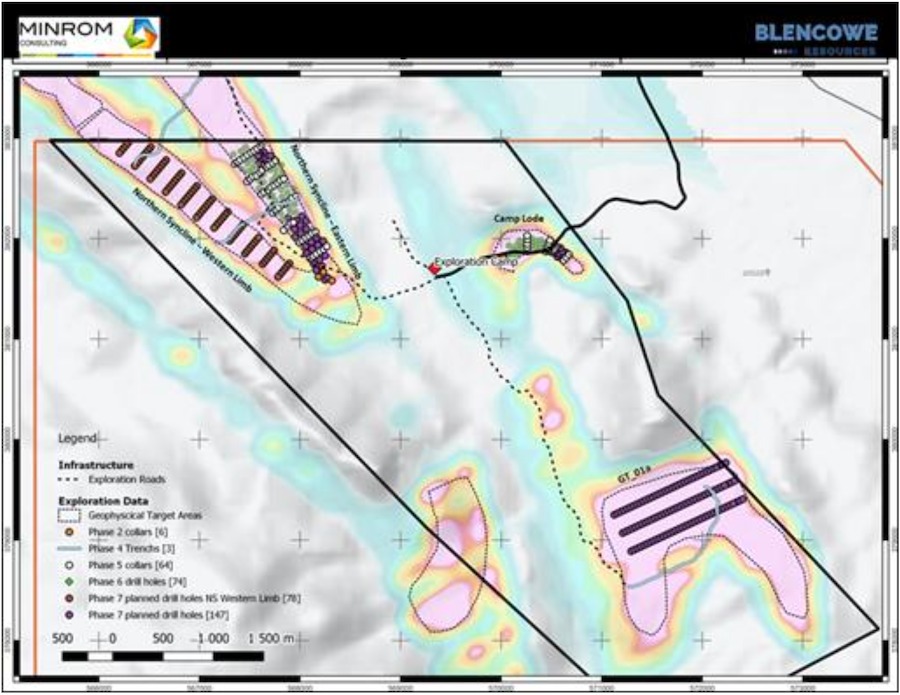
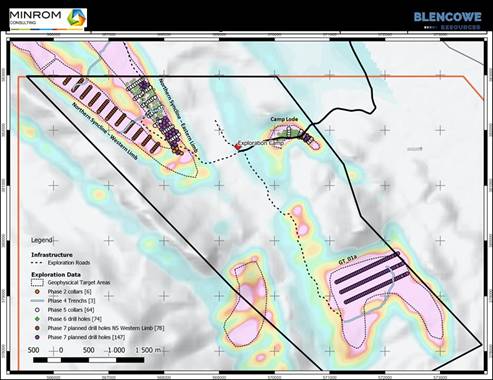
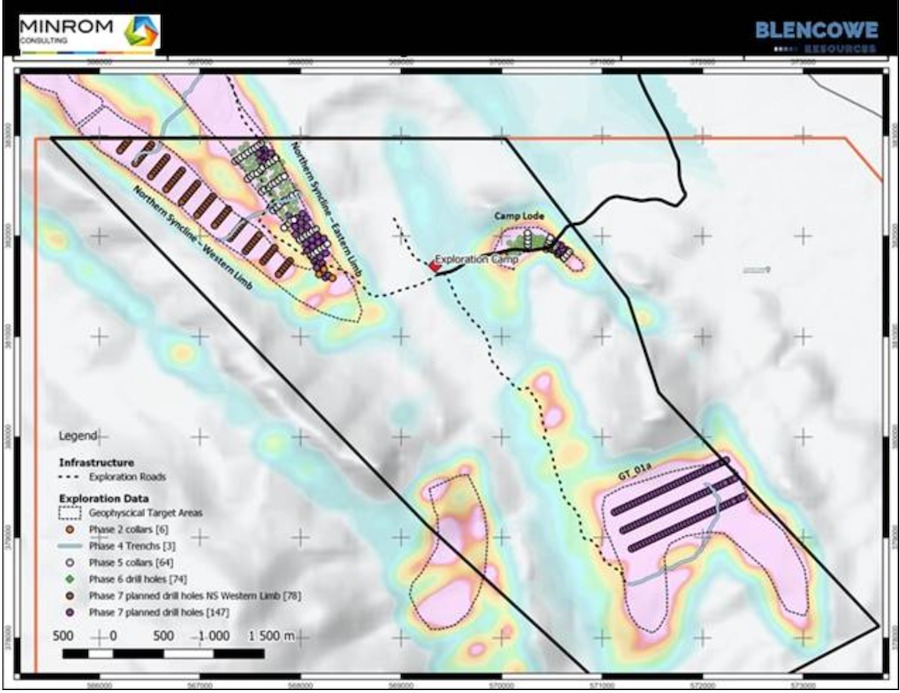
Map 1: Showing the 4x Orom-Cross deposits, including Camp Lode, Northern Syncline, and new Iyan (NS western limb) and Beehive (GT 01a) deposits.
#BRES Blencowe Resources PLC – Further Strong Deep-Hole Results at Iyan
 Blencowe Resources Plc (LSE: BRES) is pleased to report the remaining deep-hole assay results from the newly identified Iyan Deposit, located immediately adjacent to the Northern Syncline at the Orom-Cross graphite project in Northern Uganda.
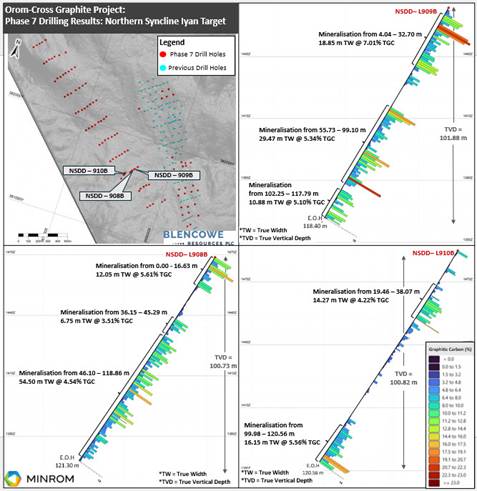
Following Iyan’s exceptional debut hole (L909B), assays from two further deep holes L908B and L910B confirm continuous, thick graphite mineralisation from or near surface to ~100 metres, with all deep holes ending in graphite. This indicates a robust, open system with clear multi-decade production potential, extending well beyond the initial 15-year mine life defined in the DFS.
Highlights
· Remaining deep holes at Iyan deliver thick, continuous graphite from surface to ~100m, with all holes ending in mineralisation.
· Results strongly support multi-decade production potential, far beyond current 15-year DFS mine life.
· Iyan confirmed as a major new deposit, not included in the current Orom-Cross JORC Resource.
· High-grade internal zones up to 13.9% TGC strengthen overall grade and development quality.
· First deep-hole assays from Beehive, the second new deposit identified in Stage 7, are expected by Christmas, with first Iyan shallow and step-out assays expected early into the New Year.
· 186 remaining shallow and step-out assays from both Iyan and Beehive prospects are pending, and these will underpin a JORC Resource upgrade in early 2026.
Iyan is a major new deposit adjacent to existing mineable deposit at Northern Syncline and not included in our recent JORC Resource reported in November 2025. Iyan will be included in the forthcoming 2026 JORC resource upgrade. 74 holes of the remaining 186 shallow and step-out holes completed in Stage 7 were drilled at Iyan, and these assays will help define further near-surface tonnage required to expand life of mine and project scale.
Assays from the three deep holes at the Beehive Deposit, the second newly identified mineralised zone in this programme, are expected shortly.
Iyan Deep Holes: L908B and L910B Confirm Continuity and High-Grade Zones
Hole L908B (Iyan):
· 12.05m (TW) @ 5.61% TGC from surface to 16.63m,
including 2m @ 9.56% TGC and 3m @ 11.55%TGC
· 54.50m (TW) @ 4.54% TGC from 46.1m to 118m,
including 5m @7.89%TGC and 6m @7.34%TGC (higher-grade internal zones)
These long mineralised intervals demonstrates both scale and grade consistency at depth, with multiple high-grade internal zones. The thickness and continuity closely match the structural trends observed within the Northern Syncline, reinforcing Iyan as its western extension.
Hole L910B (Iyan):
· 14.27m @ 4.22% TGC from 19.46-38.07m,
including 6m @ 6.97%TGC and 2m @ 8.57%TGC
· 16.15m (TW) @ 5.56% TGC from 99.98m to end-of-hole,
including 2m @ 13.92% TGC and 3.6m @ 9.74%TGC
The presence of repeated high-grade internal zones, including a standout 2m @ 13.92% TGC, highlights the high quality of the Iyan mineralisation. As with the other Iyan deep holes, L910B ended in graphite, confirming that the system remains open at depth and extends beyond current drilling limits.
Executive Chairman Cameron Pearce commented:
“These follow-up deep-holes confirm Iyan as a major new graphite deposit alongside Northern Syncline, with continuous mineralisation to ~100 metres and every hole ending in graphite. This points clearly to multi-decade production potential which is a key message in ongoing discussions with strategic groups seeking secure long-term supply.
The presence of high-grade zones, including 2m at 13.92% TGC, underlines the quality of this discovery. Iyan sits within our 21-year Mining Licence and close to the proposed plant site, making it a strategically located addition to our development pipeline.
With more than 180 shallow and step-out holes still being processed, we anticipate significant newsflow ahead and remain confident of a material resource upgrade in early 2026.
The Beehive deep holes are next in line, and we are hopeful they will mirror the exceptional continuity and grade seen at Iyan. Orom-Cross is fast emerging as one of the most significant long-life graphite projects globally, and these results further enhance engagement with strategic groups focused on multi-decade supply security.”
For further information please contact:
|
Blencowe Resources Plc Sam Quinn |
www.blencoweresourcesplc.com Tel: +44 (0)1624 681 250
|
|
Investor Relations Sasha Sethi |
Tel: +44 (0) 7891 677 441 |
|
Tavira Financial Jonathan Evans |
Tel: +44 (0)20 3192 1733 |
#BRES Blencowe Resources PLC – Exceptional Iyan Deep Hole Highlights Scale
 Blencowe Resources Plc (LSE: BRES) is pleased to announce the first assay returned from the six deep holes drilled during the Stage 7 programme at Orom-Cross confirms substantial high-grade graphite mineralisation with near-continuous graphite intercepted from near surface to approximately 100 metres. This hole was drilled at the newly identified Iyan deposit (see Map 1).
Iyan lies immediately adjacent to the Northern Syncline and represents a new mineralised zone that is not included in the current JORC Resource reported in November 2025. The exceptional continuity and grades encountered over long intervals in this first deep hole indicate the potential for a material expansion of resources in future JORC updates.
Importantly, this hole remains open at depth demonstrating that the mineralised system continues beyond the limits of current drilling.
This result is the first of three deep holes drilled at Iyan, with assays pending for the remaining Iyan deep holes and also the three deep holes drilled at the new Beehive deposit. In parallel, assays also remain outstanding from a further 186 holes completed across these extensions, step-outs and shallow drilling within the broader Stage 7 programme.
Iyan Deposit – First Deep Hole (L909B) Confirms Continuous High-Grade Graphite to ~100m
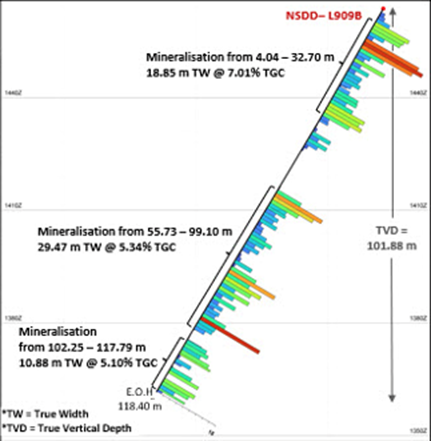
The first deep hole drilled into the Iyan Deposit (L909B) returned continuous graphite mineralisation from 4 metres below surface to the end of hole at ~100 metres.
Key mineralised intervals (True Width):
· 18.85m @ 7.01% TGC from 4.0-32.7m
· 29.47m @ 5.34% TGC from 32.7-62.2m
· 10.88m @ 5.10% TGC from 62.2-73.1m
The hole concluded still in mineralisation, underscoring both the depth continuity and the likelihood of a significantly larger system extending below the current drilling limits.
Significance of the Iyan Discovery
The results from L909B confirm Iyan as a substantial new deposit, with several important implications:
· Not included in the current JORC Resource, so all mineralisation represents direct upside.
· Excellent continuity of grade from near surface to ~100m supports long-life, lower-cost open-pit mining potential.
· Located immediately beside the Northern Syncline, offering operational synergies.
· Interpreted to form the western continuation of the Northern Syncline, indicating a potentially far larger mineralised system.
· Enhances long-term project scale, supporting the Company’s ability to offer multi-decade supply potential to strategic partners.
These early results strongly support the view that Orom-Cross continues to scale into a globally significant graphite project.
Stage 7 Drilling Programme – Ongoing Assays
The remaining deep-hole assays from both Iyan and Beehive, together with results from the extensive shallow drilling completed across the remaining holes within the drill programme, will ultimately be incorporated into updated geological models. These datasets are expected to inform an additional resource upgrade in early 2026.
Executive Chairman Cameron Pearce commented: “These preliminary results from our first deep hole at Iyan have exceeded expectations, both in the exceptionally long intersections and the consistently higher grades returned. The picture emerging at Iyan is of a continuous ore body extending from surface to around 100 metres, and we were still in graphite when drilling stopped so its full depth is yet to be defined.
Iyan is a newly identified deposit named in recognition of local communities, and it represents a significant addition to our resource potential. Together with the Beehive deposit, these two new zones sit alongside Northern Syncline and Camp Lode within our 21-year Mining Licence and close to the proposed plant site.
External geological estimates of 2-3 billion tonnes for Orom-Cross are further supported by these deep-hole results and reinforce the long-term scale of the project as we move toward first production. Over half of the Stage 7 programme comprises shallow holes at Iyan and Beehive and as those results are returned in the coming weeks we expect substantial further newsflow. These new deposits have the potential to materially expand our resource base and may justify another JORC Resource upgrade in 1Q 2026.
Orom-Cross is rapidly emerging as one of the most significant graphite deposits globally, and these results further strengthen our discussions with strategic parties seeking secure, multi-decade supply.”
Preliminary drill results Lyan Deposit
**ENDS**
For further information please contact:
|
Blencowe Resources Plc Sam Quinn |
www.blencoweresourcesplc.com Tel: +44 (0)1624 681 250
|
|
Investor Relations Sasha Sethi |
Tel: +44 (0) 7891 677 441 |
|
Tavira Financial Jonathan Evans |
Tel: +44 (0)20 3192 1733
|
Twitter https://twitter.com/BlencoweRes
LinkedIn https://www.linkedin.com/company/72382491/admin/
Background
Orom-Cross Graphite Project
Orom-Cross is a potential world class graphite project both by size and end-product quality, with a high component of more valuable larger flakes within the deposit.
A 21-year Mining Licence for the project was issued by the Ugandan Government in 2019 following extensive historical work on the deposit and Blencowe has recently completed the Definitive Feasibility Study phase as it drives towards first production.
Orom-Cross presents as a large, shallow open-pitable deposit, with a JORC Indicated & Inferred Mineral Resource deposit of 26.1Mt @ 5.58%TGC and a Mineral Reserve of 23.08Mt at 5.18%TGC (Total Graphite Content). Development of the resource is expected to benefit from a low strip ratio and free dig operations, thereby ensuring lower operating and capital costs.
#GRX GreenX Metals LTD – GreenX Uncovers Historical Estimate at Tannenberg
HIGHLIGHTS
· 1940 Historical Estimate of Significant Scale: Historical Estimate from 1940 identifies 728,000 tonnes contained copper (1,605 Mlbs) at an average grade of 2.6% copper in part of Tannenberg Project licence area discovered from original project data archives
o Estimate based on a 1935-1938 National Socialist Government drilling campaign across four zones: Ronshausen, Hönebach, Wolfsberg and Schnepfenbusch
o Drilling targeted the thin Kupferschiefer horizon only
o Focused only on copper and did not include by-product metals
· 1984 Historical Estimate provides Validation: Independent company St Joe Exploration GmbH conducted limited drilling between 1980 and 1984, further validating the 1940 historical estimate
o Drilling focused on only 28% of the Ronshausen zone but included by-product silver
o Drilling identified up to 3.45m thick mineralisation straddling the Kupferschiefer and the limestone hanging wall and sandstone footwall above and below the Kupferschiefer
o 1984 historical estimate shows consistent grades of 2.1% copper plus 25 g/t silver with 169,000 tonnes of contained copper and 6.5 million ounces of silver
· Exploration Upside Potential under Modern Interpretation: St Joe Exploration confirmed thicker widths of copper and silver mineralisation at Ronshausen, and more may exist up to 30m above and 60m below the Kupferschiefer in the limestone hanging wall and sandstone footwall
o Hypothesis is consistent with modern understanding of the Kupferschiefer deposit model as demonstrated at KGHM’s Polish mining operations which are also found on the same geological structure as the Tannenberg Project
· Active Exploration Program: GreenX is currently relogging and resampling over 4km of archived core from 47 holes to upgrade historical data to modern standards
o Investigation of German mining archives and the digitisation of original historical data continues
o Planning of future twin drilling campaign to verify the historical estimates, and to establish a mineral resource estimate in accordance with the JORC Code (2012) (JORC Code)
· Cautionary statement: The historical estimates in this announcement are not reported in accordance with the JORC Code. A competent person has not done sufficient work to classify the historical estimate as a mineral resource or ore reserve in accordance with the JORC Code. It is uncertain that following evaluation and/or further exploration work that the historical estimate will be able to be reported as a mineral resource or ore reserve in accordance with the JORC Code.
GreenX Metals Limited (ASX:GRX, LSE:GRX, GPW:GRX, Germany-FSE:A3C9JR) (GreenX or Company) is pleased to announce that through its ongoing search of original archive data, the Company has identified a historical estimate of 728,000 contained tonnes of copper (1,605 Mlbs) at an average grade of 2.6% Cu from the Tannenberg Copper Project (Tannenberg or Project) dating from 1940 (1940 historical estimate). The 1940 historical estimate was produced by the German company Mansfeldsche Kupferschieferbergbau AG (Mansfeld AG) and is based on the 95-drill hole exploration campaign carried out during the late 1930s (refer to announcement dated 11 September 2025).
In addition, a later historical estimate from 1984 was produced by St Joe Exploration GmbH (St Joe), which covers a small part of the same area as the 1940 historical estimate (St Joe’s historical estimate).
The St Joe’s historical estimate is based on limited drilling between 1980 and 1984 (refer to announcements dated 2 August 2024 and 28 April 2025). St Joe’s historical estimate provides further validation for the 1940s historical estimate.
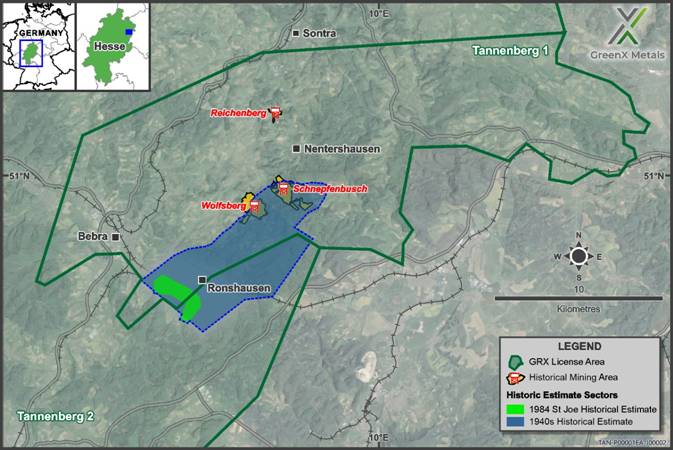
Figure 1: Map showing the location of the zones of the historical estimates and historical mining operations
GreenX’s Chief Executive Officer, Mr Ben Stoikovich, commented: “This represents a significant breakthrough in our archive search and fundamentally supports our exploration hypothesis of the Tannenberg mineral system. It demonstrates that extensive copper mineralisation was identified historically, but exploration at the time was constrained by the prevailing geological model, which focused solely on the thin Kupferschiefer shale and the urgent need to mine given the outbreak of World War II. The 1940 historical estimate, based on a narrow-mineralised interval and excluding by-product silver, was further validated by the 1984 work and modern understanding from Poland’s Kupferschiefer mining operations, together confirming that copper mineralisation extends beyond the Kupferschiefer horizon and providing major proof of concept and clear alignment with GreenX’s geological model. The implications are substantial, reinforcing the potential for a large-scale and high-grade brownfield copper project at Tannenberg, and underscoring the project’s significance as a major European copper opportunity.”
1940 MANSFELD HISTORICAL ESTIMATE
The 1940 historical estimate was calculated by Mansfeld AG according to the relevant German standards applicable during that time. The 1940 historical estimate is based on 18 holes from the 95-hole database generated during the 1935 to 1938 drilling campaign. The original archive document established 728,000 tonnes of contained copper at an average grade of 2.6% copper between the Wolfsberg and Schnepfenbusch mines in the North and the Ronshausen area in the South (Figure 2). The historical estimate covers mineralisation from a depth of 100m in the North to 400m in the Southern end area near Ronshausen.
The 1940 historical estimate covers only the narrow width Kupferschiefer shale mineralisation, which is notable due to the mistaken belief at the time that copper was only present in the distinctive Kupferschiefer shale. Later exploration campaigns have found mineralisation over much wider thicknesses (see 1984 St Joe’s historical estimate section below). This is consistent with GreenX’s exploration hypothesis that historical exploration was mainly based on an outdated deposit model that focused on the 20-60 cm-thick Kupferschiefer shale horizon. The modern understanding of the Kupferschiefer deposit model now shows that up to 95% of mineable copper can be hosted in the footwall sandstone and hanging wall limestone, as evidenced at KGHM Polska Miedź S.A’s Polish mining operations.
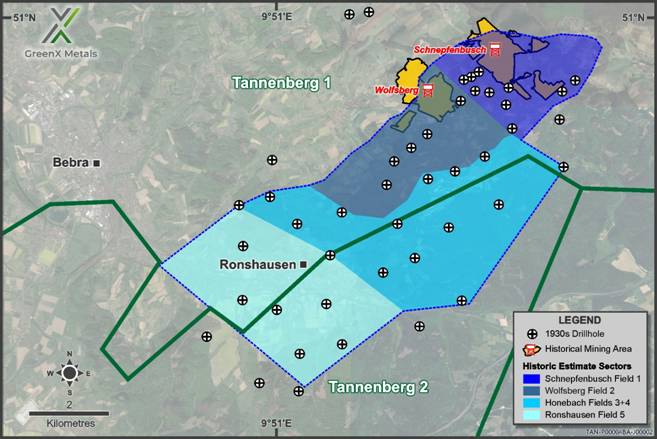
Figure 2: Map showing the locations of the zones of the 1940 historical estimate, related drill holes and historical mining operations
It is also noteworthy that the 1940 historical estimate did not include by-product silver mineralisation. The majority of the mineralisation (463,000 tonnes of contained copper) was found to be present in the Ronshausen region, with gradually decreasing amounts to the North, where the historical mining is to be found (See Table 1).
|
Table 1: Summary of Historical Estimate information from the original 1940 Mansfeld report |
||||
|
Zone |
Surface Area |
Thickness (cm) |
Grade Cu |
Contained Copper |
|
Ronshausen |
10,000,000 |
67.4 |
2.85 |
463,000 |
|
Hönebach |
8,088,000 |
34.2 |
1.92 |
130,055 |
|
Wolfsberg |
6,468,000 |
23.5 |
2.35 |
92,945 |
|
Schnepfenbusch |
5,528,000 |
19.3 |
2.38 |
65,673 |
|
SUB-TOTAL |
|
|
2.59 |
751,673 |
|
Less historical production |
(23,793) |
|||
|
TOTAL |
|
|
|
727,880 |
Cautionary statement: The historical estimates in this announcement are not reported in accordance with the JORC Code. A competent person has not done sufficient work to classify the historical estimate as a mineral resource ore reserve in accordance with the JORC Code. It is uncertain that following evaluation and/or further exploration work that the historical estimate will be able to be reported as a mineral resource ore reserve in accordance with the JORC Code.
The 1940 historical estimate data provides a good level of transparency with regard to the input data and the calculation methods used. The estimation resulting from the drill hole data was cross-checked by Mansfeld AG against the production grades at the Wolfsberg and Schnepfenbusch mines, which were operating in the area at the time of 1940 historical estimate. The comparison was favourable, and hence the assays from the exploration holes were used. GreenX has reviewed original records covering 17 of the 18 holes (~95%) used for the historical estimation and found no discrepancies.
Mansfeld AG made specific adjustments as part of the 1940 historical estimate to account for sterilisation. A total of 250,000 tonnes of contained copper was omitted to account for areas where surface features might prevent mining. Mansfeld AG also estimated that a further 23,793 tonnes of contained copper had already been extracted by mining at Wolfsberg and Schnepfenbusch (at a production grade of 2.2% Copper). This amount was then subtracted from the historical estimate, as presented in the original source document (refer Table 1 above).
1984 ST JOE’S HISTORICAL ESTIMATE
Part of the Ronshausen zone of the 1940 historical estimate was drilled by St Joe Exploration during the 1980’s, resulting in recognition of the St Joe’s historical estimate more than 40 years later. Of the many holes drilled by St Joe, a total of 14 holes were used in the estimate of 169,000 of contained copper and 6.5 million ounces of contained silver. The St Joe’s work estimated grades of 2.1 % copper and 25 g/t silver at typical depths between 290 and 370m (Figure 3).
St Joe benefited from both technological advancements and enhanced geological understanding in the 40 years following the work by Mansfeld AG. Consequently, St Joe assayed wider intersections and found that the mineralisation was up to 3.45m width. The historical estimate was calculated using thicknesses of between 1.5 to 2m, considerably thicker than the narrow Kupferschiefer assayed and estimated by Mansfeld AG in 1940.
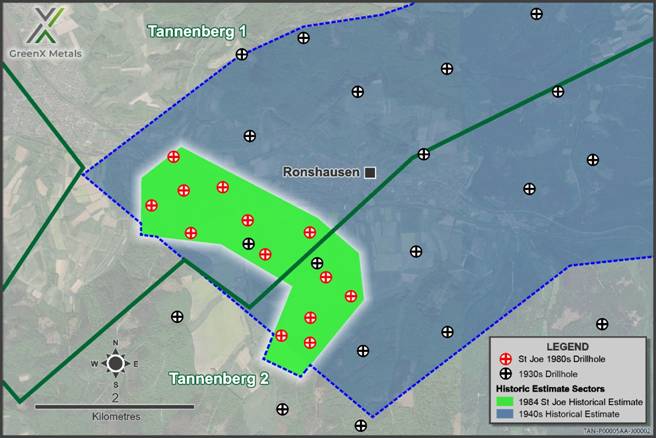
Figure 3: Map showing the drill holes and locations of the Ronshausen zone of the 1940 historical estimate and the relative location of the 1984 St Joe’s historical estimate
Given the increased mineralisation thickness covered by St Joe and the fact that the drilling covered only 28% of the Ronshausen zone, the St Joe’s historical estimate further validates the 1940 historical estimate. The identification of much thicker mineralisation and contained silver also points to considerable exploration upside over all five mineralisation zones covered by the 1940 historical estimate.
Cautionary statement: The historical estimates in this announcement are not reported in accordance with the JORC Code. A competent person has not done sufficient work to classify the historical estimate as a mineral resource or ore reserve in accordance with the JORC Code. It is uncertain that following evaluation and/or further exploration work that the historical estimate will be able to be reported as a mineral resource or ore reserve in accordance with the JORC Code.
1930s DRILLING CAMPAIGN
The 18 holes used in the 1940 historical estimate were drilled between 1935 and 1938 (Figure 4). The southern holes tested the downdip continuation of known Kupferschiefer mining sites from the mid-1800s and led to the opening of the Wolfsberg and Schnepfenbusch mines. In the northern area, the drilling discovered previously unknown down-faulted Kupferschiefer that does not outcrop and had not been previously exploited. This discovery led to the opening of the Reichenberg mine.
GreenX recently found the majority of the relevant original records of these drill holes in a regional archive. To date, of the 95 holes indicated to exist in the 1930s database, the Company has found logs for 43 holes, and of those, original historical assay results have been found for 35 holes. GreenX is continuing the archive search whilst digitising the records to add to the geological database for the Project.
Drilling up to 95 holes today is estimated to cost over €25 million and take several years, given modern permitting requirements. The discovery of the original historical drill database and 1940 historical estimate not only represents a significant saving in both time and money for GreenX, but it also provides valuable data points for its current exploration work program, including exploration targeting and 3D modelling. Combined with the 47 drill cores GreenX is currently re-logging and sampling (Figure 4), the quantity of previous exploration data available at Tannenberg is quickly growing, and underscores Tannenberg as a significant brownfield exploration opportunity.
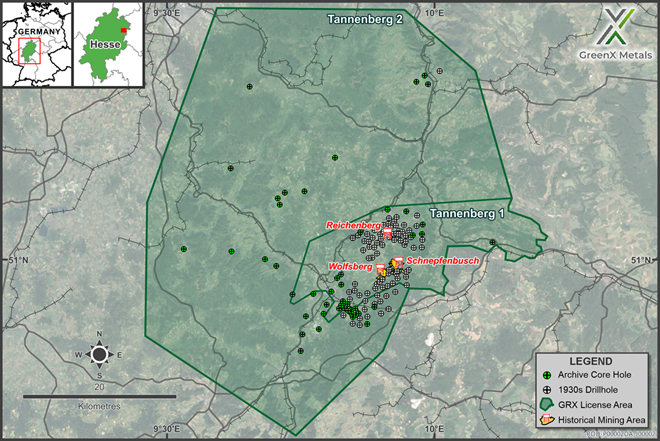
Figure 4: Location Map of GreenX’s Tannenberg project area showing the newly discovered 95 x 1930s drillholes, the location of the three underground copper/ silver mines opened during the late 1930s, and the location of the modern era 47 archive core holes that GreenX now has access to for re-logging and sampling
Upcoming Work Programs
The discovery of this historical estimate and the National Socialist era drill database is part of the Company’s continued search for original historical mining and production data in German archives, which are part of a broader exploration program at Tannenberg, which includes:
· Logging, assaying, and hyperspectral scanning of historical core (ongoing);
· Reprocessing and analysis of historical geophysical data (ongoing);
· Collation of historical geological, mine development, and production data (ongoing); and
· Airborne magnetic and radiometric survey (results released in September 2025)
In light of the discovery of this significant upgrade in the understanding of the Tannenberg mineralisation, GreenX is planning a future twin drilling campaign to verify the historical estimates, in order to establish a mineral resource estimate in accordance with the JORC Code.
ENQUIRIES
|
+44 207 478 3900 ir@greenxmetals.com |
Sapan Ghai Chief Commercial Officer – UK
|
|
Kim Eckhof Investor Relations – UK / Germany
|
Kazimierz Chojna Investor Relations – Poland
|
Competent Person Statement – HISTORICAL Estimate
The information in this announcement that relates to historical estimates is based on information reviewed and compiled by Dr Matt Jackson, a Competent Person who is a member of the Australian Institute of Mining and Metallurgy. Dr Jackson is a Technical Consultant for GreenX and is a holder of unlisted options in the Company. Dr Jackson has sufficient experience that is relevant to the style of mineralisation and type of deposit under consideration and to the activity being undertaken, to qualify as a Competent Person as defined in the 2012 Edition of the ‘Australasian Code for Reporting of Exploration Results, Mineral Resources and Ore Reserves’. Dr Jackson consents to the inclusion in this announcement of the matters based on his information in the form and context in which it appears. Dr Jackson confirms that the information provided under ASX Listing Rules 5.12.2 to 5.12.7 is an accurate representation of the available data and studies relating to the Tannenberg Copper Project.
Forward Looking Statements
This release may include forward-looking statements, which may be identified by words such as “expects”, “anticipates”, “believes”, “projects”, “plans”, and similar expressions. These forward-looking statements are based on GreenX’s expectations and beliefs concerning future events. Forward looking statements are necessarily subject to risks, uncertainties and other factors, many of which are outside the control of GreenX, which could cause actual results to differ materially from such statements. There can be no assurance that forward-looking statements will prove to be correct. GreenX makes no undertaking to subsequently update or revise the forward-looking statements made in this release, to reflect the circumstances or events after the date of that release.
The information contained within this announcement is deemed to constitute inside information as stipulated under the Regulation 2014/596/EU which is part of domestic law pursuant to the Market Abuse (Amendment) (EU Exit) Regulations (SI 2019/310) (“UK MAR”). By the publication of this announcement via a Regulatory Information Service, this inside information (as defined in UK MAR) is now considered to be in the public domain.
REFERENCES
Mansfeldsche Kupferschieferbergbau AG. (1940). On the development of the Richelsdorf area. In German. State archive of Saxony Anhalt Region (Merseburg)*
St Joe Exploration GMBH. (1984) A Final report on the activities of St Joe Explorations GMBH in the Kupferschiefer project, Richelsdorf 1984. Archive No 17. PO BOX, 5780, 3000 Hannover 1.*
*English translation of the original source document
SCHEDULE 1 – HISTORICAL ESTIMATE
Details of Non-JORC Historical Estimates in relation to ASX Listing Rule Chapter 5
Listing Rules 5.10 to 5.12: Requirements applicable to reports of historical estimates of mineralisation for material mining projects:
|
5.10 – An entity reporting historical estimates or foreign estimates of mineralisation in relation to a material mining project to the public is not required to comply with rule 5.6 of the JORC Code) provided the entity complies with rules 5.12, 5.13 and 5.14 |
For the Non-JORC historical estimate included in this market release, GreenX is not required to comply with Listing Rule 5.6 of the JORC Code as all relevant and requested disclosures are stated in this announcement and tabulated below. The Company complies with Listing Rule 5.12 requirements for the statement of Non-JORC historical estimates, as discussed below. |
|
5.11- An entity must not include historical estimates or foreign estimates (other than qualifying historic estimates) of mineralisation in an economic analysis (including a scoping study, preliminary feasibility study, or a feasibility study) of the entity’s mineral resources and ore reserves holdings. |
GreenX is not applying any economic analysis or commentary to the historical estimates in this Announcement. The historical estimates should not be relied upon for any economic evaluation. |
|
5.12 – Subject to rule 5.13, an entity reporting historical estimates or foreign estimates of mineralisation in relation to a material mining project must include all of the following information in a market announcement and give it to ASX for release to the market: |
|
|
5.12.1 – The source and date of the historical estimates or foreign estimates. |
On the 2 January 1940 a historical estimate was estimated by Mansfeldsche Kupferschieferbergbau AG (Mansfeld AG). The original source document was discovered by GreenX in the archive of the Saxony Anhalt Region of Germany located in Merseburg. In 1984, a historical estimate was created by St Joe Explorations GMBH. The original source document was found in archives of the Hessian Agency for Nature Conservation, Environment and Geology. The original data (drillhole logs and assays) for the historic estimates were found across various mining archives in Germany. |
|
5.12.2 – Whether the historical estimates or foreign estimates use categories of mineralisation other than those defined in Appendix 5A (JORC Code) and if so, an explanation of the differences. |
No resource category or reporting code was quoted as the practice of the reporting codes was only introduced in Germany in the 1990’s and common practice from the 2000’s onwards.. The 1984 St Joe’s historical estimate uses categories which were not used in this announcement to avoid inadvertent comparison with similar terms used in the JORC Code. The historical estimate figures used in this announcement are referred to by St Joe as “geological reserve” whereas in accordance with the JORC Code, the term “reserve” could only be used after quantitative assessment of modifying factors. The historical estimates were made prior to the JORC Code reporting guidelines being formulated and do not conform to the requirements in the JORC Code. |
|
5.12.3 – The relevance and materiality of the historical estimates or foreign estimates to the entity. |
The historical estimates are both material and relevant to the Tannenberg Project and Company, as they indicate the project’s scale while supporting the view that further exploration is warranted to evaluate the mineralisation in accordance with the JORC Code. Further, the historical estimate for the Tannenberg Project lie within the Tannenberg 1 and Tannenberg 2 exploration licences and are relevant to understanding the extent of mineralisation and copper grades present at the project. The original historical estimate documents also detail the results of an exploration program and historical estimates that were used to justify the establishment of mining operations in the 1940s. The information is material due to GreenX’s statutory obligation to release information that affects the understanding and prospectivity of the Tannenberg Project and any potential unmined mineralisation present. The information gained will be central to guiding future mineral exploration to develop the project. |
|
5.12.4 – The reliability of the historical estimates or foreign estimates, including by reference to any of the criteria in Table 1 of Appendix 5A (JORC Code) which are relevant to understanding the reliability of the historical estimates or foreign estimates. |
The historical estimates are not reported in accordance with the JORC Code. A competent person has not completed sufficient work to classify the historical estimates as a Mineral Resource Estimate in accordance with JORC Code 2012. The Estimates were made prior to the JORC Code 2012 reporting guidelines being formulated and do not conform to the requirements in the JORC Code 2012. Of the 18 holes used for the 1940 historical estimate, GreenX has found details of 17 holes and assays in various archives across Germany. These independently identified records confirm the grades and locations used in the estimate. The 1940 historical estimate validated the drill hole grades used in the estimate by comparing them with production grades from the Schnepfenbusch and Wolfsberg mining operations. The comparisons were favourable and confirmed the grades used in the historical estimate. A map of the 1940 historical estimate zones was reportedly attached to the original document, this has not been found by GreenX. GreenX has independently calculated the surface area of each of the estimate zones based on drill hole locations and the text description and the results match the estimation work performed in 1940. The German language 1940 estimate was translated by an online translation tool and was separately read and summarised by a specialist native German speaker. The human German speaker was not aware of the online translation. Both summaries were independent of each other and all key facts matched. The Company has completed a Table 1 of Appendix 5A (JORC Code) which are relevant to understanding the reliability of the historical estimates. Please refer below. GreenX is not treating the historical estimates as a Mineral Resource Estimate or Ore Reserve and considers the historical estimates to represent an exploration project that requires verification. However, nothing has come to the attention of the Company or the Competent Person that causes it to question the accuracy or reliability of the historical estimate and it is on this basis that the Company and Competent Person consider the historical estimates to be reliable. However, the Company and Competent Person has not independently validated the historical estimates and therefore is not to be regarded as reporting, adopting or endorsing the historical estimate. It is possible that following evaluation and/or further exploration work the currently reported historical estimates may materially change and at this point the Company will need to be update the reporting in accordance with the JORC Code (or it may never become reportable at all in accordance with the JORC Code). |
|
5.12.5 – To the extent known, a summary of the work programs on which the historical estimates or foreign estimates are based and a summary of the key assumptions, mining and processing parameters and methods used to prepare the historical estimates or foreign estimates. |
Refer to the “1930’s drilling campaign” and 1984 St Joe’s historical estimate sections of this announcement. The 1940 historical estimate were based on 18 drill-holes completed in the late 1930’s. The 1984 St Joe’s historical estimate was based on 16 drill-holes in the early 1980’s. The collar locations are indicated on the map in the main body of the announcement. No cut-off grade was used and this was believed to be appropriate because as the estimate covers only a very narrow portion of the known mineralisation with sharp grade boundaries. Additionally, the drill holes were only sampled in the very narrow portion of the copper mineralised Kupferschifer shale.
|
|
5.12.6 – Any more recent estimates or data relevant to the reported mineralisation available to the entity. |
Some additional holes were drilled by Mansfeld AG which were not used in the 1940 historical estimate because they were drilled after the publication of the estimate. GreenX has access to only part of the information for these holes and they are all believed to have results that confirm the estimate. The 1940 historical estimate was validated within the Ronshausen (Field 5) area by the later 1984 St Joe historical estimate. There are sufficient similarities between both the grade and tonnage of each of the estimates to justify confidence in the 1940 Mansfeld AS historical estimate. |
|
5.12.7 – The evaluation and/or exploration work that needs to be completed to verify the historical estimates or foreign estimates as mineral resources or ore reserves in accordance with Appendix 5A (JORC Code) |
The Company plans to take the following next steps to further seek to verify the historical estimates identified at Tannenberg: · Relogging and sampling of archived drill core (underway at the time of writing) · Further review and validation of historical data. · Twinning (repeat drilling) of certain holes. · Mineral Resource Estimation and reporting according to best practice and the JORC Code. There is no certainty that further exploration work will result in the historical estimate being reported in accordance with the JORC Code. |
|
5.12.8 – The proposed timing of any evaluation and/or exploration work that the entity intends to undertake and a comment on how the entity intends to fund that work. |
The Company expects to complete the next steps identified above in the following 12 months. GreenX currently has cash reserves of approximately $3.7 million (30 September 2025 – unaudited). |
|
5.12.9 – A cautionary statement proximate to, and with equal prominence as, the reported historical estimates or foreign estimates stating that: the estimates are historical estimates or foreign estimates and are not reported in accordance with the JORC Code; a competent person has not done sufficient work to classify the historical estimates or foreign estimates as mineral resources or ore reserves in accordance with the JORC Code; and it is uncertain that following evaluation and/or further exploration work that the historical estimates or foreign estimates will be able to be reported as mineral resources or ore reserves in accordance with the JORC Code |
A cautionary statement, proximate to, and with equal prominence as, the reported historical estimates has been stated on pages 1, 4 and 5 of this announcement. |
|
5.12.10 – A statement by a named competent person or persons that the information in the market announcement provided under rules 5.12.2 to 5.12.7 is an accurate representation of the available data and studies for the material mining project. The statement must include the information referred to in rule 5.22(b) and (c). |
A statement by a named competent person is included on page 7 of this announcement. |
JORC Code, 2012 Edition – Table 1 Report
Section 1 Sampling Techniques and Data
(Criteria in this section apply to all succeeding sections.)
|
Criteria |
JORC Code explanation |
Commentary |
|
Sampling techniques |
Nature and quality of sampling (eg cut channels, random chips, or specific specialised industry standard measurement tools appropriate to the minerals under investigation, such as down hole gamma sondes, or handheld XRF instruments, etc). These examples should not be taken as limiting the broad meaning of sampling. |
Due to the historic nature of the drilling results reported herein, it is not possible to comment on the quality of the sampling used to produce the results described. It is known from historic reports that the drill core was sawn. Sampling of ¼ core was conducted during multiple exploration phases between 1980 and 1987 within the licence area by St Joe. The information shown here was collated from original hard copy reports from that era and a State Survey Database. Assays, geological logging and gamma ray logs were conducted by St Joes Exploration and Mansfeld AG. No other information is available for the exploration drilling. |
|
|
Include reference to measures taken to ensure sample representivity and the appropriate calibration of any measurement tools or systems used. |
No details covering the representivity of the samples for the 1940 or 1984 estimate were included. Verification of the exploration assays was carried out by Masfeld AG against production grades from Wolfsberg and Schnepfenbusch production grades
|
|
|
Aspects of the determination of mineralisation that are Material to the Public Report. In cases where ‘industry standard’ work has been done this would be relatively simple (eg ‘reverse circulation drilling was used to obtain 1 m samples from which 3 kg was pulverised to produce a 30 g charge for fire assay’). In other cases more explanation may be required, such as where there is coarse gold that has inherent sampling problems. Unusual commodities or mineralisation types (eg submarine nodules) may warrant disclosure of detailed information. |
Work was not conducted to modern industry standards. |
|
Drilling techniques |
Drill type (eg core, reverse circulation, open-hole hammer, rotary air blast, auger, Bangka, sonic, etc) and details (eg core diameter, triple or standard tube, depth of diamond tails, face-sampling bit or other type, whether core is oriented and if so, by what method, etc). |
St Joes Exploration · 10 cm drill cores were collected, further specifications are not known. National Socialist Drilling (1930’s) · Unknown drilling techniques. |
|
Drill sample recovery |
Method of recording and assessing core and chip sample recoveries and results assessed.
|
Due to the historic nature of the drilling results reported herein, it is not possible to comment on the recoveries achieved at the time. |
|
|
Measures taken to maximise sample recovery and ensure representative nature of the samples. |
Not reported. |
|
|
Whether a relationship exists between sample recovery and grade and whether sample bias may have occurred due to preferential loss/gain of fine/coarse material. |
Not reported. |
|
Logging |
Whether core and chip samples have been geologically and geotechnically logged to a level of detail to support appropriate Mineral Resource estimation, mining studies and metallurgical studies. |
N/A, JORC Mineral Resources not reported. |
|
|
Whether logging is qualitative or quantitative in nature. Core (or costean, channel, etc) photography. |
Available logs are qualitative only. |
|
|
The total length and percentage of the relevant intersections logged. |
The entire hole was logged, the target zone is typically 2 m thick. |
|
Sub-sampling techniques |
If core, whether cut or sawn and whether quarter, half or all core taken. |
St Joe · A reference to ¼ core is reported however this is not specific to every hole/phase. National Socialist Drilling (1930’s) · Unknown sub sampling techniques.
|
|
and sample preparation |
If non-core, whether riffled, tube sampled, rotary split, etc and whether sampled wet or dry. |
Not reported. |
|
|
For all sample types, the nature, quality and appropriateness of the sample preparation technique. |
Not reported. |
|
|
Quality control procedures adopted for all sub-sampling stages to maximise representivity of samples. |
Not reported. |
|
|
Measures taken to ensure that the sampling is representative of the in situ material collected, including for instance results for field duplicate/second-half sampling. |
Not reported. |
|
|
Whether sample sizes are appropriate to the grain size of the material being sampled. |
Not reported. |
|
Quality of assay data and laboratory tests |
The nature, quality and appropriateness of the assaying and laboratory procedures used and whether the technique is considered partial or total. |
St Joe · Geochemical analysis was carried out by Robertson Research Ltd, Wales, however the precise nature quality and appropriateness of the assaying is unknown.
National Socialist Drilling (1930’s) · The precise nature quality and appropriateness of the assaying is unknown.
|
|
|
For geophysical tools, spectrometers, handheld XRF instruments, etc, the parameters used in determining the analysis including instrument make and model, reading times, calibrations factors applied and their derivation, etc. |
N/A |
|
|
Nature of quality control procedures adopted (eg standards, blanks, duplicates, external laboratory checks) and whether acceptable levels of accuracy (ie lack of bias) and precision have been established. |
N/A |
|
Verification of sampling and assaying |
The verification of significant intersections by either independent or alternative company personnel.
|
St Joe · No verification carried out.
National Socialist Drilling (1930’s) · Verification carried out by Masfeld AG against production grades from Wolfsberg and Schnepfenbusch production grades
|
|
|
The use of twinned holes. |
No twinned holes. |
|
|
Documentation of primary data, data entry procedures, data verification, data storage (physical and electronic) protocols. |
St Joe · No verification carried out.
National Socialist Drilling (1930’s) · Verification carried out by checking drilling data used in the 1940 original document and the 1930’s original drilling data.
|
|
|
Discuss any adjustment to assay data. |
No adjustments made. |
|
Location of data points |
Accuracy and quality of surveys used to locate drill holes (collar and down-hole surveys), trenches, mine workings and other locations used in Mineral Resource estimation. |
Location accuracy is unknown. The location of holes drilled by St Joes Exploration comes from collar tables in historical reports. All other collar locations come from State/Federal databases. |
|
|
Specification of the grid system used. |
St Joe · Latitude and Longitude in degree, minutes and seconds were provided by St Joes Exploration.
National Socialist Drilling (1930’s) · All drill collar coordinates are reported here in the DHDN / 3-degree Gauss-Kruger zone 4 grid system.
|
|
|
Quality and adequacy of topographic control. |
Unknown |
|
Data spacing and distribution |
Data spacing for reporting of Exploration Results. |
St Joe · Between 400 to 700m
National Socialist Drilling (1930’s) · Between 500 to 1500m |
|
|
Whether the data spacing and distribution is sufficient to establish the degree of geological and grade continuity appropriate for the Mineral Resource and Ore Reserve estimation procedure(s) and classifications applied. |
N/A, JORC Mineral Resources not reported. |
|
|
Whether sample compositing has been applied. |
No compositing applied |
|
Orientation of data in relation to geological structure |
Whether the orientation of sampling achieves unbiased sampling of possible structures and the extent to which this is known, considering the deposit type. |
The target Kupferschiefer layer is flat to slightly dipping, vertical drilling therefore intercepts at right angles and is appropriate. |
|
|
If the relationship between the drilling orientation and the orientation of key mineralised structures is considered to have introduced a sampling bias, this should be assessed and reported if material. |
No sampling bias introduced by intersection angles. |
|
Sample security |
The measures taken to ensure sample security. |
N/A |
|
Audits or reviews |
The results of any audits or reviews of sampling techniques and data. |
N/A |
Section 2 Reporting of Exploration Results
(Criteria in the preceding section also apply to this section.)
|
Criteria |
JORC Code explanation |
Commentary |
|
|
Mineral tenement and land tenure status |
Type, reference name/number, location and ownership including agreements or material issues with third parties such as joint ventures, partnerships, overriding royalties, native title interests, historical sites, wilderness or national park and environmental settings. |
The Tannenberg 1 licence is held 100% by Group 11 Exploration GmbH. The licences were awarded on the 6th June 2025 for three years and has now been extended for a further three years to 6 June 2028. The licence is free from overriding royalties and native titles interests. There are historical mine workings within the licence area, but no known historical sites of cultural significance outside of mining. The Tannenberg 2 exploration licence is held 100% by Group 11 Exploration GmbH. The licence was granted effective 22 April 2025 and is valid for three years also until 6 June 2028.
Within and surrounding both licence areas, there are environmental protections zones with differing levels of protections. There are small areas identified as Natura 2000 Fauna Flora Habitat Areas and Bird Sanctuaries. Other environmental protection designated areas include Nature Reserves, National Natural Monuments, Landscape Protection Area, and Natural Parks. Based on due diligence and discussions with various stakeholders and consultants, the presence of environmental protection areas does not preclude exploration or eventual mining if conducted in accordance with applicable standards and regulations.
The landform across the license area comprises mostly of farmland, forested areas, and small towns and villages. |
|
|
|
The security of the tenure held at the time of reporting along with any known impediments to obtaining a licence to operate in the area. |
The licences are in good standing. |
|
|
Exploration done by other parties |
Acknowledgment and appraisal of exploration by other parties. |
Exploration was carried out by St Joes Exploration (in JV with the Broken Hill Pty Co Ltd later a major global mining company) between 1980 and 1987. Two projects were undertaken. The Richelsdorf project within the licence area as well as the Spessart-Rhoen project 85 km to the south. Hole IDs starting with ‘Ro’ were drilled by St Joes Exploration.
Exploration in the 1930’s was carried out by Manfeld AG and resulted in 95 drill holes which were used to establish 3 mines in the area, with recommendations for the opening of a further 2 which never materialised.
Historical mining took place within the licence area. Mining activities ceased in the 1950’s. |
|
|
Geology |
Deposit type, geological setting and style of mineralisation. |
Mineralisation is of the classic Kupferschiefer type (copper slate) within the Permian Zechstein Basin of Germany and Poland. The Zechstein Basin is hosted within the Southern Permian Basin (“SPB”) of Europe. The SPB is an intracontinental basin that developed on the northern foreland of the Variscan Orogen. Very high-grade copper mineralisation is generally associated with the Kupferschiefer shale unit. However, minable copper mineralisation also occurs in the footwall sandstone and hanging wall limestone units in Poland. Mineralisation can be offset from the shale by up to 30 m above and 60 m below. |
|
|
Drill hole Information |
A summary of all information material to the understanding of the exploration results including a tabulation of the following information for all Material drill holes: easting and northing of the drill hole collar elevation or RL (Reduced Level – elevation above sea level in metres) of the drill hole collar dip and azimuth of the hole down hole length and interception depth hole length. |
N/A. Exploration drilling results not being reported. |
|
|
|
If the exclusion of this information is justified on the basis that the information is not Material and this exclusion does not detract from the understanding of the report, the Competent Person should clearly explain why this is the case. |
N/A. Exploration drilling results not being reported. |
|
|
Data aggregation methods |
In reporting Exploration Results, weighting averaging techniques, maximum and/or minimum grade truncations (eg cutting of high grades) and cut-off grades are usually Material and should be stated. |
N/A. Exploration drilling results not being reported. |
|
|
|
Where aggregate intercepts incorporate short lengths of high grade results and longer lengths of low grade results, the procedure used for such aggregation should be stated and some typical examples of such aggregations should be shown in detail. |
N/A. Exploration drilling results not being reported. |
|
|
|
The assumptions used for any reporting of metal equivalent values should be clearly stated. |
N/A |
|
|
Relationship between mineralisation widths and intercept lengths |
These relationships are particularly important in the reporting of Exploration Results. If the geometry of the mineralisation with respect to the drill hole angle is known, its nature should be reported. |
Drilling is perpendicular to mineralisation. Detailed sampling was done to lithological contacts on a range of scales from 1-50cm. |
|
|
|
If it is not known and only the down hole lengths are reported, there should be a clear statement to this effect (eg ‘down hole length, true width not known’). |
N/A. Exploration drilling results not being reported. |
|
|
Diagrams |
Appropriate maps and sections (with scales) and tabulations of intercepts should be included for any significant discovery being reported These should include, but not be limited to a plan view of drill hole collar locations and appropriate sectional views. |
N/A. Exploration drilling results not being reported. |
|
|
Balanced reporting |
Where comprehensive reporting of all Exploration Results is not practicable, representative reporting of both low and high grades and/or widths should be practiced to avoid misleading reporting of Exploration Results. |
N/A. Exploration drilling results not being reported. |
|
|
Other substantive exploration data |
Other exploration data, if meaningful and material, should be reported including (but not limited to): geological observations; geophysical survey results; geochemical survey results; bulk samples – size and method of treatment; metallurgical test results; bulk density, groundwater, geotechnical and rock characteristics; potential deleterious or contaminating substances. |
All substantive results are reported. Geological logs and downhole gamma logs are not reported here. |
|
|
Further work |
The nature and scale of planned further work (eg tests for lateral extensions or depth extensions or large-scale step-out drilling). |
The Company plans to take the following next steps to further seek to verify the historical estimates identified at Tannenberg: · Relogging and sampling of archived drill core (underway at the time of writing) · Further review and validation of historical data. · Twinning (repeat drilling) of certain holes. · Mineral Resource Estimation and reporting according to best practice and the JORC Code. There is no certainty that further exploration work will result in the historical estimate being reported in accordance with the JORC Code. |
|
|
|
Diagrams clearly highlighting the areas of possible extensions, including the main geological interpretations and future drilling areas, provided this information is not commercially sensitive. |
These diagrams are included in the main body of this release. |
|
Section 3 Estimation and Reporting of Mineral Resources
Given the Company is reporting non-JORC historical estimates, further exploration and evaluation activities are required to be completed to verify the historical estimates as mineral resources in accordance the JORC Code. Accordingly, the Company cannot complete the Section 3 Estimation and Reporting of Mineral Resources JORC table until a mineral resource estimate can be verified and estimated. There is no certainty that further exploration work will result in the historical estimate being reported in accordance with the JORC Code.