
Home » URU Metals (URU)
Category Archives: URU Metals (URU)
#URU URU Metals Ltd – Zeb Nickel Project 3D Modelling
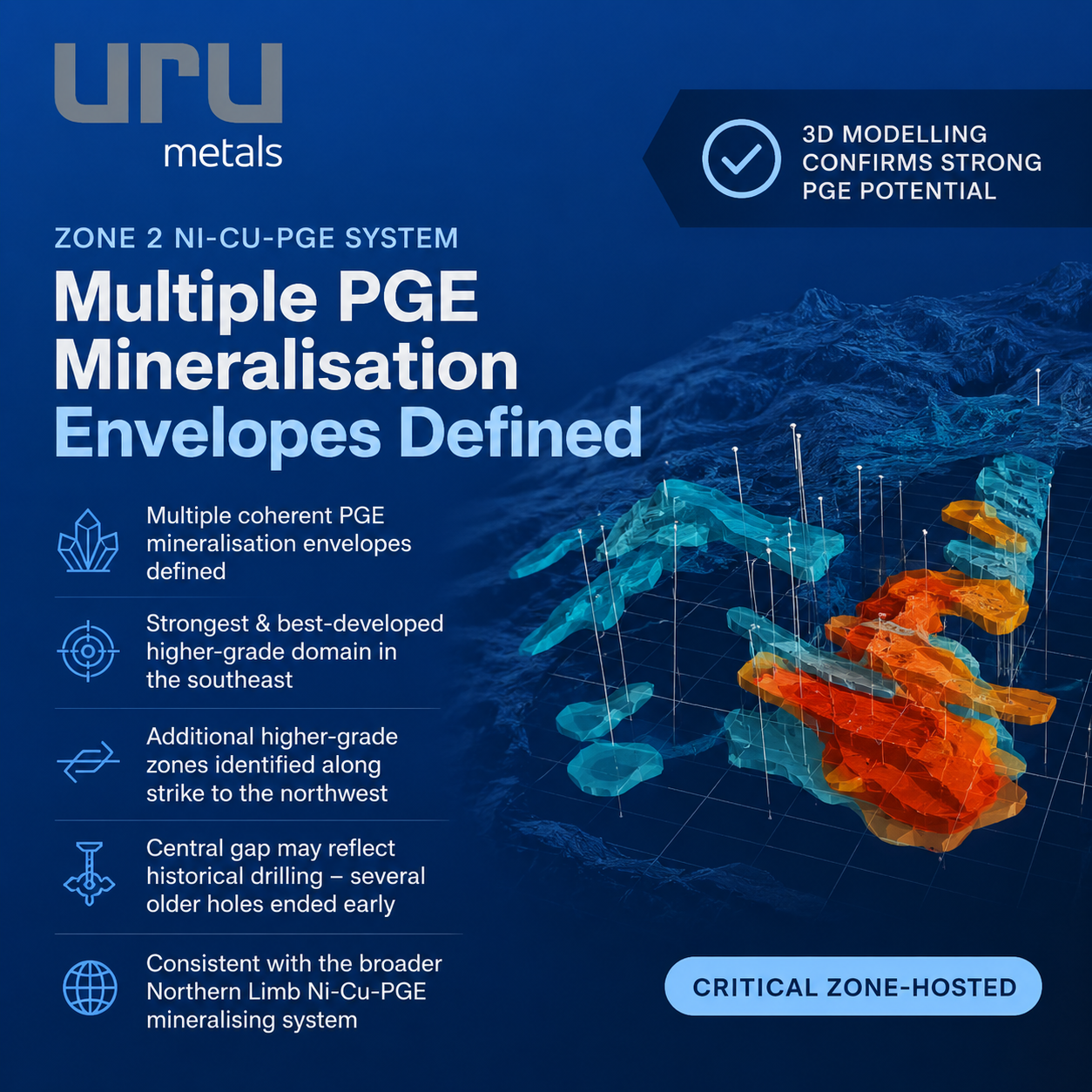 URU Metals Limited (“URU” or the “Company”) is pleased to provide a further update on the ongoing 3D geological modelling programme at the Zeb Nickel Project in Limpopo, South Africa.
Atticus Geoscience has now completed the first stage of 3D mineralisation modelling of the Project’s Zone 2 Ni-Cu-PGE system using historical and recent drill hole data.
The modelling has defined multiple coherent PGE mineralisation envelopes within the Critical Zone rocks and has highlighted a well-developed higher-grade mineralised domain in the southeast of the Project, together with further mineralised zones extending along strike towards the northwest.
Highlights
· 3D modelling has defined multiple coherent PGE mineralisation envelopes within the Critical Zone-hosted Zone 2 Ni-Cu-PGE system.
· The mineralisation is hosted predominantly within the Critical Zone pyroxenitic package.
· The strongest and best-developed higher-grade mineralised domain occurs in the southeast of the Project area, where drilling density is also greatest.
· Additional higher-grade mineralised zones have been identified along strike towards the northwest.
· The apparent break in mineralisation through parts of the central area may reflect the historical drilling pattern, as several older boreholes terminated before reaching the Critical Zone.
· The geological setting and style of Zone 2 mineralisation are consistent with the broader Northern Limb Ni-Cu-PGE mineralising system represented by Ivanhoe Mines’ Platreef Mine and Valterra Platinum’s Mogalakwena Mining Complex.
· The higher-grade mineralisation lies close to the interpreted chonolith and conduit system between the Uitloop I and Uitloop II ultramafic bodies.
· This relationship provides an important exploration vector, as repeated magma flow through the interpreted plumbing system may have created favourable conditions for sulphide saturation and concentration of Ni-Cu-PGE mineralisation.
· Future drilling will initially focus on the better-developed higher-grade areas in the southeast, with the aim of generating sufficient drilling to support a maiden mineral resource for Zone 2.
· Subsequent step-out drilling will test the central area and the possible continuity between the southeastern and northwestern mineralised domains.
· Ground FDEM Target 1 remains a separate high-priority drill target for semi-massive to massive sulphides within the interpreted chonolith system.
Zone 2 Mineralisation Model
Atticus has used the available Pt, Pd and Rh assay data to construct three-dimensional mineralisation envelopes through the Zone 2 Critical Zone.
For modelling purposes, a 3PGE grade of 0.08 g/t Pt+Pd+Rh was used to define the broader mineralised envelope, while 0.5 g/t 3PGE was used to identify the higher-grade mineralised population. These thresholds are modelling parameters and are not mineral resource cut-off grades.
The resulting model shows that Zone 2 mineralisation is concentrated predominantly within the Critical Zone pyroxenitic package and associated Marginal Facies.
The higher-grade mineralisation is best developed in the southeastern part of the Project, where the current drilling density is greatest. Additional higher-grade mineralised areas occur along strike towards the northwest.
Importantly, the apparent reduction in mineralisation through parts of the central area may not represent a genuine geological break. Several historical boreholes in this area terminated before reaching the interpreted Critical Zone, leaving a material portion of the prospective horizon effectively untested.
The southeastern area also contains the highest PGE grades currently represented in the model, with drilling having intersected grades of up to approximately 6 g/t 3PGE+Au.
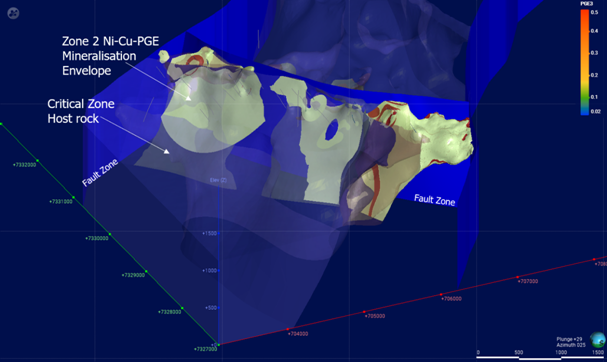
Figure 1: PGE mineralisation envelopes within the Critical Zone rocks.
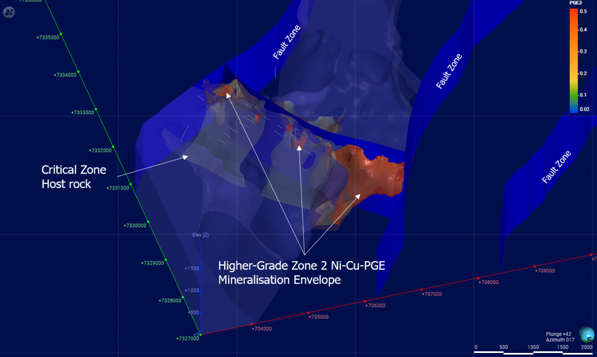
Figure 2: PGE mineralisation envelopes within the Critical Zone rocks, showing a well-developed higher-grade mineralised domain in the southeastern part of the Project area.
Northern Limb Context
The style of Zone 2 mineralisation being modelled at Zeb is consistent with the broader Ni-Cu-PGE mineralising environment of the Northern Limb of the Bushveld Complex.
Approximately the same regional geological package hosts Ivanhoe Mines’ Platreef deposit and Valterra Platinum’s Mogalakwena Mining Complex, both of which contain substantial PGM mineralisation with associated nickel and copper within thick, pyroxenite-rich intrusive sequences.
Ivanhoe describes the Platreef mineralised sequence as comprising norite, pyroxenite and harzburgite, with its principal mineralised units correlated with the Upper Critical Zone of the Bushveld Complex. At Mogalakwena, Valterra describes the Platreef as a thick, heterogeneous mafic package dominated by pyroxenite and norite, with significant nickel and copper associated with the PGM mineralisation.
URU has previously highlighted the similarity between these Northern Limb mineralisation styles and the Critical Zone-hosted Ni-Cu-PGE mineralisation intersected at Zeb. The new 3D modelling strengthens this interpretation by demonstrating coherent mineralised envelopes within the Critical Zone pyroxenitic package rather than isolated mineralised drill intersections.
Relationship to the Chonolith System
A further important outcome of the modelling is the spatial relationship between the higher-grade Zone 2 mineralisation and the interpreted chonolith and conduit system between the Uitloop I and Uitloop II ultramafic bodies.
The higher-grade mineralised envelopes occur relatively close to these interpreted intrusive conduits.
This is consistent with the Company’s broader geological model for Zeb. Repeated or sustained magma flow through a chonolith-style plumbing system may have promoted sulphide saturation and provided favourable conditions for the development and concentration of Ni-Cu-PGE mineralisation.
The relationship between the mineralised envelopes and the interpreted plumbing system gives the Company an additional geological vector for future drilling and will be considered together with the airborne and ground EM responses, gravity and magnetic data and the 3D intrusive model.
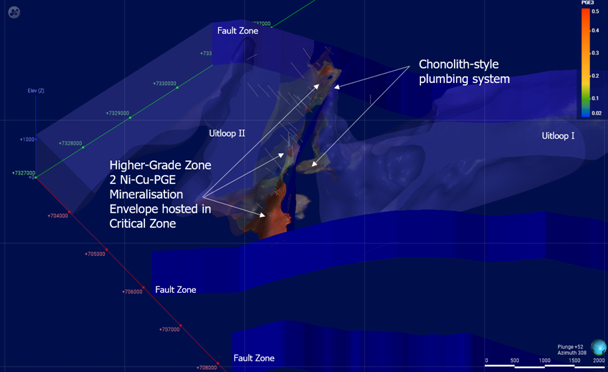
Figure 3: Spatial relationship between the higher-grade Zone 2 mineralisation and the interpreted chonolith and conduit system connecting the Uitloop I and Uitloop II ultramafic bodies.
Building Towards a Maiden Zone 2 Resource
The completed mineralisation model gives the Company a much clearer basis for planning the next phase of drilling.
Initial drilling will focus on the better-developed higher-grade southeastern mineralised domain, where the objective will be to increase drill density and test extensions to the known mineralisation.
The Company intends to use this work to build sufficient geological continuity and drilling density to support a maiden mineral resource estimate for Zone 2.
Further step-out drilling will then test the central area between the southeastern and northwestern mineralised zones. This work will determine whether the currently modelled domains are separate bodies or parts of a more continuous Critical Zone mineralised system that has simply not been adequately tested by the historical drilling.
Ground FDEM Target 1 remains a separate high-priority exploration target. The discrete conductor sits within the interpreted chonolith system at a favourable change in intrusive geometry and will be tested for a possible concentration of semi-massive to massive Ni-Cu-PGE sulphides.
The Company’s geological team will now use the completed mineralisation model, together with the airborne and ground EM, gravity and magnetic datasets, to finalise and rank the proposed drill holes within the available exploration budget.
Richard Montjoie, Exploration Manager of URU Metals, commented:
“Simon’s work has now given us a proper 3D view of where the Zone 2 mineralisation sits and, importantly, where the higher-grade parts of the system are developing.
The southeast is clearly the most advanced area and gives us a sensible place to start building towards a maiden Zone 2 resource. We are also seeing mineralisation continuing along strike to the northwest, while much of the ground in between has simply not been properly tested because a number of the historical holes stopped short.
The Critical Zone setting is also important. This is the same broad geological environment that hosts the Ni-Cu-PGE mineralisation at Ivanhoe’s Platreef and Valterra’s Mogalakwena operations nearby. We have talked about that relationship for some time, but the Leapfrog work is now allowing us to see the geometry of the Zeb mineralisation properly in three dimensions.
The fact that the higher-grade envelopes also sit close to the interpreted chonolith system fits well with our geological model and gives us another vector for drilling. We now have a much clearer strategy: build out the higher-grade Zone 2 mineralisation towards a maiden resource, test whether those mineralised areas connect through the central gap, and drill Target 1 for the more concentrated sulphide target.”
ENDS
For further information, please contact:
URU Metals Limited
John Zorbas
Chief Executive Officer
+1 416 504 3978
SP Angel Corporate Finance LLP
Nominated Adviser and Broker
Ewan Leggat / Caroline Rowe
+44 (0) 203 470 0470
Axis Capital Markets Limited
Joint Broker
Richard Hutchison
+44 (0) 203 026 0320
Market Abuse Regulation (MAR) Disclosure
This announcement contains inside information for the purposes of Article 7 of the Market Abuse Regulation (EU) No. 596/2014 as it forms part of United Kingdom domestic law by virtue of the European Union (Withdrawal) Act 2018 (“UK MAR”). Upon the publication of this announcement via a Regulatory Information Service, this inside information is now considered to be in the public domain.
URU Metals #URU – Zeb Nickel Project – Appointment of Geological Modelling Consultants to Support Upcoming Drill Programme
 URU Metals Limited (“URU” or the “Company”) is pleased to announce the appointment of Caracle Creek International Consulting and Atticus Geoscience Consulting to update and expand the Leapfrog 3D geological model for the Company’s Zeb Nickel Project in Limpopo, South Africa.
The work follows the recent ground gravity and frequency-domain electromagnetic surveys over Targets 1 and 2. It will integrate the Company’s geological, drilling and geophysical information into a single three-dimensional framework to guide the upcoming drill programme.
3D geological model
The model will combine updated surface mapping, historical drill-hole data, airborne magnetic, gravity and spectral data, Spectrem airborne time-domain electromagnetic data, and the recent ground gravity and electromagnetic results. It will also incorporate the current interpretations of the Uitloop I and Uitloop II ultramafic bodies, the intervening magmatic plumbing system and known nickel-copper-PGE sulphide intersections.
The consultants will build a lithological and structural wireframe to test the Company’s chonolith model for a magmatic conduit linking Uitloop I and Uitloop II. The work will define the principal intrusive and sedimentary contacts, layered-intrusion and sedimentary units, interpreted assimilation zones, and structures or breccia zones supported by the available data.
Supporting the upcoming drill programme
The Leapfrog model is expected to assist the Company in:
· ranking targets using the combined geological, drill-hole and geophysical evidence;
· mapping possible conduit thickening, pinches, basal keels, intrusive margins, embayments and assimilation zones that may provide traps for sulphide accumulation;
· relating known Zone 1, Zone 2 and Zone 3 mineralised intersections to the interpreted intrusive architecture and refined geophysical targets;
· distinguishing targets supported by multiple datasets from responses that may be caused by country rock, infrastructure, weathering or other non-mineralised features;
· improving proposed drill-hole collar locations, azimuths, dips and target depths; and
· sequencing the drill holes and identifying material data gaps before drilling commences.
The completed model will provide a coherent technical basis for directing exploration expenditure towards the strongest geologically supported targets and reducing the risk of drilling geophysical responses that are not supported by the wider mineral-system interpretation.
Richard Montjoie, Exploration Manager of URU Metals, commented:
“This Leapfrog modelling exercise is intended to bring the geology, drill holes and recent geophysical responses into one coherent three-dimensional model. By showing where the interpreted chonolith thickens, pinches or interacts with the footwall, it should help us rank targets within the wider feeder system and design the upcoming drill holes against defined geological positions rather than stand-alone anomalies.
The expected result is a more focused and disciplined drill programme, with better collar positions, orientations and target depths, and a clearer technical basis for sequencing holes across the Project.”
ENDS
For further information, please contact:
URU Metals Limited
John Zorbas
Chief Executive Officer
+1 416 504 3978
SP Angel Corporate Finance LLP
Nominated Adviser and Broker
Ewan Leggat / Caroline Rowe
+44 (0) 203 470 0470
Axis Capital Markets Limited
Joint Broker
Richard Hutchison
+44 (0) 203 026 0320
Market Abuse Regulation (MAR) Disclosure
This announcement contains inside information for the purposes of Article 7 of the Market Abuse Regulation (EU) No. 596/2014 as it forms part of United Kingdom domestic law by virtue of the European Union (Withdrawal) Act 2018 (“UK MAR”). Upon the publication of this announcement via a Regulatory Information Service, this inside information is now considered to be in the public domain.
URU Metals #URU – Publication of Zeb Nickel Project Investor Graphics

URU Metals Limited (“URU” or the “Company”) is pleased to announce that it has published a new set of investor graphics on its website to assist shareholders and prospective investors in understanding the regional setting, geological context, size and recently announced ground geophysics results at the Company’s Zeb Nickel Project in Limpopo, South Africa.
The graphics are available at: https://urumetals.com/index.php/projects/
The graphics are intended to illustrate, in visual form, information previously announced by the Company in relation to the Zeb Nickel Project, including the recently completed ground gravity and frequency-domain electromagnetic survey work over Targets 1 and 2. No new assay results, drilling results or mineral resource estimates are being reported in this announcement.
The newly published graphics comprise:
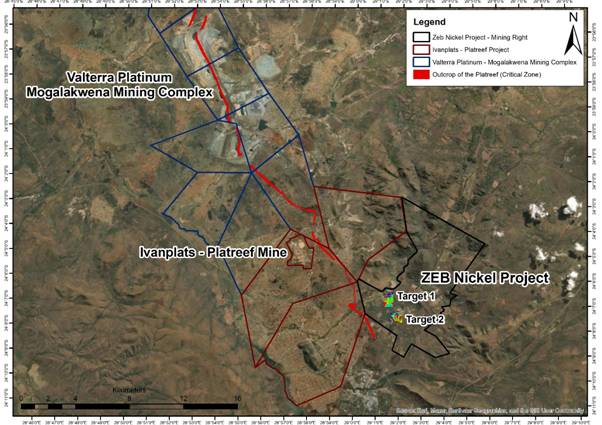
1. Regional satellite image showing the Zeb Nickel mining right in relation to the Northern Limb of the Bushveld Complex, including the location of nearby major PGM-nickel-copper operations and projects, including Valterra Platinum’s Mogalakwena operations and Ivanhoe Mines’ Platreef Project. This image is produced to illustrate the asset size and proximity in comparison to more established major operators in the area.
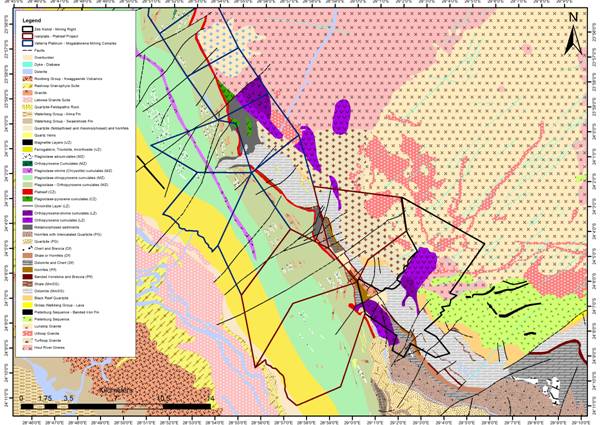
2. Regional geological image over the same area, showing the interpreted geological setting, the Platreef / reef outcrop position and the broader feeder-system context relevant to the Company’s exploration model at Zeb Nickel. The image has been produced to document the scale of the anomaly that we are working to prove up.
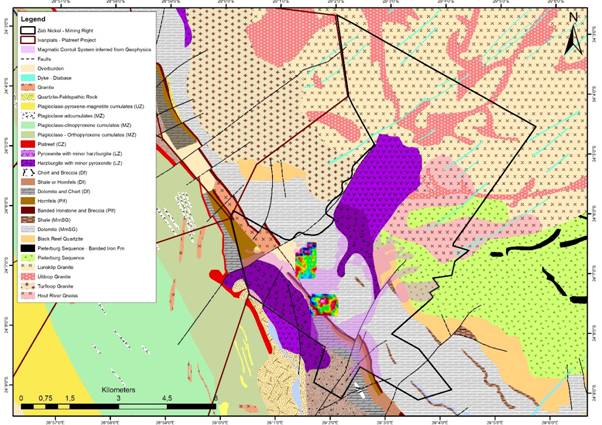
3. Detailed ground geophysics image showing the recently completed ground gravity and electromagnetic results over Target 1 and Target 2, highlighting the priority areas being integrated into the Company’s 3D geological model for drill targeting. Image 3 produced to evidence the scale at which the electromagnetic work has produced positive results and its favourable location with respect to the magmatic plumbing system, supporting the geological model.
4. The Company believes that these graphics will assist investors in understanding the scale, location and geological significance of the Zeb Nickel Project, particularly the relationship between the interpreted feeder system, the recently refined geophysical targets and the broader Northern Limb setting alongside the existing majors that already operate in the area.
As previously announced, Target 1 remains the Company’s priority follow-up target following the completed ground geophysics programme. The ground survey work has helped confirm and refine areas where conductive and dense geophysical responses occur in close proximity to the interpreted feeder system – a setting which the Company considers prospective for nickel-copper-PGE sulphide mineralisation.
Target 2 remains of geological interest, but is currently ranked as a secondary follow-up area behind Target 1. The purpose of the completed ground survey programme was to reduce uncertainty, improve target definition and assist the Company in ranking targets before finalising the next phase of drilling.
The Company will continue to integrate the ground geophysics results into its 3D geological model and refine the ranking, positioning and sequencing of drill targets across the Project. Once a drilling programme is finalised and a drilling contractor chosen the Company will update the market with anticipated drill dates.
Richard Montjoie, Exploration Manager of URU Metals, commented:
“These new graphics are intended to help investors see the bigger picture at Zeb Nickel. The Project sits in a highly prospective part of the Northern Limb of the Bushveld Complex, close to major established and advanced PGM-nickel-copper projects.
The recent ground geophysics has provided us with a much clearer view of Targets 1 and 2. Importantly, at Target 1 we have a compelling combination of geophysical responses in the right geological position, adjacent to the interpreted feeder system, where we would expect to see accumulations of dense and conductive material.
The next step is to complete the integration of these datasets into our 3D geological model and finalise a disciplined, ranked drill plan. The graphics now published on our website should help shareholders understand why this work is important and how it fits into the exploration model at Zeb Nickel and the broader mining district on Northern Limb of the Bushveld Complex area.”
Cautionary note
Geophysical anomalies are not, in themselves, evidence of economic mineralisation. The presence, grade, continuity and economic significance of any mineralisation can only be confirmed through drilling, sampling, assay and appropriate technical evaluation.
About the Company
URU Metals is a mineral exploration and development company focused on advancing high-potential critical metals projects in South Africa. The Company is committed to creating sustainable value through responsible mining practices, regulatory compliance, and active stakeholder engagement. For more information, visit www.urumetals.com
For further information, please contact:
URU Metals Limited
John Zorbas
(Chief Executive Officer)
+1 416 504 3978
SP Angel Corporate Finance LLP
(Nominated Adviser and Broker)
Ewan Leggat / Caroline Rowe + 44 (0) 203 470 0470
Axis Capital Markets Limited (Joint Broker)
Richard Hutchison
+44 (0) 203 026 0320
#URU URU Metals LTD – Ground Survey Refine Additional Zeb Nickel Targets
 URU Metals Limited is pleased to provide a further update from the recently completed ground geophysics programme at the Zeb Nickel Project in Limpopo, South Africa.
Following the confirmation of Target 1 as the Company’s priority follow-up target, the final interpretation of the ground survey data over Target 2 has refined additional targets within the broader Zeb Nickel feeder system.
Target 2 was selected as one of the priority airborne electromagnetic targets for ground follow-up. The objective of the ground programme was to determine whether the airborne targets could be confirmed from surface, to improve target definition, and to assist the Company in ranking targets ahead of the next phase of drilling.
The Target 2 results show a more complex picture that target 1 with the ground surveys also confirming underlying magnetic bodies associated with both the northern and southern Target 2 areas.
The Company considers Target 2 to remain of geological interest, but as a secondary follow-up area behind Target 1. The results will now be incorporated into the Company’s 3D geological model and ranked against the wider target pipeline at Zeb Nickel.
Highlights
· Target 2 remains prospective, but is now considered a secondary follow-up target behind Target 1.
· Independent magnetic bodies are present in both the northern and southern Target 2 areas.
· The southern Target 2 anomaly is weaker, but remains of interest due to its magnetic response and weak ground electromagnetic response.
· Target 2 lies within the broader interpreted feeder system at Zeb Nickel, which the Company considers prospective for higher-grade nickel-copper-PGE sulphide mineralisation.
· The results help the Company separate the cleanest drill targets from more complex targets, improving the discipline and focus of future drill planning.
· The next phase of drilling will remain flexible and will be designed to test the best-ranked targets across the Project.
Target 2 – Additional Follow-Up Targets Refined
Target 2 was originally identified from the airborne Spectrem electromagnetic survey flown in 2025. The ground survey work has now provided a clearer understanding of the target area.
The airborne magnetic data indicates that there are still distinct magnetic bodies below surface in both the northern and southern Target 2 areas. These features may represent ultramafic rocks or related geological bodies within the broader feeder system.
The Company will therefore treat Target 2 as a follow-up area rather than a primary target. Further work may include refined modelling, ground checking and possible scout drilling, depending on how Target 2 ranks against Target 1 and other targets across the Project.
Way Forward
The Company will now integrate the Target 1 results into the Zeb Nickel 3D geological model and use the updated model to rank drill targets across the Project.
The next phase of drilling will remain flexible and will be designed to test the best-ranked targets across the Project. This may include both Platreef-style nickel-copper-PGE targets and higher-grade massive sulphide targets associated with the interpreted feeder system. Final drill-hole locations, depths and sequencing will be determined after the new ground geophysical data has been integrated into the Company’s 3D geological model.
This approach is consistent with the Company’s stated work programme, which includes updating the Leapfrog 3D model, defining the number and position of drill holes, planning Ni-Cu-PGE resource drilling in Zone 2, testing high-grade nickel targets in Zone 3 and drilling overlapping conductor and density anomalies.
Final drill-hole locations, depths and sequencing will be determined after completion of target ranking, land access planning and contractor engagement.
The Company is in the process of sourcing and finalising drill contractors and looks forward to updating the market in due course once the contractor has been finalised.
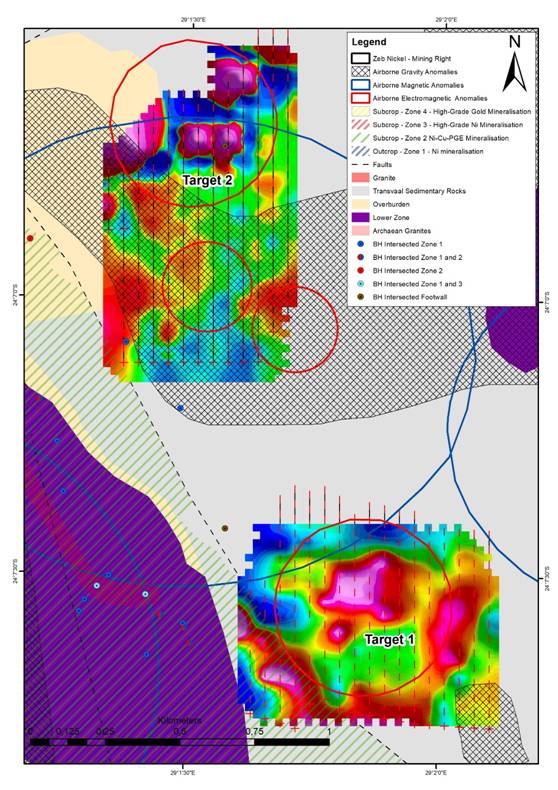
Figure 1: Maps showing the ground-based frequency-domain electromagnetic results for the two target areas overlaid on the interpreted geological map. The results align well with the results from the airborne data and provide higher resolution compared to the airborne Spectrem electromagnetic survey.
Exploration Manager Comment
Richard Montjoie, Exploration Manager of URU Metals, commented:
“The Target 2 results are important because they help us better understand and rank the wider target pipeline at Zeb Nickel. This target is more complex than Target 1 however, the presence of underlying magnetic bodies means the area remains geologically interesting and will warrant follow-up testing.
This is why the Company carried out the ground survey programme before drilling. The work has helped us reduce uncertainty, rank the targets and focus future capital on the strongest opportunities.
Our broader exploration model remains unchanged. Zeb Nickel contains a large, underexplored feeder system, and previous drilling has already confirmed higher-grade sulphide mineralisation within this setting. The next step is to integrate the new data into our 3D model and design a flexible, staged drill programme focused on the best-ranked targets across the Project.”
About the Company
URU Metals is a mineral exploration and development company focused on advancing high-potential critical metals projects in South Africa. The Company is committed to creating sustainable value through responsible mining practices, regulatory compliance, and active stakeholder engagement. For more information, visit www.urumetals.com
Competent Person Statement
The technical information contained in this announcement has been reviewed by Richard Montjoie, Exploration Manager of URU Metals Limited. Mr Montjoie is a registered member of the South African Council for Natural Scientific Professions, membership number 400131/09. Mr Montjoie holds an M.Sc. in Economic Geology from the University of the Witwatersrand, South Africa, and is a Fellow of the Geological Society of South Africa. Mr Montjoie is not independent of the Company.
Market Abuse Regulation (MAR) Disclosure
This announcement contains inside information for the purposes of Article 7 of the Market Abuse Regulation (EU) No. 596/2014 as it forms part of United Kingdom domestic law by virtue of the European Union (Withdrawal) Act 2018 (“UK MAR”). Upon the publication of this announcement via a Regulatory Information Service, this inside information is now considered to be in the public domain.
For further information, please contact:
URU Metals Limited
John Zorbas
(Chief Executive Officer)
+1 416 504 3978
SP Angel Corporate Finance LLP
(Nominated Adviser and Broker)
Ewan Leggat / Caroline Rowe + 44 (0) 203 470 0470
Axis Capital Markets Limited (Joint Broker)
Richard Hutchison
+44 (0) 203 026 0320
#URU URU Metals Limited – Priority Drill Target within Zeb Nickel
 Ground Surveys Confirm Priority Drill Target within Zeb Nickel Conduit System
URU Metals Limited is pleased to announce that final interpretation of the recently completed ground geophysics programme has confirmed Target 1 as the Company’s priority drill target at the Zeb Nickel Project in Limpopo, South Africa.
Target 1 was originally identified from the Company’s airborne Spectrem electromagnetic survey flown in 2025. The new ground survey work was designed to check whether the airborne target could be seen clearly from surface and to help define where future drill holes should be placed.
The results have now confirmed that Target 1 is a strong and coherent target. Importantly, the target is supported by more than one type of geophysical response, including an electrical response, a gravity response and an associated magnetic feature. In simple terms, the surveys indicate a body below surface that is conductive, relatively dense and geologically distinct. These are features which may be consistent with sulphide-bearing ultramafic rocks.
The Company considers Target 1 particularly important because it lies within the broader interpreted magmatic conduit system at Zeb Nickel. This conduit system, also described as a chonolith-style feeder system, is interpreted to link the Uitloop I and Uitloop II ultramafic bodies and is considered highly prospective for the accumulation of nickel-copper-PGE sulphides. The Company’s geological model identifies this plumbing system as a key exploration focus because metal-rich sulphide liquids can collect where magma pathways narrow, bend or interact with surrounding rocks. This conduit system is framed as an ideal environment for long-lived magmatism, sulphide formation and sulphide accumulation.
This exploration model is supported by previous drilling at the Zeb Nickel Project, where hole Z017 intersected the Company’s best reported Zone 3 semi-massive to massive sulphide nickel intersection of 2.25 m at 1.67% Ni, with associated copper and PGE values. This intersection occurs in the part of the system where the Company interprets the chonolith-style feeder to interact with the Uitloop II body, supporting the view that the conduit margins and interaction zones are priority areas for follow-up drilling.
Highlights
· Target 1 confirmed as the Company’s primary follow-up target from the completed ground geophysics programme.
· Ground electromagnetic survey results successfully confirmed the airborne Spectrem anomaly from surface.
· Ground gravity results indicate that the target area is relatively dense, supporting the interpretation of a potentially significant body below surface.
· Target 1 lies within the Company’s interpreted feeder-system model, which is considered prospective for higher-grade nickel-copper-PGE sulphide mineralisation.
· Previous drilling at Zeb Nickel has already confirmed that semi-massive to massive sulphide mineralisation occurs within the Project area, including drill hole Z017, which intersected 2.25 m at 1.67% Ni.
· The Company will now integrate the Target 1 data into its 3D geological model before finalising drill-hole locations, depths and sequencing.
· The next drilling programme will remain flexible and will be designed to test the best-ranked targets across the Project, including both resource-growth targets and higher-grade sulphide targets.
Target 1 – Ground Surveys Strengthen Drill Case
The Company is exploring a large nickel-bearing intrusive system with several different styles of mineralisation.
In simple terms, the Company is targeting three main opportunities:
1. A large, lower-grade nickel sulphide body already identified by historical drilling. This forms the existing historical nickel resource at Zeb Nickel.
2. Platreef-style nickel-copper-PGE mineralisation, which may occur in deeper or less-tested rock units similar to those mined or being developed elsewhere on the Northern Limb of the Bushveld Complex.
3. Higher-grade semi-massive to massive sulphide mineralisation, which may occur within the feeder system that brought metal-bearing magma into the Zeb Nickel intrusive bodies.
The Company’s current exploration focus is on the third opportunity. This is the higher-grade sulphide target model. In the Company’s geological model, this target style is referred to as Zone 3.
The Company believes that a chonolith-style feeder system links the Uitloop I and Uitloop II ultramafic bodies. A chonolith can be thought of as an irregular underground magma pathway. These feeder systems are important in nickel exploration because they can act as traps where dense, metal-rich sulphide liquids may collect.
This model is supported by previous drilling at Zeb Nickel. Drill hole Z017 intersected 2.25 m at 1.67% Ni in semi-massive to massive sulphide mineralisation, representing the Company’s best reported high-grade sulphide intersection to date. Importantly, this intersection occurs where the interpreted feeder system interacts with the Uitloop II body, supporting the Company’s view that these contact and feeder positions are key areas for future drilling. The Company Deck describes Zone 3 as semi-massive to massive Ni-PGE sulphide mineralisation associated with the Bushveld ultramafic plumbing system interacting with footwall rocks, and identifies Z017 as 2.25 m at 1.67% Ni within this target style.
Target 1 is therefore significant because it provides a new geophysical target within this broader feeder-system model. The ground surveys indicate that Target 1 is conductive and relatively dense, which are the types of features the Company is looking for when searching for sulphide-bearing bodies.
Way Forward
The Company will now integrate the Target 1 results into the Zeb Nickel 3D geological model and use the updated model to rank drill targets across the Project.
The next phase of drilling will remain flexible and will be designed to test the best-ranked targets across the Project. This may include both Platreef-style nickel-copper-PGE targets and higher-grade massive sulphide targets associated with the interpreted feeder system. Final drill-hole locations, depths and sequencing will be determined after the new ground geophysical data has been integrated into the Company’s 3D geological model.
This approach is consistent with the Company’s stated work programme, which includes updating the Leapfrog 3D model, defining the number and position of drill holes, planning Ni-Cu-PGE resource drilling in Zone 2, testing high-grade nickel targets in Zone 3 and drilling overlapping conductor and density anomalies.
Final drill-hole locations, depths and sequencing will be determined after completion of target ranking, land access planning and contractor engagement. We are currently busy with a process enabling us to select and finalise drill contractors.
CEO Comment
John Zorbas, Chief Executive Officer of URU Metals, commented:
“The ground survey results have confirmed Target 1 as a clear priority for the next stage of work at Zeb Nickel. The important point for shareholders is that this is not just an isolated geophysical anomaly. Target 1 sits within our broader feeder-system model, which we believe is one of the most prospective settings on the Project for higher-grade nickel-copper-PGE sulphide mineralisation.
Previous drilling has already shown that semi-massive to massive sulphides occur at Zeb Nickel, including the Z017 intersection of 2.25 m at 1.67% nickel. Our objective now is to use the new ground survey data, together with our 3D geological model, to target the best parts of this system.
Target 1 is now a priority, but we will retain flexibility in the next drill programme. The final programme will be designed to test the strongest combination of geology, geophysics and historical drilling across the Project in order to maximise value add to shareholders at the lowest risk.”
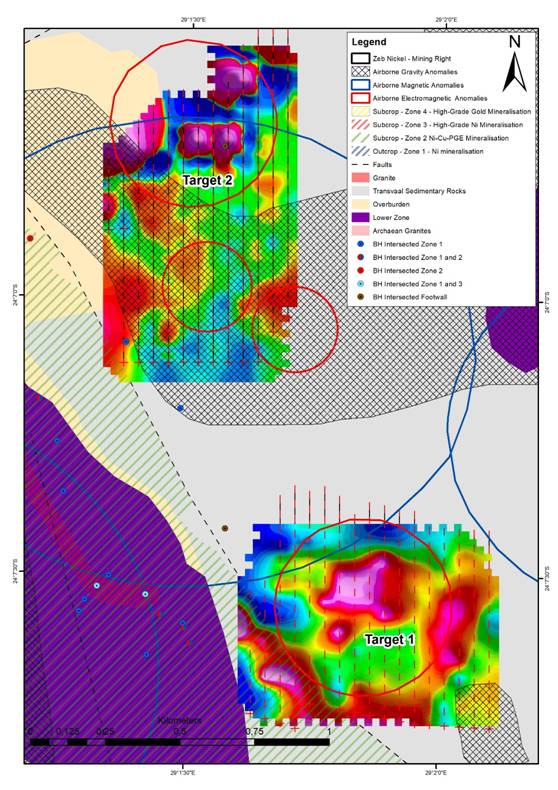
Figure 1: Maps showing the ground-based frequency-domain electromagnetic results for the two target areas overlaid on the interpreted geological map. The results align well with the results from the airborne data and provide higher resolution compared to the airborne Spectrem electromagnetic survey.
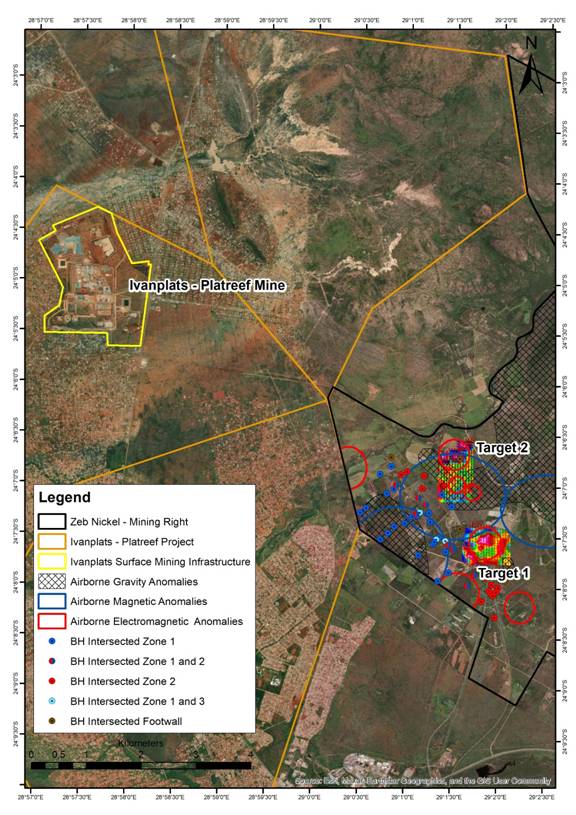
Figure 2: Maps showing the Zeb Nickel Project area and the geophysical targets adjacent to the Ivanplats “Platreef Mine,” which is expected to become one of the largest underground platinum mines globally once in full production.
About the Company
URU Metals is a mineral exploration and development company focused on advancing high-potential critical metals projects in South Africa. The Company is committed to creating sustainable value through responsible mining practices, regulatory compliance, and active stakeholder engagement. For more information, visit www.urumetals.com
Competent Person Statement
The technical information contained in this announcement has been reviewed by Richard Montjoie, Exploration Manager of URU Metals Limited. Mr Montjoie is a registered member of the South African Council for Natural Scientific Professions, membership number 400131/09. Mr Montjoie holds an M.Sc. in Economic Geology from the University of the Witwatersrand, South Africa, and is a Fellow of the Geological Society of South Africa. Mr Montjoie is not independent of the Company.
Market Abuse Regulation (MAR) Disclosure
This announcement contains inside information for the purposes of Article 7 of the Market Abuse Regulation (EU) No. 596/2014 as it forms part of United Kingdom domestic law by virtue of the European Union (Withdrawal) Act 2018 (“UK MAR”). Upon the publication of this announcement via a Regulatory Information Service, this inside information is now considered to be in the public domain.
For further information, please contact:
URU Metals Limited
John Zorbas
(Chief Executive Officer)
+1 416 504 3978
SP Angel Corporate Finance LLP
(Nominated Adviser and Broker)
Ewan Leggat / Caroline Rowe + 44 (0) 203 470 0470
Axis Capital Markets Limited (Joint Broker)
Richard Hutchison
+44 (0) 203 026 0320
#URU URU Metals LTD – Completion of Ground-Based Electromagnetic Survey
 URU Metals Limited (“URU” or the “Company”) is pleased to announce that the fieldwork component of the ground-based frequency-domain electromagnetic (“FDEM”) survey at the Zeb Nickel Project (“Project”) has now been completed.
The survey forms part of the Company’s ongoing geophysical programme designed to refine and prioritise drill targets associated with the interpreted magmatic conduit system and potential semi-massive to massive nickel sulphide mineralisation.
The Company is now awaiting the final processing, interpretation, and integration of the ground-based gravity and FDEM data with the previously completed airborne gravity, magnetic, and Spectrem electromagnetic datasets.
The combined interpretation is expected to:
· Further refine conductive and dense anomaly targets;
· Improve understanding of the geometry and continuity of prospective mineralised zones;
· Identify and prioritise the most prospective locations for the upcoming drilling programme.
The final interpretation will include recommendations on the highest-priority drill targets based on the combined airborne and ground-based geophysical datasets.
CEO John Zorbas commented:
“We are pleased to have completed the ground-based FDEM survey, marking another important milestone in the advancement of the Zeb Nickel Project. The integration of the ground-based gravity and FDEM results with the airborne datasets is expected to significantly enhance our understanding of the identified anomalies and help define the best locations for drill testing.”
“We are very excited about the progress being made and are looking forward to the upcoming drilling campaign. We will continue to update shareholders as the final interpretations are completed and drill targets are prioritised.”
About the Company
URU Metals is a mineral exploration and development company focused on advancing high-potential critical metals projects in South Africa. The Company is committed to creating sustainable value through responsible mining practices, regulatory compliance, and active stakeholder engagement. For more information, visit www.urumetals.com
For further information, please contact:
URU Metals Limited
John Zorbas
(Chief Executive Officer)
+1 416 504 3978
SP Angel Corporate Finance LLP
(Nominated Adviser and Broker)
Ewan Leggat / Caroline Rowe + 44 (0) 203 470 0470
#URU URU Metals PLC – Commencement: Ground-Based Electromagnetic Survey
 URU Metals Limited (“URU” or the “Company”) is pleased to announce the commencement of the ground-based frequency-domain electromagnetic (“FDEM”) survey at the Zeb Nickel Project (“Project”).
The FDEM survey follows the successful completion of the ground-based gravity survey and forms a key component of the Company’s ongoing geophysical programme aimed at refining and prioritising drill targets identified from the previously completed airborne surveys.
Ground-Based Electromagnetic Survey
The ground-based FDEM survey will be conducted over the previously defined priority target areas and is designed to further investigate the conductive anomalies identified from the Spectrem airborne electromagnetic survey.
The survey will utilise frequency-domain electromagnetic methods, which are capable of detecting and mapping subsurface conductive bodies at a higher spatial resolution than airborne systems.
Purpose and Benefits
While the airborne geophysical programme successfully identified several compelling coincident gravity-magnetic-electromagnetic anomalies and confirmed the presence of a magmatic conduit system, the ground-based FDEM survey provides:
· Higher-resolution definition of conductive bodies
· Improved discrimination between sulphide mineralisation and lithological conductors
· Enhanced understanding of the geometry, depth, and continuity of EM anomalies
· Greater confidence in prioritising drill targets
The survey is specifically designed to better delineate conductive zones that may represent semi-massive to massive nickel sulphide mineralisation, particularly where coincident with dense gravity anomalies identified in the recently completed gravity survey.
The integration of the FDEM results with the gravity and magnetic datasets is expected to significantly improve target definition and maximise the effectiveness of the Company’s upcoming drilling campaign.
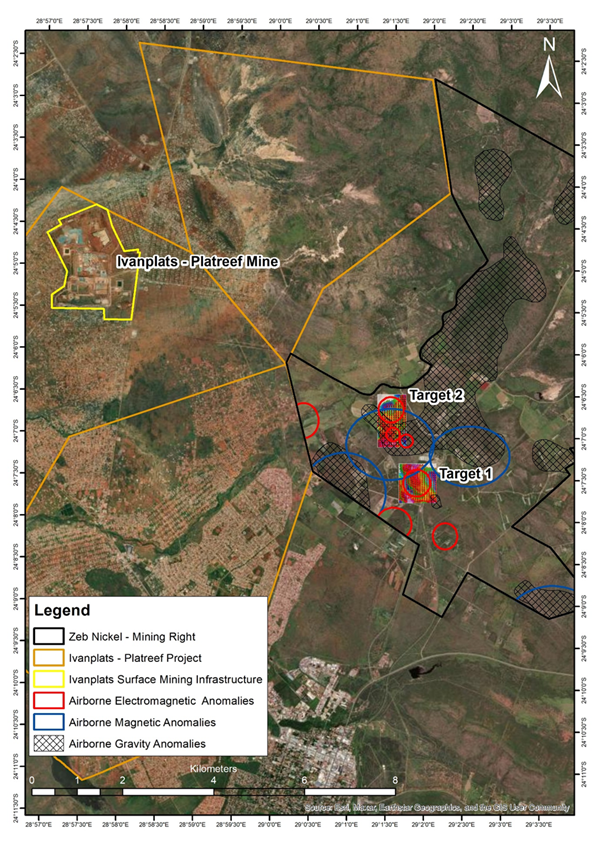
Figure 1: Maps showing the Zeb Nickel Project area, the results of the gravity survey, and the planned EM survey areas over the same geophysical targets adjacent to the Ivanplats ‘Platreef Mine,’ which is expected to become the largest underground platinum mines globally once in full production. The ground-based gravity results correlate well with the airborne gravity, magnetic, and electromagnetic datasets and provide significantly higher resolution. The upcoming ground-based EM survey is intended to determine whether the identified gravity anomalies are conductive, which may indicate the presence of semi-massive to massive sulphide mineralisation.
Request for Quotations
URU is also currently preparing the Request for Quotation documentation for the selection of a drilling contractor. The Company looks forward to updating the market once the contractor selection process has been completed and a preferred contractor has been appointed.
CEO John Zorbas commented:
“The commencement of the ground-based electromagnetic survey marks another important step in advancing the Zeb Nickel Project. Following the encouraging results from the gravity survey, this next phase will allow us to further refine the conductive anomalies and better understand their potential to host semi-massive to massive nickel sulphide mineralisation.
“We are very excited about the progress being made and look forward to the coming weeks as the FDEM survey progresses. We will continue to provide shareholders with regular updates as results are received and interpreted, further strengthening our pipeline of high-quality drill targets.”
About the Company
URU Metals is a mineral exploration and development company focused on advancing high-potential critical metals projects in South Africa. The Company is committed to creating sustainable value through responsible mining practices, regulatory compliance, and active stakeholder engagement. For more information, visit www.urumetals.com
For further information, please contact:
URU Metals Limited
John Zorbas
(Chief Executive Officer)
+1 416 504 3978
SP Angel Corporate Finance LLP
(Nominated Adviser and Broker)
Ewan Leggat / Caroline Rowe + 44 (0) 203 470 0470
#URU URU Metals Ltd – Completion of Gravity Survey
 URU Metals Limited (“URU” or the “Company”) is pleased to announce the completion of the ground-based gravity survey over priority targets at the Zeb Nickel Project, with results demonstrating strong correlation with previously identified airborne electromagnetic and magnetic anomalies.
Gravity Survey Programme
The gravity survey was completed over Targets 1 and 2, previously identified as the highest-priority anomalies from the Spectrem airborne electromagnetic survey. The programme was conducted on a 50 m x 50 m grid using high-precision CG5 gravimeters, with data quality reported as ‘very good’ following full Bouguer correction and processing.
The objective of the ground-based gravity survey was to enhance the resolution of the airborne datasets and improve the definition of potential drill targets associated with semi-massive nickel sulphide mineralisation.
Gravity Results
The results of the gravity survey are highly encouraging and provide improved confidence in the geological interpretation:
Target 1
· The Spectrem electromagnetic anomaly correlates closely with a residual gravity high, confirming that the target is both conductive and relatively dense.
· The gravity anomaly extends beyond the electromagnetic (“EM”) footprint, suggesting the presence of dense ultramafic rocks and/or sulphide accumulation zones.
· This strong coincidence of conductivity and density is considered highly prospective for nickel sulphide mineralisation.
Target 2
· A weak but distinct gravity high (~0.1 mGal) coincides with the southern portion of the northern EM anomaly.
· This gravity feature also aligns well with a first vertical derivative (1VD) magnetic anomaly, reinforcing the validity of the target.
· While the response may represent a dense ultramafic unit such as a harzburgite pulse, the combined conductive, dense, and magnetic signature is also consistent with potential sulphide mineralisation.
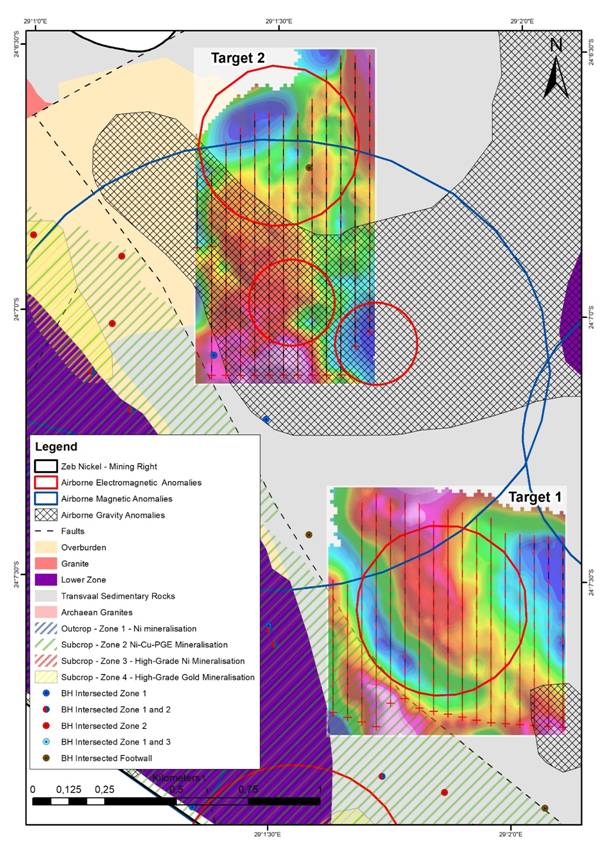 Figure 1: Maps showing the ground-based gravity results for the two target areas overlain on a mapped and interpreted geological map. The results align well with the results from the airborne data and provide higher resolution compared to the airborne gravity survey.
Interpretation and Next Steps
The ground-based gravity results align closely with the airborne datasets but provide a significantly higher level of resolution, allowing for better definition of anomaly geometry and depth.
These results:
· Confirm the presence of coincident conductive and dense targets
· Improve confidence in the interpreted magmatic conduit system
· Provide a stronger technical basis for drill targeting
The frequency-domain electromagnetic survey is expected to commence shortly, which will further refine the conductive responses and support final drill target prioritisation.
The Zeb Nickel Project is strategically located on the Northern Limb of the Bushveld Complex, adjacent to the Ivanplats Platreef Project, which is expected to become one of the largest underground platinum group metal operations globally once fully operational.
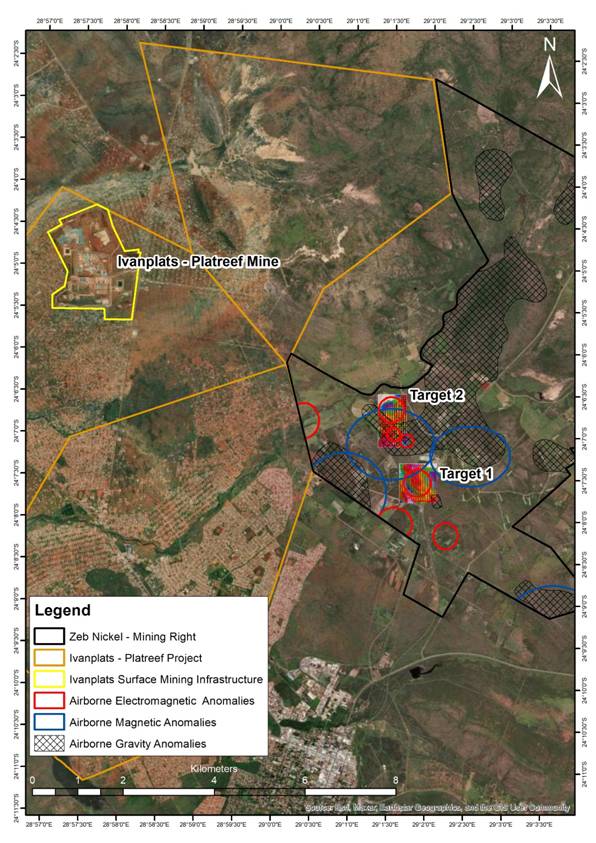
Figure 2: Maps showing the Zeb Nickel Project area and the geophysical targets adjacent to the Ivanplats “Platreef Mine,” which is expected to become one of the largest underground platinum mines globally once in full production.
CEO John Zorbas commented:
“We are very encouraged by the results of the ground-based gravity survey, which show strong correlation with the airborne electromagnetic and magnetic datasets. The improved resolution of the ground survey provides greater confidence in the interpretation of these anomalies and enhances our ability to focus on the most prospective semi-massive and massive nickel sulphide targets.
“The responses observed at Targets 1 and 2 are particularly compelling, displaying the coincident conductive and dense signatures often associated with sulphide mineralisation. With the EM survey set to commence shortly, we look forward to further refining these targets ahead of drilling.
“We are very excited about the progress being made and the momentum building at the Zeb Nickel Project. We look forward to the coming weeks and months and will continue to update shareholders regularly as results become available.”
About the Company
URU Metals is a mineral exploration and development company focused on advancing high-potential critical metals projects in South Africa. The Company is committed to creating sustainable value through responsible mining practices, regulatory compliance, and active stakeholder engagement. For more information, visit www.urumetals.com
Market Abuse Regulation (MAR) Disclosure
This announcement contains inside information for the purposes of Article 7 of the Market Abuse Regulation (EU) No. 596/2014 as it forms part of United Kingdom domestic law by virtue of the European Union (Withdrawal) Act 2018 (“UK MAR”). Upon the publication of this announcement via a Regulatory Information Service, this inside information is now considered to be in the public domain.
For further information, please contact:
URU Metals Limited
John Zorbas
(Chief Executive Officer)
+1 416 504 3978
SP Angel Corporate Finance LLP
(Nominated Adviser and Broker)
Ewan Leggat / Caroline Rowe / Devik Mehta + 44 (0) 203 470 0470
#URU URU Metals Limited – Extension of Convertible Loan Maturity Date
 URU announces that the repayment date for the convertible loan from Boothbay Absolute Return Strategies LP (“Boothbay”) has been extended to 30 September 2026 (“Maturity Date”) and Boothbay has also agreed that it will not convert sums due under the convertible loan note into ordinary shares of the Company (“Ordinary Shares”) prior to 30 September 2026.
Details regarding the convertible loan note were announced by the Company on 6 May 2020, and the maturity date for the note has been extended on a number of occasions since this date by agreement of the parties. As of today, the total amount advanced by Boothbay Absolute Return Strategies LP to the Company was US$500,000.
Unless repaid by the Company, amounts due to Boothbay under the convertible loan note shall convert at or prior to the Maturity Date:
(i) at a price that is a 35 per cent. discount to the Volume Weighted Average Price (“VWAP”) per share in the 5 trading days prior to the noteholder serving a conversion notice;
(ii) on completion of an equity fundraising by the Company, at a price that is a 35 per cent. discount to the price per share paid by investors on such equity fundraising;
(iii) on a share sale (meaning a sale of Ordinary Shares giving control of the Company, whether for cash and/or by way of exchange for shares in another company and/or for other consideration, and whether or not control of the Company changes as a result of such transaction), a 35 per cent. discount to the price per share paid on such a share sale; or
(iv) if there is no conversion notice served, equity fundraising or share sale prior to the Maturity Date, at a 35 percent. discount to the VWAP per share in the 5 trading days prior to the maturity date.
In the event that Boothbay is issued with any new Ordinary Shares pursuant to a conversion of the loan note, it will be issued with one warrant attaching to each new Ordinary Share issued, with an exercise period of 18 months from the date of grant and exercisable at £0.85 per new Ordinary Share.
Market Abuse Regulation (MAR) Disclosure
This announcement contains inside information for the purposes of Article 7 of the Market Abuse Regulation (EU) 596/2014 as it forms part of UK domestic law by virtue of the European Union (Withdrawal) Act 2018 (“MAR”), and is disclosed in accordance with the Company’s obligations under Article 17 of MAR.
For further information, please contact:
|
URU Metals Limited John Zorbas (Chief Executive Officer)
|
+1 416 504 3978
|
|
SP Angel Corporate Finance LLP (Nominated Adviser and Broker) Ewan Leggat / Caroline Rowe / Devik Mehta |
+ 44 (0) 203 470 0470 |